All Posts By

Jeff Meade

Music, News, People

Haunted by the Memories of Molly-O-Ween … All Very Good Ones

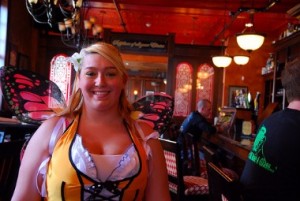
Katie, our winged hostess.

Katie, our winged hostess.

Off in the back, the kids were carving and scooping out jack-o-lanterns.

On stage, kilted performer Seamus Kennedy was singing songs, telling stories (funny ones, not ghostly ones), and occasionally flashing a jack-o-lantern grin.

Oh, yes, and Elvis was in the house … about an 8-year-old version of the king who came and went before we could get his (her?) picture.

This was the very first Molly-O-Ween celebration at Molly Maguire’s pub in Lansdale, but it probably won’t be the last.

Luckily, the day dawned bright and clear and, by the time the festival began, the temperatures had warmed up. A little too warm for some of the costumes, maybe, but, hey, they’re kids, and kids put comfort aside in the name of Halloween.

Shoppers kept the Irish vendors busy, and musicians (Kennedy, Celtic Spirit and Doc Freeman) kept many of the festival-goers up and on their feet. Food and beer, too, of course, and inside the tavern, business was brisk.

We have photos from the day.

News

A Much-Needed Boost for the Parade

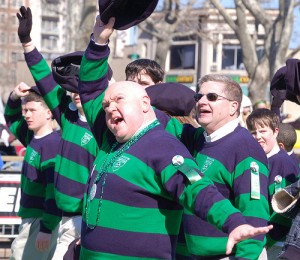
A timely donation worth cheering for.

A timely donation worth cheering for.

The Philadelphia St. Patrick’s Day Parade got a nice little shot in the arm this week.
 
U.S. Rep. Bob Brady, cable tycoon “Gerry” Lenfest and Joey Vento (he of Geno’s steaks) have come up with a large wad of cash that will help the city’s ethnic parades and festivals—including the St. Pat’s parade—offset some of its setup and cleanup costs.

The Greater Philadelphia Traditions Fund is what it’s called. According to the Inquirer, the fund has coughed up $200,000 for 2011 costs, with the $100,000 set pledged (so far) for 2012. What’s more, the story noted, the funds “will include reimbursement for expenses in 2009 and 2010.”

All of which came as welcome news to Michael F. Callahan, president of the board of the St. Patrick’s Day Observance Association.

“The way I understand it, this is for the City of Philadelphia’s costs, which include police and sanitation, the healthiest amount of costs,” said Callahan. “It also includes the EMT (emergency medical crews) costs as well.” Callahan estimates that the Traditions Fund donation could pare $30,000 to $35,000 off the costs of the parade.

That doesn’t mean the parade has anything like a free ride. Quite the contrary. “It costs about $110,000 to put the (St. Patrick’s Day) parade out,” Callahan said. “The costs just add up. So if they’re paying for $30,000 to $35,000, we still have to come up with the balance. We’re very grateful for their efforts. They’re allies of the ethnic traditions in the city. But we still need to get out there and beat the streets in tough economic times.”

Callahan credited Brady in particular for shepherding the deal through: “He’s a guy who gets things done, no doubt about it. He stepped up and said we needed a powerful voice, someone who has the ear of the money people and the people in City Hall. He was a godsend.”

Music

Five Questions for Breanndán Begley

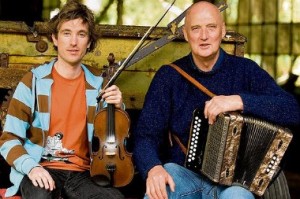
Caoimhín Ó Raghallaigh and Breanndán Begley

Caoimhín Ó Raghallaigh and Breanndán Begley

There is a ruggedness and a wildness to the West of Ireland. To Breanndán Begley, one of he most accomplished two-row button accordion artists in the world, it’s only natural that the music of the region should match its terrain.

West Kerry, where Begley makes his home, is also part of Ireland’s Gaeltacht—an Irish-speaking region. So if West Kerry music seems to have a slightly different flavor from, say, the music of the heartland, that ancient language wields its own influence, too, says Begley.

Begley appears with his playing partner Caoimhín Ó Raghallaigh (kwee-veen o-Rye-a-lah) in two Philly-area concerts this weekend, the first, at the Coatesville Traditional Irish Music Series Saturday night at 8, and the second Sunday night at 8 at the Philadelphia Irish Center. (Details on our calendar.) To Begley, his Gaeltacht roots are a point of pride, and he clearly exults in the sound of the popular West Kerry dance music.

We tracked him down last week as he and Ó Raghallaigh made their way along the tour route that would bring them to our front door.

Q. To a lot of people, Irish music is Irish music. For the uninitiated, what is Kerry music and how is it different?

A. First of all, musically Ireland is a very big place and Kerry just has a dialect of its own. Even within the dialects, there are variations as well. In Kerry (for example), there would be the West Kerry style, which would have its own little differences. (West Kerry music) is more for dancing, first and foremost—slides, polkas and reels, for example. The dancing would be a very important
thing. You (also) have a lot of variety in Kerry music. Airs are valued in a session.

West Kerry is a rugged place, and the music reflects that. The music in the middle of the country is very different. The ruggedness in the music is (expressed) in the ornamentation. It’s something you wouldn’t shy away from. It’s a part of the sound within the sound. It’s rugged and lively—it’s everything.

Q. Your family background is musical, as it so often is when we interview Irish traditional artists. Have you ever stopped to ponder the old “nature/nurture” argument, and which is it?

A. It’s a mixture of all those things. I feel very lucky to be able to play like I do. It’s what I do best. It’s good that the background is there but it’s not necessary to be a great player. Breeding is better than feeding, they say, but I think it’s pure luck, really.

Q. Who taught you, and how did it influence your style of play?

A. I learned Irish music the same way I learned the language. My father played and sang. it was all around the place. Kids today have the computer; we had the accordion.

I never had any formal training. I don’t read music. It’s all by ear. It’s an oral tradition; it comes from the people. You didn’t even know you were playing music. All the musicians I knew in Kerry, none of them read music.

Q. You sing as well as play. Did one evolve later than the other, or did they come about more or less concurrently?

A. We did it (sang) all the time, more or less. I find the bridge between a Gaelic speaker and a musician is bridged by the singing. When you sing you’re doing both. In my youth there was hardly any radio. The only music you heard was live. The singing was live.

I didn’t really start singing on stage until the band Beginish (one of the notable ensembles to which he has belonged; another is Boys of the Lough) was formed. We didn’t have a singer so I started singing. I really love it. I love the songs.

The older I get, the more important I think the language is. The Irish language goes back farther than anything we have. It’s a living art form. It predates any of our poetry, and I’m sure a form of Gaelic was spoken by the Newgrange people. (In singing) I’m speaking my first language. In West Kerry youre never asked to “sing” a sing. You’re asked to “say” a song.

Q. How does collaborating with other musicians, which you’ve certainly done a lot, influence your play? How does playing with Caoimhín Ó Raghallaigh influence you?

A. In Boys of the Lough, I didn’t try to put my own stamp on it., (although) when it came to a solo, I’d do it exactly the way I wanted to do it myself. With Beginish, in one way it was easier because it was all Irish musicans. It was a kind of a melting pot playing with them.

I can safely sayer that I find so much freedom playing with Caoimhín. Music with him is definitely music of the moment. There’s a plan, but rarely do we ever do exactly like the plan. If you do anything else, you’re going by memory, or you’re doing an imitation of what sounded good last night. No two nights are the same, with Caoimhín and me together. It’s a great feeling playing with Caoimhín. Do I get bored? Never! Tired? Maybe.

Columns, How to Be Irish in Philly

How to Be Irish in Philly This Week

Can you carve one of these bad boys? Test your punkin-carvin' mettle at Molly-O-Ween.

Can you carve one of these bad boys? Test your punkin-carvin' mettle at Molly-O-Ween.

We’re heading into a big, fat honkin’ weekend, including one big fall festival, not-to-be-missed concerts, and a couple of really fun benefits.

All the Saturday action is concentrated into the nighttime hours. You may have a very hard time making up your mind.

Here’s what’s on tap:

  • Two of the most talented and creative Irish traditional musicians appear together in a Coatesville Traditional Irish Music Series concert. Breanndán Begley and Caoimhin Ó Raghallaigh (Kwee-veen O-Rye-allah, if you want to say it right) take the stage at 8 p.m. at the Coatesville Cultural Society (a very cozy venue indeed), 143 East Lincoln Highway in Coatesville. For tickets, contact Frank Dalton at (610) 486-2220. 
  • The Spring Hill House Concert Series hosts Aoife Clancy—she of the amazing voice and hair—starting at 8 p.m. You may know her from her stint with Cherish the Ladies. The daughter of Bobby Clancy, Aoife (“EE-fa”) sings pretty much everything. For you singers, there’s a workshop before the concert. The show takes place in one of our favorite (and most intimate) settings, the home of Bob Hendren and Bette Conway, 136 East Third Street in Lansdale. For details, call (215) 368-0525.
  • Blackthorn takes the stage, starting at 8 p.m., for a beef and beer benefit for St. Laurence Parish, 8245 West Chester Pike in Upper Darby. Tickets are 40 bucks per person, including food, beer and set-ups. The boys of Blackthorn never fail to entertain. You just know you’ll be on your feet the whole night. To order tickets, call Ann Char at (610) 789-6960 or e-mail her at achar@stlaurence.org.
  • Also Saturday night, The Martin Family Band returns for their third year in an Evening of Celtic Music, Song & Dance at Bucks County Community College Gateway Auditorium, 275 Swamp Road in Newtown, Bucks County. Showtime is 7:30.
  • If you want to hear a very talented Scot (Irish, Scottish … we don’t discriminate), lend an ear to singer-songwriter Brian McNeill (founder of the Battlefield Band) Saturday at 8 p.m. at Lower Brandywine Presbyterian Church, 101 Old Kennett Road, in Wilmington. This is a presentation of the Green Willow Folk Club, and they know how to put on a show.

Sunday is almost as crowded:

  • If you’re a golfer, you can start your Sunday on the links and help the Philadelphia Irish Center at the same time. The Irish Center will host a benefit golf outing at Walnut Lane Golf Course, 800 Walnut Lane (near Henry Avenue), with tee time set for 9:30. Call John Nolan at (215) 843-8051 for details. The fee is $60, but it includes a lot: greens fee, cart, awards, luncheon & on-course refreshments. And plan on Saturday night Mass.
  • Later in the day, you’re likely to run into lots of your Irish compatriots at Molly-O-Ween, a free (we like “free”) festival at Molly Maguire’s Pub, Main and Wood Streets in Lansdale, Sunday from 1 to 8 p.m. Carve pumpkins! Slip into your Halloween costume, and win a prize! (If you’re looking for ideas, I read a story predicting Lady Gaga and the cast of “Jersey Shore” will be the most popular costumes this year. But I digress, and the mental images are just too disturbing to continue.) There’ll be plenty of great food and drink, of course, plus music by Seamus Kennedy, Celtic Spirit, the Doc Freeman Band, and a local bagpipe band. The Timoney irish Dancers will also take the stage throughout the day.
  • Later on that night, Breanndán Begley and Caoimhin Ó Raghallaigh will appear in concert at the Irish Center, 6815 Emlen Street in the Mount Airy section of town, starting at 8 p.m. So if you miss them at Coatesville, you get a second chance. Better yet, see them both nights.

And that, folks, is just the weekend!

Inis Nua Theatre Company’s presentation of the Leo Butler play “The Early Bird” continues throughout the week at The Playground Theatre at the Adrienne, 2030 Sansom St., in Center City. Show times vary. Check the Web site for details.

Music, People

Kevin Crawford’s Summer Song

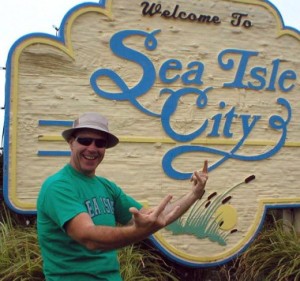
Kevin Crawford, visiting sunny Sea Isle.

Kevin Crawford, visiting sunny Sea Isle.

Add another tune to the “Jersey Shore Sound” songbook—and no, Bruce Springsteen didn’t write it.

It’s called the “Shore House Reel,” and it comes from a surprising source: virtuoso flutist Kevin Crawford of Lúnasa. You can hear it on the band’s most recent recording, “Lá Nua.” It’s the peppy little number at the very end, and it is an homage to none other than Sea Isle City.

Crawford came to know one of our favorite shore towns courtesy of Bob McLaughlin (brother of Jim McLaughin, board member of the Irish American Business Chamber & Network), who lives outside Chicago. McLaughlin owns a shore house about a block from the beach. Crawford started staying there as a guest a few years ago.

“”I got to know Bob first and foremost because he’s an up-and-coming flute player. He came to flute camp at the Swannanoa Gathering in North Carolina about five years ago,” recalls Crawford. “He was in my class and we hung out together for about a week. we just got to be good friends.”

A couple of years into the relationship, McLaughlin mentioned that he had a beach house and wondered if Crawford might want to use it from time to time when he was touring in the States. Crawford jumped at the chance for a place to charge his creative batteries.

“It’s been very good, actually,” he says. “I come in periodically. I’ve been fortunate to have the odd four- or five-day stint down there. A few years ago, myself and Cillian (Vallely, Lúnasa’s uilleann piper) recorded our (2009) duet album “On Common Ground” at Maja Studios in Philadelphia. We just commuted in and out of sea Isle. We’d get up in the morning and go for a run along the boardwalk, go for a swim, and then head into Philadelphia. And then back to Sea Isle again. It was good to get out of the city.”

Crawford lives in County Clare—which boasts a few stunning shore towns of its own—but he says he doesn’t think of Clare in the same way. Touring and living out of a suitcase can be exhausting. For Crawford, Sea Isle offers a respite. For a few days at least, he can settle in and blend into a community and make it his own. “I go on lots of trips abroad with the band, but you never really feel like you’ve seen the place or been part of things for any period of time. It all worked out perfectly for this trip. We had a few days in New York City, and it was fairly mental. We were staying downtown amid all the hustle and bustle. Then we went down to the shore. It was chalk and cheese. After a few days there, I felt fully fit and ready to go.”

Jim McLaughlin understands why the shore—and the house—are so appealing. “I think he likes the feeling that this is Bob’s plce. Bob and he have become like brothers. If Kevin ever needed bail money theres no doubt who the call would go to. He feels like it’s an extension of home.”

Just like Philadelphians who annually migrate to a particular shore town, Crawford has come to know Sea Isle pretty well. He says he’s become a big fan of local eateries, including Braca’s, Mike’s Seafood Market and O’Donnell’s Pour House. “I usually kind of steer clear of Irish pubs,” he confesses, “but I’ve been there a couple of times, and it was brilliant.”

(Jim McLaughlin notes that Kevin has also become a major fan of Wawa.)

It was during one of those recent “chill out” visits to Sea Isle that the idea came to him for a tune in honor of his adopted South Jersey resort town. He had been thinking of naming a tune for Sea Isle for some time, but had no firm plans. It wasn’t as if, he says, “I went up to my music room and say, ‘I’m gonna write a tune for Bob.'” It came to him one night out when he and Cillian were out on the deck.

“You could hear the waves crashing one block over from us. It was a really serene vibe when we were there. I said to Cillian that it would be nice if we had a track (on the upcoming CD) that was a little more laid back. So we started rearranging things for different instruments. We wound up recording the tunes (there are two other reels in the set, “Inverness County Reel” and “The Beauty Spot”) on lower pitched pipes. It just made it sound not as mad and as upbeat. It just reminded us of the calmness of Sea Isle.”

Some writers going for “calm” might have opted for a slow air. Crawford penned a reel because, he says, Bob McLaughlin loves reels. “I know from teaching Bob at workshops that there are certain tunes he likes, that he’s attracted to. I wanted a tune that Bob would like. It’s made for him.”

Crawford hints that this won’t be the last composition in honor of his gracious hosts. “The McLaughlins have just been so good to us, they’re a great family, really love their Irish heritage,” says Crawford. “I’m sure there will be more tunes.”

Lúnasa appears in concert this week—Wednesday, October 6, 2010 at 7:30 p.m.—at Calvary United Methodist Church, 801 South 48th Street (at Baltimore Avenue), in West Philadelphia.

News

Tee Up for the Philadelphia St. Patrick’s Day Parade Golf Tourney

Here’s your chance to aid the wearin’ of the green with a day on the greens.

The Jack McNamee Masters of the Green Golf Tournament tees off Monday (October 4) at Paxon Hollow Golf Club in Media. Play in it, and you’ll help pay for the Philadelphia St. Patrick’s Day Parade.

The contribution is $110, but that includes golf cart, prizes (Eagles tickets, sports memorabilia and such) and gifts (there’s a spiffy new jacket) and dinner.

Sign-in is at 12 noon, with a 12:30 p.m. shotgun start, scramble format.

All you have to do is take half a day off–surely they can spare you for an afternoon–and spend your day on the links. How hard is that?

The tournament has been going great guns for about 15 years. Last year, it was named after the late 2008 parade grand marshal and parade committee board member Jack McNamee, but this year it’s also dedicated to the memory of Jim Kilgallen, 2004 grand marshal of the Philadelphia St. Patrick’s Day Parade and owner of Kilgallen’s Tavern, who died in March.

“Jimmy Kilgallen really helped out on this golf outing, right from the beginning,” says Mike Callahan, president of the St. Patrick’s Day Observance Association board of directors, who’s coordinating the tournament.

The day of golf is all fun, but it has a serious purpose. “We need to keep raising money,” says Callahan. “Even though we’re working with the city (on lowering costs), we still need to pay for insurances, port-a-jons, electricians, set-up people…”

The tournament typically attracts about a hundred golfers, so–do the math–a successful tourney can a big shot in the arm.

You can do your bit. Head over to the Paxon Hollow Golf Club, 850 Paxon Hollow Road, Monday at lunch time, and support the parade.

For more information, contact Mike Callahan at (215) 983-7224.

Music

Five MORE Questions for Eileen Ivers

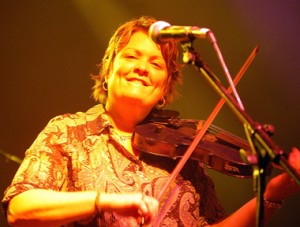
The acclaimed fiddler Eileen Ivers.

The acclaimed fiddler Eileen Ivers.

The fire-breathing fiddler Eileen Ivers has deep Irish roots. Her parents are from Ireland. She learned fiddle from the great Martin Mulvihill. She won the All-Irelands nine times. (Yikes.)

But if you know Ivers at all, you know she’s profoundly influenced by other musical genres, from jazz to Afro-Caribbean roots music. She was the featured fiddler in the megahit Riverdance, which brought Irish music to the fore in the United States and throughout the world (and which many purists regard as not at all Irish).

If you’ve ever attended an Eileen Ivers show, you know that her performance (and that of her band Immigrant Soul) can be both exhilarating and exhausting. She pours absolutely everything into a show—blood, sweat, tears, shredded bow hair and all. I attended an Ivers outdoor summer concert a few years back and, at the end, she was just drenched. (I hugged her, anyway.)

We chatted once before, and her upcoming show (Saturday, September 25, at 8 p.m. in the Zellerbach Theatre on the Penn Campus) gave us an opportunity to touch base once again. So we just picked up where we left off the last time. Here’s what she had to say.

Q. How often do you get into traditional Irish music sessions these days?

A. Not nearly as much I would like. Were going to Ireland in October and I seem to play in more sessions there than I do at home. We have a little house in Mayo, and there are a couple of really good sessions that I try to get to. It totally rejuvenates me. Sometimes, at festivals, there are great sessions on when you get back to the hotel. They’re always good to sit in on, of course.

Q. Is playing in sessions something you do, mostly, when you’re home? Or something you fit in when you’re on the road?

A. Definitely more on the road. When you’re home. you’re in a “home” mode. When I’m out and about, that’s when I hang out in sessions.

Q. What do you get out of sessions that you don’t get from performance?

A. It’s really all part of being an Irish traditional musician. It’s a wonderful privilege to be traveling around and playing Irish music. The venues that are looking to book Irish artists are really spectacular. We’re blessed to be able to perform, to do the symphony work. But at the same time, it’s important to get off the stage and sit in where the music is really living and breathing, playing with friends and remembering tunes, playing tunes that you haven’t played in years. You have to get back to that. It brings back why you’re playing in the first place.

Q. I don’t play fiddle, but if I did, I’m not sure I’d be able to play with you sitting next to me. My guess, though, is that you’re not really all that scary … or that’s not how session etiquette would dictate that people respond to you.

A. I don’t feel like that at all, and I would hate to have anybody think that or feel that. What I love about this music and our culture is that you’re part of a much bigger thing. And when you’re sitting down with a bunch of folks, and you look around and see the smiles, it’s healing. You’re just a part of it, and it’s so cool.

Q. How much time do you spend in teaching and workshops these days?

A. Not as much as I would like. That’s such a great feeling to put the music out there, especially to kids. I actually love when the band is in stage with me for the master class. They talk about the history of the music and the rhythms, and each musician will show how his instrument works. All of sudden, they’re inspired by this stuff. They see the fun, the joy of it. They think it’s the coolest thing ever. We do it as much as we can. We always offer it and we love doing it.”

News, People

Honoring Franny Rafferty

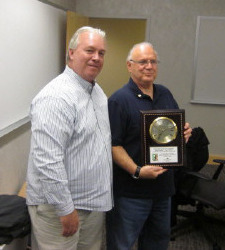
Mike Callaghan with Franny Rafferty.

Mike Callaghan with Franny Rafferty.

Anyone who knows Philly politics knows former Democratic councilman-at-large Francis W. Rafferty. Suffice to say, he was no shrinking violet in the exercise of his official duties.

People who serve on the St. Patrick’s Day Observance Association know Franny Rafferty in an entirely different light. Rafferty has served on the association board, which oversees the St. Patrick’s Day Parade, for over 30 years. For two years, he was president. (Those are recalled by current president Mike Callaghan, somewhat ruefully, as the two years in which the parade enjoyed some of its best weather—sunny, with highs in the low 70s.)

So let others dwell on the colorful history. His colleagues on the board know him as one of their hardest-working, most forward-thinking members. Recently, they honored Rafferty for his long years of service.

Callaghan says the accolades are well-deserved. “Franny’s a sweetheart,” says Callaghan. “He’s very focused and very zealous about what he believes in. He was a tremendous board member.”

Rafferty himself is grateful for the kind words, but he’s characteristically reluctant to toot his own horn. Instead, he redirects the very public attention to those who have served before him. “the guys that created the Observance Association, they deserve all the credit,” he says. “They’re the ones who brought us recognition. They’re good guys, good people. I was just proud to serve with them.”

He singles out the late board member Marie Burns for particular praise. “Marie Burns was my mentor,” he says. “She just took me under her wing. When i came on the board, I would just lay back. I was a councilman and younger then. I just wanted to be part of what they were doing. Marie took me under her wing. She said, ‘Someday, we’re gonna make you president.’ She was just a nice person to be with. I really miss her.”

Rafferty’s appreciation of his Irish heritage didn’t come naturally. In some families, Irish cultural awareness is front and center. In others, it’s rarely discussed. Rafferty’s family fell into the latter category.

Still, his family history is every bit as colorful as the man himself. His grandfather Pete Rafferty came from County Tyrone and established a horse manure business and, with hard work, came to own many properties along Washington Avenue. “He was supposed to have had the first bottom-drop wagons,” Rafferty says. “He worked a lot of construction jobs with it. He was just a hard-working little guy. He would haul stuff, and people would ride his horses on Sunday.”

Rafferty’s own Irish awakening came with the onset of The Troubles in Northern Ireland. As a member of Philadelphia’s City Council, he felt it was time for him to become involved, and he pursued his interest in the cause of Irish unity with characteristic vigor–even visiting Irish political prisoners in the infamous Maze Prison in County Down. He also stayed in private homes with Northern Irish families. “I really started to learn what these people were going through,” he says.

To Rafferty, service to the St. Patrick’s Day Observance Association is all a logical outgrowth of that deep and abiding passion for history and tradition. He recalls his time in the center of things with great fondness. “”It was just a beautiful time,” he says. “Now it’s time for the younger guys to take over.”