All Posts By

Jeff Meade

News

Plotting a Course for the New Anti-Defamation Federation

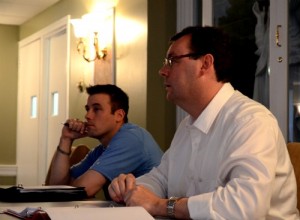
Joe Fox and Tim Wilson moderated the meeting.

Joe Fox and Tim Wilson moderated the meeting.

Out-of-control pub crawls.

Offensive St. Patrick’s Day merchandise.

Members of the new Irish Anti-Defamation Federation really have their work cut out for them. How are they going to do it? A little at a time, it seems, and with considerable diplomacy.

The Federation hosted a meeting at the Philadelphia Irish Center in Mount Airy Thursday night, drawing representatives from a wide sampling of Delaware Valley Irish organizations, from the Rose of Tralee to the Ancient Order of Hibernians to Clan na Gael.

The discussions were also fairly wide-ranging, but two issues of pressing concern moved to the fore: Pub crawls conducted around St. Patrick’s Day, featuring some noteworthy exhibitions of public drunkenness; and tasteless, insulting t-shirts, mugs and other Irish-themed tchotchkes of the like sold by many merchants around the saint’s day, with Spencer Gifts apparently regarded as Offender No. 1.

Joe Fox, president of the AOH Philadelphia County Board, chaired the meeting, with help from Tim Wilson. The purpose of the meeting was to help determine where the group should focus its efforts—and how to do it.

Starting off the meeting, Fox was at pains to stress that the IADF is for anyone and everyone who is interested. “Even though Tim and I are with the AOH, this is not just an AOH thing, he stressed. “This is all of us.”

With that, he opened the floor, and a free-wheeling discussion ensued. What emerged was a consensus that the defamation of the Irish did not happen overnight, and it won’t be solved overnight.

Too, there was a sense that the Federation will need to choose its battles and try not to come across as—to employ a phrase offered up by one attendee—”Irish crybabies.”

Deciding which problem to tackle and how to tackle it, many in the room acknowledged, is also going to be an issue of some delicacy. After all, several noted, AOH divisions themselves run pub crawls, and the North Wildwood Irish Weekend—where public drunkenness is hardly unknown and derogatory Irish merch can be easily located and bought—is sponsored by a division of the AOH in South Jersey. Other Irish and Celtic organizations run similar festivals and fairs, and they have similar problems.

Fox noted that the AOH in particular rigorously rides herd over pub crawls to ensure that members behave in a manner that will not bring dishonor to the organization. And as far as North Wildwood is concerned, he added, the local AOH specifies in contracts with sellers that insulting and derogatory merchandise must not be sold—and when such merchandise is found, sellers are warned to cease and desist.

That said, it was clear to many that the Federation can’t and won’t declare war on bars and purveyors of Irish-themed apparel. People are allowed to make money, and what’s more, they’re allowed to have fun. “There’s nothing (inherently) wrong with pub crawls,” Fox said by way of example. “We’re not looking to stop people from drinking. It’s only when they go too far. We need to think about these matters and how to be successful with them.”

Joe Roan, from the Dennis Kelly division of the AOH in Havertown, concurred. “We can’t come across telling pub owners that they can’t have a pub crawl,” he said. But he suggested that the Federation have frank discussions with pub owners to see about moderating the conduct of pub crawlers. “When we’re calling someone down, we can’t be doing it with a hammer in our hands,” he said. “And let’s not lose our sense of humor. Every time someone paints something green, let’s not get all upset over it.”

The group plans to reconvene to continue discussing these issues, and to hold an election for a new board in coming weeks.
Music, News

To Dingle and Back

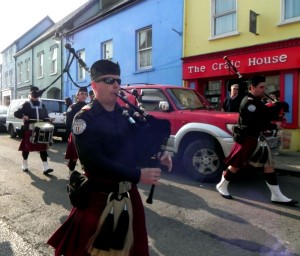
Marching through the streets of Dingle.

Marching through the streets of Dingle.

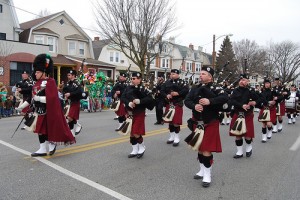
The Swedesburg Ancient Order of Hibernians pipe band Irish Thunder recently returned from a trip to Ireland’s southwest Dingle Peninsula, where they took part in the annual Pan Celtic Festival.

As the photos and video show … it looks like band members had a good time.Pete Hand, Irish Thunder’s drum major, passed along the group’s many visual memories of the journey, and we happily share them here with you. 

[cincopa AMEAjmailZlg]

Music

NicGaviskey in Concert

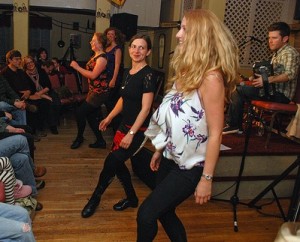
An Irish kick line: Keiran Jordan and Siobhan Butler, joining Bernadette and Caitlín Nic Gabhann.

An Irish kick line: Keiran Jordan and Siobhan Butler, joining Bernadette and Caitlín Nic Gabhann.

Fans of traditional Irish music got a super treat Saturday night at the Philadelphia Irish Center.

The band is called NicGaviskey—a kind of mooshing together of the band members’ names: Sean Gavin, flute; Bernadette Nic Gabhann, fiddle; Caitlín Nic Gabhann, concertina; Sean McComiskey on accordion (he’s the son of celebrated box player Billy McComiskey).

Gavin is from Detroit and McComiskey is from Baltimore; the ladies are from County Meath. They met at Catskills Irish Arts week in upstate New York in 2009, and sparks flew. In time, they collaborated on a CD, “Home away from Home,” recorded both in Miltown Malbay, West Clare, and Baltimore.

The band brought many of those tunes to the Irish Center, playing to a packed house.

And as an added treat … there was dancing. First, the Nic Gabhanns; and then the Nic Gabhanns, joined by acclaimed sean nos dancer Keiran Jordan, a Philly-area native now in Boston, with Siobhan Butler, also of Boston.

We’ve put together a photo essay of the night’s doings right here.

And, as you can see above, we offer four very cool videos to give you a sampling of the band’s superb playing.

History

Remembering the Patriots of 1916

Local Irish organizations, including Clan na Gael, Irish Northern Aid and the Ancient Order of Hibernians, gathered Sunday at Holy Cross Cemetery to commemorate the 95th anniversary of the 1916 Easter Rising.

Gathering at the gravesite of Joseph McGarrity, who coordinated and provided financial support for those who sought to drive the British out of Ireland, they recalled the names of many patriots for whom Holy Cross is also their final resting place. There’s a fair number: Martin Noone, Danny Catalan, John Ryan, Danny Duffy, Luke Dillon, John Devoy, Tom Mylott. And it’s probably not all.

Ireland is an ocean away and 1916 is a long time ago, but in Philadelphia, they’re not forgetting.

Music

Randal Bays’ Musical Journey

Randall Bays

Randall Bays

OK, granted, Randal Bays already was a serious musician before he took up Irish fiddle. He started on trumpet when he was 8, and went on to make his mark as a classical guitarist.

All the same, Randal Bays’ subsequent accomplishments as a fiddler, universally hailed as one of the most expressive and creative of his generation, is all the more remarkable in light of these facts: a.) He stumbled into the Irish musical tradition completely by accident, and b.) He is self-taught.

Among Irish musicians, the story of Bays’ introduction to traditional music has passed into legend. The story goes like this: One night in 1978, while accompanying a couple of friends to the Medieval Inn in his Portland, Oregon, stomping grounds, Bays witnessed the glorious spontaneity of a traditional Irish music session for the very first time.

He recalls that fateful evening.

“It was raining hard,” he says. “I had some friends who were involved in Irish music. I didn’t know anything about it, really. I’d heard some Chieftain albums. These friends, I thought they were really pretentious, going around wearing their caps and drinking Guinness. But they took me to hear this music, and that’s what did it. This was the first time I’d heard really great traditional music played in a session atmosphere and it really got to me.”

Bays remembers being impressed by both the music itself and the camaraderie of the musicians. In short, the same things most Irish musicians love about a session.

“There’s this combination of the potency of the music coupled with the intensity of good feeling that goes on in a good session,” Bays says. “If not unique to Irish music, it’s something that I love. Another thing that really thrilled me was the discovery of a whole room full of people focused on melody. We are all melody, all the time.”

That he gravitated to fiddle of all instruments, he says, is not surprising, given the makeup of sessions in Portland in the 1970s. Sessions back then were 80 percent fiddle, if not more, he says.

Too, Portland had no shortage of truly fine fiddlers to learn from and emulate, such as the virtuoso Kevin Burke.

As an already gifted musician, Bays wasn’t all that daunted by the prospect of self-instruction, and he set about learning by listening. Only later did he realize that, in teaching himself, he picked up many good techniques—but also a few that did not serve him as well.

“There were people around who were very good players,” he says. “I spent a lot of time with Kevin. With the fiddle, I learned, it’s all in the bowing. Someone at some point has to show you how the bow might work. It’s not intuitive. But basically for me, I was into it several years, and I realized I wasn’t going to progress unless I took it apart and started all over again.”

Did he ever. Not only has he become one of most the creative and expressive Irish fiddlers in America, reknowned for the delicacy and precision of his bow work, but he has also become a much sought-after teacher, sharing what he knows at the prestigious Willie Clancy Summer School and Festival, Catskills Irish Arts Week in New York, the Swannanoa Gathering, among many others. Of course, Bays would also include the Friday Harbor Irish Music Camp in Roche Harbor, Washington, which he co-founded with with Dan Paulson. Bays is equally well-known as a fingerstyle guitarist who has accompanied many of the finest Irish musicians in the world.

He long ago moved up to a fiddle worthy of his mettle, as well. The fiddle he now plays was custom crafted for him by Andranik Gaybaryan, now living and plying his trade in Amherst, Massachusetts. The award-winning Morgan Andersen of Rosalia, Washington, made the bow.

“I love this fiddle. Gaybaryan trained in Russia and he is also a great player. He is one of a handful in people in North America who understand the sound production of these instruments,” Bays says. “The trouble with the fiddle and the bow now is, I can never blame my equipment. If there’s anything wrong, it’s all my fault.”

See if you can catch him in a mistake (good luck) when he appears in concert with guitarist Davey Mathias at the Coatesville Traditional Irish Music Series, 143 East Lincoln Highway, on Saturday, April 30 at 8 p.m. For details, visit: http://www.ctims.info/

Music

Review: “800 Voices,” by Danny Ellis

Danny Ellis in concert.

Danny Ellis in concert.

I apologize in advance for just now getting this. Danny Ellis’s “800 Voices” arrived in my mailbox a couple of months ago, and then St. Patrick’s Day and all the mayhem surrounding that day landed on me, and I just put it off.

In any case, I don’t want to let my slowness off the mark signify in any way my feelings about “800 Voices.” It’s a brilliant, if haunting piece of work.

Danny Ellis is a survivor of the notorious Artane Industrial School, in Dublin’s Northside, operated with wanton cruelty and unrestrained brutality by the equally notorious Christian Brothers. Clearly, their mission—to care for young children, many of them orphans, some of them categorized as delinquents—was wholly uninspired by Jesus Christ.

Ellis was committed to the school by his ailing mother, who was unable to care for her five children. Two of his brothers went to a school in Rathdrum, and two sisters wound up in an institution for girls in Booterstown. Young Danny Ellis entered Artane in 1955. He remained there for eight years, released when he turned 16. Artane, opened in 1870, was the largest of Ireland’s industrial scholols. According to the Commission to Inquire into Child Abuse, which investigated such schools, the Christian Brothers’ use of corporal punishment was “systemic and pervasive.” Allegations of sexual abuse and neglect also surfaced.

In light of that ugly history, you might suspect that Ellis’s cathartic musical recollection of his sad days at Artane could be a bit hard to take. And make no mistake, Ellis is unflinching in his depiction of his struggle at Artane—the fear, hunger, brutality, anger and lingering resentments.

Take, for example, these searing lyrics from Ellis’s “Innocence Back”:

They shattered our bodies
and they scattered our minds,
they broke us and beat us
’til we were twisted in time.
Then they cut us all loose
like rats in a sack,
now there’s no amount of money
gonna give us our innocence back.

And yet, for all the harrowing memories, “800 Voices” ultimately lands in a very hopeful place. The trauma of life in Artane clearly continued to color Ellis’s worldview for many of his adult years, but ultimately “800 Voices” makes you believe in redemption.

One reason Ellis is able to give voice to the poignant and painful memories that many others have kept submerged is that, after years of suffering what he refers to a “vague discontent,” he was able to connect with his feelings and find peace through meditation.

But way before that, when he was still a child navigating life at Artane, Ellis’s soul remained open to even the faintest possibility of joy. He found comfort in small things—the singing at Mass of another student, Tommy Bonner, and the arrival of summer signified by the Brothers’ issuance of soft red leather sandals to replace the usual stiff hobnail boots. And speaking of that rugged footwear, there’s a cute little song, “Who Trew Da Boot,” about the loud bang produced by an ancient loaf of bread on the dormitory floor after lights out. McCarthy, the ridiculous nightwatchman investigated, and assumed that the loud noise (the bread now safely hidden) was the result of a student tossing one of those heavy boots. “When 150 kids share a joke that the adult is not privy to,” Ellis writes in his liner notes, “suppressed laughter doesn’t remain suppressed for very long.”

But ultimately, Ellis found a sanctuary within Artane’s walls—a “friend,” as he puts it in another song—in music. Early on, he was recruited for the Artane Boys Band. He played trombone, blowing his lungs out. As he sums up his feelings in “The Artane Boys Band:”

There was nothing in this wide world as glorious or grand as the blast of freedom’s yearning from the Artane Boys band.

When he left Artane, Ellis carved out a musical career for himself, playing trombone in a string of Irish show bands, writing tunes for a time, and working as a session singer at London’s Abbey Road studios. (You’ll hear his trombone on the jazzy “Innocence Back.” He hasn’t lost his touch.)

For most of the CD, of course, Ellis accompanies himself on guitar and piano, but he also surrounds himself with some outstanding musicians: Duncan Wickel on fiddle, whistle and and uilleann pipes; River Guerguerian on hand and frame drums; and the mighty John Doyle on guitar bouzouki, mandolin and banjo.

It’s going to be some time before Ireland recovers from the bleak legacy of the industrial schools. Still, Danny Ellis offers ample evidence of the strength and power of the human spirit to overcome even the most tortured past.

History

Remembering the Rising

Tom Conaghan and Patricia Noone Bonner at a recent Rising ceremony.

Tom Conaghan and Patricia Noone Bonner at a recent Rising ceremony.

It has been 95 years since the 1916 Easter Rising, the abortive effort by Irish republican forces to bring an end to British rule. Still, the long-ago insurrection continues to resonate for many Philadelphians of Irish descent. After almost a century, a key stumbling block remains—Ireland remains divided.

Representatives of several groups, including Clan na Gael and Irish Northern Aid, will commemorate the rising—as they do every year—with a ceremony of remembrance Sunday at Holy Cross Cemetery in Yeadon. The memorial will take place at the gravesite of Joseph McGarrity, a confirmed physical-force republican from Philadelphia who provided a considerable sum of money to the Irish rebels.

Patricia Noone Bonner has been taking part in the ceremony for about 40 years. She remembers attending with her children. For her, the struggle remains unfinished. Memories of the 1981 Irish hunger strike at Long Kesh remain painfully fresh.

For Bonner, it’s all too personal. Her father Martin Noone was a dedicated republican from a little village near Ballina, County Mayo, who ultimately left Ireland in 1924, after the Irish Civil War, to find some measure of peace in Philadelphia, joining his brother in his home across the street from Our Lady of Mount Carmel Church at 3rd and Wolf.

To this day, Bonner is not completely certain of her father’s role in the troubles of the time. “He would have been too young for 1916,” she says. “I do know he was in the civil war. He went against the treaty with England. He didn’t go with the free-staters led by Michael Collins. But he didn’t talk about a lot of stuff. He talked about some things, but he didn’t talk about everything.” Martin Noone died in 1960.

As to why local Irish continue to commemorate the Easter Rising, Bonner is clear: “The 1916 rising was hopefully going to be the start of a united ireland. For us, it’s like celebrating the 4th of July. We do it in memory of all those patriots who have died for Ireland, and those who were in it (the Rising) who did not die.”

At McGarrity’s gravesite, this turning point in Irish history is recalled through the reading of the Proclamation of Indepenence, originally recited by prominent Irish leader Pádraig Pearse outside the General Post Office.

Continuing to remember the Rising is important, Bonner says, because “it’s still not a united Ireland. I know they are working toward it. They’ve stopped the armed struggle part of it. And many of the Irish will keep that goal in there minds over there, just like a lot of us here.”

The ceremony is scheduled for Sunday, April 17, at 2 p.m. in Holy Cross Cemetery, 626 Baily Road, in Yeadon.

Music, News

On the Road to Dingle

Irish Thunder Pipes and Drums

Irish Thunder Pipes and Drums

For many of them, it will be their very first trip to Ireland.

But what a way to go, as members and friends of a gen-u-wine Irish-American bagpipe band, and one of the most popular in the Delaware Valley at that.

Seventeen members of Irish Thunder Pipes and Drums will be heading to the Dingle Peninsula in Ireland’s wild southwest to take part in the Pan Celtic Festival. With friends and family, 78 people altogether are going on this trip.

The Pan Celtic Festival is a huge gathering of clans from Ireland, Scotland, Wales … anywhere there are Celts. The festival takes place from April 26 through May 1. The Irish Thunder band will march in the Parade of all Celtic Nations through Dingle Town on Friday night the 29th, says Pete Hand, the band’s drum major.

The last time the maroon-kilted band traveled to Ireland, it was in July of 2000, for the All-Ireland Pipe Band Competition in Kilkenny. So, says Hand, this journey has been a long time coming. Members of the band have talked about a return for several years, but plans for this year’s trip crystalized over the hot dogs and potato salad at the annual band picnic last year.

“We’re getting excited now … we’re getting closer,” says Hand, who leads the band.

“It’s the first time (traveling to Ireland) for me,” adds Hand. “It’s the first time for a few of the other guys, too. It’s gonna be great ..I think its really going to be fun.”

Irish Thunder won’t be the only pipe band in the parade, but they’ll be one of the few carrying an American flag. “I’m sure we’ll be playing some American tunes that they don’t normally hear over there,” he says.

Of course, there will be plenty of time for sight-seeing as well. The travelers will do the obligatory Ring of Kerry, take in the white-knuckle view (1,300 feet above sea level) from Conor Pass, and visit the Cliffs of Moher.

Hand also notes that in Dingle, a town of 1,300 when nothing else is going on, there are 52 pubs. Band members are likely to belly up to the bar in, oh, a few of them. Says Hand: “We might have a contest.”