delphia.com/wp-content/uploads/2012/09/marykaymann-300×300.jpg” alt=”Mary Kay Mann” width=”300″ height=”300″ />
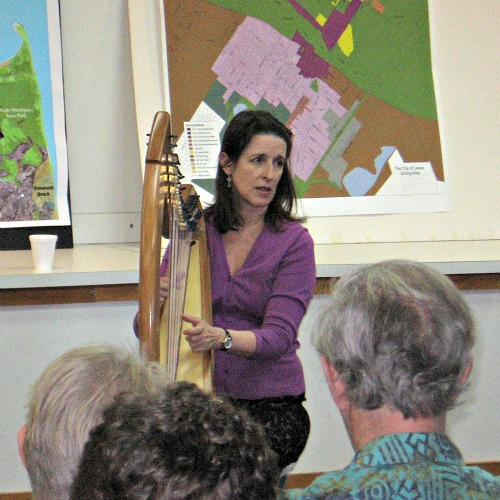
Mary Kay Mann

delphia.com/wp-content/uploads/2012/09/marykaymann-300×300.jpg” alt=”Mary Kay Mann” width=”300″ height=”300″ />
Mary Kay Mann
If an 11-year-old could compete in the world championships of Irish traditional music, harpist Mary Kay Mann reasoned, then so could she.
In this case, the then-fifth grader was Keegan Loesel, who took up the tin whistle at about 5 years old, and Mann was his teacher. Keegan is one of a small posse of incredibly talented local kids who have competed at the Fleadh Cheoil (pronounced flah KEE-ohl) on one or more occasions. Keegan put his skills to the test last year in County Cavan, Ireland, where the Fleadh was held.
Keegan played well but didn’t place in the under-12 whistle event, but it takes incredible talent, discipline and determination to get even that far. Inspired by her student, Mann decided to give it a shot.
Give it a shot she did … and even better than that: She came in third in over-18 slow airs.
It wasn’t easy. Unlike the local Fleadh kids, Mann, who lives in Media, has grown-up responsibilities.
“I have a day job, and students, and gigs, and a lot of things going on,” she says. In order to compete and have a snowball’s chance in Ireland, Mann knew she would have to choose the event best suited to her talents.
“I chose slow airs. I would have to really work to compete with 16-year-olds on jigs. I thought that, as a person who is not exactly young, slow airs might be something I could do. Slow airs don’t take speed; they take maturity. They’re slow and emotional and not rhythmic, and they are ornamented. I could probably study them for the rest of my life. I like challenges like that.”
Even then, Mann says, it was tough going. In order to compete in Ireland, Mann needed to know eight slow airs, and her playing of those eight airs needed to be bulletproof. “It takes a lot of time,” Mann says. “Once you get there, you have to play three of them … except that you don’t know which three, so you have to prepare all of them.”
Unlike other Fleadh contests, which can attract large numbers of contestants, over-18 slow airs for harp drew only six contestants. Mann thinks that might have improved her odds, but all the same—all six players were world-class.
“I think I was the only American … and these girls were incredible. Really young and really good. They’re driven, they’re self-driven, they practice all the time, and they love it.”
To her surprise, Mann more than held her own. But that’s not to suggest her third place medal was some kind of fluke. Mann, who took up Celtic harp in the mid-1990s, has always been a deeply committed performer and teacher, with a bachelor’s degree in instrumental music education. She already played classical flute and piano before she added the Celtic harp to her repertoire. (She also plays tin whistle.)
As for how Mann got her start, she blames another well-known local harpist, Ellen Tepper. “”I was playing flute in a duo with her, and at one point she just handed me the harp and said, ‘Try this, it’s easy.'”
It wasn’t all that easy, but it wasn’t all that hard, either. Celtic harp is often taught “by ear,” without aid of sheet music.
For Mann, that was just fine.
“I already played piano by ear,” Mann says. “I had already learned how to do that before I transitioned to the harp. It’s fun without all the little dots on the page. And it really is nice to start when you are older because you sound decent right away. If you started on fiddle, you’d probably sound pretty bad, but a lot of people start learning harp in midlife because it’s gratifying right away.”
After years of learning and trying to perfect her craft, competing and placing at the Fleadh is icing on the cake. For now, Mann is content to return to her teaching and performing life. She’s not sure the Fleadh experience she will repeat any time soon. “It costs a lot of money. I didn’t do benefit concerts; I had to pay for it. It’s a lot of money and time … and it’s exhausting.”
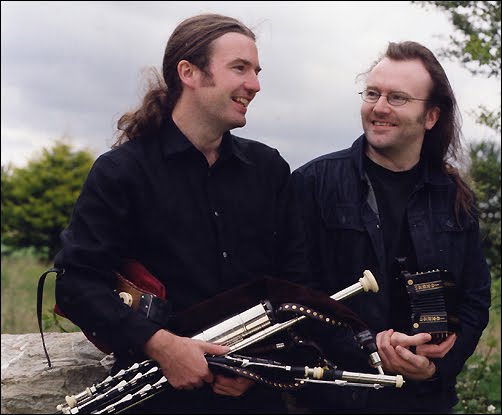
lely” src=”http://irishinphilly.com/wp-content/uploads/2012/09/niallandcillian-300×248.jpg” alt=”Cillian and Niall Vallely” width=”300″ height=”248″ />
Cillian and Niall Vallely
Maybe you have to really know Irish music, in the way that you know breathing and heartbeat, before you can begin to take creative liberties with it.
For uilleann piper Cillian Vallely, perhaps best known for his work with the exceptional Celtic fusion band Lúnasa, the seed of experimentation was planted early on.
First came learning Irish music in its purest form at a school known as the Armagh Pipers Club, following in the footsteps of both his father Brian, a piper, and his mother Eithne, a fiddler. Brian Vallely is the club’s director; Eithne, director of music.
“When my father started playing, there wasn’t a whole lot of Irish music at all, and there weren’t a lot of pipers in Ireland,” Vallely explains. And that was the main reason why his father and several other pipers started the club in 1966, he says. “It was a real mission they were on, to keep the music going. For political and cultural reasons, Irish music was almost underground. It was looked down upon then. People were almost embarrassed by it.”
The club gave the early members the opportunity to teach themselves, even as they taught their first pupils.
Vallely remembers trooping off to the club with his sister and three brothers once a week, all of them starting out on whistle, and eventually taking up different instruments. (In spite of the club’s name, it wasn’t all pipers and piping.)
“My father tried us all on the pipes, but they (his siblings) let it go,” Vallely says. “I remember my mother trying to teach me the fiddle. I remember not liking it. I started the pipes when I was 8. I think it was just a case of liking the pipes.”
In retrospect, he laughs, “My life would have been simpler if I’d learned the fiddle.”
As obsessed with traditional Irish music as the Vallelys were, all were expected to branch out in another direction: in this case, classical music. Eithne Vallely was also a music teacher, and Cillian Vallely learned to play flute and saxophone. This is where the Vallely kids began to take a broader view.
“I was probably never just playing Irish music,” says Vallely. “My parents were never too narrow-minded about the music. They were never saying to us that there is only one way to play. We were never above doing other stuff, playing other styles. My mother put together arrangements that, when I look back on it, were pretty modern.”
At the same time, Vallely recalls, he began to be heavily influenced by the Bothy Band, the Chieftains, Moving Hearts, and Planxty, all of which were known for pioneering innovations.
In the end, it was probably a surprise to no one who knew him that Cillian Vallely’s career would take him in many non-traditional directions. And then, in 1999, came an opportunity to play with the band with which he is most often identified.
“I had been playing professionally about four years before Lunasa came along,” Vallely says. “Lunasa was already up and running when they asked me to join. I understood where they were coming from. Their music made total sense to me—that’s what I wanted to play.”
At the same time, Vallely continued to explore other musical collaborations, including the Celtic Jazz Collective, Riverdance, and the New York-based band known as Whirligig.
Perhaps not surprisingly, his collaborations are more familial, as witness his upcoming Delaware Valley concerts with brother Niall on concertina.
“Me and Niall are less than two years apart, but we’ve been playing together since I was 10. He understands piping, and he understands my music. We play different instruments and we only play together maybe twice a year, but we both like the same kinds of music, and we are playing the same style in a lot of ways. His concertina style has been affected by piping. Neither of us have to travel to0 far to play well with each other. “
You have two opportunities to judge for yourself. The Vallelys will appear in a house concert in Voorhees, N.J., on Wednesday, September 26, and on the concert stage at the Coatesville Traditional Irish Music Series on Sunday, September 30. Do yourself a favor, and go to both.
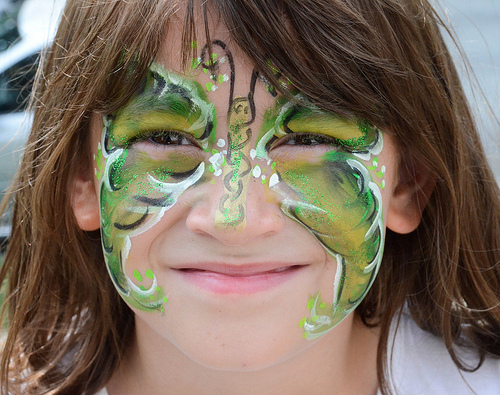
src=”http://irishinphilly.com/wp-content/uploads/2012/09/constancehome-300×237.jpg” alt=”Constance the Butterfly” width=”300″ height=”237″ />
Constance the Butterfly
From singers’ night last Thursday to Saturday’s smashing finale, a concert by the legendary Dé Danann, the 2012 Philadelphia Ceili Group Festival was far and away one of the most popular and best attended ever.
Probably the best sign of success was the Saturday Dé Danann show, with opener, the uillean piper Paddy Keenan accompanied by Dé Danann bouzouki player Alec Finn. The Irish Center ballroom was as packed as it’s ever been, with a lot of late-arriving concert-goers going chairless. They didn’t seem to mind. Dé Danann, with the luminescent singer Eleanor Shanley belting out tunes, was incredibly sharp for a band that was formed at about the time the Pleistocene era was ending. OK, maybe not that long ago, but there sure was a lot of gray hair up onstage.
Earlier in the day, festival-goers had their choice of things to do, from face-painting with the kids to dancing lessons to musical workshops with the likes of Dé Danann iconic bodhran player Johnny “Ringo” McDonagh.
Sean Tyrrell’s one-man show, “Who Killed James Joyce,” was likewise well attended on Friday night.
We were there for most of it, and we have the pictures to prove it.
Check them out:
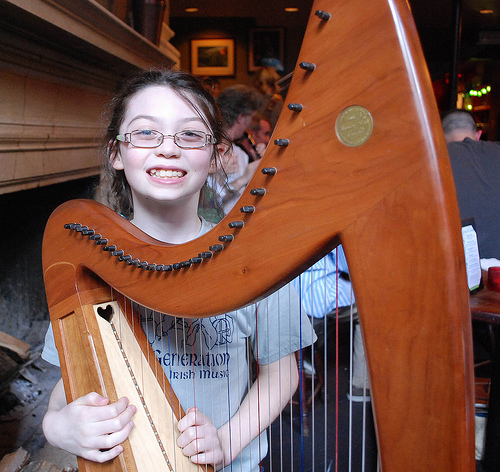
lphia.com/wp-content/uploads/2012/09/emilyhomepage-300×283.jpg” alt=”Emily Safko” width=”300″ height=”283″ />
Emily Safko
Amy and Greg Safko knew early on that their daughter Emily had vision problems. When Emily was 2, doctors told the Medford, N.J., couple that their daughter was highly nearsighted.
“We knew something was off,” says Amy Safko. “She would pull everything right to her face.”
Then, three years ago, Emily’s vision declined dramatically. She was diagnosed with a rare genetic disorder call Stickler Syndrome, which damages the eyes, along with the ears, and connective tissue throughout the body.
Emily’s vision problems came to a head late last year when she started noticing spots and flashes in her field of vision—floaters—and she suddenly couldn’t read the blackboard in school. What followed were multiple surgeries and, finally, the finding that Emily, now 10 years old, is legally blind.
All of which makes Emily’s fourth place finish in the under-12 Celtic harp competition at the Fleadh Cheoil last month—the annual “world series” of Irish music—that much more remarkable. Some might say it was miraculous.
“She’s remarkably better than we ever could have expected,” Amy says. “We are just so happy.”
Optimism apparently runs in the family. When she learned of her condition, Emily recalls, “I thought it was cool because not many other kids have it. It wasn’t getting me down.”
Stickler Syndrome also appears to run in the family. Testing showed that Amy Safko herself had Stickler, but had never been symptomatic. She had been born with a cleft palate, which is associated with Stickler Syndrome. Additionally, her joints had always been hyperflexible, which can also be a sign.
The family’s upbeat attitude was sorely tested in the months leading up to the Fleadh Cheoil (flah KEE-ole), held in August in County Cavan.
Following her surgeries, doctors told the Safkos that Emily had a long road ahead of her. “Her right eye has no lens,” says Amy. “The left eye is the better of the two. She still has a cataract they didn’t want to touch.”
Emily’s eyes are both filled with silicone, a temporary step to help promote healing, her mother explains. “The silicone was put in there as part of the retinal detachment repair. It usually comes out in three months, but she still has it in both eyes. If they work on the cataract, the oil can get in other parts of the eye. No one wants to touch that eye.”
Overall, Emily lost a month of practice time leading up to competition season, and when she was finally able to start playing again, nothing about it came easily.
“I had to re-learn harp, sort of,” says Emily. “At first, I lost some parts, but my teacher always talks about ‘muscle memory.’ My fingers remembered.
“It was really tricky with the strings. When I started to play the harp again in January, the strings were all weird. Some of the strings are see-through, and I couldn’t see them at all.”
Those difficulties held Emily back for just a week. “It doesn’t take long for me to remember things. Once I learn a tune, all I have to do is put my fingers in the starting position, and then I just go from there.”
Before her most recent Fleadh, Emily had competed in Ireland twice. This is the first year she finished so high up in the rankings. She almost finished in the top three in slow airs. She tied for third, but finished fourth after a callback.
One reason for Emily’s strong finish is her deeply competitive nature, Amy Safko says. But support from the Irish music community provided another big boost.
“One of the biggest things that was so amazing to us was just how supportive the Irish music community was to us,” says Amy Safko. “We got cards from harpists every day from around the world, people we didn’t even know. Some of them sent gifts, and we didn’t even know them. It was amazing to us.”
As for where she goes from here, Emily Safko has no doubt about it. She wants to go back to Ireland next August to try again.
“It’s a lot of fun going there. I’m looking forward to next year.”
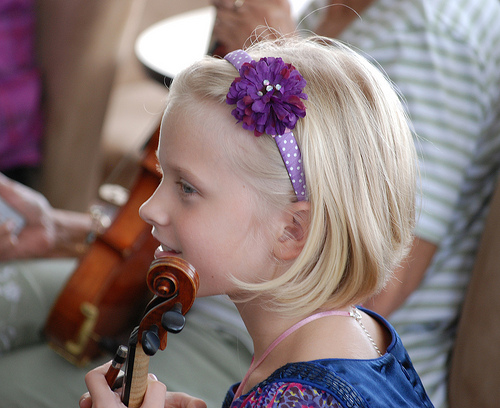
hiladelphia.com/wp-content/uploads/2012/09/haleyhome-300×244.jpg” alt=”Haley Richardson” width=”300″ height=”244″ />
Haley Richardson
For a fleeting moment, 10-year-old Haley Richardson knew what it was like to finish first in the under-12 fiddle competition at the Fleadh Cheoil na hÉireann. The Fleadh is something like the world series of Irish music, held just a couple of weeks ago in County Cavan.
After blazing through traditional tunes, “The Old Gray Goose” and “Trim the Velvet,” Haley found herself tied for first with a young man from County Laois, with the unquestionably Irish name of Senan Ó Móráin. Both were called back to play another tune. The judges asked Haley to play “Dowd’s Reel.” Ó Móráin edged her out.
But still—an American kid in a field of more than 20 players, most of them Irish, coming in second at 10 years old. It’s certainly no longer unheard of for a Yank to place at the Fleadh, but it’s a thrill nonetheless.
Haley is one of two local kids, both members of the all-kids Next Generation traditional music group, who fared exceptionally well in Cavan. Harper Emily Safko tied for third, and then was called back. She finished in fourth place.
Back at home in South Jersey, Haley seems pleased with the result, but otherwise unfazed. She’s been playing since she was 3, and competing for the past several years. Including this year, she has competed in the Fleadh Cheoil four times. In March, she shared the Kimmel Center stage with the Chieftains. As anyone who has heard her play can attest—and in any traditional Irish music session, she more than holds her own with experienced adult players—this gifted blonde-haired sprite of a fiddler is already an old hand.
“I just felt like I did the best I could do, and really couldn’t do any better,” she says. “I didn’t think I would win; I never thought I would place. All the other kids were from Ireland, so I never thought I would win, coming from the United States.”
“I was just really happy that I placed. I thought that someday I might place, but I didn’t think it would be this time.”
Kathy DeAngelo was Haley’s teacher for two years. She, together with husband Dennis Gormley and fiddler pal Chris Brennan Hagy, run the Next Generation Irish traditional music group, all kids. Haley has been a member for years. Though Irish players frequently win, she sees signs that the playing field might be becoming a bit more level.
“Everybody says it’s rare that Americans win. That may have been the case 10 or 15 years ago, but it’s not rare anymore. The level of playing here has gotten so much better here the last 10 or 15 years.”
DeAngelo says she, Dennis and Chris encourage Next Gen kids go to the Fleadh, but not just for the competition. “We think of it more like putting a bug in the kids’ ears. We’ve always been a proponent of going over there, not just for the Fleadh but for the Scoil Éigse. (Classes and workshops.) Sometimes you can get the feeling over here like you’re the big fish in a little pond. Over there, the level of play is so high hopefully it’s an inspiration.”
Of course, the non-stop music that occurs around the Fleadh town is also a draw.
“You can go into any building at any time of day, and there will be somebody playing,” says Haley, “which I think is really cool.”
Haley’s mom Donna is thrilled, of course.
“I was surprised that she placed, but I thought it was about time. She has gone for a number of years, and played really well,” she says. “I trust that she’ll do her best. She seems to take it all in stride, whether she wins or loses. I prepare her the best I can, but she goes out and does her thing, and we’ll see what happens.”
More Fleadh coverage next week, with a profile of harper Emily Safko.
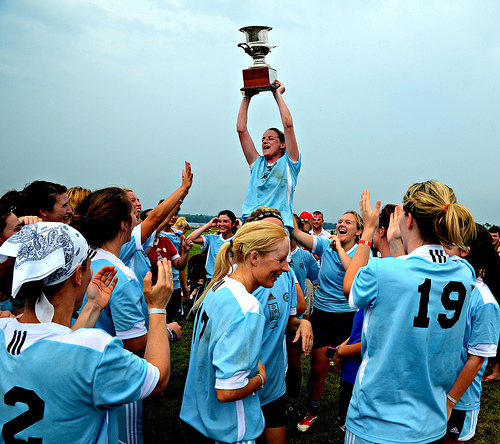
Jubilant Notre Dames footballers hoist their beloved captain, Maureen Ennis, over their shoulders.
For Maureen Ennis, captain of Philly’s Notre Dames Gaelic football club, the team’s first ladies senior football championship will likely be her last.
One minute, she was thrusting the silver cup above her head to wildly enthusiastic cheers by her teammates; the next minute, she was holding in her arms the reason for her retirement, at least for now, from the sport she loves. It was her son, Shea. (She loves him more.)
“This is my first year with a child,” she said. “This is probably my last game, but it’s brilliant to win.”
Win, the Notre Dames most decidedly did, taking the final game against Connacht (Boston) with a score of 3-15 to 0-06. (Here’s how to understand Irish football scoring.) There was no moment at which Connacht even came close. Ennis wasn’t surprised by how well the Dames played.
“We knew we were going to be strong,” she said. “As soon as we started training, we just knew.”
The Dames’ North American championship continues a tradition of national ladies football titles by Philly teams. The Mairead Farrells held the honor last year and the year before.
Two other Philly teams made it all look too easy.
The Eire Ogs Junior C team triumphed over the team from San Francisco, 3-16 to 1-6. It was a long time coming for the Eire Ogs, too.
“We’ve been trying to win (the championship) for 10 years, so we didn’t know what to expect,” said Conor Trainor, captain of the eire Ogs. “You come out, not knowing who you’re playing.” Giving due credit to the team from San Fran, Trainor acknowledged, “We both played against tough teams to get here.”
And while we’re on the subject of lopsided victories, let’s all raise a glass for the Young Irelands, who took the men’s intermediate football trophy gainst the Michael Cusacks club from San Francisco, 5-16 to 0-7.
Edged out on Sunday in their final game against New Hampshire were the Hibernians of Allentown: New Hampshire 1-11 to the Hibos’ 0-16. They didn’t win, but they sure didn’t make it easy.
We have so many photos from the championships, both on and off the field, that we’ve just lost count of them all.
Check them all out here.
ck Conneely (© 2011 Con Kelleher)” src=”http://irishinphilly.com/wp-content/uploads/2012/08/20120823mickconneelypic1-300×300.jpg” alt=”Mick Conneely (© 2011 Con Kelleher)” width=”300″ height=”300″ />
Mick Conneely (© 2011 Con Kelleher)
Fiddler Mick Conneely won’t forget the first time he saw the pioneering Irish folk group De Danann live, every last detail permanently etched into his memory.
“I was 15. It was Sunday the 23rd of May 1982. It was the first time I saw them live, a concert my teacher Brendan Mulkere had organized, in Slough, a town south of London. It was dinner time. Me and my dad went. It was the ‘Star Spangled Molly’ tour, my favorite album. It was the only time I was starstruck.”
Conneely, born in Bedford, England, to Irish dad and fiddle player Mick and mum Lizzi, in a home where Irish music was ever present, had been playing fiddle under Mulkere’s tutelage since he was 11. Mulkere must have thought pretty highly of the young man’s abilities, because, Conneely recalls, “didn’t Mr. Mulkere drag me by the scruff of my neck up to the stage to play solo during the intermission?”
Conneely nearly passed out from fear, but the terror quickly passed as he started to play sets from the 1977 duet album, “Frankie Gavin & Alec Finn.”
Looking back, he says, “it was a brilliant exposure. For the first five minutes I was afraid for my life, but then the butterflies turned into something else.”
Gavin, he recalls, was mightily impressed that his young friend had chosen to play tunes from that album, which Conneely describes as his favorite, both then and now. “When I met the lads afterward, Frankie gave me a hug,” he recalls, still sounding like that starstruck kid. “I was on a high from it for years afterward.”
Conneely kept on plugging away devotedly at his fiddle, playing at sessions, ceilis and house parties, in time maturing into a young virtuoso. Then, in 1984, when Conneely was 17, his parents allowed him to accompany some other young musicians to the Willie Clancy Summer School Festival in the West Clare Irish traditional music hotbed of Miltown Malbay. He suddenly found himself surrounded by the royalty of Irish music.
“You’d hear music in a pub, with the likes of Frankie and Mary Bergin and Jackie Daly. It was just unbelieveable. You couldn’t dream it. I’d never been exposed to that level of music. It changed my whole life. 1987 was the year I knew I would be playing till the day I die. What I experienced in Miltown Malbay would never leave me.”
The members of De Danann didn’t forget about Conneely either, as he found out in 1991, when he was 24 years old. What happened then was musical kismet.
“I toured America with the band,” he says, a note of awe still in his voice. “Frankie had broken his arm or his wrist just before the tour, and I got a call from the tour coordinator.” At first he thought it was his childhood friend, now Lunasa frontman Kevin Crawford, playing a joke on him, but it soon became clear: This was no joke.
“That was unbelievable. I knew the tunes, there was no learning curve at all. Why I was thought of, I have no idea to this day, really. I was totally honored and blown away. Imagine being a guitarist and getting a call from Mick Jagger. I went over a boy and came home a man, musically speaking.”
So began a relationship with De Danann that has lasted years, as Conneely became established as Frankie Gavin’s stand-in. He did a couple of tours after that, and a couple of one-off concerts.
Conneely is on the tour that will take De Danann through Philadelphia on Saturday, September 8, for the grand finale concert of the 38th Annual Philadelphia Ceili Group Festival at the Philadelphia Irish Center in Mount Airy. He’ll join De Danann originals, bouzouki wizard Alec Finn and bodhran player Johnny “Ringo” McDonagh, together with the great singer Eleanor Shanley, accordion player Derek Hickey, and Brian McGrath on piano and banjo.
Of course, this incarnation of De Danann is absent Frankie Gavin. The band split up in 2003. Conneely says he doesn’t harbor any illusions that he can take Gavin’s place. “No one can really replace Frankie. He’s still my favorite fiddle player. He’d lift anyone’s soul.”
For now, though, Mick Conneely is happy to share the stage with the band that most inspired him as a kid. “Looking back now,” he says, “I realize I’m the luckiest guy on earth. I’ve realized many of my ambitions, which is rare. Some dreams do come true.”
Learn more about the Philadelphia Ceili Group Festival.
minated” src=”http://irishinphilly.com/wp-content/uploads/2012/08/ladieshurlingfinal-300×237.jpg” alt=”The Notre Dames dominated” width=”300″ height=”237″ />
The Notre Dames dominated
If you didn’t get your fill of hurling and football on Sunday afternoon at Cardinal Dougherty, then, well, you must be insatiable.
The day’s games started with a fast-paced hurling match, and the rest of the afternoon was dedicated to football, both men and women. The day’s biggest upset came in the final game of a series between women’s national champs, the Mairead Farrells, and challengers the Notre Dames. The Notre Dames came out on top, 3-14 to 1-10, winning the Philadelphia Senior Champions crown.
We have photos from all but the final game of the day, the men’s Division 1 football matchup between the St. Patricks and the Kevin Barrys. (Wish we had time for all of them, but we were verging on heat stroke.)
Here are all of the final scores:
Philadelphia Hurling League
Na Toráidhe beat Allentown Hibernians (Score to Follow)
Series Tied at One Apiece
Men’s Division II Football
Young Ireland’s • 3-14
Kevin Barry’s • 0-07
Young Irelands and Saint Patrick’s are the Top Two (2) Teams thus far…
Ladies Senior Football
Notre Dames • 3-14
Mairead Farrell’s • 1-10
Series 3-0, Notre Dames crowned Philadelphia Senior Champions
Men’s Division I Football
Saint Patrick’s • 0-10
Kevin Barry’s • 1-03
Saint Patrick’s progress to the Philadelphia Final, while the Kevin Barry’s face the Young Irelands next week.