All Posts By
Jeff Meade
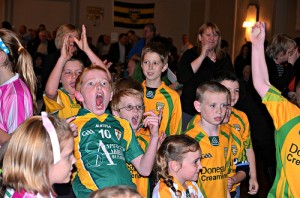
Kids might have been the most excited fans … but it would have been a close contest.
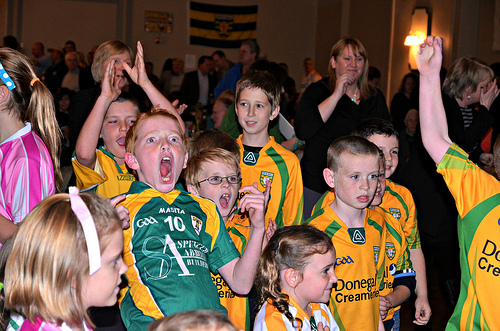
Up Donegal! If we heard it once, we heard it a thousand times, and it never got tired. On a Tuesday night when a lot of kids otherwise would have been home getting ready for bed, they were instead decked out in their bright yellow Donegal jerseys and running around the Philadelphia Irish Center like children possessed.
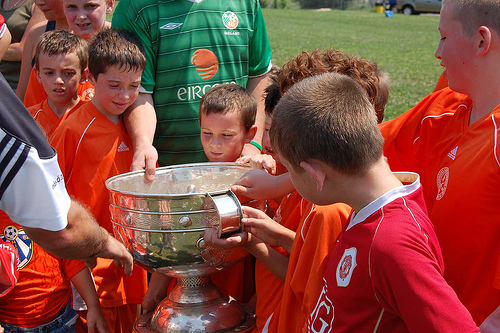
And possessed they were, perhaps, by the presence of the shiny Sam Maguire Cup, brought to Philadelphia by three incredibly proud representatives of the 2012 All-Ireland Football champion team from Donegal: coach Jim McGuinness, along with all-stars Mark McHugh and Michael Murphy.
When the kids weren’t setting land-speed records running from one end of the Irish Center ballroom to the other, they were standing in line with their parents, relatively patiently, waiting for the chance to get their pictures taken with cup and players.
And yes, the place was jammed with ecstatic adult fans, too, including dozens of Donegal natives, and sons and daughters of natives, celebrating the county’s first All-Ireland championship in 20 years. (And they were just as eager to get their picture taken, too.)
After a couple of hours smiling and posing, McGuinness and his players adjourned to the ballroom, where they accepted presentations from the Philadelphia Donegal Association, along with local Gaelic Athletic Association representatives, the Philadelphia Irish Center, state lawmakers Kevin and Brendan Boyle, and many others.
For the Donegal footballers, it had been a long day, but they showed no evidence of tiring. Player Mark McHugh, son of legend Martin McHugh, was still a little wound up—or maybe just jet-lagged—as he spoke about his Philadelphia welcome, and the rigors of the tightly coordinated U.S. victory lap.
“We just got in this morning,” he said. “We flew into New York, and we just drove down. We’re flying off to Chicago at 9 o’clock in the morning, and back to New York on Thursday. It’s just a full-time job, but it’s a good complaint to have. If we hadn’t won the All-Irelands, we wouldn’t be here.
“It’s so good to see all the American kids wearing the Donegal jersey. That’s one of our main reasons for coming over, to promote the GAA, to get young kids involved. And as they get older, maybe their kids will get involved. You never know what could happen.”
Addressing the many fans who have waited a long time to see the cup return to Donegal, McGuinness thanked his hosts for the wildly enthusiastic turnout.
“It’s a great honor for us to be here tonight,” he said. “And along with the honor goes a lot of pride. We’re very happy to bring the Sam Maguire Cup to Philadelphia and the United States. There’s obviously a lot of people in the room tonight who have very, very strong connections to Donegal who were not able to make the journey home for the final, and that’s why I feel it’s very special to take the cup across the water and let the people who were not fortunate enough to be there on the day get their hands on the cup and pretend you’re Michael Murphy.”
McGuinness also recalled his brief time playing football in Philadelphia in the summer of 1999. “I made a lot of very good friends here that I still have to this day. It’s fantastic to be back amongst everybody tonight. I just hope it won’t be 20 years before we’re back with the cup.”
We have many photos from the night’s celebration. Check out our photo essay, above.
/2012/11/eshome-300×199.jpg” alt=”Ed Slivak” width=”300″ height=”199″ /> Ed Slivak
Pete Hand remembers the point at which Ed Slivak decided to become a leprechaun.
Hand, who was then president of Ancient Order of Hibernians Division 1 in Swedesburg, says he was sitting around the club one night, and Slivak came over and popped the question.
“He walked up, and he said, ‘Do you mind if I dress up like a leprechaun?’ I said, ‘Sure, you look like one, anyway.’”
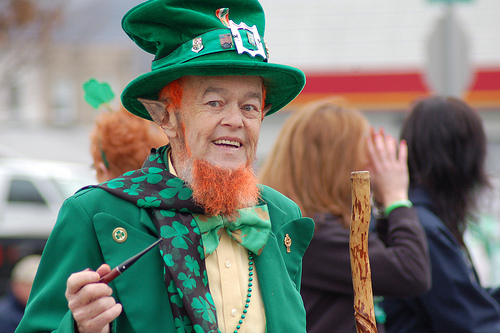
And he really did. Edward J. Slivak, who died this week at the age of 70, was small of stature, with a face that always looked like he was ready to ask a question. The turned-up nose, the laughing eyes, and the little scruffy beard completed the picture. It didn’t take much makeup to complete the transition. After he added a set of latex pointed ears, tinted his beard orange, and donned the green bowler hat (sometimes a crumpled top hat), that’s who and what he was.
The women of the division’s Ladies Ancient Order of Hibernians helped Slivak flesh out the other elements of his wardrobe―jacket, vest, bow tie, knee pants, athletic socks with green and orange stripes, and green Converse All-Stars. “He looked good,” says Hand.
(Slivak’s own recollection of events was a little different. In a 2010 interview shortly after he was named Grand Marshal of the Montgomery County St. Patrick’s Day Parade, Slivak said his outfit wasn’t quite all there yet: “I looked like an immigrant, just off the boat.” He also confessed to not being completely at home in the role at first: “I felt a little goofy. I thought, here I am a grown man dressing up as a leprechaun.”)
In time, Slivak reached his comfort level, and then some―maybe because there was a lot more to being a leprechaun, in his view, than just dressing the part. His leprechaun had a charitable heart.
“He always remembered being sick in a hospital when he was a kid, and he really liked to raise money for the Ronald McDonald House (at St. Christopher’s Hospital for Children),” says Hand.
Current Division President Mark Ryan says Slivak was tireless in his pursuit of the greater good. “He was the one who came up with the idea of collecting money for the children’s hospital. He did a lot of events, like our annual Irish Festival in Montclare and the Scottish-Irish festival at Green Lane. He always seemed to enjoy it very much, and he loved to take pictures with the kids. What he did was important. He really exemplified our values. Charity is one of the things the AOH is about.”
Slivak kept it up until 2009, when he became ill at the end of the Montgomery County St. Patrick’s Day in Conshohocken. Someone gave him a ride home, and that was the last thing he remembered until waking up in Montgomery Hospital. He had suffered a debilitating stroke. After he returned home to his wife Gi (short for Virginia) and a little pug dog named General Patton, he began several long, trying months of rehabilitation.
In spite of it all, he counted himself lucky to be alive. “I think the Lord was calling me for judgment day,” he recalled in his 2010 interview. “But St. Patrick, St. Brendan and St. Bridget all went to the Lord, and they gave me a little extra time on earth.”
Slivak, of course, is not an Irish name. Growing up in Fishtown, he took the name of his stepfather, whom he recalled as “a good man.” His mother Clare had roots in Cork and Donegal, however.
After working for 25 years as a tearsheet clerk at the Philadelphia Inquirer and Daily News, Slivak and his wife moved to Swedesburg in 2001. AOH Division 1, up the hill on Jefferson Street, beckoned, and the curious Slivak joined the same year―even though he only had a vague notion what the AOH was all about. “I remember, I didn’t know what the initials stood for,” Slivak said in his interview. “But in the past 10 years I’ve learned a lot more about being a Catholic and Irish.”
Once in, Slivak was completely in. His commitment to the AOH was noticed and appreciated: in 2007, he was the division’s Hibernian of the Year. “He made a lot of friends,” Hand recalls. “But he wasn’t hard to make friends with. He was just a good guy.”
Funeral arrangements for Slivak have been announced. Learn more here.
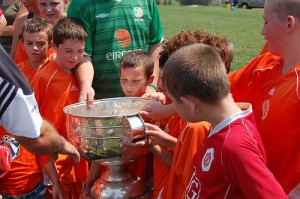
“The Sam” drew an enthusiastic young audience in a previous visit to Philadelphia.
Jim McGuinness, manager of the Donegal Senior Football Team that this year snagged the All-Ireland Senior Football Championships, played on Philadelphia’s Donegal team for five short weeks in the summer of 1996. He visited Philly again in 1999, and evidently liked what he saw.
When he arrives on Tuesday night for one more visit—this time to the Philadelphia Irish Center—he’ll have some splashy company. It’s called the Sam Maguire Cup, more familiarly known as “the Sam,” awarded to the winning senior football team.
“Jim McGuinness was here 13 years ago,” says Louie Bradley, chair of the Philly Gaelic Athletic Association team, the Delco Gaels. “He hasn’t been back in all that time, and he knows a lot of people here, which is why he wants to come back.”
The Philadelphia visit is one of several in the U.S.—a kind of victory lap that will take McGuinness and the cup to such Irish hotbeds as Chicago, Boston and New York City. The Irish Center event—billed as “An Evening with Jimmy McGuinness and the Sam Maguire Cup”—will also bring to town two Donegal all-stars, Mark McHugh and Michael Murphy.
As eager as McGuinness is to visit Philly, the Sam Maguire tour schedule is tight. Bradley says the local Gaelic Athletic Association, which had only a couple of weeks to pull things together, was hoping to get the Donegal delegation to come to town on a Saturday, but “we had to take what we could get. We are lucky to get them.”
Nevertheless, the local GAA is expecting a great turnout on Tuesday night, with 250 to 300 of tickets already sold, with time to sell more. “It should be a big crowd,” says Bradley.
Admission to the event is $50, which will buy you hors d’oeuvres, dancing to the music of Sullivan Bridge, and photos with the cup, coach, and his all-stars. Kids under 18 will be admitted for free. (Bradley is expecting as many as 100 of them.) Local organizations, such as the Philadelphia Donegal Association and Donegal Philly GAA, will present tributes. State Legislators (and brothers) Kevin and Brendan Boyle will present a citation from the Commonwealth. The Donegal athletes can also expect to receive the key to the city.
The event runs from 7 to 11 p.m.
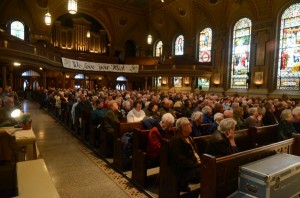
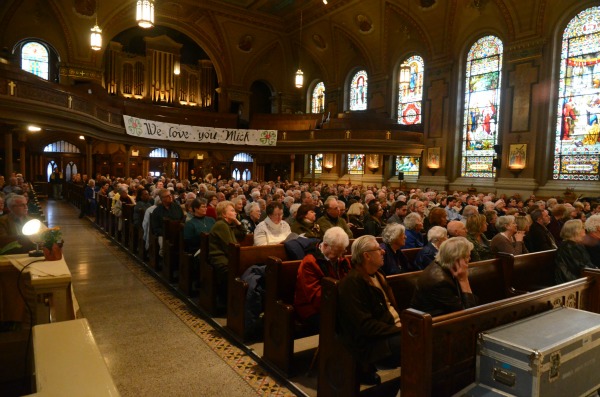
No question about it: the St. Malachy’s crowd loved Mick Moloney.
Maybe the big anniversary had something to do with it, but it was one of the largest crowds ever for this grand tradition, the 25th annual concert benefiting St. Malachy Mission School in North Philadelphia.
Moloney, who spent many years in Philadelphia and is close friends with former pastor Father John McNamee, returns every November with a stellar lineup of musical talent. This year, Moloney’s “friends” included fiddler Dana Lynn; uilleann piper Joey Abarta; singer, guitarist and harmonica player Saul Brody; singer and guitarist Robbie O’Connell; accordion player Billy McComiskey; and two outstanding local fiddlers, Caitlin Finlay and Paraic Keane.
As always, it was all in a good cause: to help support what has been called “a beacon of hope” in a neighborhood that knows more than its fair share of hardship.
We were there from beginning to end, and we captured some photos we think you’ll like. And the pièce de résistance: A video capturing a huge blast of tunes by—fittingly enough—Philly’s prolific Irish tunesmith, Ed Reavy.
wp-content/uploads/2012/11/lilt-300×200.jpg” alt=”Lilt: Keith Carr and Tina Eck” width=”300″ height=”200″ /> Lilt: Keith Carr and Tina Eck
Anyone who has ever traveled to Ireland knows that German tourists love the Emerald Isle as much as Americans do. (I can remember bumping into a tour bus full of Germans on holiday at the Poulnabrone Dolmen, an ancient tomb out in the middle of one of Ireland’s most remote places, the Burren.)
So from the perspective of Tina Eck, who hails from Travemünde, a seaside resort along the border with Denmark, it is not at all unusual that she plays Irish flute, and is part of a popular duo called Lilt. The traditional twosome, which also features Irish bouzouki and tenor banjo player Keith Carr, is scheduled to play Sunday, November 18, as part of the Coatesville Traditional Irish Music Series. (Note to readers: This concert has been canceled.)
Eck, who now lives in Cabin John, Maryland, works as a radio correspondent covering Washington. She moved to the United States to work for Voice of America in September 1992, around the time of Bill Clinton’s election to the presidency. She had traveled to Ireland several times over the years, so she was familiar with Celtic culture. The music, not so much.
Then, one night in the mid-1990s, Eck visited the well-known Connecticut Avenue watering hole Nanny O’Brien’s, where a traditional Irish music session was going full blast.
“Nanny O’Brien’s was a hangout for journalists. You’d sit and drink, and talk politics. It was the first time I had ever heard an Irish session. It was completely mesmerizing.”
Eck resolved to do whatever she needed to do to be a part of that session. She started to teach herself tin whistle, soaking up tunes at the feet of guitarist, session leader and Nanny O’Brien’s owner Brian Gaffney, and others.
“I hadn’t played a musical instrument since I was in 4th grade,” Eck recalls. “I learned a bit of recorder then. But with Irish music, it was unbelievable that you could just sit behind a piper, and pick it all up by ear. You didn’t need to read music. I still can read music a little, but Irish music is truly accessible. You learn the music from your friends. That’s part of the appeal … the whole social thing, you know?”
Eck never did have formal lessons, though she did pick up bits and pieces from other whistle players. At that point, she was content to just keep tootling along on her whistle. But it wasn’t all that long before some of the other players were suggesting that she just might like the Irish wooden flute.
“Everybody said I should, Eck says. “I didn’t want to as I was really happy with the whistle. Then, one night, one of the flute players brought an old Casey Burns flute to the session—it was in a long green woolen sock—and he said, ‘Hold onto it as long as you like, and learn this.'”
It wasn’t long before Eck found herself banging out tunes on the flute. She says she was highly influenced by one of the best Irish flute players on the planet. “I complete idolized Seamus Egan (of the band Solas). To be able to play like him would be so great. That really motivated me.”
As with whistle, Eck learned flute in dribs and drabs from other players. She recalls in particular an informal—really informal—lesson from the great Galway-born Mike Rafferty.
“I asked him, ‘How you play a roll?” and he said ‘You just wiggle your fingers.” End of lesson.
Eck followed up with frequent trips to Ireland to pick the brains of the best at the Willie Clancy, Frankie Kennedy and Sligo summer schools. All of that learning was having the desired effect. She was getting good, and becoming known.
Eck’s musical partnership with Keith Carr—which would lead to the formation of Lilt—began in 2009, and quite by accident. Eck had booked a funeral, lining up guitarist Zan McLeod to accompany her, but McLeod dropped out at the last minute. Eck knew Carr from the Nanny O’Brien session, so she asked him to accompany her, and she quickly discovered that she and this talented bouzouki player were a good musical fit for each other.
“I think it was in the fall of 2009 that we started playing together more,” Eck recalls. “And in 2010, we went into the studio to record a few things, just for fun. I remember, it was in the middle of a blizzard. We sat down for a few hours, and we played what we liked to play.”
Eck didn’t everything on the recording, but she says Capital-area Irish music aficionados had a different opinion. “I think we made 500 copies of that first demo. People loved it. They were just ripping the CDs from our fingers.”
At that point, it became clear that Eck and Carr should formalize their partnership. Then came the question of a name, but Eck had actually thought about that even before a band of any kind became a possibility.
“My husband actually came up with the name ‘Lilt,” says Eck. “He said, if you ever have a group, why don’t you call yourselves ‘Lilt’?” That name stuck with Keith and me, and we began to play together more regularly.”
As to the question of what to play, the answer was obvious: dance music. As she had progressed, Eck had been invited to play in ceili bands. She remembers it being a challenge: “I could barely keep up.” But soon she settled in, and discovered a whole new reason to enjoy playing Irish music, and in particular, a preferred style of play for the then-new duo Lilt.
“I love playing for dances. The dancers fill in all the blanks. I think a hornpipe can sound a little dorky all by itself, but as soon as you have shoes pounding out the rhythm, that’s when the music has lift and energy. So Lilt now is the quintessential dance band. We still do play for dances, but sometimes in performances, we also have step dancers and sean nos (old style) dancers. Not in every tune, not in every piece, but when the dancers get going, it’s not only a crowd pleaser. I get goose bumps.”
You can get your own goose bumps by snagging a ticket for the Coatesville concert.