All Posts By

Jeff Meade

News

Prayerfully Celebrating the Irish Center’s 50th

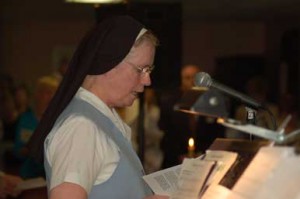
Sr. James Anne does a reading.

Sr. James Anne does a reading.

Father Joseph McLoone looked around the Philadelphia Irish Center’s Barry Room. Noting that the place was packed to the rafters for the Irish Center’s Lady of Knock Mass, he quipped: “Every pastor whose parish you belong to is probably mad at me today.”

The Knock Mass, commemorating the appearance of the Blessed Mother in a little town in County Mayo in August 1879, seemed an appropriate way to kick off an afternoon and evening of festivities in honor of the Irish Center’s 50th anniversary.

In his homily, Father McLoone touched on a theme near and dear to practically every heart in the room. Taking his cue from the Gospel reading—the story of the Canaanite woman, an outsider who persisted in her belief in Jesus even as he appeared to rebuff her—Father McLoone noted that, in American society, we mostly hail from immigrant stick and are, therefore, all outsiders.

“We are all foreigners in this country,” he said. “All of us, in one sense, are not native to this country. We should see no distinction in who comes early or who comes late.”

We took a few photos of the service.

News, People

A Virtual Community Rises to Meet a Real-Life Challenge: Breast Cancer

Courtney Malley, BethAnn Bailey, Rosaleen McGill and Anne McNiff—all residents of our cool little Irish community, BallyPhilly—are getting set to take a long walk with lots of their closest BallyPhilly friends and neighbors.

You can help make their journey a little easier. Come this October, they’ll set off on a three-day, 60-mile walk to raise money for breast cancer research. But before that, on September 7 at the Philadelphia Irish Center, they’ll host a benefit beef and beer with the great local band The Hooligans providing the night’s music.  

For more than one of the team members, this is personal.

For Courtney, the story starts with her mother, a nine-year survivor. More recently, friend and Full Frontal Folk band mate Jen Schonwald also was diagnosed with breast cancer.

“She was diagnosed at age 36,” Courtney says. “I thought to myself: I can watch her kids for her, I can bring her food. But in February, I said to her, ‘I m gonna walk this walk for you.’ She said screw it, ‘I’m gonna do it with you.’ We now have a team of 14.”

Three of the walkers—Anne, Courtney and Rosaleen—are members of the Philadelphia Ceili Group. But since they’re all members of BallyPhilly—an online community that embraces Irish folks from many walks of life, representing interests as diverse as Gaelic athletics, set dance, county associations, firefighting and law enforcement, Irish language and just plain freeform Irish pub crawling—the local breast cancer team thought that a benefit might also be a good way to bring this vibrant online village together for real, and in common cause.

“We’re really hoping to bring out, not only our own friends, but to get the word out to the greater Irish community,” says Anne. “It’s also a great opportunity to have a great afternoon with a great band.

“We were lucky enough to speak with (local musician) Fintan Malone about the bands he represents. One of those bands is The Hooligans. We asked whether they’d be willing to work with us, and they were very accommodating.”

The benefit should go a long way toward helping the team meet its goal of roughly $35,000. Each team member needs to pledge $2,200. Only a few of them have been able to do so thus far. As a group, they’re about half the way there.

You can help them get the rest of the way, and have a hell of a good time, too.

Once again, the details:

Sunday, September 7.
4 p.m. to 9 p.m.
Philadelphia Irish Center/Commodore Barry Club
6815 Emlen St
Philadelphia, PA 19119

Tickets: $25 in advance, $30 at the door.
For advance tickets: www.theirishcenter.com/ceili.php

Or call:
(215) 848-1657

The price of admission gets you food (including vegetarian options), soda, beer and an afternoon and evening of great music. (Might even be some special guests.) There’ll also be a basket of cheer, raffles and other personal fund-raising opportunities.

Arts

“Stones in His Pockets” Coming to Ambler’s Act II Playhouse

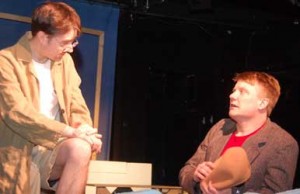
Tony Braithwaite and Chris Faith, during rehearsals at Act II.

Tony Braithwaite and Chris Faith, during rehearsals at Act II.

Marie Jones’ award-winning comedy, “Stones in His Pockets,” is classified as a two-hander. In theatre jargon, that means there are two main characters.

Maybe they call it that because to call it a 30-hander would seem physically impossible. And yet, here you have two veteran local actors, Chris Faith and Tony Braithwaite, intrepidly embodying 15 characters, with all of the action compressed into one tight, fast-moving little show.

(Editor’s note: There’s been a recent change in the cast. See below.)

“Stones in His Pockets” is about what happens when a Hollywood movie company descends upon a tiny town in County Kerry. The show, directed by William Roudebush, starts September 2 (press opening on the 5th) and runs through September 27 at the cozy Act II Playhouse in Ambler.

(And for those of you who just can’t wait to see this multiple award-winning comedy, stay tuned for news about a sneak preview that is also a benefit for the Hibernian Hunger Project.)

Braithwaite and Faith have worked together before, including their 2005 performance of “Good Evening,” by Peter Cook and Dudley Moore. That’s right—a two-hander. And, technically, yes, they’re two characters in “Stones”— Charlie Conlon and Jake Quinn, who hired on as extras for the film, a hyper-romantic view of the Emerald Isle. But the play also requires that they fill a whole lot of other shoes.

“Good Evening” posed a challenge, Braithwaite recalls. There were two characters on stage from beginning to end, and they assumed other characters. But, says Faith, “in this play there can be three or four characters on stage at the same time … or more, even.”

So as bad as it is to step on another actor’s lines in a play, Braithwaite and Faith have the potential to step on their own. Or worse, adds Braithwaite: “Showing up as the wrong character for a split second, and then realizing that you have to turn the hat around a little bit, or whatever that character’s little flair is.”

In rehearsals, Faith is wrestling wth similar issues: “I can hear when a voice from another character creeps into the voice I’m doing, and I pull back. For now, it’s fine-tuning all that stuff.”

Juggling the multiple personalities also poses a challenge for the director.

“Oftentimes when characters play multiple roles they go off and they come back on as another character, which makes immense sense,” says William Roudebush. “But sometimes the changes are instantaneous, right in front of your eyes. Part of what I’m trying to do as a director is to make that change very magical, to take advantage of the moment.”

Another challenge: Playing Irish, which Braithwaite has done before. He played the character Paddy O’Gratin in “The Big Bang,” described as a “madcap tour of history.”

“He sang to his potato, the last potato in Ireland,” he recalls. “It was a love song. That was the last and the only time I ever had to do Irish.”

For Faith, putting on an accent—something that sounds something other than “stage Irish”—is a new experience. “It’s challenging,” he says, “but I think there are three major sounds we’ve got to hit all the time. I think that, if we’re in the ballpark, we’ll be OK.”

Though “Stones” is a comedy, Roudebush says it’s his goal to treat all 15 of those characters, especially the Irish, with respect. “The soul of the play is Irish,” he says. “It’s a great honor and challenge to have to try and live up to that—and not make it a cliché, that’s for sure.”

All three describe themselves as journeymen—or, as Roudebush quips, “I like to say that my job is finding work.”

Roudebush has been “finding work” for over 30 years. His 2002 revival of “Equus” was nominated for eight Barrymore awards and won five, including Best Overall Production of a play, Best Ensemble and Best Director. He has taught at The American Academy of Dramatic Arts in New York, The University of Memphis, The University of the Arts, Virginia Commonwealth University, along with being Theatre School Director for the Walnut Street Theatre for four years. He is currently director of musical theatre for the Performing Arts Institute in Kingston, Pa.

Both the actors are well-known in Philadelphia theatre. Like most actors, they do—or have done—other things. But what they do all the time—because to do otherwise would be unthinkable—is act, and when they’re not doing that, looking for opportunities to act some more.

Braithwaite, a Barrymore award winner (for the role of Boyd in “The Big Bang”) used to teach theology, theatre—and sex education to freshmen—at St. Joe’s Prep: “I used to say—I teach theatre, theology and sex ed, so we do ‘Agnes of God’ every year.” (Cue the rim shot.) He still directs shows at St. Joe’s.

Faith has appeared Off-Broadway in “The Secret Garden” and “Like It Is” at the York Theatre. He is a three-time Barrymore Award nominee. He and his wife have a children’s performing arts studio in Plumsteadville.

Now, as to that sneak preview:

The final dress rehearsal of “Stones in His Pockets” will be open to the public on Sunday, August 31, at 2 p.m. The suggested donation is $10, and all contributions will be donated to the Hibernian Hunger Project, a community service program that feeds needy people in the Philadelphia/Camden area. (Hey, how can you call yourself a Hibernian and not go?)

Three preview performances will be held September 2-4, with tickets discounted at $20. Talkbacks will be held after the first two 8 p.m. previews, as well as on Thursday, September 11, at 8 p.m. and Sunday, September 21, at 2 p.m.

Opening night is September 5, followed by a reception. All evening performances are at 8 p.m., and matinees begin at 2 p.m. on Wednesdays and Sundays.

Tickets are $25 for all Wednesday-Thursday performances and $30 for Friday through Sunday shows, with discounts available for groups of 10 or more. Tickets are available by calling the Act II Box Office at (215) 654-0200 or online at www.act2.org.

Act II is at 56 East Butler Avenue, just a block from another venerable borough institution, The Shanachie Pub. Shanachie is also a show supporter. Look for an opening night appearance by the pub’s co-owner, singer Gerry Timlin.

P.S.: We’re supporters, too, even though it’s mostly moral support.

Editor’s note: Broadway and Irish actor Declan Mooney is stepping into the role of Charlie Conlon. Mooney, who joins Tony Braithwaite in rehearsal, replaces Chris Faith, who was forced to leave the show due to a family emergency.

Mooney will easily fill the shoes of Faith. He has performed the role of Charlie two other times, including as stand-in for Tony-nominated Conleth Hill in the Broadway production of the play. Dialect training will not be necessary for Mooney: He hails from Downpatrick in County Down, Ireland, and came to the States to attend college on a soccer scholarship.

Music

Review: “For Love and Laughter”

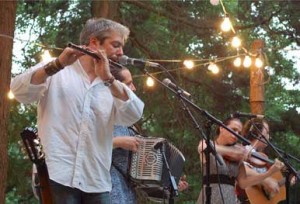
Solas, in a Chestnut Hill concert in Pastorius Park.

Solas, in a Chestnut Hill concert in Pastorius Park.

Previews of the new Solas CD, “For Love and Laughter,” have been up on the band’s Web site for many weeks. The clips are short, but tantalizing. There’s just enough there to make it clear that Solas—with the band’s new singer Máiréad Phelan—is evolving.

The clips are just a half a minute long—the merest tease. So you were left to wonder just how much Solas might change following the departure of singer Deirdre Scanlan.

Whatever were you fretting about? 
Solas is still Solas—the band’s trademark sound fully intact—and all’s right with the world. With the new singer and some intriguing collaborations, including cellist Natalie Haas, world music artists The Duhks and the Appalachian multi-instrumentalist Dirk Powell—they might even be better. And of course, no Solas performance would be complete without longtime bassist Chico Huff.

The opening set—“Eoin Bear’s Reel,” “Tune for Sharon” and “The Rossa Reel”—could settle comfortably into any Solas CD to date. With leader and all-Ireland multi-instrumentalist Seamus Egan setting the pace, the rest of this gifted band—the fiddler Winifred Horan, button accordionist Mick McAuley and guitarist Éamon McElholm—merrily bend tradition to their will. The first sound you hear is a sly little smile of a note from Horan’s fiddle. The two tunes that follow are tightly controlled—but just barely—with Horan’s fiddle and McCauley’s accordion playfully crossing paths, occasionally overlapping, then spinning off in opposite directions. This is Irish music as Jezzball. Egan and McElholm close out the set with a strong, percussive “Rossa Reel.”

(In fact, the whole album is percussive. Perhaps because it was recorded and mixed by Solas associate and drummer John Anthony, who plays on several tracks, “For Love and Laughter” seems like the most percussive Solas recording since 1997’s “Sunny Spells and Scattered Showers.”)

A later set—the improbably named “Vital Mental Medicine” paired with “The Pullet”—cinches the deal. The first is a scary Rubik’s Cube of rhythms and counter-rhythms, Egan leading the way on banjo. The whole “Mental Medicine” gives way to a furious interpretation of “The Pullet.” If you’ve ever seen Horan play, you know that she does cruel things to bowstrings. It’s a pretty good bet she shredded a few on this number.

That’s the Solas we know. But what about the new singer?

Máiréad Phelan gets a chance to earn her pay early on. She is front and center on the second track, “Seven Curses,” and she more than holds her own.

It’s clear from the start that Phelan does represent something of a departure. Her voice is softer and breathier than Scanlan’s. And she’s not a belter like the diminutive Karan Casey, Solas’s first vocalist. Think Heidi Talbot or Pauline Scanlon. That’s closer to the mark.

Phelan’s voice stands out on its own, but she is often supported by harmonies from McAuley and McElholm.

The material is generally very well matched to her talents, perhaps especially the haunting traditional long song, “Molly na gCuach Ni Chuillean.” It sounds like a tune she was born to sing. Once again, McAuley and McElholm join in on harmonies. Natalie Haas also makes her first of three appearances. (A later pairing with Horan on the instrumental “My Dream of You” is dreamlike and nothing short of inspired.)

Probably the best overall vocal performance features Phelan with accompaniment by The Duhks on the bluegrass-flavored “Merry Go Round,” written by frequent Solas contributor Antje Duvekot. If there is one number destined to become the perennial crowd-pleaser, this one probably is it.

McAuley’s vocal talents also are showcased on the tune’s title track, with superb harmonies from McElholm and Phelan. During the brief period in which the band was without a lead singer, McAuley and McElholm (who also plays piano and Hammond organ on some tracks) stepped into the breach. It’d be nice to hear more from them.

At the heart of it all, of course, is Seamus Egan, who plays no fewer than nine instruments on this album—crushingly depressing to those of us who play only one, and not as well. Certainly not to discount the contributions of others—notably, the wonderful Winifred Horan—Egan pretty clearly remains the soul of Solas.  So long as that is the case, the band can weather personnel changes, as it has many times in its 13 years.

You can see and hear the proof for yourself September 21 at 7:30 at World Café Live.

You’ll also be able to hear the whole album—and not just our few clips—when “Love and Laughter” goes on sale August 26.

News, People

A Philadelphia AOH Leader Moves into the National Organization’s Top Spot

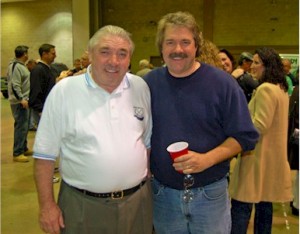
Seamus Boyle with local AOHer Will Hill at the Ancient Order of Hibernians' Project St. Nicholas in the Northeast in December.

Seamus Boyle with local AOHer Will Hill at the Ancient Order of Hibernians' Project St. Nicholas in the Northeast in December.

Seamus Boyle has always been a prominent player in the Ancient Order of Hibernians locally, and active in Irish and Irish-American issues.

Over the years, he has continued to make his mark as a leader within the national AOH.

Now, following the AOH’s election in New Orleans in July, Boyle is the organization’s newest president. He’s not the first Philly guy to hold the top post, but he is the first Quaker City-based national AOH president since Michael Donohue, who held the office from 1923 to 1927. (Before that, according to Gerry Ennis, secretary of the state board, Joseph McLaughlin held the post from 1912 through 1919. And before that, Maurice Wilhere was president from 1886 to 1893.

It’s been a long, long time, then, since a Philadelphian claimed the top spot.

We asked the new president to tell us about his plans—and a bit about himself.  Turns out there’s more than a bit to say. Seamus Boyle has led an amazingly active life.

Here’s what he had to say:

Q. The AOH has been identified with a lot of issues over the years—protecting Catholic churches from the Nativists and supporting the Molly Maguires in the early going, all the way to more recent concerns about Northern Ireland and immigration. During your tenure as president, is the AOH likely to try to have an impact in any particular areas of politics of public policy? On what issue or issues would you like to make your mark?

A. I think the issue of immigration and the undocumented is probably one of the most important issues facing us as Irish-Americans today. It seems that those who are not eligible to receive a green card because they overstayed a visa or some other minor infraction are treated the same as a terrorist who wants to destroy the United States.

The Irish immigrant is for the most part young, works hard, pays taxes, stays out of trouble and wants to stay here and raise a family. The only difference between them and the millions of immigrants who came before them is the bureaucracy and the lack of common sense that will not let them stay.

Many of our ex-political prisoners like Pol Brennan are treated like a criminal or worse. Malachy McAllister, Matt Morrison, and many more have been harassed and badgered by every agency in our government; it is time it stopped and we are the only ones that can do it.

We need to stand up for our people, we need to band together no matter what organization we belong to and pressure our politicians to do the right and just thing. Politicians hear us when we have a loud voice because they know what we can do if we were organized. We only have a few months left to make the politicians listen to us and, make no mistake about it, when they know the voting power we have they will listen or suffer the consequences. After November we have no leverage; once they are elected all we will get is lip service. We need to do it now. Remember, if they don’t help us, then we don’t help them. It’s a very simple formula.  

Q. Is Northern Ireland a non-issue for the AOH, now that we have had our kumbaya moment with Martin McGuinness and Ian Paisley? What has to happen next on that issue, from the AOH perspective?

A. Northern Ireland is at peace now, or so we are told, but they cannot be at a true and lasting peace until they are One United Nation. I have heard on so many occasions that the war is well and truly over and our help is no longer needed. Ask the people of Belfast or Derry, Tyrone or Armagh whether we are needed or not, and I know you will get a different answer. Our ex-prisoners who need to be trained for jobs, the many organizations that help the prisoners and their families, the families who were affected by the collusion of the British security forces and the Loyalist death squads need our help.

The reason we need to be involved in bringing a closure to all the open cases is because the world listens to America. We need to pressure the British government through our politicians to bring our Island together as one and we can accomplish that end if we organize, put our petty differences aside, unite and pressure our politicians here in America. If we do this, we can accomplish anything.

Q. You’ve been closely identified with immigration reform. What’s your approach to the issue? What would you regard as the best income for Irish immigrants?

A. Years ago it was much easier for people to immigrate but because of many reasons including 9/11 and the situation in Iraq and Afghanistan it has made it almost impossible to get permanent status here. Family does not count any more, and corporations no longer want to put advertisements in newspapers for workers as they once did to attract our Irish qualified workforce because they were getting sued for discrimination. All our visa programs have dried up, and our green card quota has been drastically reduced.

Q. Some have said that one possible result of immigration restrictions is that Irish communities like those in Delaware County might become much smaller or dry up altogether. Why is that an issue?

A. I think we need to find a fair quota for our people and work with other groups to find this solution. If we have few or no immigration policy it affects all the communities as it hinders our heritage and eventually our children will know nothing about our history, which is so precious to us. Our language and sports here have already suffered and we cannot afford to let it decline any further.

Q. Do you feel like the Irish need to work with other immigrant groups to achieve reform? I mean, fundamentally, this is not an Irish issue so much as an immigrant issue, is it? Can we really achieve any progress on Irish immigration without finding common cause with, say, Latin American or Asian groups?

A. I think that the Irish have more to offer than some of the other groups and I do not mean to degrade any nationality. The Irish have a head start on other groups because the have a tremendous work ethic, great education and speak English, and that is an advantage for employers. We as Irish are not looking for anything except to be treated fairly.

Q. I understand you are a native of Armagh. When did you move to Philly? Tell us about yourself and your family.

A. I was born in the townland of Faughiletra, Jonesboro, County Armagh on July 5, 1942, to Terence and Katie (McArdle) Boyle. My father came to Philadelphia in 1953, where my aunt Mary lived and he stayed with her until we arrived in May of 1954. My father was a carpenter who was offered a job in Philadelphia with Matthew McCloskey, one of the biggest contractors in the Northeast and later became ambassador to Ireland.

My father bought a new house, which was being built at the time in Mayfair, St Matthews’s parish. I finished 8th grade in St Matthew’s and went to Father Judge, graduating in 1961. I had an older sister, Noulagh, who passed away in October of 2004, another sister Carmel, brother Michael who passed away in September of 2005 and a brother Thomas. I was the second oldest of 5.

I married Bernadette (maiden name also Boyle) in Ireland in August 1970, and have three children, Michael, Tara and Bronagh, and six grandchildren: Kieran, Colin, Megan, Sheila, Brady and Finnegan.

I became an apprentice carpenter in Carpenters Local 122, graduating in 1966. I went to work traveling for (BACM) British American Construction Company, returning to Ireland meeting Berna and building a house in South Armagh in Killeavy.

I returned to Philadelphia in 1971 and became very involves in Irish Northern Aid and the AOH. I became involved in the Carpenters Union as an officer and worked up to get elected as business agent for the Philadelphia Council of Carpenters and got elected every election until I retired in 1997.

I had always been involved in the AOH Division 39 from 1972 and became an officer shortly after joining and have been an officer ever since on a division, county, state or national level. I wanted to do more for my community and for the people of the North of Ireland, where I was born, and the AOH was very involved in both of these issues.

News

Session Surprise: A Visit from Angelina Carberry and Martin Quinn

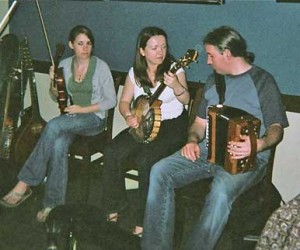
Angelina Carberry and Martin Quinn settle in next to local fiddler Caitlin Finley.

Angelina Carberry and Martin Quinn settle in next to local fiddler Caitlin Finley.

Banjo whiz Angelina Carberry and her husband, the great box player Martin Quinn, were in town over the weekend for a concert at the Coatesville Traditional Irish Music Series. I missed it, and I was feeling bad about that.

Of course, one way to make yourself feel better when you know you’ve missed out on some choice traditional Irish music is to find yourself a good traditional Irish music session. So I headed off to Shanachie Pub in Ambler on Tuesday night, bodhran in hand, planning to console myself with a couple of pints of Smithwick’s and the odd reel or jIg. (If you’ve ever heard me play bodhran, you know what I mean by odd.)

The place was already jammed with musicians when I got there, including—estimating conservatively—327.5 bodhran players. My partner Denise showed up, with her husband and son in tow. With so many drummers, I sat things out for a while with Denise, Ed and Pat.

Then I looked up to see Dennis Gormley and Kathy DeAngelo, who ride herd over the Three Beans session in Haddonfield, walk in the door. And right behind them … Carberry and Quinn. Kathy manages the two.

I headed back to my seat and waited for an opportunity to jump in on a tune or two. I got the opportunity at last … a blistering set of reels. My right hand fell off at the end. And it was good.

Carberry and Quinn, based in County Longford, play with laser-like precision, and yet they somehow—magic, I’m thinking—sound spontaneous and fresh.

The unexpected appearance caused no end of upset for Denise and me. We’re rarely sans camera. Shanachie co-owner Ed Egan went off in search of a disposable camera (thanks, Ed!), and Denise squeezed off a few shots. Not the quality we’re used to, but workable. Oh, thank heaven for 7-11.

Thanks, too, to Ed for risking life and limb by standing on a chair to capture an aerial view of the proceedings.

Aside from an accidental encounter—and what are the odds of that?—your last chance to see Carberry and Quinn in this neck of the woods is Saturday, August 2, at the Hunting Shanty in Tuckerton Seaport, 120 West Main Street. The show starts at 7:30 p.m. Tickets are $15.

Music

Review: The Big Spree (Compass)

“The Big Spree” is a big darn deal from a hot little Scottish band.

I’ll admit to being hooked from the first track, featuring Breabach’s two pipers Donal Brown and Calum MacCrimmon on a perky little traditional tune, “John MacColl’s March to Kilbowie Cottage,” which gives way to a more contemporary piping number, “Davy Webster’s.” Accompanied by Patsy Reid on fiddle and Ewan Robertson on guitar, Brown and MacCrimmon set just the right tone for a CD that artfully blends the ancient traditions with a more updated approach to Celtic music.

Like most contemporary Irish and Scottish traditional bands, Breabach boasts an abundance of talent. Brown and MacCrimmon also play flutes and whistles; Reid plays cello and viola, and sings; and Robertson is also the band’s lead vocalist. The band invites comparisons to ensembles like Lunasa, Danú, Flook, Old Blind Dogs and Solas. “Super group” is an overused description. But don’t let that stop me. Breabach is super.

Breabach’s debut album features 11 tracks, all firmly grounded in the music of Scotland, whether it’s an up tempo version of a classic piping tune like “Merrily Danced the Quaker’s Wife,” or “Caber Feidh,” a lush version of “Hector the Hero” or Ewan Robertson’s spirited interpretation of Scottish folk singer Matt McGinn’s “Rolling Hills of the Borders.” (With tight, bluegrass-like harmonies from Reid and MacCrimmon on the last.)

I also fell in love with Reid’s sweet vocals on “Lochaber No More,” a classic farewell song with lyrics by the poet Allan Ramsay, written in 1724.

Hope for a tour. And while you’re waiting, “pick up The Big Spree.”

Sports

Kicking Off Three Days of Championship Youth Football and Hurling

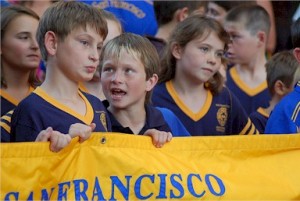
The team from San Francisco making their way up Gay Street.

The team from San Francisco making their way up Gay Street.

Tracy Guerriero was wandering down Gay Street in West Chester, her maple-leaf flag of Canada draped over her shoulder—and looking a bit at half-mast herself.

Guerriero, accompanying the Brampton, Ontario, Rebels, had only just arrived in West Chester that afternoon after a long bus ride. They had just marched in the parade to kick off the Gaelic Athletic Association’s Continental Youth Championships. All the kids had taken off in search of pizza or burgers or whatever they could find to eat.

Leaving Guerriero holding the flag, and with a severe case of bus lag.

“We left this morning at 4:30,” she said. “Ten hours on the bus with the kids—and one bathroom. We’re all a bit punchy.”

Looking only slightly less bedraggled were N. Martin and Miriam Skelly of the Gaeil Colmcille na nOg Club from Kells, County Meath. They’d just flown in from Dublin to Philadelphia the night before. Like all the other teams post-parade, they were checking all of the Gay Street restaurants—opening doors, looking, and seeing huge crowd. Places like Vincent’s, Peace a Pizza and Kildare’s were doing land-office business. The Skellys were hoping for a quick bite before heading back to the hotel. Other than the parade, they hadn’t yet had much time to sample Philadelphia hospitality. “We went to the films this afternoon,” said Martin Skelly, still looking a bit done in.

As night fell—and it was falling pretty quickly even as the parade wound down and the last team made its way up Gay Street escorted by local pipe bands—the town was crawling with kids and families from Ireland, England, and from as far away as San Francisco in the U.S. Ask them what they want to see and do, and the answers are predictable. Like the kid from Chicago standing in line at the Sprazzo gelato joint, who hoped to see the Liberty Bell.

For the group from Brampton, one stop seems essential: “We want to run up the Rocky steps,” said Guerriero. “And we have to have a cheesesteak.”

Of course, the main attraction for the 1,700-plus athletes is the Continental Youth Championships, held today, Saturday and Sunday at Greater Chester Valley Soccer Associations’ Line Road Complex in Willistown, Chester County. For details, visit the CYC Web site.

If you want to see the future of Gaelic athletics in the United States, this is where to see it. The CYC happens but once a year, and this is the first time it has been held in Philly. Check out the games and support the cause of Irish athletics on your home turf.