All Posts By

Jeff Meade

News, People

Remembering Sean Cullen

Sean Cullen was a union steamfitter by trade, but to his many friends in the Far Northeast, he was a man of many talents and wide-ranging interests.

Cullen, a member of the Ancient Order of Hibernians Division 88, died May 22 in an accident on his beloved Harley motorcycle on Knights Road, in front of Frankford Torresdale Hospital. He was 36. He leaves behind a wife, Alicia—he met her at Archbishop Ryan—and a 7-year-old son, Ryan.

According to 88’s Paddy O’Brien, who knew Sean for close to eight years, his death leaves a big hole in the community.

“I knew Sean as a member of Division 88,” he says. “A lot of the other guys knew him longer; they knew him from the neighborhood. Sean ended up being our go-to guy. If somebody needed something they’d say, ‘Call Sean.’ He was our handy man. He’d load up that little red truck of his with tools, he’d come to your house. We built people’s rec rooms…we did all kinds of stuff. Sean was the leader of all that.”

Sean Cullen was a guy who could have done many things with hs life, O’Brien added. For example, he could just as easily have been a Philadelphia police officer. His parents, Bert and Mary Cullen, were retired police officers, and his brother Jimmy is a narcotics officer. Sean took the department test, but, as O’Brien recalls, the steamfitters union called first.

Friends recall Cullen as a man who wouldn’t say no. No one was surprised when he became athletic director for Calvary A.A., and recently its lacrosse coach,even though there wasn’t much in the way of participatory sports in his background.

“We used to say that he was the most unathletic athletic director in the history of sports,” O’Brien laughs. “He never played anything himself. He ended up as one of those people who learned the games and learned to coach. He’d ever picked up a lacrosse ball in his life. He’d just find out what it took. he spent his own money to go to classes to learn about lacrosse, just to teach the kids.”

Sean Cullen clearly left his mark on the community. Over 1,000 mourners came to his funeral at Our Lady of Calvary Church.

Friends and family are honoring Sean’s memory by establishing a trust fund to assist in Ryan Cullen’s education.

On Saturday August 29, Quaker City Yacht Club, 7101 N. Delaware Avenue, Philadelphia, Pa 19135 will host a fund-raising event from 12-5 p.m. The cost of the event is $30 and includes domestic draft, wine, soda and food. Entertainment will be provided by popular local band The Cram and DJ Tommy Kuhn.

Three Monkeys co-owner Gavin Wolfe has partnered with the generosity of Muller Beverage and the Philadelphia Credit Union to sponsor the event. All proceeds will go directly to the family.

The second event, on Sunday October 4 from 12-4 p.m. will be hosted by Joe Santucci at his Woodhaven Road location. There will be an outdoor tent available in case of inclement weather. The $25 event donation includes domestic draft, wine, soda and food samplings of Joe’s original Best of Philly menu items. Again, all proceeds will directly benefit the family. There will also be live entertainment and a DJ.
Sports

A Saturday Full of Gaelic Athletics

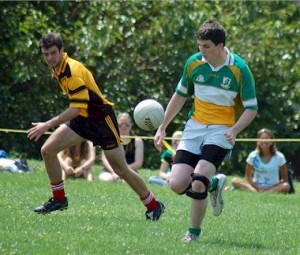
Action from Saturday's games.

Action from Saturday's games.

Cardinal Dougherty High School field was filled with non-stop action Saturday, including the battle for the McCartan Cup in junior football. 

Teams from throughout the Eastern Seaboard duked it out under clear skies and hot, hot sun.

The D.C. Gaels beat Philly’s Eire Og in the final to win the McCartan Cup. Washington won hurling against the Allentown Hibernians. The ladies from D.C. beat Philadelphia’s Notre Dames in football.

We have shots from the day’s games.

News

A Torrent of Talent Comes to the Aid of the Sunday Irish Radio Shows

Gerry Timlin, your emcee.

Gerry Timlin, your emcee.

And, lo, the clouds masseth in the sky and unleasheth a whole heap o’ water. Yea, verily, the water did riseth up to filleth up Bethlehem Piketh and lots of other roadth. Lightning and thunder was there, and hailstones and winds, even. And the Lord looked down from on high and said, to no one in particular, “Holy cow … did I do that?!”

You betcha. No one would have been surprised if frogs and locusts had suddenly showed up. It was that bad.

Did any of the flooding stop dedicated Irish music fans as they made their way to Shanachie Pub on Sunday for a benefit to support local Irish radio shows? Well, maybe it stopped some, but lots of other people just strapped on their water wings and floated on into Ambler for an afternoon jam-packed with local musical talent.

Gerry Timlin, your genial emcee and co-owner of the Shanachie, presided over the entertainment, which included the Bogside Rogues, the King Brothers, McDermott’s Handy, members of the Morrigan, the Jameson Sisters (Maura and Lessa, also known as Ellen Tepper and Terry Kane), and more.

And, yea, the fans hung around for the fun and saw that it was good.

We’ve captured lots of the aforementioned fun.

Sports

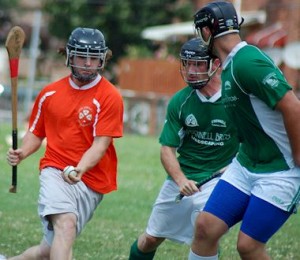
Hibernian Hurlers Win Trophy Match

Orange facing a wall of green.

Orange facing a wall of green.

The Allentown Hibernians are headed to the North American County GAA Finals in Boston, following their hurling victory Sunday over the Philadelphia Shamrocks.

With their 3-8 to 1-3 win, the Hibernians also claimed the Hurling League Cup and the Philadelphia Junior C Championship trophy.

Not too shabby for a team that was brand new to hurling last year.

The Hibernians put on the pressure and kept it on from beginning to end, entering the half with a 1-6 to 0 lead. The Shamrocks came out for the second half clearly determined to get back into the game. They battled valiantly, but the Hibos offense was too much for them.

Pat O’Donnell, the Hibernians’ team captain said this year’s team was very different from the first-year squad, which often struggled to get consistent attendance at practice. That’s changed in 2009. “For a second-year team, everybody’s stoked to play all the time,” he said.

Over the Labor Day weekend, Allentown will give Beantown their best. “We’re going to go up to Boston,” O’Donnell said, “and hopefully have a good run up there.” 

We’ve got game-day photos.

View photo essay: http://www.flickr.com/photos/irishphiladelphia/sets/72157621733679279/

View as slideshow:

http://www.flickr.com/photos/irishphiladelphia/sets/72157621733679279/show

Music

Five Questions for Harpist Ellen Tepper

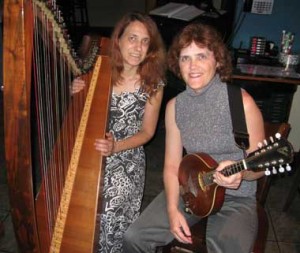
The "Jameson Sisters:" Ellen Tepper on Harp, and singer Terry Kane.

The "Jameson Sisters:" Ellen Tepper on Harp, and singer Terry Kane.

Two inseparable passions drive Ellen Tepper—history and harp.

Her interest in the former begins with what she calls her “unusual childhood.” Her father was director of the American International School in Vienna. “We not only read history,” she says. “We saw where it happened. I’ve always been interested in history and finding the true origins of things.”

She recalls visiting ruins and historical sites all over Europe, including, memorably, the castle of Durnstein along the banks of the Danube, where Duke Leopold V of Austria imprisoned Richard the Lionheart in the 12th century.

It was a fertile environment for an imaginative child.

”We had no TV, only books, live music and a few English language records, one of which was the Clancy Brothers and Tommy Makem,” she recalls. “I was a dreamy sort of kid, and we were encouraged to find things out for ourselves… we played Crusaders and Turks instead of Cowboys and Native Americans.”

Her interest in harp comes at about the same time. At eight years old, Tepper started learning classical harp. Though she couldn’t have known it at the time, her curiosity would, marking the beginning of a musical journey that would eventually intersect with her interest in history. She would go on to learn to play Celtic and medieval harps, the Irish wire strung harp, the Italian triple harp, and the Renaissance bray harp. She would also become an historian of the early harp.

We caught up with Ellen and posed five questions for her.

Q. Classical pedal harp and medieval or Celtic style harps seem to spring from different traditions. As someone who is trained in the pedal harp, is it difficult to make the transition to the Celtic harp? What adjustments, if any, do you need to make?
 
A. The most immediate response would be that you have to get off the printed page. The technique of playing is similar and you have to adjust to the difference in spacing and string tension. I got my first small harp when I was 16 and had begun to play early music then. There was nowhere to study this back then, and I probably played early music with modern harmonic sensibilities. Another difference is the lack of accompaniment for Irish harp music and learning how to make it work in the absence of printed sources. Then there is the ornamentation so important in Irish music, some of which I was able to translate from Baroque music. Playing and learning by ear was another issue. I’ve been blessed with a bardic sort of memory, and this seemed to follow easily, in spite of having been “paper trained”.
 
Q. How did you learn to play all the different types of traditional harps that you play?
 
A. In 1989 I attended the Historical Harp Workshop and conference at the Amherst Early Music Festival. There I found 30 other people just like me! I had bought a wire strung harp in 1979 and studied with Ann Heyman that week, learning wire technique with nails and a lot about Irish harp history. It was the beginning of my life as a self-taught musicologist. I read everything I could find about Irish harp, including Edward Bunting’s 99-page preface to his collection “The Ancient Music of Ireland,” which includes the music he collected from all the surviving harp players from 1792 to 1839.  Every summer I went back for further study on wire, and then triple strung harp, or Arpa Doppia which opened up another few hundred years of music for me. I practice like a fiend whenever I get a new technique, and also find that by teaching it, I learn it even more thoroughly. I try to find the earliest printed source for music. I am a history nerd.
 
Q. You are well-versed in the history of the early harp. How did you come by your knowledge? What do people find most interesting or surprising about the tradition?

A. I read. I study, and talk to others doing work in the same field. The tradition itself is a broken one. In antiquity (1000 or so) the harp was an integral part of the clan society’s structure. As the society was destroyed, the harp player’s role merged with those of the clan poet and reciter, which is the beginning of the Itinerant harper tradition. It was made illegal to harbor a harpist beyond the pale, and in 1580 an edict was issued to “hang the harpers wherever found and destroy their instruments”… though the penal laws were relaxed in the 17th century the damage was done to the tradition and we’ll never know what they really played. In modern times, since the 1950s, attempts are being made to restore the traditional approach to the harp.
 
Q. You’ve been performing with singer Terry Kane as the Jameson Sisters. How did you and Terry Kane hook up?

A. I had heard her name before in various e mail lists about Irish music. We met one night at the Session at the Mermaid Inn, and I accompanied her singing. Afterward, we talked and had a few drinks; Jameson’s was our drink of choice. We swapped CDs and talked about getting together. Almost a year later, Terry saw one of my educational five-minute videos on Mind-TV and called me. We started rehearsals in January of this year.

Q. I think I can guess, but why the Jameson Sisters? Where does that name come from?

A. I was given a “nom de pluck” by my friend Dregs Malarkey (not his real name) one night. He told me I needed an Irish name, and I picked “Maura.” He asked Maura what? And I looked at the bottle of Jameson’s on the table. I told Terry about it and she said she would like to be known as “Lessa.” And so Maura and Lessa Jameson became the Jameson Sisters.   

You can hear the Jameson Sisters twice this week: First, at Fonthill Museum in Doylestown at 7 o’clock Tuesday night; and on Thursday night starting at 7 p.m. at the Mount Airy Train Station, 7423 Devon Street. Rain date is Friday night.

Columns, How to Be Irish in Philly

How to Be Irish in Philly This Week

I remember a few years ago when a reporter asked Denise and me, “So what are you going to write about when you’re all done writing about beer and shamrocks?”

I suppose he thought it was a good joke. Whatever could be happening in that sleepy little Irish Philadelphia community?

Ha ha ha, Mister Jokey Reporter Man. The joke’s on you this week, pal.

It isn’t just that there’s a lot to write about this week; it’s also the variety.

Let’s start wth two Saturday benefits.

First, starting at 3 p.m. and lasting ’til 9, the venerable MacSwiney Club in Jenkintown will host a building fund picnic and raffle. Here’s a great way to help sustain one of the Irish community’s most beloved institutions.

Next, from 7 to 10 at Bain’s Deli/Fuelhouse Coffee in Vineland, N.J., lovers of traditional Irish music will plunk down cash to support 6-year-old fiddler Haley Richardson’s trip to the world Irish music championships, the Fleadh Cheoil na hÉireann in Tullamore, County Offaly. Haley snagged first place in under-12 fiddles at the Mid-Atlantic Fleadh at Pearl River, N.Y., in the spring, qualifying her to compete at the world level. (See our story.) Haley and her brothers are slated to perform. If you’re an Irish musician, you’re invited to bring along your instrument and participate in a big session. You can count on Haley to keep up.

Switching gears, those rabid Gaelic Athletic fans will gather at Cardinal Dougherty High School field in the Olney section of Philadelphia on Sunday for game two of the Joe Lyons Championship Cup hurling match. If you’ve never seen hurling, you’ve missed one of the most exciting and crazy fun sports on the planet. Turn out to watch the local Shamrocks battle the Allentown Hibernians, starting at 1 p.m.

Later in the week, the Jameson Sisters—also known as singer Terry Kane and harper Ellen Tepper—will team up for two Delaware Valley performances: first, Tuesday night from 7 to 8:30 at Doylestown’s cool Fonthill Museum, and on Thursday from 7 to 9 p.m. at the Mount Airy train station. (Read our interview with Ellen Tepper.)

Going out a bit beyond a week, get ready for some kick-butt Paddy rock as the Young Dubliners and Na’ Bodach perform at Sellersville Theatre Saturday, August 1, from 8 to 10 p.m.

All that, and we haven’t even mentioned shamrocks and beer. You’re bound to run into them somewhere this week.

News

A Warm Philly Reception for the Irish Navy

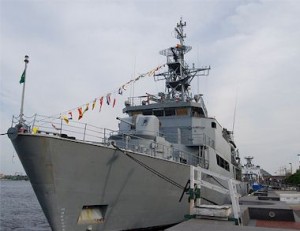
The Eithne, at Penn's Landing.

The Eithne, at Penn's Landing.

In Ireland, the traditional greeting is céad míle fáilte: A hundred thousand welcomes.  

When the Irish Naval Ship Eithne docked at Penn’s Landing early Tuesday morning—the first Irish navy vessel to visit Philadelphia—the city returned the favor.

Eithne’s Cmdr. David Barry remembers the scene: “We were met by Irish dancers, the USO, the Navy League … We damn nearly had a party on board at 8 a.m.”

The rest of the week, those welcomes just kept rolling in. On Wednesday night, hundreds of local guests crowded aboard ship for a cocktail party and reception. Thursday, there was a raucous Irish football game between the crew and local players at Cardinal Dougherty field. Also Thursday night, the Philadelphia Irish Center played host to the officers and crew.

Of course, the people of Philly—especially the merchants—offered their own welcomes. It wasn’t unusual to see groups of Irish sailors in Phillies T-shirts heading back to the ship with bags of locally-purchased loot. One of the crew speculated that the ship will weigh a lot more going back.

We’ve captured memories of the visit in photos.

Check them out.

Music

Harp Guitar Performer John Doan Brings Celtic Music and Mysteries to Newtown

When he was a teen-ager, John Doan says he was “suspicious something might be wrong with me.” There weren’t many two-neck guitar players in garage bands, but Doan was one of them. But his affection for unusual musical instruments didn’t stop there.

Always on the lookout for something new, Doan was studying guitar in college when he happened on a lute. Not too long afterward, he was playing it. And not long after that he had an encounter with a bizarre-looking instrument called the harp-guitar—a guitar, yes, with six strings on one side, but with an extended body that plays host to any number of fixed, fretless harp strings.

His reaction was perhaps predictable:

“I thought … wouldn’t that be cool? I ended up getting an old Gibson harp guitar sometime maybe around 1979. I had it repaired. I’ve been at this thing now, 30 years or so. It goes places that guitar goes … but then it goes beyond.”

Doan, now a professor of music at Willamette University in Oregon, taught himself to play the harp guitar. Along the way he also acquired other weird and wonderful musical instruments, including a three-necked affair called the harpolyre and another strange critter called the banjuerine. (They’re both so weird and strange, my spell-check thinks I misspelled them.) But the real star of our story is the harp guitar; Doan is considered an expert on its history and one of its foremost practitioners.

It’s an instrument that lends its ethereal, bell-like tones to many forms of music—including Celtic/New Age. In fact, a recent Doan recording, “Eire: Isle of the Saints (A Celtic Odyssey),” on the Hearts of Space label, is highly acclaimed. It’s a Billboard Magazine critic’s choice.

On Sunday, Doan is bringing his 20-string harp guitar and his Celtic music to Newtown’s Temperance House in a multimedia show called “A Celtic Pilgrimage” that blends tunes with story-telling. It’s based on Doan’s travels to the Emerald Isle.

Doan first visited Ireland in the ‘80s—roughing it, hitchhiking, sleeping under the stars. One night, he says, he yearned for a real bed and a shower, and he scraped together enough cash for a stay in a bed and breakfast. The two aged “aunties” who ran the place kept him well entertained, he said, and they told him that when he went back to the States they should look up their nephew Billy, who also lived in the Pacific Northwest. “Tell him he should visit us,” they said.

When he got back home, he called the phone number he’d been given and starting chatting up Billy, who turned out to Billy Oskay, the fiddler and producer of Nightnoise.

Over the years, the two became friends, and Oskay became a fan of the Doan’s harp guitar. In the ‘90s, Oskay asked Doan to contribute an Irish-sounding piece for the first Celtic Twilight album from Hearts of Space. By the time Celtic Twilight 2 came along, Doan had composed more Celtic music. Some bright soul suggested an entire album of Celtic harp guitar. Doan was sold.

“I said I’d like to go to Ireland and make musical pictures,” he recalls. “I had already written a bunch of stuff. Billy said go for it.

“Well, I had just read ‘How the Irish Saved Civilization.’ It’s about how Ireland became a sanctuary for saints and scholars during the Dark Ages. That’s the very time of Saint Patrick. I thought I would follow in the footsteps of Saint Patrick.”

Doan focused on pilgrimage places—places where the separation between heaven and earth is believed to be thinner than in other places.

“I went to these places and started improvising,” he says. “I took my tape recorder with me. This place opened up to me. As an artist I could translate it into music; it was timeless. I captured these stories that I think are the underpinning of the Irish mystique. It was just so moving to go to these places and have them be places that were still filled with beauty, charm and resolve.”

Those stories are precisely the ones Doan plans to share with his Newtown audience. You can add to your Irish cultural education and hear a rare performance at the same time. (Here’s a preview on YouTube: http://www.youtube.com/watch?v=bUkxR21OVx0)

The show begins at 7 p.m. at the well-known restaurant, at 5 South State Street.