Monthly Archives:

March 2012

Music, News

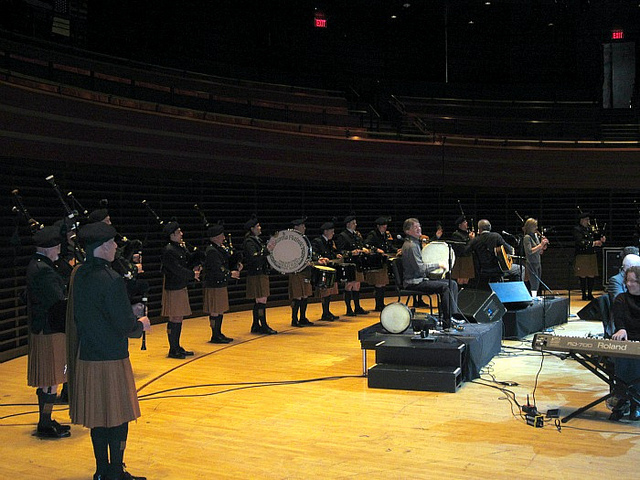
On Stage With the Chieftains

The Philadelphia Emerald Society Pipe Band, on stage

The Philadelphia Emerald Society Pipe Band, on stage

There we all were, a long crescent-shaped line of bottle green and saffron, 17 pipers and drummers playing our hearts out onstage in Verizon Hall at Philadelphia’s Kimmel Center, surrounded by roughly 2,500 clapping, cheering, wildly enthusiastic Irish music fans.

And wait, it gets even more awesome. We were accompanying the world’s foremost Irish traditional band: the Chieftains.

Not many people get to say they’ve done either—perform at the Kimmel or sit in with the Chieftains—but we members of the Philadelphia Emerald Society Pipe Band can add that show to the list of the coolest gigs we’ve ever played. Probably the coolest.

It began for us about a month before the Chieftain’s annual St. Patrick’s show when we were approached by representatives of the band and asked if we’d want to play. We’d need to learn two tunes, the “March of the St. Patricios” and a Breton dance tune called “An Dro.” No one needed to think long about it.

It was a challenge. We’re a competition band, so we spend months focusing on the three tunes we’ll have to play at highland games and Irish festivals throughout the spring and summer. It’s a fussy business, and you’d be surprised at how long it can take before you get to the point where you think you’re ready for prime time.

And here were the Chieftains—the Chieftains, no less—asking us to learn two new tunes and to be ready to hit the concert stage in just a few weeks. Happily, we were kind of like the Cardinals in the National League Division Series last year: We peaked at just the right time.

Friday night, we all showed up at the Kimmel stage door entrance on 15th Street and were escorted down into the basement to two small rooms with little white plaques marked “The Chieftains Pipers.” We did what we usually do: wrestle with pipe tuning until we felt we got them where they needed to be.

After that, everything happened quickly. We were ushered upstairs and led out onto the stage for our pre-show rehearsal—the only rehearsal we would ever have, for a show that was scheduled to start in a little under an hour. Paddy Moloney quickly explained how we were to come in on both tunes. We played together for perhaps 10 minutes, and then we were escorted back downstairs.

And then, about 20 minutes later, back upstairs again, where we waited in the wings while the Chieftains motored through the first half of their show.

We were shortly joined by the striking Scottish singer Alyth McCormack, and after a Carolan tune by Celtic harper Trina Marshall, out we marched to thundering applause. A lot of what happened next passed by in a blur:

The march started.

We joined in.

We marched off.

I’m pretty sure we played well, but probably more than a few of us were only just starting to realize that about 2,500 sets of eyes and ears were suddenly focused on us. There wasn’t time for stage fright, but there was time to take in just how thrilling this moment was.

And then, a few tunes later, we herded back out on stage for the encore. “An Dro” is always the band’s last number at the Kimmel—and maybe everywhere else, for all we know. The Chieftains’ dancers always prance out onto the stage, and from there out into the audience, where anyone who wants to can join this kind of Breton kick line all the way around the auditorium and back up onto stage.

Once again, the Chieftains started off. After the first verse, with a signal from Paddy, the drones kicked in, and off we went, playing this other-wordly folk tune, drums banging out the rhythm. Before we knew it, the dancers were back up the stage, jumping up and down in front of us, and the whole number ended with a long and loud drum roll—and then the audience erupted, giving us all a standing ovation.

The Chieftains hurried off stage left, and we headed off stage right. There were smiles everywhere, threatening to become permanent. One of the pipers, I don’t remember who, looked at me and asked, “Did that really just happen?”

Oh, yeah, it did. And not one of us will ever forget it.

Here are a few photos from the night, with a great YouTube video up top.

View the photos.

News

Party Time in Springfield

No doubt about it

No doubt about it

A lot of events lead up to the Philadelphia St. Patrick’s Day Parade. One of the biggest is the annual fun-raiser at Springfield Country.

This year’s “do” was no exception, bringing in scores of party-goers who just couldn’t wait to get started on their St. Patrick’s celebrations. Parade Grand Marshal John Dougherty led the list of VIPs.

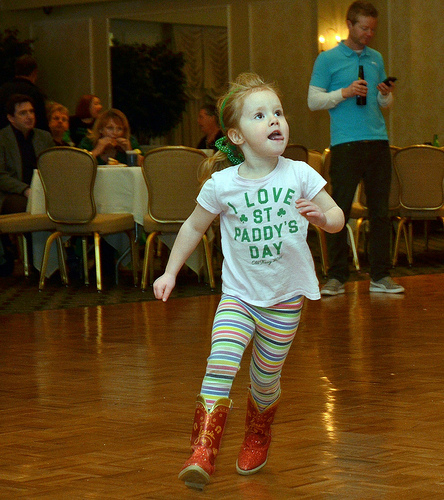
This year, the Hooligans and the Vince Gallagher Band took center stage, and had guests up and dancing all afternoon. (Especially the wee ones.)

We have the pics!

Check them out.

Music

A Lifetime Achievement Award for the Chieftains

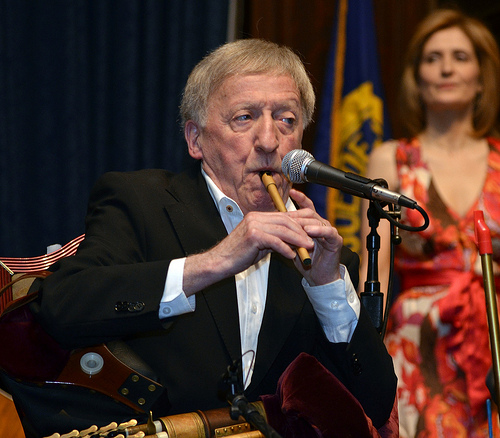
Paddy Moloney

Paddy Moloney

Fifty years. Count ‘em.

That’s how long the Chieftains have been banging out Irish traditional music—along with dozens of inventive musical collaborations, from the Rolling Stones to Tom Jones to Emmylou Harris.

The band was in Philadelphia for their annual St. Patrick’s Day pilgrimage to Philadelphia, and as luck would have it, the timing was perfect for a truly special event: the presentation of the first-ever lifetime achievement award to the Chieftains by the Irish National Concert Hall.

The event, held at the Union League, was hosted by the American Ireland Fund, a philanthropic network supporting worthy causes in Ireland and worldwide.

Simon Taylor, chief executive officer of the National Concert Hall, explained why the Chieftains—and Paddy Moloney in particular, who was a board member for a time—were chosen for this honor.

“It would be hard to think of anyone more deserving. We have a number of awards we give to young musicians. We thought it was about time we gave one to, I won’t say old musicians (laughs), but to musicians for their services to music. It’s something that hopefully over the years will become the must-have award for Irish musicians.”

For his part, Paddy Moloney had only a few words to say, but he and his bandmates found a marvelous way to express their gratitude.

“Thank you so much to the National Concert Hall,” Moloney said. I’ve been watching all the great work for you’ve been doing for Ireland, and please continue to do so. I won’t be sayin’ any more, though. I’m gonna grab me old pipes and whistle, get the lads out, and let’s have a bit of fun.”

And that’s just what they did for nearly an hour, delighting the audience and filling the hall with some of the best Irish traditional music on the planet.

We were there, and have the pictures to prove it.

Check them out.

Food & Drink, People

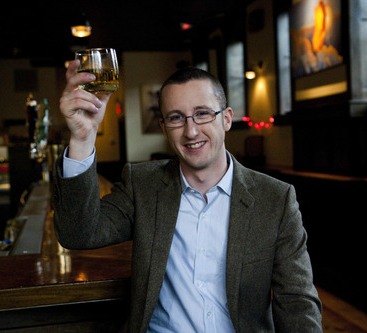
Five Questions for Tullamore Tim

Tullamore Tim

Tullamore Tim

Tell us you don’t want Tim Herlihy’s job.

As the United States ambassador for Tullamore Dew, the second-largest Irish whiskey in the world, he has to travel from city to city sharing his knowledge about one of favorite spirits.

He’ll be in town Wednesday night, a guest of Irish Network-Philly at The Bards on Walnut Street, for a whiskey tasting and dinner. He’ll lead whiskey lovers through a tasting of three entries from the Tullamore line—10-year-old reserve, 12-year-old special reserve, and 10-year-old single malt. He’ll also talk about Irish whiskey, once second fiddle to other alcoholic beverages, has become one of the hottest-selling Irish exports.

We asked Herlihy to give us a sneak preview of his presentation. Here’s what he had to say.

Q. There are a lot of whiskeys in the world. How and why are Irish whiskeys different?
A. Irish whiskey is known for being a friendly spirit, smooth, sweet and approachable.

Q. When people taste an Irish whiskey, what should they be looking for? What should their mouths and noses be picking up? Maybe you could tell us what your far more experienced nose and mouth are picking up.
A. Most Irish whiskey is triple distilled, giving it an approachable and smooth taste profile, compared to Scotch, which tend to be more robust. With Tullamore Dew, it’s a triple distilled, triple-blend whiskey, giving it a smooth character, but it’s a whiskey made up of grain whiskey, which gives it a sweetness, malted barley which gives it great citrus fruit flavours, and pot still whiskey which creates a buttery, oily, melt-in-your-mouth texture.

Q. What’s the audience for Irish whiskeys these days? IN-Philly seems to be a younger crowd (though certainly not exclusively), and I’m wondering if younger folks are part of a trend? That is to say, perhaps they go through their college and young adult years, and then they start to crave something more adult in character. Is any of the above true?
A. The new wave of whiskey drinker is enjoying Irish whiskey because of its taste profile, but also because Scotch (by comparison) is seen as a very serious drink. With Irish whiskey, there are no rules; it can be sipped neat, on the rocks, or mixed. The only rule with Irish whiskey is to drink it with friends! Scotch, on the other hand, is a more reflective drink to be had on your own by the fire, plotting the downfall of your enemies.

Q. Tell me about Irish whiskey as a category, Tullamore being the second largest distiller. How has its popularity grown, and how do you account for that?
A. Right now, Irish whiskey is the fastest-growing spirit in the world. Historically at the beginning of the 20th century, Irish whiskey accounted for 60 percent of all world whiskey sales, before suffering a tragic decline due to Prohibition, a trade embargo with the United Kingdom and other factors, which led to Scotch replacing it as the No. 1 whiskey. Today, Irish whiskey is entering a new renaissance with drinkers falling in love with its taste profile, and it’s sociable nature.

5. Tullamore is promoting “Irish True,” a campaign that urges Americans to forget shamrocks and leprechaun costumes, and to focus on the true meaning of St. Patrick’s Day. (irishphiladelphia.com is a shamrock-free zone, so we appreciate the sentiment.) How are you and the folks at Tullamore suggesting we celebrate the occasion, and how is it different from how we typically do, awash in green beer?
A. There’s much more to being Irish than leprechauns, Lucky Charms and pots of gold. Here’s a couple of St.Patrick’s Day tips:

  • Kick off the day with a hearty, traditional Irish breakfast; it’s going to be a long day and you’ll need sustenance—my favorites include bacon rashers (real back bacon, if you can get it), both white and black pudding, fried eggs and a strong cup of Irish breakfast tea.
  • Take in a local St. Patrick’s Day parade; in Ireland, a parade can be found in a big city, complete with massive floats, right down to a simple tractor parade in a small village. Every city, town and village has its own parade on St. Patrick’s Day. In America it’s no different—go out there and show your support!
  • Catch some Irish entertainment; pull up a chair at your favorite pub and listen to a traditional session band.
  • Go out and find an Irish True bar or pub; forget the green beer and shamrocks on the wall; an Irish True establishment has its own character and way of doing things; there’s sense of community and camaraderie and, above all, friendship.
  • Have a St. Patrick’s Day toast at the ready; toasting is a big part of Irish culture; it should speak from the heart and is meant to be shared with those most important to you.
How to Be Irish in Philly

How to Be Irish in Philly This Week

She knows how to be Irish!

We say it every year: If you don’t know how to be Irish in the next two weeks, we are drumming you out of the clan.

This is a huge parade weekend, so we’ll start there:

On Saturday, both Conshohocken and Bucks County are having their parades in the afternoon. They’re both popular little parades with lots of kid-friendly events, so whichever one you choose, get there early.

On Sunday, the Philadelphia St. Patrick’s Day Parade gets going at noon (an hour later than last year). Since Sunday is when we turn the clocks forward, you probably won’t notice a thing. The whole parade—which may be bigger this year than ever, thanks to predictions of nice weather—will also be streamed live on the CBS3 website and broadcast on the CWPhilly, CBS3’s sister station. As usual, anchor Susan Barnett and meterologist Kathy Orr will be in the broadcast booth with parade chaplain Father Kevin Gallagher, parade director Michael Bradley, and color commentator Karen Boyce McCollum. Look for the ever-lively Bob Kelly on this street.

The Philadelphia parade will start with a Mass at St. Patrick’s Church at 20th and Locust.

Look for www.irishphiladelphia.com marching in the parade. It’s our second year and we welcome marchers who think of themselves as Irish Philadelphians.

Here’s the rundown for the rest of the weekend and week. Hold on to your leprechaun hats.

Saturday

Several pub crawls are in progress: The Erin Express and the Running of the Micks in Philadelphia, and Shamrock and Roll in Delaware County. There’s music, drink specials, and those all-important buses to keep you from doing something stupid behind the wheel. Try not to do anything stupid behind the wheel.

Handy with a Stick, a local trad group, is performing at the Water Gallery in Lansdale. Two of the featured musicians, Bette Conway and John Brennan, are also jewelry makers whose works will be available for sale.

The John Byrne Band is performing a Circle of Friends house concert in the Palmyra, NJ, area.

Jamisons is at Paddy Whack’s on South Street.

The Shantys are rocking out at Reedy’s Tavern in Frankford.

Sunday

Irish Network-Philly is retiring after the parade to The Bards on Walnut Street where, along with socializing, they’re collecting children’s books for donation. They also have a soccer game scheduled for 5:50 PM at Star Finders in Manayunk.

There’s an after-parade party scheduled at the Irish Center in Mount Airy.

Jamison is also having an after-parade party at Finnigan’s Wake in Northern Liberties.

The Jamison Sisters (Ellen Tepper and Teresa Kane) will be performing at the Woodmere Art Musem in Chestnut Hill from 3-4 PM. This is a special opportunity to see Ellen Tepper perform on several different harps including the ancient Irish wire-strung harp. Terry Kane will also be featured singing many different styles of Celtic songs.

Speaking of harps, you can catch Grainne Hambly and William Jackson perform their Masters of the Celtic Harp program in Vineland at 3 PM.

The 65 singers of the VOICES chorale will join Irish singer Gerry Dignan in concert at the Anchor Presbyterian Church in Wrightstown, Bucks County, at 3 PM.

The Heartstring Quartet—four topnotch Irish musicians—will be giving a concert at Calvary United Methodist Church in Philadelphia, at 7:30 PM

You can also catch Ryan Kelly and Neil Byrne of Celtic Thunder in a special acoustic show at The Plough and the Stars in Philadelphia on Sunday night.

Tuesday

The John Byrne Band is booked  to open for The Saw Doctors at the TLA at night.

Hugo Hamilton, best-selling author of “The Speckled People,” a memoir about growing up Irish-German in Dublin after World War II, will be speaking at Villanova University as part of the 14th Annual Literary Festival.

Wednesday

Tullamore Dew—mmmm, mother’s milk to some people I know. There will be a tasting of this Irish whiskey, sponsored by IN-Philly, at The Bards on Walnut Street at 6 PM.

Lunasa, fronted by talented musician and aspiring comic Kevin Crawford, will be playing at the Exhibition Hall at Longwood Gardens at 8 PM.

Thursday

The Port Richmond AOH 87 is sponsoring a talk by Carrie McIntyre, wife of Dr. Anthony McIntyre who with Ed Moloney conducted interviews for the Boston College Oral History Project, documents that the British government is attempting to gain access to because of reputed new information on the IRA killing of a mother 10 children in Belfast, Northern Ireland, Jean McConnville. For the project, Irish Republican and Loyalist paramilitaries were interviewed and some of those oral histories allegedly contain evidence implicating prominent Irish politicians in her death.

Celtic Pride is performing at the Sellersville Theatre and the Irish Rovers will be roving over to the Keswick Theatre in Glenside.

St. Malachy’s Orchestra from Belfast will be performing at the Irish Center.

Friday
Moya Brennan, of the well known Irish folk group, Clannad, will be peforming in concert at The Irish Center in Mount Airy.

Brendan Callahan and John Brennan will hold forth at a house concert in Lansdale.

Brian Conway, Billy McComiskey, and Brendan Dolan, will be joined by RUNA’s Shannon Lambert-Ryan for a concert Friday night at West Chester University. Earlier in the day, Dolan will be giving a free piano workshop at West Chester, sponsored by Kildare’s of West Chester.

Eileen Ivers and Immigrant Soul is on tape at the Appel Farm Arts and Music Center in Elmer, NJ.

Celtic Pride will be at the Temperance House in Newtown.

Mike and Kitty Kelly Albrecht will perform upstairs at Roller’s in Chestnut Hill.

Soprano Jackie Dunleavy Boyle, accompanied on harp by Samanta Wittchen, will be on stage for an Irish concert at Covenant United Methodist Church in Springfield, Delaware County.

You’ll find the Shanty’s at the Glenside Pub in Glenside and the Broken Shillelaghs at the Dubh Linn Square Pub in Sewell, NJ.

St. Patrick’s Day falls on a Saturday this year and it is jam-packed, from the annual Judge Jimmy Lynn Breakfast at the Plough and the Stars, to the ceremonies at the Irish Memorial at the waterfront, to the Donnybrook Cup (Ireland vs. US in live rugby at Widener University in West Chester) to the Springfield, Delaware County, St. Patrick’s Day parade.

There’s lots more which you can see on our calendar. Or check back next week. The calendar is changing daily.

Dance, News

Dancing for God

A happy moment during rehearsal

A happy moment during rehearsal

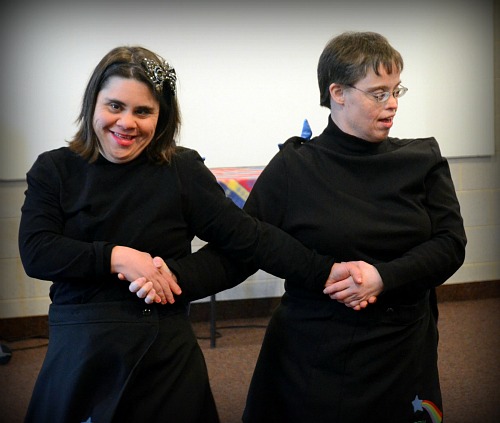
In a school auditorium in Springfield, Delaware County, nine women in simple black Irish dance outfits clasp hands together as their slipper-clad feet lightly skip across the floor. You can see the intense concentration in their faces as they rehearse traditional dances like “Shoe the Donkey” and “Bridge of Athlone.” Led by their instructor Kathleen Madigan, they count aloud:

1-2-3-4-5-6-7

1-2-3

1-2-3

Learning traditional Irish dance can be a test for anybody. For Madigan’s “ladies,” as she fondly calls them, developing all the fancy footwork and consigning it to muscle memory is an especially daunting task. They’re the Rainbow Irish Step Dancers, an enthusiastic troupe of developmentally challenged women from Divine Providence Village, a cottage-style community operated by Catholic Social Services. This Sunday will mark their debut in the Philadelphia St. Patrick’s Day Parade. You’ll recognize them by the pretty rainbow sash they proudly wear across their backs.

The idea for the Rainbow Dancers began over a year ago at a Christmas show at Divine Providence, which Madigan, a former nutritionist at the facility and a student at the Irish Stars Parker School of Irish Dance in Hellertown, attended. When the chorus began to sing “Jingle Bell

Rock,” Madigan recalls, “all the ladies got up and started dancing like crazy. Well, when you think about it, ‘Jingle Bell Rock’ actually fits a light jig. It was then that I realized: They could do this.”

Starting last February, Madigan started running an every-other-Saturday Irish dance class, and every resident of the village who wants to can come and dance. And that’s all it was ever going to be—an opportunity for a couple dozen residents to socialize and have fun. But after a month or two, Madigan realized that there was a core group who could, with coaching, perform publicly.

“These ladies really stood out. They were just so happy when they danced, I thought we could teach them, and they could help each other learn steps. A little over a year later, and we’re still going strong.”

Madigan herself has only been dancing for four years, having started at age 50, so coaching the Divine Providence dancers is a way to bolster her own skills. But more than that, seeing her dancers’ excitement and knowing how hard they have to work, gives her joy.

“Kathy in our group is almost totally blind,” she says. “Eleanor holds her hand so she can dance. Diane is in a brace. There are a lot of physical and mental obstacles to overcome so they can do this, but it gives them a sense of belonging to a team. They know they are the Irish dancers. They just feel special.”

Unlike other dancers, Madigan adds, the Rainbow ladies dance simply for the love it. And it shows. They possess a childlike purity of purpose. “They don’t face competition,” Madigan says. “They don’t have to come in first. They’re just there for each other. And they’ll readily tell you that they dance for God.”

zp8497586rq
News, People

Honors for “Doc”

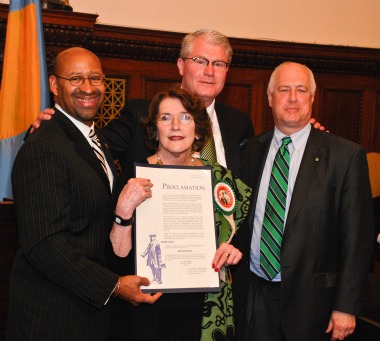
Parade officials Kathy McGee Burns and Michael Bradley, far right, pose with Mayor Michael Nutter, left, and Grand Marshal John J. Dougherty Jr. ,t he 2012 parade grand marshal.

As always, there’s a long day of ceremonies a few days before Philadelphia’s St. Patrick’s Day Parade. But this one was longer than most. It was filled with accolades for this year’s Grand Marshal, John J. Dougherty Jr., business manager of IBEW Local 98, the electricians’ union, and a long-time fixture on the city’s political scene.

Saluting Dougherty were mayors (current Philadelphia Mayor Michael Nutter and former Mayor Bill Green), politicos (including most of city council as well as the Pennsylvania State Senate and House of Representatives), clergy, local TV celebs, and family members (including Dougherty’s younger brother Kevin, a judge, who said he knew that Dougherty was destined to be a fundraiser when, as a young child, Kevin asked his big brother to hold his hand when he was scared one dark night and John replied, “Sure. . .for a quarter.”).

Dougherty defiantly repeated his mantra “I’m proud to be white, Irish, Catholic, union, and a Democrat” several times over the course of the day, though he said he’d been dogged by reporters that day who wanted to know, “Did you really say that?”

“I said, yes I did, and I’m going to say it again later,” Dougherty told the crowd at the Doubletree on Broad Street, where he was officially “sashed” as Grand Marshal, as he mimicked hanging up a phone.

“I am proud of those things,” he told the friendly, receptive audience. “That describes my father. Why would I not want to be like my father?”

Early in the day, the Friendly Sons of St. Patrick, the second oldest Irish organization in the US, laid a wreath at city hall to honor Revolutionary-era patriots of Irish descent. The city erected a plaque on the west side of city hall acknowledging those men, but current construction force the ceremony to the north side of the building facing Market Street.

Also honored: Five men selected for the parade Ring of Honor for their efforts to preserve Irish heritage in the US. Read about them here.

View our photos of the events.

People

The 2012 Parade Ring of Honor

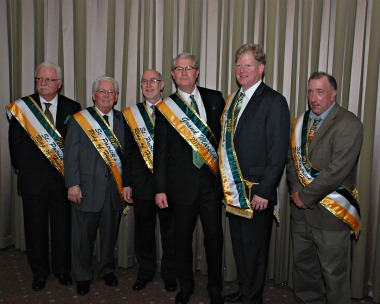
The Ring, from left, Joseph Kelley, Thomas O'Leary, Gerry Timlin, Grand Marshal John Dougherty Jr., Tom Higgins, and Bill Watson.

By Kathy McGee Burns

It is my privilege and pleasure as the President of the St. Patrick’s Day Observance Association to choose a Ring of Honor. This is a select group of Irish/Irish Americans who have contributed to the continuance and preservation of Irish traditions. I am very proud to introduce you to them.

“It’s not the honor you take away with you but the heritage you leave behind.” – Branch Rickey

Thomas Higgins was born in Philadelphia to Irish-born parents: Tommy Higgins (Mountbellew, Co.Galway) and Peggy Kelly (Termon, Co.Donegal). When he was 10, his family moved back to Galway to raise their family of three sons, Tom, Sean and Mickey, back at the old homestead. Tom was a great athlete, excelling in soccer, basketball and Gaelic football. He often came back to Philadelphia to play football in the North America League. He also played for the Mayo, Donegal and Galway teams. winning championships for all.

After attending college at Holy Rosary (Mountbellew) and the University College of Cork where he earned a B.A. in Liberal Arts, he moved back to Philadelphia
to attend St. Joseph’s University and complete his education in accounting. He is now a realtor.

Tom, who is 6’3, red headed, freckled, and very handsome, still has the youthful look of an athlete. He is now the coach of Gaelic football team, Philadelphia Youth. He has dedicated his life to being a player, manager, and a coach.

I asked him why and he readily said, “Heritage. With the lack of Irish Immigration the sport needs life blood and American youth had to start playing it. Now every team has 2/3’s Irish descent and the rest just plain ordinary kids.”

Tom has three sons who practice what he preaches: Tommy,17, Connor, 15, and Ronan,12, are all Gaelic players. He has been married for 18 years to Dee (McAllister) and they also have a sweet, feisty 8-year-old daughter named Ciara.

Tom wins this honor for his preservation of Gaelic football.

“Among all men on earth, bards have a share of honor and reverence because the muse has taught them songs.” – Homer

Well known musician and pub owner, Gerry Timlin, was born in Coalisland, Co. Tyrone, to Joseph and Susan Timlin. His father was the town barber and carpenter. His father, he said, believed that one always needed two occupations, “just in case.” There were five other Timlin siblings: Seamus, Malachy, Niall, Shane and Eileen.

Gerry first gig was playing the coronet (at age 10) in the local marching band. At his first talent contest (age 14) his brother, Shane, lent him his guitar and after winning, Gerry said, “Holy Smokes, there are people who liked me.” He had caught the bug.

In the 50’s and 60’s there was a resurgence of Irish folk music which had a great influence on Gerry. So by the tender age of 16, Gerry was touring as soloist with a group called the Jolly Tinkermen and shared the stage with the likes of the Clancy Brothers, Dubliners and Paddy Reilly.

When he came to the United States in the 1970s, Tommy Makem, who was his greatest hero, gave him some advice, “Grab the audience by the throat and make them listen to you, talk them through every song.” Gerry paid attention. He is an enchanting, lovely man with a voice that charms your heart. He’s one-half of Timlin and Kane, a musical duo that’s been together for more than 30 years.

His restaurant, The Shanachie, in Ambler, is the fulfillment of a 30-year dream. Sadly, though, just last week Gerry and his partner announced that they had sold The Shanachie, though it’s unlikely that this is the end of Gerry’s career as a publican. He’s already looking to the future.

And he’ll never give up entertaining. “Bringing Irish traditions through music, song and story is very gratifying. When I do a show it is one of the greatest feelings to have an audience along with you knowing they’ll be back for more.”

Gerry is married to Lois and has two daughters, Sherri and Susan. Gerry wins this honor for his years of serving up Irish music—and some good food.

“You make a living by what you get. You make a life by what you give.” Anonymous

Thomas J. O’Leary Jr., was born in Philadelphia, to Thomas and Elizabeth Whalen O’Leary. He was raised in the Westbrook Park section of Upper Darby attending Holy Cross Grammar School, Msgr. Bonner, St. Joseph’s University and the American Academy McAllisters Institute of Funeral Services. The family owns O’Leary’s Funeral Home.

Tommy, as he is affectionately known, has spent a lifetime giving, unselfishly, to many causes. He not only gives monetarily but physically and emotion
ally. There are not many ad books, sports teams, or good causes that do not have the O’Leary name attached to them in some way.

In the ‘80s, Tom and his wife, Carol, were involved with Project Children, an organization founded to provide much needed respites in the United States for children from Northern Ireland. Although they had 6 children of their own– Megan, Kathleen, Elizabeth, Margaret, Thomas, and Colleen–
Tom and his wife opened their home to many of these children to give them a break from the grim politics and violence surrounding them.

His dear friend, Parade chaplain Father Kevin Gallagher, said “Tommy O’Leary is a wonderful man who has served, faithfully and selflessly, the Irish community for five decades. His assistance to families at a most difficult period of their life has helped them cope.”

Tom loves his Irish heritage and especially the people for their happy-go-lucky, friendly ways. His own family has roots in Cork. Tom is a member of the Friendly Sons, AOH #4, and Knights of Columbus. Tommy wins this honor for his dedication to the Irish Community.

“It is with great pleasure that I accept this very generous honor on behalf of the Brehon Society, my dad, and all of the labor leaders, John Dougherty included, who have devoted their lives to the betterment of the American worker.” – JosephT. Kelly Jr.

That was the eloquent response from Joseph T. Kelley, Jr. Esq. when he accepted the invitation to be part of the 2012 Ring of Honor, so appropriate this year because the parade grand marshal is a union leader and the parade theme honors the American worker. “Labor” is in his blood.

Joe Kelley was raised in East Germantown, in Immaculate Conception Parish, by Helen (nee Murphy) and Joseph Kelley, Sr. His father was president of Local 113, IUE, International Union of Electrical Workers and president of the Philadelphia CIO.

Joe attended Villanova University and without knowing what career path he wanted to take, opted to go to Villanova Law School. However, the die had been cast for Joe from the beginning; because as his Dad had spent his life in labor relations, he would end up spending a large part of his legal life practicing union labor law.

Joe Kelley is President of the Brehon Law Society, which was founded in 1976 in order to foster the profession of law among individuals of Irish ancestry. This year under Joe’s tutelage and along with his co-chairs, JohnO’Malley, Esq. and Kevin Kent, Esq., an Irish solicitor, they successfully launched the U.S./Ireland Legal Symposium in Westport, Co.Mayo. This conference tackled critical legal issues faced by United States and Irish companies when conducting business at home and abroad. The keynote speaker was the Taoiseach, Enda Kenny. In October 2012, Philadelphia will be hosting the 2nd Symposium.

Joe Kelley is married to Donna and they have two sons, Joseph the 3rd and Austin, and 2 grandchildren, Sophia and Joseph the 4th called Leo. The Kelley and Murphy Family have roots in Co. Mayo.

Joe wins this honor for building bridges between our home and our homeland.

“How come the bosses had silence on their lips as 57 Navvies were buried in a pit, no stone to mark their resting place, no one to mourn their passing.” Wally Page, “Duffy’s Cut”

There is a saying that beneath every mile of railroad track, there’s a dead Irishman. Well, in the case of Mile 59, the Duffy’s Cut of legend, there are actually 55 men and 2 women.

William E. Watson, PhD, head of the History Department at Immaculata University in Malvern, has made sure that the Irish workers from Duffy’s Cut will be mourned, buried and their resting spot memorialized by a beautiful 10-foot Celtic cross.

In 1832, 57 Irish laborers stepped off a ship, the John Stamp, which had come into the Philadelphia port. According to the ship’s log, they were from Donegal, Derry and Tyrone. They were hired by Philip Duffy to build a section of track, near Malvern, for the Philadelphia and Columbia Railroad. Within 6 weeks they were all dead, mostly murdered…brutally. A small number of them had died from cholera but the rest were hunted down, some shot in the head, others beaten with shovel, but most buried in a common grave. Why? They were expendable; there was a strong prejudice against the Irish Catholics and there was a widely held belief that they would spread cholera.

Bill Watson was left paperwork from his grandfather who was secretary to four different presidents of the railroad that led him and his twin brother, Frank, to look for the last burial grounds of these ill-fated immigrants. He saw the injustice. “It’s like an echo through time. They weren’t meant to die there,” he said.

So began the long journey: targeting the exact spot, beginning the dig, fighting the bigotry, getting local cooperation and raising the money. And then they started to appear: coffin nails, buttons, tools, and at one point when Dr. Watson put his shovel into the ground, up popped a completely intact bowl of a clay pipe which was embossed with the words, “Erin Go Bragh,” or Ireland forever. Then, finally, they found the first bones.

No one in Ireland ever heard from these lost children again, but Bill Watson has made sure that they won’t ever be forgotten. The remains of at least some of them, are to be buried at West Laurel Cemetery in Bala Cynwyd on March 9. Watson and his colleagues can’t remove the other remains which are 30 feet down and too near the existing Amtrak tracks, though he hasn’t given that fight up quite yet. He feels that he was chosen by the spirits of the men from Duffy’s Cut, and he intends to do his best by them.