Monthly Archives:

July 2011

Arts, People

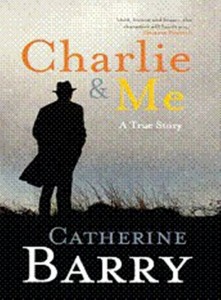
Catherine Barry & Charlie: The Dublin Author Pens Her Story of Recovery


Catherine Barry's new memoir, "Charlie & Me"

All of us have our demons, but few of us ever can, or do, write about them as honestly and eloquently as Catherine Barry has in her new memoir titled “Charlie & Me.” 

The writer, Dublin born and bred, has three well-received novels to her name: “The House that Jack Built (2001),” “Null and Void (2002)” and “Skin Deep (2004),” as well as a place on the fund advisory board of the Dove Self-Esteem Awareness campaign.  But for her latest book, Barry is mining her own life, and turning the focus to her fierce battle with recovery from alcoholism.

“There’s a saying,” Barry told me by phone from her home in Dublin. “It’s called a ‘dry drunk.’  It’s when someone stops drinking, but they still have the disease.  In the beginning, you’re just so thrilled to not be drinking, it’s a honeymoon period. But then, you start having to deal with the issues underneath, what made you drink in the first place.”

Barry began her recovery in 1993, on an April night when she made her way to her first Alcoholics Anonymous meeting.  She had finally said the words to herself, and out loud to her physician, “I think I might have a bit of a drinking problem.”  Still, she had already turned around to leave the meeting before it began when she felt a staying hand on her shoulder.  Charlie Gallagher, who would become her sponsor, her mentor, her lifeline, her savior, and her title character, had found her. And with a smile and the words “Welcome home, Cathy,” he led her back inside.

The decision to begin her story on the first day of her journey to recovery was deliberate; Barry realized that many of the books on the topic of alcoholism start with the destructive road to the bottom, and end at the point where the person decides to seek help. But for Barry, and for everyone facing recovery, that’s where the real fight begins.

“I literally woke up in the middle of the night with the idea for ‘Charlie & Me.’  I was in the middle of writing another book at the time, when I realized that this was what I was meant to be writing.  I knew I was onto something, I just felt that with this book.  I’m on a mission now to just tell the truth because it needs to be told. I don’t think I would have made it through the first year without Charlie.”

At the time, Barry was the unemployed mother of two small children, and was in the process of removing herself from an abusive marriage: “I had no job, no money, I was in an insane marriage.”  She was at her rock bottom.

Charlie, as Barry writes about him with undying love and affection, is a character quite unlike any other.  He had to begin their relationship by explaining what a sponsor was, by telling Barry that he would “simply pass on the tools of recovery as they had been passed on to him twenty-five years earlier.”  He would help her get, and stay, sober.

He was a man who had equal parts passion for coaxing dilapidated old cars to run for him, for collecting junk that he masqueraded as antiques, for chain-smoking rolled up tobacco cigarettes, for dressing up dapper in suits of many colors and hats of many feathers and for warbling Sinatra tunes off-key. “He wasn’t a saint,” Barry told me, but as she writes in her book, Charlie “imparted his wisdom, warmth and sense of humour to me…His attitude towards life gave me a blueprint—an instruction book on decent living, if you like.”

“The funny thing, I suppose,” Barry laughed, “is that we were a bit like the blind leading the blind. Two sick people trying to help each other, like the patients themselves healing each other.  It was a strange paradox that I still don’t fully understand.”

It was Charlie who encouraged Barry to begin really using her writing talent. “I was always writing as a child, always writing diaries. I fell in love with the smell, the ambiance of libraries. I would write short stories and poems…and then put them in the drawer. “

But there was one poem of Barry’s that a friend had had written up and framed for her. Charlie noticed it hanging on the wall one evening, and commented, “God, that’s brilliant…Do you know who wrote it?”  When Barry replied that she was the author, Charlie wouldn’t let her off the hook until she’d shown him what else she’d written. He made her type out the poems, and begin the submission process.

“We writers, we’re always the last people to see it in ourselves.  I’m always looking for validation from the outside world. I used to pester other authors and say ‘Am I a writer?’ You have to acknowledge it yourself.”

Writing “The House that Jack Built” came about as a bit of a dare, when someone said to Barry, “You know, you could write a book.” She could barely conceive of it, but she persevered.

“The day I got the check for the advance on the first book, I brought the check to the bank and then kept waiting for them to ring me and tell me that it had bounced.  It’s almost like a passion for self-destruction that an alcoholic has…practicing forgiveness is something you have to do up until the day you die.”

Barry is unstinting in her honesty as she recounts the darkest days of her early recovery.  One chapter in particular recounts her obsession with a boyfriend who had his own issues of addiction.

“A lot of people have spoken to me about that chapter. It’s struck a nerve with many people.  It’s the mentality of ‘Now I’ve stopped drinking…what other things can I use to distract myself from the pain that started the drinking in the first place.’ I wanted to fix this man; I’d spent my life trying to fix other people. There was a hole in me that I wanted to fill, and it’s just the same old thing. It’s what I see addiction is, trying to find a way to cope with the pain.”

“And while I’m saying this,” Barry laughed. “I still haven’t figured it all out.  Insanity—the definition is doing the same thing over and over again and expecting a different result.”

“I just say, ‘Go for progress and not perfection.’”

Barry’s mission to “just tell the truth” has produced a beautiful, poignant, funny, devastating memoir. Even seeing the end coming, I have to say I sobbed as I finished the book. Her personal triumph is that she continues her recovery, one day at a time, and that she has shared her story with the world. Based around her fight for sobriety and stability, it’s a narrative that will resonate with anyone battling any kind of demons.  Although I daresay readers will wish they had their own Charlie by their side for the rumble.

“Charlie said it to me, that I can’t stop from touching the flame, and he was right. That’s the way I am. But I found a higher power and I still continue to rely on that higher power today. Forgiveness is a process.”

Charlie always told Barry that “the writing will cure you” and she has never felt that more strongly than with this book. “I feel like it’s saving my life all over again. This is the road I want to be on…I’ve found my voice now.”

“Charlie & Me” can be ordered online through www.amazon.uk and www.easons.com. And check out Catherine Barry’s facebook page at: http://www.facebook.com/pages/Catherine-Barry/230954423587434#!/pages/Catherine-Barry/230954423587434

News, People

Philadelphia’s Fond Farewell to Alan Farrelly

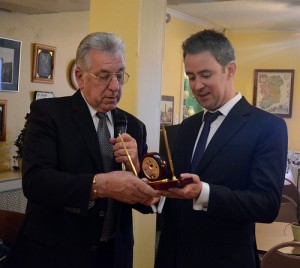
The Irish Center's Tom Farrelly (no relation) presents a token of recognition to outgoing New York Irish Vice Consul Alan Farrelly.

The Irish Center's Tom Farrelly (no relation) presents a token of recognition to outgoing New York Irish Vice Consul Alan Farrelly.

Irish Vice Consul Alan Farrelly has spent a good deal of time in Philadelphia, strengthening ties with the Quaker City Irish community.

He’s leaving the post after four years and returning to Ireland in August, but Philadelphia’s Irish made sure his hard work here was recognized.

There were a few speeches, some parting gifts and a bit of music and dance to mark the occasion. But mostly, representatives of the Philadelphia Irish Center and the organizations that make their home there lined up to shake his hand, say a few words of thanks and to have their pictures taken with Farrelly in the center’s cozy little Fireside Room. (Earlier, they had him out on the roof, looking out upon the badly needed repairs. An unfailingly polite young man in a dark suit on a hot day, standing out above the trees of Mount Airy, still doing the government’s business.)

President of the Irish Center Vince Gallagher and board member Tom Farrelly (no relation) led the brief, mostly informal ceremonies, which also honored first secretary Lorraine Christian, who also is returning to Ireland.

“They were never strangers here,” said the Philadelphia Farrelly. “We adopted them, and they adopted us.”

As the Irish Farrelly accepted a commemorative pen-and-clock set from his local admirers, he acknowledged that the admiration is mutual, and he added, “we’re proud to have been a part of the work you do here.”

Farrelly’s involvement—indeed, the involvement of the entire Irish Consulate staff in New York—has been deeply appreciated in the Philadelphia area, said Siobhán Lyons, executive director of the Irish Immigration Center of Philadelphia.

“Alan has just been great,” said Lyons. “The Consul General can’t be every where, so one of Alan’s jobs has been to travel to different places. A lot of that started with (former New York Consul General) Niall Burgess’s recognition that the East Coast of the United States is not just New York City.

“Alan’s been extremely helpful with the Irish Immigration Center. He was there when I was taking it over, and helping to figure out the future strategy of the center. He’s met everybody. It’s going to be a shame to lose him because he knows so many people and he likes Philadelphia. Those will be very big shoes to fill.”

We captured some photographs of Farrelly’s farewell fete at the Irish Center. Check them out.

Arts

Shining a Bright Light on an Ancient Irish Martial Art

John Hurley with son Liam

John Hurley with son Liam

Irish history means everything to John W. Hurley.

It starts with his family. His grandfather William Hurley was from a coastal town called Ballyheigue in County Kerry. Young William fought in the British army in World War I, then with the Irish Republican Army in the war of independence, and later on the side of those who were opposed to the 1921 Anglo-Irish Treaty.

That turned out to be the losing side, and so William packed up his family (including then 24-month-old Michael J., John’s dad) and moved to Jersey City.

Like many emigrants, the Hurleys assimilated—but they never forgot where they came from, and they made sure they passed on their Irish pride to their children and grandchildren.

“My dad really valued his heritage and his culture and tried to instill that pride in us,” says the soft-spoken Hurley, a graphic artist from Pipersville, now back in college and hoping to one day teach high school social studies.

Clearly, something must have penetrated, and pretty deeply at that. Although he’s only an amateur historian, John W. Hurley has managed to make himself into a passionate expert in a very obscure yet fascinating subject: the history of shillelagh.

Most people think of this iconic symbol of old Ireland as a walking stick. But Hurley knows what it really is: a weapon.

He started to come by this knowledge early in life, mostly by making some chance connections.

For a start, he recalls hearing his grandmother speak Irish. Like a lot of kids, he paid little attention to what the grown-ups were doing. And then, one day, when he was in high school (Essex Catholic, taught by the Christian Brothers), “it dawned on me that there was an Irish language, separate from the English language. it was an epiphany, and I wondered what else about Irish culture I was missing.”

Around the same time, he and his family went to the Irish festival in Holmdel, N.J., and he found a book of stories by the little-known Irish novelist William Carleton. In one of the stories, there was an account of a “stick fight.”

“I was a kid who watched a lot of kung fu movies,” Hurley says. “In this scene, two guys are fighting, and one guy moves in close and flips the other guy over his shoulder. I thought to myself: This is like kung fu. That made me realize that there was more to stick fighting than barroom brawling.”

Indeed, fighting with the shillelagh proved to be Ireland’s own martial art. Once Hurley made that connection, he became obsessed with the idea. He wanted to know more.
He went on to attend the University of Dayton for a degree in commercial design, and then, in 1975, he went to Ireland to spend time with family. While there, he found a 1975 book, The Irish Faction Fighters of the 19th Century, by Patrick O’Donnell. It provided more detail on stick fighting, and by then it clear to Hurley that that battling with a shillelagh was not just about two hard-headed Irishmen frantically whaling away at each other. There was a formal discipline and an art to stick fighting, passed down from father to son, together with an elaborate set of unspoken rules—shillelagh law—for how a fight must be conducted.

It was Hurley’s father Michael who urged him to follow his passion.

“I was talking to my dad about it (stick fighting) one day,” says Hurley. He was the one who suggested I should write a book about it. I had always wanted him to write. He really was like an old fashion seanchie (the Irish word for story-teller). He was a really good guy with an outgoing personality. The problem was, he didn’t have the patience to sit down and write. But I was a lot more introverted.”

So the more reserved son began a project that would drag on for years, through marriage, kids, jobs, layoffs and all the other joys and challenges of adult life. Right from the start, Hurley knew he had his work cut out for him.

“When I was a kid, I knew what a shillelagh was. Everyone knew what a shillelagh was. It was iconic, like a harp. I also knew that not a lot of people realized it (fighting with a shillelagh) had been a martial art. I knew it would be hard to convince them. So I really wanted to make it a good book, to provide evidence that it was for real.”

Hurley spent countless hours tracking down every bit of documentation he could find, piling up copious notes.

Around 1994, he was reading a kung fu magazine–that interested had never faded away–and he discovered a story about a stick fighter in Canada by the name of Glen Doyle, who had learned the art from his father.

Hurley wrote to him, and for a while they corresponded, but not much came of it.

Then a few years later, Hurley again found information about Doyle, this time on the web–and now Doyle was actively teaching his family’s stick fighting method. At this point, Hurley was a able nail down even more detailed information.

Finally, after years of fact-gathering, Hurley wrote his book, “Shillelagh: The Irish Fighting Stick.” Self-published in 2007, it is Hurley’s densely documented, 370-page homage to a forgotten Irish art. It is dedicated to his father, who, by all accounts, was proud. (Michael Hurley died in November 2010.)

Hurley’s book is not exactly sailing off the shelves, but ultimately, it’s not whether the book becomes a best-seller. It’s that the book exists at all.

“I just thought I always wanted to do something like this, almost in a patriotic way,” he says. I wanted to contribute something to Irish culture somehow. No one else was interested. It seemed the one thing I could do.”

Arts, History

Colin Quinn Makes a “Long Story Short”

Colin Quinn in "Long Story Short"

Colin Quinn, you are funny.

I already knew that, but I had it reconfirmed for me on the opening night of Quinn’s one man show, “Long Story Short,” at the Suzanne Roberts Theatre on Broad Street. Fresh from Broadway, and making its Philadelphia debut, this 75 minute tour-de-farce of history bites where it’s supposed to and makes short work of some of history’s biggest moments.

And keeps the audience laughing throughout the entirety of the evening.

Quinn’s point, made with his trademark raspy-voiced rat-a-tat delivery, is that in all the years humanity has been evolving, we haven’t changed all that much: “With all the progress, where’s the progress?” he asks early in the show.

He points out that “our ancestors weren’t the ones who starved to death waiting their turn in line for food.”  In other words, survival of the fittest doesn’t mean survival of the nicest.

Directed by Jerry Seinfeld (I looked all around the theater in the hopes that he is a hands-on director who was perhaps directing from the seat next to me; no luck), the show’s style of humor reflects the sensibility of the man best known for his show about nothing. This time, however, he’s steering a show about all things universal.

No history stone is left unturned: politics, philosophy, psychology, arts & literature. Quinn touches on all of them. And the points he makes are the kind that have you going, “Oh, yeah…” Like his take on democracy, for instance:

“It’s sad. Marxism didn’t work. Communism didn’t work. Capitalism doesn’t work.  Nothing works. Even democracy doesn’t work. Democracy—the greatest form of government and we have two choices for who’s our leader. In fascism you only have one choice. That’s great. We have one more choice than the worst form of government.”

It’s sageness like this that keeps the audience holding fast for the next pithy piece of insight wrapped in humor to be delivered by the craggy-faced man pacing the stage.  It’s actually a bit like sitting around with a funny friend, the one who minored in history and knows how to draw the connections between the follies of early civilizations and our own modern messed-up universe.

As Quinn makes perfectly clear, we have always been searching for the truth of our existence, or as he puts it: “Don’t judge me by what I do…judge me by what I’m telling you when I’m doing the opposite.”

“Long Story Short” is here in town through July 10th, and it’s worth an evening of your time.  For more information, check out The Philadelphia Theatre Company’s website: http://philadelphiatheatrecompany.org/events/LSS.html

Columns, How to Be Irish in Philly

How to Be Irish in Philly This Week

Piping hot

Piping hot

Well, I can tell you for certain how one local Irish group will celebrate the 4th of July.

The Philadelphia Emerald Society Pipe Band is marching in the 114th Riverton, N.J., 4th of July Parade, one of the truly great local small-town Independence Day traditions. I know this because I will be joining the drum line for the day. Why? Because there’s nothing that says “Ain’t that America?” to me more than wrapping a heavy woolen blanket around my hips, strapping on a 14-pound drum and marching a couple of miles in extreme heat and humidity.

Join me in praying for a cooling breeze off the Delaware.

So what are you doing over the holiday weekend and beyond? Well, judging by our calendar, a lot of you have your own plans.

Sure, the South Jersey Irish Society is holding its big picnic Sunday from 11 a.m. to 7 p.m. in Yardville. And that promises to be a great day, with Irish music and dance, swimming, grilling and lots of outdoor activities for everybody. Details here.

As for the rest of the week, there are Irish traditional music sessions all over the landscape. I’m always amazed at the folks who have never taken in an Irish music session. Local Irish musicians—it can be a few, or it can be well over a dozen—get together and play every tune they ever knew (even if they don’t always remember the names of those tunes). Sessions take place at pubs all over the place, and the music is free. (The food and drinks aren’t.) Your being there also helps support local Irish businesses, and in a down economy that’s always a good thing. So take a look at our calendar and by all means, go.

We want to draw your attention to something brand new, if a bit off the beaten track, toward the end of this week.

If you’re up for a road trip, trek on down to Anne Arundel, Maryland, for the Annapolis Irish Festival on Saturday (July 9). It’s a bit of a hike, but on the plus side you get to experience the unbridled joy of driving on I-95. Seriously, we’ve been to the Anne Arundel County Fairgrounds many times over the years, and it’s a beautiful rural venue, a terrific place for a summer Irish festival.

This is the first Annapolis Irish Festival, as I say, so you can be in on the ground floor. One of our favorite local bands, Burning Bridget Cleary, is on the bill, as are many other Irish musical groups and performers, including the irrepressible Seamus Kennedy (if you haven’t seen him, do), Screaming Orphans, The Rovers, the Shamrogues, and more. The Chesapeake Caledonian Pipes and Drums will circle up and play from time to time. There are Gaelic games, tons of food and drink, vendors galore, and kiddy activities (pony rides!). Don’t worry about the heat. The festival organizers promise there will be a “misting tent.” (I want one of those.) The whole deal runs from 11 a.m. to 9 p.m. Details and directions here.

There’s more coming up this month, including the Celtic Heritage Festival in Graeme Park, Horsham, on the 16th, and a great concert at the Coatesville Traditional Irish Music Series—Irish Fiddle & Flute Music: Maeve Donnelly & Conal Ó Gráda—on the 20th. Keep checking our calendar for more. New events pop up all the time.

And if you are holding an Irish event and it ain’t on our calendar, then it just ain’t happenin’. Submit your event here.