Monthly Archives:

July 2011

How to Be Irish in Philly

How to Be Irish in Philly This Week

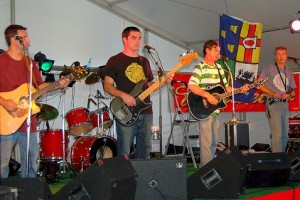
Alex of the Martin Family Band--at Graeme Park this weekend.

Though the former residents of Horsham’s Graeme Park (Keith House) were from Scotland, the historic site’s annual Celtic Heritage Festival (Saturday, starting at 10 AM) always has a decidedly Irish flavor thanks to the Timoney and Sabo Schools of Irish Dance, The Martin Family Band, and the Hooligans. Scottish folksinger Carl Peterson will also perform (he does Irish folk songs too). There are plenty of kid-friendly activities too, including a moon bounce, a (kilted) juggler, and balloon animals.

Later that evening, catch the Broken Shillelaghs at the Dublin Square Pub in Bordentown, NJ. (They’ll be at the Blue Monkey in Merchantville, NJ next Thursday.)

On Monday, two charity events for Irish pub employees.  Friends of longtime Fado server, bartender and events manager Regon MacInnis will be holding a fundraiser at the Locust Street pub to help defray the costs of cancer treatment for the young Maine native. The $20 ticket price covers the cost of dinner and your first pint. And the money will help this young woman, known to many in the Irish community, fight a particularly aggressive form of cancer. At the Plough and the Stars  on Second Street the same night, friends of bartender Stef Stuber will he holding an event to raise money to pay for medical costs she incurred in a serious moped accident while vacationing in Thailand recently. Your $20 donation covers one free drink and appetizers. There will be a 50/50 drawing and a silent auction as well.

Also Monday evening, the Inis Nua Theatre Company is holding its summer happy hour at Fergie’s Pub where they’ll reveal plans for next season. Don’t forget to go to the little ad at the right under the heading “Help one of our partners” to donate to the Inis Nua “Send a local theatre company to New York” campaign. Inis Nua has been invited to bring its tour de force “Dublin by Lamplight” to New York’s first ever Irish Theater Festival this year and they need some financial help to get there.

On Wednesday night, remarkable Irish fiddler Maeve Donnelly returns to the Coatesville Cultural Center with Cork flute player Conal O’Grada for an evening of traditional music that falls into the “must-hear” category. Tickets are going fast, so order now.

Or, you can join the Bogside Rogues and Jamison Celtic Rock on Wednesday night in bucolic Pennypack Park in Philly’s Fairmount Park for an under-the-stars concert. Bring a picnic dinner, blankets, chairs and bug spray. (Catch Jamison at Shenanigans in Sea Isle, NJ, on July 24.)

Next weekend, a real treat: Enter the Haggis AND the John Byrne Band are appearing at the Sellersville Theatre on Saturday.

Speaking of John Byrne, we recently stopped in to his new bar in Northern Liberties, The Blind Pig. Best Cuban sandwich I ever had. Incredible list of beer in cans and some powerful brews on tap (there are parts of the evening I can’t remember, like leaving). And you can probably talk the bartender into singing a few songs. It’s getting great reviews in the Philly media (and from citizen reviewers on sites like Yelp), particularly for its “Thanksgiving Balls.” Seriously, how could you go wrong with an appetizer of turkey, wrapped in mashed potatoes and stuffing, breaded, fried, and served with gravy and cranberry sauce? (All you cardiologists, pipe down.)

Check our calendar for details on these and other goings on.

News, People

Father Ed Brady Takes a New Post

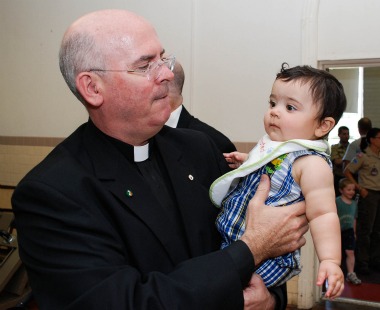
Father Brady and his little cousin, Joseph.

The parishioners of St. Anne’s Church in the Kensington section of Philadelphia are going to have to learn all the words to the hymn, “Our Lady of Knock,” now that Father Edward Brady is their new pastor.

On Sunday, July 10, Father Brady, former pastor of St. Isidore’s Parish in Quakertown, was installed at pastor at the church at a ceremony that was decidedly Irish. There was a bagpiper outside the church as everyone entered. The regional bishop presided: Bishop Michael Fitzgerald. Then there was the regional vicar: Father Paul Kennedy. Father Brady’s brother, also Father Brady (James), flew in from his parish in New Orleans, LA, to be one of the concelebrants of the Mass. And local singer Theresa Kane sang “Our Lady of Knock,” a hymn that pays tribute to the Blessed Mother who reportedly appeared to a group of people in Knock, County Mayo, Ireland in 1979, which is a staple wherever the Irish in the Philadelphia region gather.

Also in the church were members of all the organizations for whom Father Ed Brady serves as chaplain: The Irish Memorial, The Friendly Sons of St. Patrick, the Cavan Society, the Galway Society, and the Inspirational Irish Women Awards. Philadelphia Councilman Bill Green and his wife, Margie, participated in the Mass. Tyrone-born singer Raymond Coleman performed at the reception afterwards.

View our photos of the event.

News

Celts to Gather at Graeme Park

Have a hot time with the Hooligans.

Have a hot time with the Hooligans.

Another weekend, another festival.

This time out, its the 15th Annual Celtic Festival at Graeme Park in Horsham, Montgomery County.

As festivals go, this one’s a nice comfy size, spread out across the park, which features the historic Keith House, once home—in the early 1700s—to the provincial governor of Pennsylvania, Sir William Keith.

The festival started out pretty modestly, says park spokesman Carla Loughlin, but over the past six or seven years it has grown. The Graeme Park Celtic Festival features about 30 vendors selling all manner of Celtic-themed merch, from T-shirts to jewelry to gifts. Occupying a corner of the park will be about 10 Scottish clans and non-profits, hosting their customary There’s music all day on the main stage, local Irish dancers and three pipe bands—Bucks Caledonian, McKay and McGregor, circling up and playing several times during the day. The full schedule is below.

The festival started out as solely Scottish, Loughlin says, in honor of the local Keith, Graeme, and Fergusson families, but the festival is really for Celts of every stripe.

“Maybe the first few years it may have just been Scottish, but since then we’ve always included the Irish, and even Cornish the past few years,” Loughlin says.

In the past, the festival has drawn between 1,000 and 2,000 visitors, says Loughlin. “It all depends on the weather,” she says. “The weather is supposed to be nice tomorrow (Saturday), so we should be on the higher side.”

Here’s the schedule:

Schedule of Events

Main Stage (behind the Keith House)

11:30: Flag raising and pipe bands
12:00: Carl Peterson
12:30: Sabo School of Irish Dance
1:00: Timoney School of Irish Dance
1:30: Pipe Bands
2:00: The Martin Family Band
3:00: Sabo School of Irish Dance
3:30: Timoney School of Irish Dance
4:00: The Martin Family Band
5:00: The Hooligans
5:45: Pipe Bands
6:15: The Hooligans

Barnyard

Carl Peterson

Front of the Keith House

Now & Then
WireHarp

Kids’ Area

The Kilted Juggler

To get there: Graeme Park is at 859 County Line Road in Horsham.

Music

Virtuoso Fiddler Maeve Donnelly Returns to Coatesville

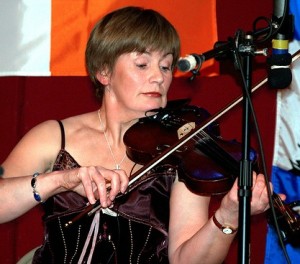
Maeve Donnelly in concert at Coatesville in April 2007 (photo by Gwyneth MacArthur)

Maeve Donnelly in concert at Coatesville in April 2007 (photo by Gwyneth MacArthur)

The acclaimed East Galway-born fiddler Maeve Donnelly plays with deep passion and conviction, bringing out the beauty of Ireland’s old music and making it all seem new again.

We spoke to Donnelly in 2007 just before her Coatesville Traditional Irish Music Series appearance with Scottish guitarist Tony McManus. Donnelly returns for a concert at the Coatesville Irish Music Series Wednesday at 8 p.m. This time around, she is accompanied by the East Cork flute player Conal Ó Gráda.

The upcoming show gives us an excuse to dust off our 2007 Q and A. We’ll also link you to our review of that concert (short, but enthusiastic), together with Gwyneth MacArthur’s lovely photos.

Maeve Donnelly is that rarest of birds, an Irish musician whose parents are not players themselves. (Which would make them, um … kind of like the Muggles of the Irish traditional world.)

Somehow, in spite of her inauspicious roots, she has managed to muddle along.

She won her first All-Ireland Fiddle Competition at age 9. She won two more All-Ireland fiddle titles after that. She also picked up the National Slogadh Competition for Solo Fiddle and The Stone Fiddle Competition in County Fermanagh.

In a recent phone conversation from her home in Quin, County Clare, Donnelly explained how she made the journey from the Galway of her childhood and a house somehow not filled with fiddle-playing parents, aunts, uncles and cousins to emerge as one of the preeminent traditional players of her generation.

Q. How did you start out? How old were you?
A. I started very young. I was probably about 6 or 7 or so when I started playing. The reason for starting was, my two older brothers had gone to music lessons. Their teacher taught specifically Irish music.

We had a fiddle hanging on the wall at home. My other brother Declan had played fiddle, and so he had advanced on to another fiddle. It was no great mystique toward learning fiddle.

I got the fiddle put in my hand and a bow, and off I went with my two brothers to learn music.

Q. Not everyone who starts out on an instrument stays with it. Why did you?
A. I didn’t ever exactly like music lessons. I don’t think there’s a child who does. It was no great treat. My lessons would have started on a Saturday. I still feel like I had a big black cloud over me until it was over. I wasn’t great at reading music and I picked it up as best I could, playing by ear.

The way it happened was, we used to go to fleadhs as a family. We in turn were part of a bigger unit, and we played at fleadh cheoils all over the country. It was a special group of maybe 30 people. Within that group, everybody would go to the fleadhs. We would combine in different ways to go in for competitions.

A big proportion of praise goes to my parents, who put in a great sacrifice and weren’t pressuring us to get first place in the fleadhs. It developed as a social outing.

That (playing in fleadhs) made a difference. I was playing in fleadhs and competing from about the age of 9. At the time we would have traveled up to three hours back in the late 1960s. It was quite a journey to go to these fleadhs.

Q. Your parents didn’t play. It seems like everyone else I’ve interviewed who plays an instrument comes with a pretty deep family background.
A. I often think, would it have been nice to have had parents who were musicians? Sometimes it can be more refreshing not to have parents playing musical instruments at home. It’s better doing your own thing, and a challenge.

Q. Was there a point at which you felt like your playing had progressed beyond the routine of lessons, to where you knew that there could be something more?
A. I finished classes in my teenage years. At about that time, a whole new breed of festival started in Ireland. They were non-competitive workshops. The first one was Willy Clancy Week. That was my first introduction to learning music for a whole week, and having great fun and being immersed in it for a week. The first year I went there I was in a class taught by Sean Keane of the Chieftains. And I met a lot of pipers. I never met pipers. I met Seamus Ennis. It was an eye-opening experience. That was about 1974.

After that, I would go back annually.

Q. How has your approach to playing progressed since then? How did what you learn in workshops influence your playing?
A. It sort of organically grew. I enjoyed what I was doing. I also felt that I worked at what I was doing. I’m not claiming that it dropped down or I was gifted in any way. It sort of spurred me on to studying the music, to working at the music, rather than sitting and playing at sessions. I spend a lot of the just sitting at home and playing.

I think session music is a great form of practice and a great form of picking up tunes and great form of fun. As an exercise in improving your playing, I’m not sure I would agree. It depends on the session. At that level you just play as an ensemble groups. The individual part of the playing doesn’t come. But playing in sessions also gives you motivation to keep playing. Every time I go to a session, I always hear a new tune. It’s like a lifeline in its own way.

Q. What do you do when you aren’t playing?
A. My full-time job, and has been since I was 20, I’ve been a teacher. I teach in the area of learning support. I take children 7 to 12, children who have trouble with literacy and numeracy. Being a teacher means I have a long holiday time. I have more flexibility. I can take one week and I can tour.

How to Be Irish in Philly

How To Be Irish in Philly This Week

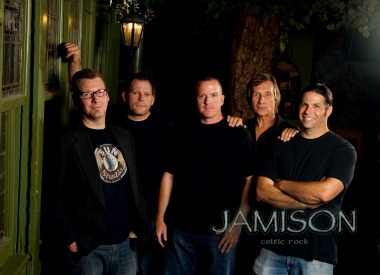
Celtic rockers Jamison.

If you’re at the Jersey shore, the Maryland coast or stay-cationing in or around Philly, you can easily be Irish this week.

For example, the Annapolis Irish Festival is in full swing this weekend at the Anne Arundel County Fairgrounds. You can see some local faves like Burning Bridget Cleary and Seamus Kennedy (and the Screaming Orphans who, while they’re not local, are big faves around here), among other great Celtic bands. There are also Gaelic games and vendors—two of our favorite things.

Speaking of our favorite things, Celtic rockers Jamison will be performing at Keenan’s Irish Pub in North Wildwood on Saturday night and at Shenanigan’s in Sea Isle City on Sunday. You might be able to find them on the beach in the daylight hours. Remind them to use Celtic-strength sunscreen.

If you’re staying close to home, think about heading to the Kildare’s weekly session in West Chester on Sunday night. The regulars are being joined by a few guest stars, including 12-year-old fiddler Alex Weir and 11-year-old whistle player and piper Keegan Loesel, who are heading to the All-Ireland Fleadh in August to compete against other young traditional musicians in Cavan Town. The session is a benefit for the two youngsters to help defray the cost of their trip. They have another benefit, organized by Belfast Connection fiddler Laine Walker Hughes, coming up later in July at Brittingham’s. More on that later.

Next Friday, hear Raymond and Mickey Coleman, two musical brothers from Tyrone, at The Plough and the Stars in Philadelphia. We haven’t heard the duo, but Raymond, whom we have heard, is worth the price of admission. You know, if there was one. There isn’t. It’s a great venue, great menu, and a great evening of music. (Listen to Raymond here. See, am I not right?)

Tickets are going fast for Maeve Donnelly and Conal O Grada, appearing on July 20 at the Coatesville Cultural Society. Donnelly is a remarkable fiddler, last in Coatesville with guitarist Tony MacManus (a highlight of my own personal trad concert-going). O Grada is a flute player from Cork who, we’re told, will blow you away, pun intended.

And hey folks, help us out here! If you have an Irish event, don’t make us look for it! Tell us about it! And we’ll tell everyone we know, promise. Yes, we troll Facebook and other sites to find you and yes, we’re probably on your mailing list if you have one, but most people looking for an Irish event to attend come HERE! You may reach a couple of hundred people by sending out a Facebook event invite, but we have more than 2,000 hardcore local Irish folks on our Facebook page and our Mick Mail list. You do the math.

We make it easy for you to put your event on our calendar yourself. (Tell them, Jamison and Belfast Connection and Irish Club of Delaware County!) Simply go to the orange bar at the top of the page, click on Irish Events Listing, click on “Submit Your Irish Event,” and fill out the form. If you fill in the full address of your event, our calendar will even draw people a map! (Clever calendar!)

If you really want to get people to pay attention, our ads are really cheap. So cheap, we make absolutely no money! Now, that’s cheap! (One of us has got to get a business degree.) If you’re interested, go to the same orange bar and click on “Advertise.” That will take you to a page that tells you everything you need to know except that those little ads at the bottom of the page are $25 a month each (they’re newish).

While you’re roaming the site, check out the calendar for all the details.

Music

India Meets Ireland

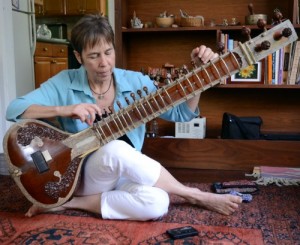
Allyn Miner, tuning up

Allyn Miner, tuning up

If you listen to Allyn Miner play fiddle in the Tuesday night Irish music session at the Shanachie Pub in Ambler, you’re hearing what one talented player can do with just four strings.

You ought to hear what she can do with 20.

In addition to her skill as a fiddler, Miner is a well-known player and instructor on the much-larger-than-a-fiddle traditional Indian instrument called the sitar.

(If you don’t know what a sitar sounds like, pull out your old Beatles Rubber Soul album. George Harrison plays the instrument on Norwegian Wood. You’ll recognize the distinctive metallic buzz, a kind of silvery sizzle, and the whining, hypnotic drone.)

A senior lecturer in Penn’s Department of South Asia Studies—she’s been there for 20 years—Miner began her long love affair with the sitar when she was still a junior in the Indian Studies program at the University of Wisconsin. Born and raised in Chestnut Hill, she grew up knowing how to play the violin. Sitar, when it came into her life, was not so much a departure, she says, but a way of building on musical skills she already possessed.

The path to sitar enlightenment evolved largely out of Miner’s enrollment in the University of Wisconsin, which had an Indian Studies program. The desire to attend school far away from the safe confines of Philadelphia came first, but the university’s Indian Studies was definitely an allure.

“My mother said I had that in mind before I went there (the University of Wisconsin),” says Miner. “Really, I was mostly interested in going to a different place, to another environment away from Philadelphia for a change. The university’s Indian Studies program was an attraction.”

Miner took Hindi to fulfill her language requirement, took courses in Indian culture, attended many of the department’s social functions. She found herself pulled more and more into this country 8,400 miles away.

“I guess I was first drawn out of curiosity,” she says. “I wasn’t sure what to make of it. I wanted to know more about it.”

When Miner got the opportunity, she signed up for the department’s junior year abroad in India.

She knew right away that she had made the right choice.

“It was a huge adventure, of course. I lived in Banares (now called Varanasi, in the country’s southeast.) It was a smallish town,” Miner recalls. “There were no telephones or refrigerators or even cooking gas at that time.”

For Miner, junior year in Indian was a total immersion learning experience, starting with the language. “Hindi was the whole doorway into everything. People didn’t feel comfortable speaking English, not the people I hung around with.”

In time, she met a teacher of sitar, Thakur Raj Bhan Singh. Before she left for India, she had taken some lessons from a teacher in Wisconsin. This new teacher was a very different. “My experience took a new musical direction when I found a good teacher. It sucked me in,” Miner says. “He took me under his wing. He had five kids but I became like a family member. He introduced me to all these other people, including his own teacher, this elderly man who gave me his instrument. None of his children played. It’s a very, very rare instrument. It’s one of a kind.”

When she first started to take instruction, Miner admits she was not “the quickest of students.” However, she persevered.

To be fair, the sitar probably is not the easiest of instruments to learn. (Many say it takes at least a decade to master.) First, there are the aforementioned 20 strings, stretching to the top of the instrument’s three-foot red cedar neck. The neck itself is about three and a half inches wide, with 19 widely spaced raised brass frets. The deep rounded base of the instrument is formed from a pumpkin gourd, and it is decorated with intricate carvings, often in a lotus design.

Traditionally, the sitar player sits cross-legged on the floor, with the neck draped across the right thigh. Miner is petite, and when she plays, the top of the keyboard is level with the top of her head.

Although sitar is a very different instrument, Miner found that her years of playing violin proved useful.

“It (the sitar) has a lot of strings, but it’s a single melody line, and all the rest of the strings are droning. Violin was great ear training. If you can hear intervals in a tune, you can just imitate.”

Unlike Western music, which is notated—violin players follow sheet music—sitar has no notation. There is a fixed scale, but sitar tunes—raags (pronounced roggs)—are taught by ear. Each of these raags has a basic core structure, Miner says, but then you improvise around it.

Complex rhythms also prove challenging.

“They have a long repeating number of beats—say, 16—and you improvise within that, but you have to keep track of where you are within the 16. The big thing is keeping track of where you are. That’s a skill that also takes a while.”

Sitar also appealed to Miner’s sense of creativity. There are rules and structure to a raag, but there is freedom as well, she says. “Those rules are free enough that you can do anything. You can do what your teachers taught you or you can take off from there. You have to create your own style, so you’re not reproducing anyone else’s music. You’re creating your own music.”

As Miner’s Wisconsin Year in India came to a close, there was little doubt that the country held her in thrall. She stayed another year in India before returning to the university to finish her degree, then headed back to India for a long stay, with the assistance of Fulbright and Rockefeller scholarships. In all, she lived in India nearly 11 years, receiving her Ph.D. from the Department of Musicology, Banaras Hindu University, in 1982.

After Miner’s return to the United States, she became a lecturer in ethnomusicology at Temple University, and in 1987 became a lecturer in South Asian studies at Penn. (She also received another Ph.D. from the university’s Department of Asian and Middle Eastern Studies in 1994.)

Like most good musicians, though, Miner always had room for other forms. Music is music. A few years ago, quite another culture and style of music intruded on Miner’s consciousness. One of her friends had traveled to Ireland and she had taken some Irish fiddle lessons. The friend asked if Miner wanted to take some lessons, too, and she said yes, never knowing where it would lead. So she went and learned a tune from another friend up in Boston. That tune was a jig called “Dan the Cobbler.”

Then, she looked for places where Irish music is played. She found the Sligo Pub in Media. “I just wanted to see an Irish music session. I’d never been to one before, and the one at Sligo was good-sized, maybe eight or nine musicians.”

Miner hadn’t brought her fiddle along, but another fiddler lent her his and invited her to play her one and only tune.

“And they all joined in and I was hooked,” Miner recalls. “Completely, totally, thoroughly. They all just joined in and I thought: I’m in heaven.”

After that, she took lessons from local fiddler (now in Boston) Brendan Callahan and later on from Padraig Keane and local teen phenom Caitlin Finley. (She remembers thinking: “Omigod, my idol is a high school senior.”)

Since then, Miner has become a regular at local sessions—the Shanachie in Ambler and the Plough and Stars in Old City, in particular.

That she should pursue two cultures and two different musical forms seems not at all unusual to Miner. Both are forms of folk music. Indian music does differ from Irish music in one key way, she says: Sitar music is mostly a solo performance. “You play with a drummer, but not a group ever,” she says. There’s a lot of pressure when you’re performing. You have to create the performance right on the spot. That’s a big responsibility.”

In contrast, Miner says, Irish musicians play in a group, and they play for each other. It’s a more social activity.

Miner remains devoted to Indian music in all its haunting loveliness. She continues to be renowned for her teaching and playing. But there’s always room in life for more passion. And Miner found it, she says, when she discovered the music of Ireland.

[kindlethis]

Arts

Help the Inis Nua Theatre Company Get to NYC

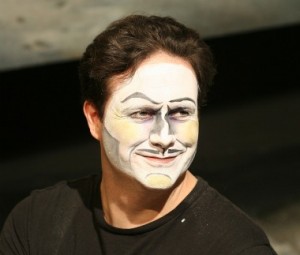
Jared Michael Delaney as "Frank and others." Photo by Katie Reing

If they can make it there, they can make it anywhere.

At least that’s what the folks at Philadelphia’s Inis Nua Theatre Company are hoping. But they’re going to need help from you.

More specifically, they’re hoping to take their acclaimed production of “Dublin by Lamplight” to the Big Apple as one of the featured plays in the 1st Irish Theatre Festival, which runs from September 7 to October 4. (See our review. We loved it. Or as we theatre reviewers say: It was “boffo.”)

“Dublin by Lamplight” is booked to run four weeks—24 performances in all— at the prestigious off-Broadway 59E59 Theatre.

Inis Nua, an extremely creative bunch, produces plays from Ireland, England, Scotland and Wales. Their talent has not gone unnoticed, certainly not by local theatre goers. But someone else pretty important also noticed.

“Elysabeth Kleinhans, the artistic director of 59E59, came and saw the show (Dublin by Lamplight) during its last week,” says Tom Reing, Inis Nua’s founder and artistic director. 59E59 is one of the participating venues. “That’s when she offered us a slot. I think she had an idea we were interested in doing this, but I had no idea she was coming. She e-mailed me the day before. The last time we were in New York, we were in an off-off-Broadway house, but 59E59 is much more of a destination point for people.”

All pretty exciting. But before they get to New York City, the theatre company needs a little traveling money—$40,000 to be exact, of which they have raised $26,000. Moving the play to New York for an extended run is a costly proposition, involving everything from travel and housing costs for the cast and crew to piano rental.

What’s more, they need it no later than September 1. Inis Nua continues to raise larger amounts through some of the traditional non-profits, but just important are the smaller-scale grassroots efforts.

“We’re doing a multi-pronged way of raising money,” says Reing. “We’ll also be doing things like happy hours and other events. We’re basically taking a leap of faith that our supporters will help us out and we’ll be able to do this. It’s such a great opportunity.”

Reing is especially eager to present this particular play. “It’s one of the reasons I started this company,” he says. “When I first saw this play in Dublin in 2002, I was blown away by it. I would love to have directed it, but I didn’t have the money at the time. This past spring, I had the money to do it justice.”

You can help Inis Nua do the play justice in New York City. Navigate on over to the Kickstarter Web site to make a pledge. The company is attempting to raise $5,000 on Kickstarter, which bills itself as “a new way to fund and follow creativity,” of which $2,470 has been pledged as of today.

It’s easy to make a pledge, and it’s all in an extremely worthy cause. Please pledge today.

News, People

A Year Later: A Hero Remembers

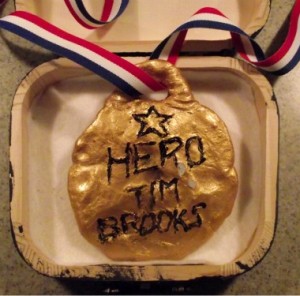
A treasured honor: a homemade medal from a child saved.

When the call came over the police radio, Tim Brooks knew it was something big. He could feel it. A boat capsized off Penns Landing. There were survivors in the Delaware.. “It’s not something you hear every day,” says Brooks, a 19-year veteran of the Philadelphia police department and a detective with the bomb squad. “If you’ve been a cop for any amount of time you get some sense of what’s going to be legit and this sounded legit.” And serious.

Brooks was with his partner and an ATF agent at ATF headquarters at Customs House at Second and Chestnut a year ago–on July 7, 2010—when they heard the call. Just a couple of blocks away, a 2,100-ton city-owned barge picking up sludge rammed a stalled sightseeing boat operated by Ride the Ducks with 37 tourists on board, sending the crew and passengers into the murky, fast-moving waters of the river.

That’s what Brooks saw when he and his colleagues arrived at the scene just a few minutes later. He remembers it like a photograph: heads bobbing like buoys in the Delaware, many of them terrified children frantically swimming toward shore, the ravaged Duck boat now sitting at the bottom of the river. “You had to take a moment,” recalls Brooks. “There were so many people in the water. You didn’t know where to begin. It seemed overwhelming.”

But that’s where the thinking stopped and instinct took over. Brooks quickly shed his gun, his wallet, shoes and keys and jumped into the water, his eyes on a woman and three children struggling to grab on to a row of wooden pylons about 20 yards offshore.

“The first one I reached was a young girl, maybe 10 years old,” Brooks recalled. “She wasn’t panicking, but I could see she was upset.” He grabbed hold of her and helped her grasp one of the pylons.

By this time, a Coast Guard boat had reached the group, but couldn’t get close because “if a wave came or the current switched, you could get crushed,” says Brooks. The Coast Guard crew tossed a rope out, and Brooks put the little girl’s arm around his neck and swam her to the boat where she was pulled on board. “Then I went back for the other girls,” he says, “and a group of Navy Seals in a small boat arrived.” Fortuitously, the Seals were visiting Philadelphia from Reston, Virginia, for Navy Appreciation day. Since their vessel was an inflatable Zodiac, they were able to pull alongside the group and Brooks helped pull the woman and the other children out of the water.

There was no room for Brooks in the Zodiac so he swam back to the Coast Guard boat. “I was pretty tired when I got back. Someone told me that I had been in the water for 15 minutes which is a long time to tread water. But I couldn’t have told you how long I was in there—I was a little busy,” he says, laughing.

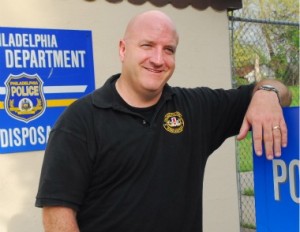
Medal of Honor winner, Det. Tim Brooks of the Philadelphia Police Department.

Sitting outside the small office of the city’s bomb disposal unit in northeast Philadelphia, the sound of bullets and explosives punctuating the air, Brooks concedes that the case was unusual for him—he’s an investigator whose milieu is fire, not water. But he still considered his actions all in a day’s work. “I don’t feel like I did anything special. It’s my job,” says the tall, affable Brooks, whose family tree, like that of many descendants of Irish immigrants, is crowded with cops and firemen.

But other people thought that what he did was more than special. They thought it was heroic. One of them was Philadelphia Homicide Detective Jack Cummings who nominated Brooks—without his knowledge—for a Congressional Medal of Honor Foundation award. The organization, chartered by Congress in 1958, consists exclusively of recipients of the Congressional Medal of Honor, the highest military decoration given by the US. These same honorees, most of whom risked their lives in combat, choose the recipients of the Citizen Service Above Self Award every year.

“He did it in December and told me in January,” says Brooks. “He said he just wanted to let me know that ‘that was a good thing you did.’”

In March, the Foundation announced that Brooks was one of three people from around the country—including a Boston school crossing guard who died after throwing herself in front of a car to protect a child—chosen to receive the award, which is bestowed at a ceremony at the Tomb of the Unknowns at Arlington National Cemetery in Virginia. Marine Lt. Col. Harvey C. “Barney” Barnum, who received the Medal of Honor for risking his life to save his beleaguered battalion when they were pinned down by enemy fire at Ky Phu in the Quang Tin Province in Vietnam in 1965, presented Brooks with his award.

“I never in a million years thought I’d ever get something like that,” says Brooks. “I still don’t think I deserve it. Millions of people do tremendous things every day and I’m not one of them. I feel humbled to be considered among them.”

Brooks spent three days in the Washington area with the Medal of Honor winners. “We were throwing back war stories like we were old friends,” he says grinning. He and the other honorees met President Obama at the White House. The days were already fraught with emotion, but Brooks had another reason to be grappling with his feelings. The day on which he received his award was the first year anniversary of his father’s death. “It still gets to me,” he confesses, his eyes watering. “I carried his picture in my pocket. I really think the date was no coincidence.”

Brooks was carrying something else with him too. One of the children he rescued, a little girl named Lily, had surprised him at the ceremony with her own medal—homemade from clay, painted gold, and even inscribed with his name. (See a photo of Lily and her hero here. )  How they met—both the first and second time–was serendipitous. “When the story appeared in the paper, my wife Shannon’s hairdresser told her she was dying to tell her something. She said, ‘The woman your husband saved is one of my clients. She was in here the other day, crying, and she said she was going to contact the police department because they want to meet him.’”

When they finally did meet, Lily’s mother gave Brooks a copy of the letter that her daughter had written to the Congressional Medal of Honor Foundation. “I read it and we sat around sobbing like a bunch of two-year-olds,” Brooks confesses sheepishly.

In Arlington, he showed Lily’s medal to Col. Barnum. “We were about to have our official pictures taken and I said to him, ‘Colonel, can I leave this on? He said, ‘If you don’t, I’ll break your arm.’”

Brooks is the only one in the official photos wearing not one, but two medals. It’s hard to tell which he treasures more.

“As you can see,” says Brooks, “I’m really humbled by this whole thing and I’m not comfortable talking about it. But I wanted to speak out because I am a product of the training I got in this police department. In my opinion, this is the most professional law enforcement organization on the planet, though sometimes the media tends to highlight the negative. The truth is, cops from here to Alaska are doing heroic things every day. I didn’t do anything special. I was doing my job. I know that any of my fellow police officers would do the same thing.”