Monthly Archives:

April 2011

People

RUNA Launches “Stretched On Your Grave” at The Irish Center

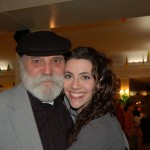
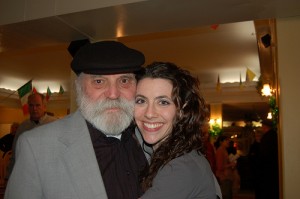
Shannon and her grandfather, Bob Lambert

Shannon and her grandfather, Bob Lambert

If there was a handbook on how to successfully launch a new CD, RUNA could have written it, with the first rule being: Fill the audience with old and new fans, and welcome them all as though they were part of the family.

Deciding to hold their launch concert for “Stretched On Your Grave” at the Commodore Barry Center (aka The Irish Center) in the Mt. Airy neighborhood of Philadelphia was a no-brainer for the group, whose lead singer, Shannon Lambert-Ryan, grew up dancing there. Turning it into a place as welcoming and familiar as a pub in Ireland became a family affair, with Lambert-Ryan’s mother, Julie Lambert, taking the lead in creating tables of authentic food.

The significance of the role family plays in the band members’ lives was on relaxed display throughout the evening. With percussionist Cheryl Prashker’s husband Charles Nolan at the CD table, and Lambert-Ryan’s younger sister Emma joining her onstage for a delicate and luminous duet of “I Wish My Love Was a Red, Red Rose,” everyone took part.

Even family members across the sea were included, as Dublin-born guitarist Fionán de Barra explained to the packed audience that his mother told him the other day that “she doesn’t think there’s anybody in Ireland who sings the Irish songs as well as Shannon sang them on the album—anybody.” Lambert-Ryan added, “She was the ultimate test, we’ll tell you. If it doesn’t pass her and doesn’t pass Fionán’s eldest brother, Cormac, it doesn’t go onto the album, it doesn’t go into the set. Fionán’s family actually has been very involved in bringing the Irish language back into use in Ireland…so it’s quite a compliment.”

Lambert-Ryan’s best friend from childhood on, Erin McMenimen was also in the audience, and shares photo credits on the CD cover with Philadelphia photographer Jayne Toohey.  McMenimen took the delightfully disquieting picture of Lambert-Ryan that appears as the front of the album. “We went on a search for the perfect front cover…to find THE perfect grave…and that is me on the cover of the album.  We searched around this area, and up into New England and the Northeast,” said Lambert-Ryan. But the photo they went with was taken by McMenimen in Doolin, County Clare, last summer when they were all over in Ireland for Lambert-Ryan’s Irish wedding to de Barra. “None of the graveyards that we found looked quite forlorn enough over here.  So we said we need to stick with that one.  And it was a gorgeous picture.”

And the latest addition to the RUNA family is violinist Tomoko Omura. “As we’ve gotten into more of the traditional side of things, we’ve stolen her, or borrowed her, so to speak, from the jazz and classical world, and we really don’t want to give her back,” Lambert-Ryan told the audience. Hopefully, they will be able to keep her for a long time to come, Omura’s exquisite playing is a brilliant addition to the band.

A fabulous, fun evening at The Irish Center, filled with an audience treated to some innovatively traditional music. Watch our videos and take a look at our photos.

http://www.flickr.com/photos/irishphiladelphia/sets/72157626282836011/with/5580045046/

Arts

Light and Shadows at the Plough & Stars

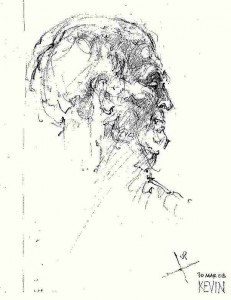
Kevin McGillian © Ted Watson

Kevin McGillian © Ted Watson

For more years than he can remember—practically since the Plough and Stars opened in the former Corn Exchange in Philadelphia’s Old City—architect Ted Watson has whiled away countless Sunday afternoons applying his well-honed visual skills to something very unlike the design of buildings. Instead, he takes pencil and pad in hand to capture in exquisite detail any and all aspects of ordinary life in one of Philadelphia’s most popular Irish pubs.

During the week, as an executive associate for Heery Design, Watson works on a range of architectural projects, including schools, health care facilities, and extended care and high-end retirement communities such as the Walnut Street Theatre Tower project. But on Sundays, he strolls a few blocks from his home in Old City over to the Plough to soak in the local color and translate it into unembellished black and white.

Bar patrons, diners, waiters and waitresses, brass beer taps, piles of crumpled napkins—they all find their way onto the pages of his sketchpads.

But if you’re leafing through the bright white pages looking for a recurring theme, a favorite quickly emerges: It’s the fiddlers, flutists, pipers and accordion players who meet every Sunday afternoon at the Plough for a free-wheeling traditional Irish music session.

Watson doesn’t play an instrument, but he understands and appreciates the energy and the passion that the Plough musicians pour into their reels, jigs and hornpipes.

“I appreciate creative effort above anything else in life,” he explains. “They’re givers. They maybe get a free beer, but they’re here mostly because they love doing it.”

[cincopa AMEAvhqBbqAo]

Irish musicians can be a shy bunch. They’re surrounded by chattering diners, a soccer game is playing on the gigantic wall screen, waitresses bearing drink trays pirouette past, but the musicians are mostly in their own world. Regardless, they don’t seem to mind Ted Watson staring at them.

Says Tom O’Malley, who has played guitar at the session for years: “Ted is part of the group. If he didn’t show up, I’d miss him.”

Perhaps one reason why no one minds is that Watson is completely unobtrusive. He’s average height, his brown hair is flecked with gray. He wears a simple plaid shirt and jeans. He is friendly but soft-spoken. But his Everyman appearance doesn’t explain it all. Watson possesses a sniper’s talent for fading into the scenery, and there’s a skill to that.

Hunched over a glass-ringed high-top table below a second-floor overhang, Watson easily blends into the woodwork. A focused yellow beam from an overhead canister shines down upon his sketchpad, illuminating his head and shoulders. The light refracts through the lenses of his glasses, forming tiny bright puddles on his cheekbones. From his perch, he sits mere feet from the ring of padded stools near the fireplace where the musicians pound out their tunes. Beyond the players, Watson has a bird’s eye view of the whole restaurant—the regulars propping up the bar and quietly sipping their pints, the families and gatherings of friends celebrating birthdays, the bright afternoon rays slanting down through the bar’s 16-foot windows, the dust motes dancing in the sun.

Watson knows what he’s looking for: the contrast between soft light and deep shadow on a fall afternoon—“Those old bank windows are incredible”—or the facial expression of a banjo player totally locked into an old Ed Reavey hornpipe.

And there’s one other element, harder to define, but Watson knows it when he sees it.

“The best thing is, it’s the moment,” he says. “The vitality of the moment is what fills the sketch with its energy.”

Energy might seem like the last thing you’d expect to see in a stark black-and-white pencil sketch. But Watson is highly skilled in capturing emotion. His sketches are not snapshots—they’re character studies, rich in detail and yet, as he says, “not super-realistic.”

Take, for example, one of Watson’s long-ago renderings of Kevin McGillian, a two-row button accordionist and the unassuming patriarch of Philadelphia’s traditional Irish music scene. In the lacy swirls, scribbles and delicate crosshatching, Watson presents meticulous detail while at the same time seeming to fill in only the barest outlines of his subject. On one level, we take in the clearly delineated outlines of McGillian’s prominent, sloping nose and strong, jutting jaw; on yet another level, we see only a cat’s cradle of spidery strokes and soft shading.

The McGillian drawing is one of Tom O’Malley’s favorites: “It’s hard to get a picture of Kevin. It really brings out the best in him.”

Watson is pleased, of course, when someone likes his work, but sketching does just as much for him as it does for his subjects. It’s clearly a departure from what he does, and does well, during the week. “I’m an architect, and people say I like doing this because it doesn’t involve straight lines,” he laughs.

But Watson’s love affair really goes back to when he was 15, in high school. “It was just an interest that I had,” he says. “I did portraits of all the team captains.”

He went on to major in anthropology, with a minor in art, at Franklin & Marshall College. He embarked upon a career in architecture in a roundabout fashion. Around the end of junior year, the chairman of the anthropology department took him aside, noted that he had all these other interests—art, sports, student activities—and suggested that perhaps anthropology might not be the correct career path. The anthropology chair suggested he talk to his art professor for advice … and he suggested architecture.

The professor, who had worked with Frank Lloyd Wright, “had forsaken architecture, or it had forsaken him, for sculpture; he was a very good sculptor. He saw art as a very difficult choice, financially and otherwise, as it surely is. He believed that architecture was a course that should result in a stable, employable life style, and in theory artistic satisfaction. He believed that my ability in sculpture and art would be applicable, as it was once for him.”

Watson went on to study at Penn, in the waning years of the great Louis Kahn.

Throughout his career in architecture, Watson’s love of art—he declines to describe himself as an artist—continued, though he pursued it only on his yearly vacations to Scotland, where he sketched castles and country life. “Then I’d come back here and I wouldn’t draw at all,” he says.

There came a point, though, when he knew that drawing only on holidays was just not enough. In time, that desire to do more led him to start taking in the creative opportunities available to him at the Plough and Stars. The music of the place was particularly appealing.

“Listening for me includes seeing, seeing includes action, trying to reach into the emotion, and energy of the moment. I became aware that I had so many willing, and often unaware, models for my visual research into the anthropology of living.”

Over the years, Watson has developed a kind of symbiotic relationship with those models, who, like him, pursue art for art’s sake. They don’t seek to draw undue attention to themselves, and neither does he.

“The joy of sketching is, it’s just my opinion,” he says. “If I don’t like it, I keep it and learn from it. If I do like it, I might show it to someone.”
[cincopa AgFA4jKUbiIk]

Music

A Photographic Visit to County Blackthorn

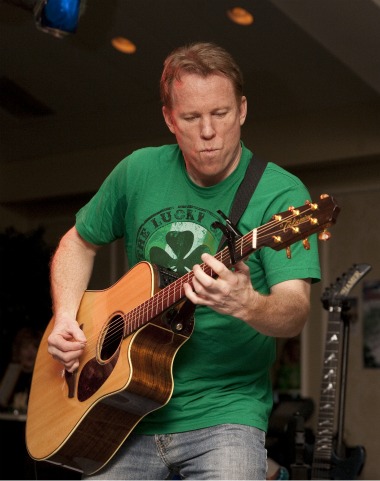
Blackthorn's new guitarist, Rob Dunleavy

Our roving photographer, Brian Mengini, spent a lot of time in March talking to and photographing the many Irish groups that came to Philly to help us celebrate St. Patrick’s Month. Some guys have all the luck.

Fortunately, he’s sharing some of his best photos with us at www.irishphiladelphia.com. This week, we get to see the fun he had at the Blackthorn concert at Springfield Country Club on St. Patrick’s Day. The photo on the right is of Rob Dunleavy, the newest member of this local phenom group that traces its roots to Ireland and Delaware County. Three years ago, Dunleavy, a certified public accountant who grew up in Delco,  gave up the other people’s money business for the crazy no-money life of a full-time musician (and part-time music teacher). He replaces longtime Blackthorn lead guitarist Seamus Kelleher, who has embarked on a solo career  but who will be guesting with Blackthorn occasionally.

The other members of the band are Delco’s finest–brothers Michael and John Boyce and button accordion player John McGroary–and Mike “Casba” O’Callaghan, the Buddy Rich-inspired drummer from Tralee in County Kerry.

Take a look at the fun they were having on St. Patrick’s Day in County Blackthorn, all captured by Brian Mengini.

News, People

Mary O’Connor Award Winners Announced

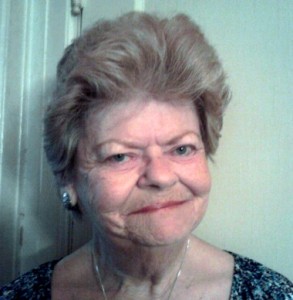
Mary O'Connor Awardee Serena White

This Saturday, the 2011 Philadelphia Rose of Tralee will be chosen at a gala event at the Springfield Country Club. The Philadelphia Rose of Tralee was established in 2002 as an official center of the International Rose of Tralee Festival, one of Ireland’s longest running regional festivals that has as its central focus the selection of the International Rose of Tralee, a young woman of Irish descent who is chosen, according to the International Rose of Tralee website, by the “indefinable quality that captures ‘the truth in her eyes,’” a reference to the song on which the Rose festival is based.

The original Rose of Tralee was a woman named Mary O’Connor, a woman of humble beginnings who fell in love with the wealthy son of her employer. She, wisely sensing that their union could never be because of their class difference, refused William Mulchinock’s offers of marriage. But it was a flase accusation of murder against her lover that tore them apart. He fled to India where he worked a a war correspondant. When he finally returned, it was on the day of Mary’s funeral. Though William Mulchinock married and had a family and emigrated to American during the famine years, he returned to Ireland to live again in Tralee and was buried next to Mary in Clogherbrien, County Kerry.

Three years ago, the Philadelphia Rose of Tralee Centre established a separate award given the night of the Rose Gala to a woman who embodies the proud spirit of Mary O’Connor. This year, the Mary O’Connor Spirit Award is being given to three women who have worked tirelessly for a variety of causes in the Irish community: Pat Bonner, Frances Duffy, and Serena White.

Sarah Conaghan, co-chair of the Philadelphia Rose of Tralee, provided these brief bios of this year’s winners:


Pat Bonner and Frances Duffy: Still activists!

Patricia (Pat) Noone Bonner, was born the 5th oldest of seven children (5 girls and 2 boys) and was raised in Philadelphia where she still lives today.  Her later school years were spent in the old Good Shepherd Parish and graduated in 1958 from West Catholic High School for Girls.

Pat’s first trip to Ireland was three months long.  She and her father sailed to Ireland aboard the USS America in 1959.   Her family roots are in County Mayo, specifically Ballina.

In 1964, Pat married Knute (Phillip, Sr.) Bonner and are the proud parents of eight children: Patrick, Mary Beth (she and her band provide the entertainment for the Philadelphia Rose Gala), Phillip, Jr., Sean, Seamus, Erin, Brigid and Deidre.  Currently, they have seven grandchildren and one more on the way!

Pat is still very active with groups that promote the reunification of Ireland such as Clan na Gael, Irish Northern Aid and the Federation of Irish American Societies.  Like many strong women through out history, it’s not the big dramatic things that have made a difference in people’s lives but the small and steady efforts of their tireless abundant devotion; this would sum up  Pat.  With her father, Martin Noone, who was a proud soldier of the East Mayo Brigade, Republicanism and the rights of Irish Soldiers has been instilled in her from an early age.   She doesn’t just talk the talk but walks the walk.  Not only would you see Pat and her husband Knute attending almost every Irish function in the area for over the past 40 years or more, they would have been volunteering.  A number of years ago Pat started the Philadelphia area branch of the Irish Political Prisoners Children’s Holiday program when she learned that children of political prisoners were not given the opportunity to enjoy a holiday in the United States.  Through her long standing friendship of over thirty years with the family of Tom Conaghan, founder of the Irish Immigration and Pastoral Center in Upper Darby, Pat began volunteering in 2001. As she would say “I’m only doing my father’s business!”

Frances O’Donnell Duffy was born on September 20 and raised in the Germantown section of Philadelphia by Irish immigrant parents, James and Bridget O’Donnell from Letterkenny and Creeslough, County Donegal, who instilled a great love for her Irish ancestry.  Living in a very Irish neighborhood she had many friends with the same family background, and she and her friends enjoyed going to dances all over the city.  It was at one of these functions that she met Daniel Duffy from Derry City, County Derry.

On August 2, 1958, Dan and Frances married and settled in Collingdale, PA. With moves to Germantown and West Philadelphia, they eventually settled in Upper Darby where they raised their four children, Mary Frances, Theresa, Danny and Maureen, instilling the same value and love of Irish ancestry in their own children.

Along with her husband, she became a member of the Derry Society in 1970 holding several offices including recording and financial secretary as well as treasurer.  While a member of the Derry Society she worked on committees that brought several youth groups from Derry with the focus on arranging events and housing with families in the Philadelphia area, housing many in the Duffy household.  The Duffy house saw many visitors from individuals such as Northern Irish political leader John Hume to the Doire Colmcille Minor Football Team.  You never knew who you would find at the dinner table or sleeping on the living room floor. It didn’t matter –Frances always made them feel welcome.  Over the years the Derry Society disbanded, but in 2009 Frances played an integral part in bringing it back to life. On May 1, the Derry Society will hold its second annual Derry Society Social at the Irish Center in Philadelphia.

Frances and her husband were involved with many of the Irish societies and were members of the Irish Center and the Federation of Irish American Societies where Frances held the office of recording secretary and is currently the treasurer.

They were members of Irish Northern Aid from its formation in the early ‘70s working toward a united Ireland.  Frances is still a member of Irish Northern Aid.

On December 23,, 1975, Daniel Duffy was indicted by a federal Grand Jury which charged him with conspiracy to ship weapons to Ireland in the fight for Irish freedom from British rule.  Frances showed great strength as she stood by her husband during this time.  As a result she returned to the work force to help support her family.  From May until July of 1976 she attended the trial in the afternoons while working in the mornings.  When the trial was over and her husband was acquitted,  she enjoyed being back in the work force and she remained in her position at Merrill Lynch for 28 years.  She started as a PBX operator and worked her way up to become assistant to administrative manager and ended her career at Merrill as the main administrative support person for one of the firm’s most productive management teams.

In 2004, she retired and continued in supporting the Irish community by volunteering at the Irish Immigration and Pastoral Center in Upper Darby where she assisted by fielding phone calls and walk-ins for such things as Irish citizenship for Irish Americans, helping individuals with the forms to renew their passport, green card applications and filling out of forms for American citizenship.  One of her most successful and rewarding accomplishments at the Center was the formation of the “Senior Luncheon Group”.  Along with Mary and Sarah Conaghan, she worked to contact a group of senior Irish Immigrants and those of Irish American descent to gather at the Immigration Center on Wednesday for lunch and an afternoon of social interaction.   After 8 ½ years, she left the Immigration Center.

She is still an active member of the Derry Society, Clan na Gael, and LAOH Trinity division where she holds the post of “Freedom for Ireland” representative.

Serena White arrived into the High (maiden name) family as Alicia Serena just after the start of World War II.  Her family moved to Drexel Hill in 1953.  Except for a year away, she has lived in the same home for more than 57 years.  Serena’s mother, a Bolger, Kinsella, Reilly, is her Irish connection and their roots go back to counties Carlow and Cavan in Ireland.

Serena attended Archbishop Prendergast High School and was a proud member Prendie’s first graduating class.  After high school, she taught third grade at St. Joseph’s in Collingdale, while attending Immaculata College.  Then she went to work for Bell Telephone Company of Pennsylvania (now Verizon).  During her 33 plus years at “Ma Bell”, Serena was part of the external affairs department. During her last eighteen months there, she worked in Harrisburg where she managed the special services group.  When Serena retired in 1994, she was working and interacting with 38 independent telephone companies in Pennsylvania.

In 1976, Serena married and became a Mom to her 20-month-old stepson on the same day.  Since her son had special needs, she joined a parent advocacy group that negotiated with schools and health professionals to get children the services they needed.  Also part of Serena’s work was representing parents’ views at the vounty level and with the Pennsylvania Department of Education in Harrisburg, where she was the first parent Representative for the statewide Student Assistance Program.

In 2000, Serena met Father Gerry Burns.  He asked her to do him a favor and the rest is history!  Serena spent ten years with Tom Conaghan, Fran and Pat helping the Irish and Irish Americans at The Irish Immigration and Pastoral Center.  Currently she devotes time to LAOH, Trinity division 4, where she has been a charter member since 1998.  Serena also serves as 2nd Vice-President for the Federation of Irish American Societies, (including the Commodore John Barry USN Association), and is the National Secretary of Tar Anall America – a program that supports former Irish political prisoners and their families.

Serena has two beautiful and loving grandchildren who live with her.  Her grand­daughter Alicia is a 16-year-old veteran Rose Petal in the Rose of Tralee pageant, and grandson Paul is a 13-year-old first time escort.


How to Be Irish in Philly

How To Be Irish in Philly This Week

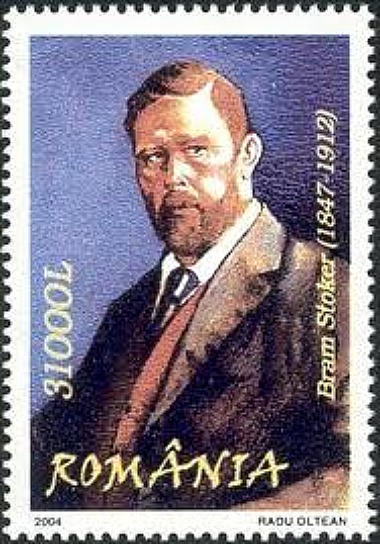
Dubliner Bram Stoker on a Romanian stamp.

There is absolutely nothing Irish going on this week.

Wait for it.

April Fool!

Okay, now that we’ve gotten that out of the way, here’s what’s really going on, starting this weekend.

Rose of Tralee! The 10th annual Philadelphia Rose of Tralee Selection night is Saturday, April 2, at the Springfield Country Club. A new Rose will be chosen and last year’s winner, Mairead Conley, will give up her crown. The chosen one will compete this August at the annual Rose of Tralee Festival in Tralee, County Kerry. This year’s Mary O’Connor Spirit Award, given by the Philadelphia Rose of Tralee Centre, will be shared by three local women, Pat Bonner, Frances Duffy, and Serena White.

Sebastian Barry’s play, “The Pride of Parnell Street,” continues at Act II Playhouse in Ambler.

Also on a run are the paintings of Irish artist T.C. Murphy at Colm Rowan Fine Art on South 10th Street in Philadelphia. This is Murphy’s second show in the US of his modern works that combine spirals, circles, pyramids, coils and waves on a palette of primary colors. The show starts on Sunday and runs through the end of April.

On Sunday, the Rosenbach Museum and Library has a special program called “James Joyce and Irish Authors” which will feature readings from Joyce’s “Ulysses” and Bram Stoker’s “Dracula,” and other Irish writers. (You didn’t know Abraham “Bram” Stoker was Irish, did you? He was a Dubliner and his day job was acting as personal assistant to then famous actor Henry Irving and business manager of the Lyceum Theatre in London which Irving owned. Apparently, that wasn’t enough work for Stoker—he began writing short stories and novels of which “Dracula” is his most famous.  He was in essence the Stephen King of his day; most of his stories and novels fall into the horror genre. Stoker had a newspaper background. He was also a theater critic for the Dublin Evening Mail, which is how he met Irving who hired him away. Oddly enough, Stoker the Dubliner has a Pennsylvania connection—the original manuscript of Dracula, thought to be lost, was found in the early 1980s in a  barn in northwestern Pennsylvania.)

Bonus: The Rosenbach has an original manuscript of “Ulysses” written in Joyce’s hand and Bram Stoker’s notes and outlines for “Dracula” as well as other Irish manuscripts that will be available for viewing. It’s like being in the presence of greatness. Just don’t touch.

The Rosenbach is the center of all things Joyce in the Philadelphia area. Every year on June 16, the Rosenbach hosts a day-long Bloomsday celebration to commemorate the day Leopold Bloom, Joyce’s “Ulysses” protaganist, spent wandering the streets of Dublin. Local actors and politicians – pardon us if that sounds redundant—read passages from the book from morning till night.

If you’re at the Rosenbach, check out its latest Joyce exhibition—“Exile Among Expats: James Joyce in Paris.” It’s a multi-media exhibition that includes pages from Joyce’s Ulysses, artist Man Ray’s portrait of Joyce, selection from fellow ex-pat and poet Ezra Pound’s “Island of Paris” report in “The Dial,” a literary magazine, and a first edition of “Ulysses” smuggled out of Paris into the US in 1922. (After it was serialized in the US magazine “The Little Review,” the book was banned in the US as obscene, hence the need to smuggle it in.)

On Tuesday, Celtic Woman’s Orla Fallon, now a solo act, will be appearing at the World Café Live on Tuesday night. A singer and harper from Knockananna, Ireland, she, like her Celtic Woman colleagues, is a major attraction on PBS.

We’re filling up the calendar for April and there’s some fun stuff on the way. Check it out.