Monthly Archives:

April 2011

Music, News

Belfast Choir Coming to Philadelphia

Cappella Caeciliana

I have heard the Heavenly Host and it is 20 people from Belfast.

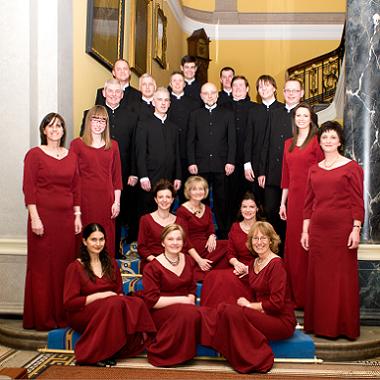
In their real lives, they’re bankers, priests, music teachers, insurance brokers and telecommunications workers. But when they sing, Cappella Caeciliana, Northern Ireland’s premier liturgical choir, will literally make you feel like you died and went to heaven.

They’re coming to the Philadelphia area the last week in April for two concerts, one at Villanova and the other at St. Malachy’s Church in Philadelphia, bringing 18 singers, a playlist of religious and Irish music, and a brand new composition by Neil Martin, who, as a musician, has played alongside Sinead O’Connor, Phil Coulter, Altan, and the Dubliners and records on Universal with his own West Ocean String Quartet.

Founded in Belfast in 1995 on the feast of St. Cecilia, the patron saint of musicians, Cappella Caeciliana specializes in liturgical music that’s largely gone from weekly worship. When was the last time you heard your church choir sing “Tantum Ergo?” Or “Ave Maria” in Latin? Or “Jesu Joy of Man’s Desiring?” Many younger Catholics will have to say, “Never.”

Choir member Phillip O’Rawe, who works for British Telecom, says the choir was started to “prevent that tradition from dying out.

“A lot of what we sing would rarely be heard at Mass because it’s a lot of Latin stuff from the 16th century and requires a reasonable advanced choir to sing it,” he says. “Although we do a wide range of music, including Irish music, from the 16th century till today. We just don’t sing secular music, except for the Irish stuff which we do for tours and concerts.”

When the choir was formed it was largely all Catholic. “It was started by three priests and a couple of other guys who roped in their friends,” O’Rawe says.

And those three priests? They’re “The Priests,” the break-out group made up of Fathers Eugene O’Hagan, Martin O’Hagan (they’re brothers), and David Delargy who have three CDs on Sony (one spent 13 weeks on the UK classical album charts) and can fill a concert hall the way many priests these days wish they could fill their pews.

Cappella Caeciliana is no slouch in the CD department either. They also have three, including Cantate Domino (2001), Sing for the Morning’s Joy (2005) and O Quam Gloriosum (2008), all available at CDBaby.com, where you can listen to excerpts of their music. The priests are on the CDs, but as  part of the choir. “If we had known [The Priests] were going to be famous we would have had them do some things as a trio and we could make a lot of money,” jokes O’Rawe, laughing. (The poverty, chastity, and obedience vows are still in place: the priests are hardly rock stars since they continue their parish work and fit their musical careers around daily Mass, baptisms, weddings and funerals.)

The choir members are not all Catholics anymore. “Over time we changed and spread the net wider to keep bringing new blood in,” says O’Rawe. “But everyone in the choir has a feeling for the music. A lot of the members have have grown up with the music and have sung in other choirs. It’s very much their own ethos and the underlying religious significance is important to them. I think if people believe what they’re singing, they’ll give a better expression of it.

“Not that we’re a bunch of holy Joes going around all day in prayer,” he adds quickly, laughing. “Still, we try not to have our pictures taken in pubs because it might get used in the wrong way!”

Having Protestants in the choir will likely be helpful when the choir sings choral evensong at the National Cathedral in Washington, DC, on April 29. “It’s Anglican and we’re used to Anglicans and the way they do psalms,” says O’Rawe. “They’re very much into chanting, which is more English style, while ours is a much more Italian style of singing.”

And being from Northern Ireland has had its perks. The concerts are free because the choir was able to get funding from both the Arts Council of Northern Ireland (via the UK National Lottery) and Culture Ireland, the Irish republic’s international arts program. The National Lottery made it possible for the choir to commission a new work from Neil Martin, “Exsultet,” a traditional Easter song of praise, to be premiered in Northern Ireland and on the US tour.

The only thing required to join Cappella Caecilia is the voice of an angel. When O’Rawe joined the choir at its inception, there were no auditions as there are now. Having an exceptional voice is vital: Except for the occasional organ accomaniement, the choir, as it name suggests, sing a cappella. “And there’s no hiding place in a choir of 20,” he points out.

Cappella Caecilia will perform at 7:30 PM on April 27 at Villanova University’s St. Thomas Church on the Villanova Church and at 7 PM on April 28 at St. Malachy’s Church, 1429 North 11th Street in Philadelphia. Both concerts are free.
 

Arts

The Roar of the Greasepaint

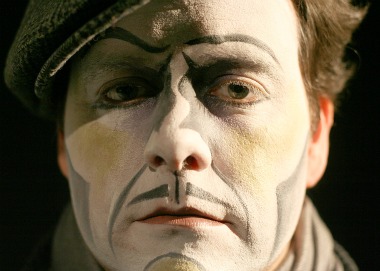
Actor Jared Michael Delaney, in character. Photo by Katie Reing.

Can six actors play 40 characters while wearing painted-on masks?

We’re about to find out. The Inis Nua Theatre Company’s production of the ground-breaking play, “Dublin by Lamplight,” opens on April 27 at Broad Street Ministry on the Avenue of the Arts in Philadelphia.

The play is set in 1904 when the King of England is paying a visit to Dublin where Republican sentiment is high and the atmosphere volatile. At the same time, a group of actors in the “Irish National Theatre of Ireland” are trying to put on a play called “The Wooing of Emer.” While the company producer is doing a little wooing himself—of a local rich woman who is leading protests against the British and whom he hopes will fund the play—his brother is gathering explosives to protest in his own way.

Inis Nua Artistic Director Tom Reing has been waiting a long time to bring the play to the US. He first saw it in 2004 when he was training at England’s Corn Exchange Theatre Company. Written by Michael West, whose “A Play on Two Chairs” was Inis Nua’s debut play, “Dublin by Lamplight” was directed at the Corn Exchange by Chicago-born Annie Ryan, who is also West’s wife. It wasn’t until Reing was able to get funding (and not by wooing any local rich women) that he was able to afford to produce a play with six actors. (And he’s not saving money by making them play 40 parts—it’s in the play.)

“It’s a dream come true for me,” Reing says. “This is the play that inspired me to start Inis Nua and we’re finally doing it.”

There’s more than a hint of Commedia dell’arte about “Dublin by Lamplight.” In the Italian style, the actors’ faces are painted to look like masks, so their characters and emotions are revealed instead by their voices, facial contortions and physical movements. It’s also true to Corn Exchange Theatre Company’s mantra, says Reing: “dancing on the razor’s edge between the grotesque, the heartfelt, and anything for a cheap gag.”

Funding for the play, which came from the Pew Center for Arts and Heritage through the Philadelphia Theatre Initiative, the Wyncote Foundation, the Charlotte Cushman Foundation and the Independence Foundation, also allowed Reing to bring in musician and composer John Lionarons to provide an original score.

“The music underscores the entire piece. It makes it feel like a silent move soundtrack but obviously we have dialogue,” Reing says.

Though Inis Nua’s season of Irish, English, Scottish and Welsh plays are usually staged at the Adrienne Theatre on Sansom Street, “Dublin by Lamplight” will unfold in the Sunday school room of the Broad Street Ministry which now occupies the Chambers Wylie Presbyterian Church, a Gothic Revival Church built in 1901, right across from the Kimmel Center. The setting couldn’t be more apt.

“There are six archways on two floors where all the classrooms were and the center of the room where they used to have choir practice is what we’re using for the performance,” says Reing. “Since the play takes place in 1904, we’re getting a lot of mileage out of the setting. We knew we couldn’t use the Adrienne because the style needed depth and height. We use only one chair, our only set piece, with a backdrop. The physicality transforms the stage. There’s a lot of ambiance.”

And, like many Irish plays, it is “riotously funny,” Reing says, “and then at the very end. . .well, I’m not going to tell you.”

You won’t have to wait for it for too long. Preview night is April 26, and the play officially opens April 27 and runs till May 14. Tickets are $20, $25 and $30 and can be ordered online or by emailing the box office at boxoffice@inisnuatheatre.org.

The play stars Jared Michael Delaney, Mike Dees, Kevin Meehan, Charles Delmarcelle, Megan Belwar, and Sarah Van Auken. Makeup by Maggie Baker.

See more of makeup artist Maggie Baker’s magic here. Photos by Katie Reing. And go behind the scenes at Inis Nua’s blog.

Music

Review: “800 Voices,” by Danny Ellis

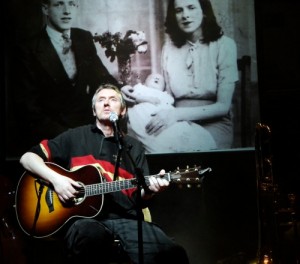
Danny Ellis in concert.

Danny Ellis in concert.

I apologize in advance for just now getting this. Danny Ellis’s “800 Voices” arrived in my mailbox a couple of months ago, and then St. Patrick’s Day and all the mayhem surrounding that day landed on me, and I just put it off.

In any case, I don’t want to let my slowness off the mark signify in any way my feelings about “800 Voices.” It’s a brilliant, if haunting piece of work.

Danny Ellis is a survivor of the notorious Artane Industrial School, in Dublin’s Northside, operated with wanton cruelty and unrestrained brutality by the equally notorious Christian Brothers. Clearly, their mission—to care for young children, many of them orphans, some of them categorized as delinquents—was wholly uninspired by Jesus Christ.

Ellis was committed to the school by his ailing mother, who was unable to care for her five children. Two of his brothers went to a school in Rathdrum, and two sisters wound up in an institution for girls in Booterstown. Young Danny Ellis entered Artane in 1955. He remained there for eight years, released when he turned 16. Artane, opened in 1870, was the largest of Ireland’s industrial scholols. According to the Commission to Inquire into Child Abuse, which investigated such schools, the Christian Brothers’ use of corporal punishment was “systemic and pervasive.” Allegations of sexual abuse and neglect also surfaced.

In light of that ugly history, you might suspect that Ellis’s cathartic musical recollection of his sad days at Artane could be a bit hard to take. And make no mistake, Ellis is unflinching in his depiction of his struggle at Artane—the fear, hunger, brutality, anger and lingering resentments.

Take, for example, these searing lyrics from Ellis’s “Innocence Back”:

They shattered our bodies
and they scattered our minds,
they broke us and beat us
’til we were twisted in time.
Then they cut us all loose
like rats in a sack,
now there’s no amount of money
gonna give us our innocence back.

And yet, for all the harrowing memories, “800 Voices” ultimately lands in a very hopeful place. The trauma of life in Artane clearly continued to color Ellis’s worldview for many of his adult years, but ultimately “800 Voices” makes you believe in redemption.

One reason Ellis is able to give voice to the poignant and painful memories that many others have kept submerged is that, after years of suffering what he refers to a “vague discontent,” he was able to connect with his feelings and find peace through meditation.

But way before that, when he was still a child navigating life at Artane, Ellis’s soul remained open to even the faintest possibility of joy. He found comfort in small things—the singing at Mass of another student, Tommy Bonner, and the arrival of summer signified by the Brothers’ issuance of soft red leather sandals to replace the usual stiff hobnail boots. And speaking of that rugged footwear, there’s a cute little song, “Who Trew Da Boot,” about the loud bang produced by an ancient loaf of bread on the dormitory floor after lights out. McCarthy, the ridiculous nightwatchman investigated, and assumed that the loud noise (the bread now safely hidden) was the result of a student tossing one of those heavy boots. “When 150 kids share a joke that the adult is not privy to,” Ellis writes in his liner notes, “suppressed laughter doesn’t remain suppressed for very long.”

But ultimately, Ellis found a sanctuary within Artane’s walls—a “friend,” as he puts it in another song—in music. Early on, he was recruited for the Artane Boys Band. He played trombone, blowing his lungs out. As he sums up his feelings in “The Artane Boys Band:”

There was nothing in this wide world as glorious or grand as the blast of freedom’s yearning from the Artane Boys band.

When he left Artane, Ellis carved out a musical career for himself, playing trombone in a string of Irish show bands, writing tunes for a time, and working as a session singer at London’s Abbey Road studios. (You’ll hear his trombone on the jazzy “Innocence Back.” He hasn’t lost his touch.)

For most of the CD, of course, Ellis accompanies himself on guitar and piano, but he also surrounds himself with some outstanding musicians: Duncan Wickel on fiddle, whistle and and uilleann pipes; River Guerguerian on hand and frame drums; and the mighty John Doyle on guitar bouzouki, mandolin and banjo.

It’s going to be some time before Ireland recovers from the bleak legacy of the industrial schools. Still, Danny Ellis offers ample evidence of the strength and power of the human spirit to overcome even the most tortured past.

History

Remembering the Rising

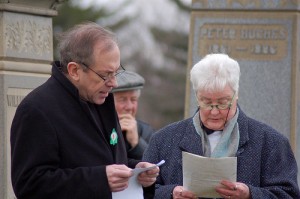
Tom Conaghan and Patricia Noone Bonner at a recent Rising ceremony.

Tom Conaghan and Patricia Noone Bonner at a recent Rising ceremony.

It has been 95 years since the 1916 Easter Rising, the abortive effort by Irish republican forces to bring an end to British rule. Still, the long-ago insurrection continues to resonate for many Philadelphians of Irish descent. After almost a century, a key stumbling block remains—Ireland remains divided.

Representatives of several groups, including Clan na Gael and Irish Northern Aid, will commemorate the rising—as they do every year—with a ceremony of remembrance Sunday at Holy Cross Cemetery in Yeadon. The memorial will take place at the gravesite of Joseph McGarrity, a confirmed physical-force republican from Philadelphia who provided a considerable sum of money to the Irish rebels.

Patricia Noone Bonner has been taking part in the ceremony for about 40 years. She remembers attending with her children. For her, the struggle remains unfinished. Memories of the 1981 Irish hunger strike at Long Kesh remain painfully fresh.

For Bonner, it’s all too personal. Her father Martin Noone was a dedicated republican from a little village near Ballina, County Mayo, who ultimately left Ireland in 1924, after the Irish Civil War, to find some measure of peace in Philadelphia, joining his brother in his home across the street from Our Lady of Mount Carmel Church at 3rd and Wolf.

To this day, Bonner is not completely certain of her father’s role in the troubles of the time. “He would have been too young for 1916,” she says. “I do know he was in the civil war. He went against the treaty with England. He didn’t go with the free-staters led by Michael Collins. But he didn’t talk about a lot of stuff. He talked about some things, but he didn’t talk about everything.” Martin Noone died in 1960.

As to why local Irish continue to commemorate the Easter Rising, Bonner is clear: “The 1916 rising was hopefully going to be the start of a united ireland. For us, it’s like celebrating the 4th of July. We do it in memory of all those patriots who have died for Ireland, and those who were in it (the Rising) who did not die.”

At McGarrity’s gravesite, this turning point in Irish history is recalled through the reading of the Proclamation of Indepenence, originally recited by prominent Irish leader Pádraig Pearse outside the General Post Office.

Continuing to remember the Rising is important, Bonner says, because “it’s still not a united Ireland. I know they are working toward it. They’ve stopped the armed struggle part of it. And many of the Irish will keep that goal in there minds over there, just like a lot of us here.”

The ceremony is scheduled for Sunday, April 17, at 2 p.m. in Holy Cross Cemetery, 626 Baily Road, in Yeadon.

How to Be Irish in Philly

How to Be Irish in Philly This Week

Siobhan Hughes leads the procession at Holy Cross Cemetery for the Easter Rising commemoration.

This weekend, the Bristol Riverside Theatre is present Late Nite Catechism 2, the return of “Sister,” who in LNC 1 was filling in for Father Murphy at his late night catechism class because he was attending his weekly poker game. Sister covers everything from Vatican to the afterlife to the “publics”—those unfortunate kids who didn’t go to Catholic School. In the sequel, Sister is instructing her class—that would be the audience—about the afterlife, including heaven, hell, purgatory and limbo. This one-nun play is as instructive as it is funny so even if you were a “public,”  it will probably do your soul good.

On Saturday, the California Celtic group Tempest—which only contains one Celt, fiddler Michael Mullen—will be bringing its high energy brand of modern folk rock with Norwegian influences (group leader Leif Sorbye is a native) to the stage at The Colonial Theatre. Opening for them is the popular local folk group, Full Frontal Folk.

On Sunday, we take a serious turn: Commemoration of the 1916 Irish Easter uprising that helped pave the way for an independent Irish state. The ceremonies take place at  Holy Cross Cemetery in Yeadon. The event starts with a procession to the grave of Fenian financier Joseph McGarrity, a Tyrone man and member of Clan na Gael, who immigrated to Philadelphia in 1892 where he became a successful businessman. There’s a social immediately after at the Galileo Club of Yeadon.

On Sunday evening, the group Belfast Connection is holding an EP release party at Brittingham’s Irish Pub and Restaurant in Lafayette Hill where group members often played when they were part of the late great Paddy’s Well. Dancing is encouraged.

If you own a pub or work in one, you should consider signing up asap for the Irish Pubs Global Conference being held over three days at Philadelphia’s Crystal Tea Room. Dave Magrogan, founder of local pub phenom Kildare’s, is a guest speaker.

Coming up next week: NicGaviskey, a transatlantic trad band (members come from Ireland and the US—maybe they practice via Skype), will be appearing on stage at the Irish Center on Saturday, April 23,  thanks to the Philadelphia Ceili Group. You can listen to them online (try not to tap your toes and bounce in your seat too much) and check out their photos (they’re very cute!). If you think that’s a funny name for a band, read their names. See? Get it? It’s a nice pre-Easter concert and kids are welcome.

If you’re in Bethlehem on Saturday, stop in and hear one of our favorite local bands, RUNA, at the small, cozy Godfrey Daniels Coffee House. If you haven’t been to Bethlehem, you should go. Stop in for lunch or the musical traditional breakfast on Sunday morning at Granny McCarthy’s Tea Room on Main Street (attached to Donegal Square, a huge Celtic gift shop).

Also heading our way, Cappella Caeciliana, the premier liturgical choir in Northern Ireland, will give two free performances, one at Villanova (April 27)  and the other at St. Malachy’s Church in North Philadelphia (April 28), before they head to Washington, DC, to perform at the National Cathedral. We’ll have a story on them next week.

And we’re getting excited about the debut of “Dublin by Lamplight,” an ambitious play produced by the fearless Inis Nua Theatre Company, in which six people play more than 30 roles. The play is being staged in the Sunday School room of the Broad Street Ministry building, a 1901 Gothic Revival church where John Wanamaker used to worship, across the street from the Kimmel Center. Preview is April 26 and opening night April 27.

This week’s answer to the question–where will I find more information on these events?–is the same as it always is. All the details are on our calendar.


Music, News

On the Road to Dingle

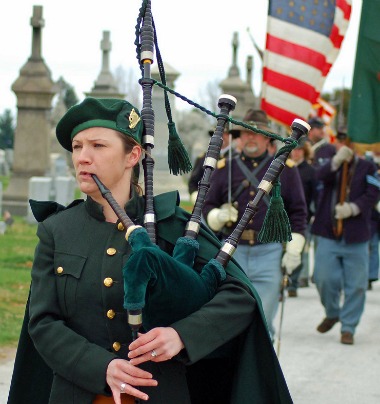
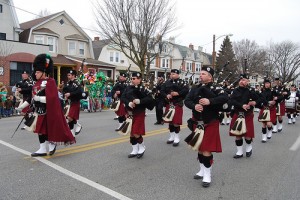
Irish Thunder Pipes and Drums

Irish Thunder Pipes and Drums

For many of them, it will be their very first trip to Ireland.

But what a way to go, as members and friends of a gen-u-wine Irish-American bagpipe band, and one of the most popular in the Delaware Valley at that.

Seventeen members of Irish Thunder Pipes and Drums will be heading to the Dingle Peninsula in Ireland’s wild southwest to take part in the Pan Celtic Festival. With friends and family, 78 people altogether are going on this trip.

The Pan Celtic Festival is a huge gathering of clans from Ireland, Scotland, Wales … anywhere there are Celts. The festival takes place from April 26 through May 1. The Irish Thunder band will march in the Parade of all Celtic Nations through Dingle Town on Friday night the 29th, says Pete Hand, the band’s drum major.

The last time the maroon-kilted band traveled to Ireland, it was in July of 2000, for the All-Ireland Pipe Band Competition in Kilkenny. So, says Hand, this journey has been a long time coming. Members of the band have talked about a return for several years, but plans for this year’s trip crystalized over the hot dogs and potato salad at the annual band picnic last year.

“We’re getting excited now … we’re getting closer,” says Hand, who leads the band.

“It’s the first time (traveling to Ireland) for me,” adds Hand. “It’s the first time for a few of the other guys, too. It’s gonna be great ..I think its really going to be fun.”

Irish Thunder won’t be the only pipe band in the parade, but they’ll be one of the few carrying an American flag. “I’m sure we’ll be playing some American tunes that they don’t normally hear over there,” he says.

Of course, there will be plenty of time for sight-seeing as well. The travelers will do the obligatory Ring of Kerry, take in the white-knuckle view (1,300 feet above sea level) from Conor Pass, and visit the Cliffs of Moher.

Hand also notes that in Dingle, a town of 1,300 when nothing else is going on, there are 52 pubs. Band members are likely to belly up to the bar in, oh, a few of them. Says Hand: “We might have a contest.”

How to Be Irish in Philly

How To Be Irish In Philly This Week

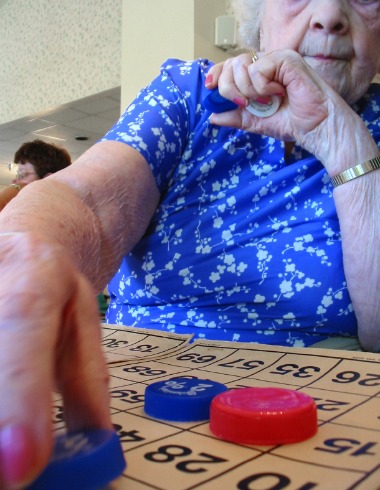
It's bingo afternoon at the Irish Immigration Center! Photo by iStockphoto.

This Saturday, you can combine some good-deed-doing with fun at the Eighth Annual Project Children fundraiser at Gloucester County AOH Richard T. Rossiter Memorial Hall in National Park, NJ. (It’s just over the bridge from Philadelphia.) The Broken Shillelaghs and O’Farrelly’s Whiskey will provide the music in support of this organization that brings children from Northern Ireland to the US for four weeks in the summer.

And while you’re in Jersey on Saturday, check out Enter the Haggis, a Canadian group with a huge local following, at the Appel Farm Arts & Music Center in Elmer. On Thursday, the Appel Farm is kicking off its annual June music festival at a free event at Fergie’s Pub on Sansom Street in Philadelphia with performers, giveaways, and drink specials. There will be buses leaving from Fergie’s to take festival goers to Elmer for the day-long event (featuring our own local phenoms, RUNA) on June 4. It’s never too early to celebrate.

Scots folk singer Archie Fisher and Canadian singer-songwriter Garnet Rogers are coming together in concert for Green Willow on Monday at the Lower Brandywine Presbyterian Church in Wilmington, DE.

On Wednesday, it’s Bingo! afternoon at the Irish Immigration Center of Philadelphia in Upper Darby. Bring your bingo markers and join in the fun.

Later in the afternoon, enjoy an “Afternoon of Irish-American Poetry” with Dr. Joseph Lennon of Villanova and Dr. Nathalie Anderson of Swarthmore at the Falvey Library on Villanova’s campus.

Beginner ceili dance classes, taught by local dance celebrity Rosemarie Timoney, are being held at the Knights of Columbus Hall in Glenside every Wednesday for the next 13 weeks. It’s open to anyone, 12 and up.

On Thursday, genealogist John McDevitt will be offering tips and advice for anyone looking for their Irish ancestors at the Irish Immigration Center. Ooops, adventures in grammar—you probably won’t find your Irish ancestors at the immigration center, but John will help you find them wherever else they may be.

Dublin alt-folk songwriters Kevin May and Mick Lynch of The Guggenheim Grotto will bring their own brand of folk-acoustic stylings to the World Café Live on Thursday.

On Friday, kick up your heels with The Shantys at the Gloucester County AOH Hall in National Park, NJ. That place is rockin’ this week.

Also on tap this week: The paintings of Irish T.C. Murphy at the Rowan Gallery in Philadelphia, and “The Pride of Parnell Street,” a Sebastian Barry play, on stage at ACT II Playhouse in Ambler.

One change to our calendar—the Jam for Japan scheduled for Saturday was cancelled because of flu. They’re going to reschedule when they get well.

Coming up next week—tax day! Boo! Think about celebrating it with the John Byrne Band and Citizens Band Radio at the Tin Angel on 2nd Street in Philadelphia. Or with the crazy Norwegian-Celtic group Tempest at The Colonial Theatre in Phoenixville, with their special guests, Full Frontal Folk, one of the area’s best folk groups. The Bristol Theatre is bringing Late Night Catechism II to the stage for those of you who missed Sister. And the Irish Pubs Global Conference is coming to Philly—but it’s only open to pub owners and staffs. Our own Dave Magrogan (founder of the Kildare’s empire) will be a speaker.

Later this month—Irish Night at the Reading Phillies, Fiddler Randal Bays and guitarist Davey Mathias, a visit from a celebrated Belfast choral group (we’ll have more on them later), and much, much more. Stay tuned! And read the calendar for all the details.

News, People

2011 Philadelphia Rose of Tralee Crowned

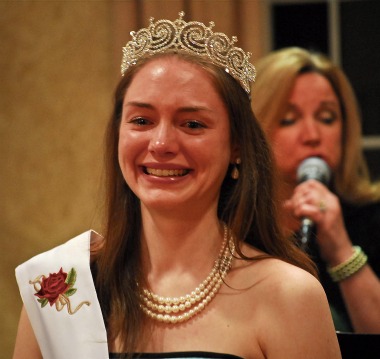
With tears in her eyes, the 2011 Philadelphia Rose of Tralee, Beth Keeley, poses for photographers.

A 25-year-old writer from Philadelphia, Beth Keeley, was crowned the 2011 Rose of Tralee at a gala event Saturday night at the Springfield Country Club in Springfield, Delaware County.

Keeley, a graduate of Temple University who spent a semester abroad in Dublin, is web content coordinator/project manager at eCity Interactive, an online marketing and web design company in Philadelphia. While at Temple, Keeley lived in a community service themed dormitory and she and her house mates worked in homeless shelters, food kitchen, cleaning community parks and raising money for cancer research. She and her father host a radio show on Saturday mornings. Her Irish roots are in Donegal and Mayo.

She will travel to Portlaoise on June 3-6 for the Rose of Tralee Regional Final.

Three familiar faces to Irish immigrants—Pat Bonner, Frances Duffy, and Serena White—received the Mary O’Connor Spirit Award for their tireless work with the newly arrived at the Irish Immigration Center in Upper Darby and with organizations such as Irish Northern Aid and Clan Na Gael.

CBS3 consumer reporter Jim Donovan was the host—and a very funny host, at that—and music was provided by Mary Beth Ryan and Friends. It was a special evening for Mary Beth Ryan—her mother is Mary O’Connor awardee and her 12-year-old daughter, Tara, was a Rose Petal, one of two programs for younger women and girls to become involved in the Rose of Tralee Program, which has a focus on community service and charity. The Philadelphia Rose participates in the annual Susan G. Komen Race for the Cure, does an annual food fundraiser around the Christmas holidays for a local food pantry and last year for the first time participated in Philly Clean-Up Day.

Along with 2010 Rose of Tralee Mairead Conley, there were five former Roses at the event, including Christine Frawley, the 2006 Rose, who was a judge.

It was a real family night, as you’ll see from our photos. And there wasn’t a soul there who wasn’t having a great time.