Monthly Archives:

November 2010

Music

Another Successful Benefit for St. Malachy’s

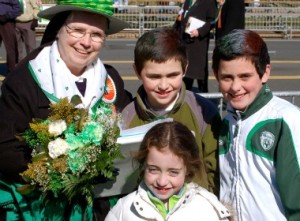
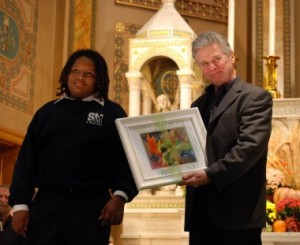
Musician Billy McComiskey shows off the art work presented to each of the musicians.

Musician Billy McComiskey shows off the art work presented to each of the musicians.

Nearly 1,000 people filled the pews at St. Malachy’s Church in North Philadelphia on Sunday for the annual “Mick Moloney and Friends” concert that benefits St. Malachy’s School, an independent Catholic school that educates more than 200 minority children in a parish that was once Irish.

The families of many former parishioners return to St. Malachy’s every year to hear folklorist Moloney tell stories and jokes and play the traditional music that the parish’s founders—a group of Irish immigrants and the Sisters of Mercy– listened to in the late 1800s when St. Malachy’s was the “little church in the woods.”

This year, the Galway-born Moloney, who is professor of music and Irish studies at New York University, brought friends Billy McComiskey (accordian), Dana Lyn (fiddle), and Jerry O’Sullivan (uillean pipes), along with Saul Broudy on guitar and vocals with Dennis Gormley, one-half of McDermott’s Handy, on electric guitar. Also on hand: Pastor Kevin Lawrence and retired pastor John McNamee, along with student Jalesaa Figueroa, a 2007 graduate of St. Malachy’s who is now a senior at Little Flower High School.

Figueroa, who lives with her disabled grandmother, threw herself a benefit concert and dinner this year to cover her last year’s tuition at Little Flower. A soloist in St. Malachy’s choir, Figueroa was the star of that particular benefit—and she came to St. Malachy’s benefit to tell the audience that she owed everything to the school that needed their help.

Music

Five Questions for Dana Lyn

When Mick Moloney and friends take the stage (or altar) at the annual benefit concert for St. Malachy’s School, Dana Lyn usually is one of the guests. There’s no one sitting up there who isn’t gifted, but Lyn’s gifts are pretty interesting.

She’s classically trained, with a degree in violin performance from Oberlin. At some point, one of her numerous online bios says, she “took a left turn” and was drawn to Irish music. The reality, though, is that her career has taken, and continues to take, many turns.

Her own MySpace bio is mind-blowing: She’s played Carnegie Hall. She was cast as an onstage musician in the Public theatre’s production of “Hamlet.” She focuses on string arranging and composition. Her musical associations include The Green Fields of America, Dionne Werewolf, Bach Reformed and the Yeti String Quartet. And I could go on and on, but I invite you to read the whole thing for yourself: http://www.myspace.com/danalynfiddle

Another one of those bios notes that “Dana was born in Los Angeles in 1974 to Taiwanese parents.” Lyn is one more of those non-Irish who has fallen head over heels for Irish music, enriching the tradition in ways that the old guys back in Clare and Sligo never could have predicted. (Pretty sure they’d like it, though.)

Dana Lyn is one very busy musician, but we managed to snag her for a quick five questions. Here’s what she had to say.

Q. How did you come to be in a Pogues cover band, and how did that influence your interest in Irish music?

A. I was in a Pogues cover band in college. We played once a year, at St. Patrick’s Day. We thought it was a good idea to put a few instrumentals in the set, so we learned a few sets off an Altan record and that got me started. More importantly, Miles Krassen was the Judaic Studies professor at my college; he edited a version of O’Neills and is a fiddle player. He introduced me to recordings of Michael Coleman.

Q. You’re certainly not the only non-Irish musician to play Irish music. What is there about Irish music, do you think, that speaks to people from a non-Irish background?

A. That is a difficult question to answer if you’re speaking about the music itself, as an abstract, or a group of notes played in a certain way. Generally, I am attracted to music that either challenges or comforts. I know that I was attracted to Irish music largely because the context in which it is played was so different from the musical context I had grown up with; it was informal, community-based, and relaxed. Also I was intrigued by listening to music played on my instrument in such a different way than I was used to.

Q. Once you discovered this interest, how hard was it to get into the scene?

A. I never really thought about getting into a “scene.” All I wanted to do was listen to the music and learn tunes. So I went wherever there was a session, and lurked about, really; listening most of the time, especially in the first few years.

Q. Who did you study with, and did you spend a lot of time honing your skill in sessions?

A. I didn’t study with anyone. I listened to a lot of records—everything I could get my hands on, and a lot of field recordings and tapes of sessions. I spent a lot of time at home practicing and analyzing the recordings I liked the most. I spent a lot of time at sessions, of course, but in terms of ‘honing skills’ and learning—it was more about practicing at home in a quiet space, and playing with a few people whose music I loved.

Q. You have a degree in violin performance, you have a classical background … and you play Irish music. How unusual is that kind of musical cross-pollination, really?

A. I suppose people find it unusual—or perhaps impractical—that I decided to delve so deeply into Irish music after having spent so many years playing classical music. I like playing ‘art’ music and I also like to play ‘folk’ music, both for different reasons. I don’t think I would be musically fulfilled if I did just one or the other. It makes a lot of sense to me, and life is too short to just limit yourself to one way of doing things.

Q. You’ve been involved in other projects outside of the classical. I’ve known classical musicians who have always and only played classical. How do you explain your diverse musical interests?

A. My childhood hero was Ludwig van Beethoven, because he played the piano, the violin, and the viola, and was a conductor, an improviser, and of course a composer. It makes sense to me that to experience music fully, and to be a musician (which is all I have ever wanted to be), one would have to know it from all angles. So…. I play the piano, the violin, the viola; I play classical music, I play traditional Irish music, I back singer-songwriters, I work as a string arranger, I can improvise, and I spend a lot of time writing (and erasing) music. Maybe I have ADD or something. Probably.

Music

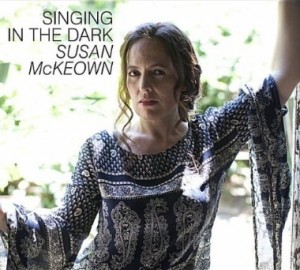
Review: “Singing in the Dark,” by Susan McKeown

Singing in the Dark

Singing in the Dark

The defining moment of “Singing in the Dark,” Susan McKeown’s moving meditation on the relationship between deeply debilitating mental illness and soaring creativity, comes toward the end of the recording, in a musical adaptation of the Welsh poet Gwyneth Lewis’s “Angel of Depression.”

The words McKeown sings, Lewis’s words, are brutally unsentimental: “Don’t say it’s an honour to have fought with depression’s angel. It always wears the face of my loved ones as it tears the breath from my solar plexus, grinds my face in the ever-resilient dirt. Oh yes, I’m broken but my limp is the best part of me. And the way I hurt.”

When McKeown hurls herself into the word “broken,” she tears through the upper registers like a razor blade through silk. In that single harrowing moment, you can begin to see depression for what it is at its worst, a soul-destroying cancer.

This is strong stuff, in an album full of strong stuff. In “Singing in the Dark,” McKeown and her musical colleagues Frank London and Lisa Gutkin take on the daunting task of putting difficult words to music. The album celebrates the work of poets such as Anne sexton, Nuala Ní Dhomhnaill and and Theodore Roethke. Lord Byron makes an appearance. So do Leonard Cohen and Chilean singer-songwriter Violetta Parra. A recording industry pitchman might describe it as a tribute to troubled souls. It is far more than that.

McKeown says she was inspired to make this album after reading Kay Jamison’s book, “Touched with Fire: Manic-Depressive Illness and the Artistic Temperament.” She also met with familiy members and friends of those suffering from mental illness, and she tapped into the melancholic themes that run like a dark vein through much of her native Irish music. Recording began in a studio on Ireland’s Achill island in August 2008. Thus emerged McKeown’s exploration of mental illness as the wellspring of creative genius.

The source material is indisputably rich: Take, for example, Anne Sexton’s “Her Kind,” in which the poet casts herself in the role of madwoman-witch: “A woman like that is not a woman, quite. I have been her kind.” Or Roethke’s poem, “In a Dark Time,” which ponders life at the extremes but ends on a transcendent note: “A man goes far to find out what he is—Death of the self in a long, tearless night, All natural shapes blazing unnatural light.”

Most of this material is not, by nature, “hummable.” None of this would work if the music didn’t just hold together, but hold its own with the world-class poetry. This, it does—in spades.

Take, for example, “The Nameless One,” by 19th-century Irish poet James Clarence Mangan. With verses like the following, it’s hardly upbeat:

“Him grant a grave to, ye pitying noble,
Deep in your bosoms: there let him dwell!
He, too, had tears for all souls in trouble,
Here and in hell.”

Amazingly, McKeown and colleagues deliver a wonderfully folky tune to accompany those words. The bouncy banjo treatment reminds me of Woody Guthrie’s “Gonna Get Through This World” on the group’s 2006 Klezmatics collaboration, “Wonder Wheel.”

“The Crazy Woman,” based on the poem by Gwendolyn Brooks, is a revelation. If you think about the opening lines of the poem, “I shall not sing a May song. A May song should be gay. I’ll wait until November I shall not sing a May song. A May song should be gay. I’ll wait until November and sing a song of gray,” you may not be able to hear a jazzy little piano lounge tune in it. McKeown and friends did, and it’s a treat.

I was wondering where I’d first heard the dolorous “In Darkness Let Me Dwell,” written by the lutenist John Dowland. It was on Sting’s 2006 CD, “Songs from the Labyrinth.” Susan McKeown’s version will easily make you forget Sting ever tried his hand at Madrigal singing.

“The Crack in the Stairs,” based on the work of Nuala Ní Dhomhnaill, is a bit more challenging, both for the singer and the listener. It’s a dissonant modern piano piece written by Irish composer Elaine Agnew. Give it a chance. It fits the bleak material.

And if not that, there’s more. The Latin standard “Gracias a la Vida,” by Violetta Parra, is a pretty piece. You may remember a Joan Baez version. McKeown’s version of Leonard Cohen’s “Anthem,” is performed with soulful elegance.

That any song on the album would be sung otherwise is unthinkable. McKeown at her best is always balanced right on the edge: fragility on the one side, strength on the other. It’s perfect for material that is so emotionally weighted—and for painting a portrait of life at the extremes.

News, People

The Boyle Brothers Go to Harrisburg

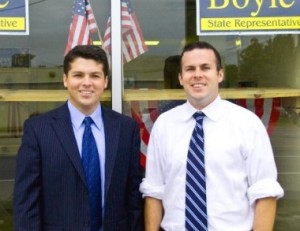
Your men in Harrisburg, Brendan, left, and Kevin Boyle. Photo by Katherine Gilbert

Your men in Harrisburg, Brendan, left, and Kevin Boyle. Photo by Katherine Gilbert

A pair of Irish-American brothers from Olney are heading to Harrisburg—and the record books—as the only brothers ever to serve together in the state assembly since it was founded in 1682.

On Tuesday, the voters in the 170th and 172nd district decided they wanted a guy named Boyle to represent them in Harrisburg. Kevin Boyle, in his first election as a candidate, beat beleagured Rep. John Perzel (who represented the 170th since before the 30-year-old Boyle was born), to join older brother, Brendan, who handily won his second term as state rep from the 172nd.

The Boyles, both Democrats, bucked the trend that put the GOP in charge of the state from the top down. Brendan’s district includes parts of Northeast Philadelphia and Montgomery County. Kevin’s district encompasses more of Northeast Philadelphia, including Mayfair, Tacony, Fox Chase and Holmesburg.

The Boyle brothers have already been compared to the Kennedys, but they may have more in common with Tom and Ray Magliozzi, better known as Click and Clack: the Tappet Brothers of NPR’s funny car repair show, “Car Talk.” The perpetually joking Magliozzis end their show with the trademark: “Don’t drive like my brother.” “And don’t drive like MY brother.”

Because, of course, every reporter in the world has asked them if they plan to carpool down the turnpike to the state capital. Even when they’re asked separately, both Boyles respond the same way. “I don’t know about that,” says Kevin. “I’m a much better driver than he is.” Says Brendan, “I have a great deal of trust in my brother when it comes to matters of public policy, but not so much in his driving.”

But Brendan did allow that sharing an office in Harrisburg—to save money during the state’s budget crunch—is “not out of the question. We shared a small apartment when we both went to Harvard.”

The Boyles, the sons of Irish immigrants (father Francis is from Donegal, mother Eileen from Sligo) and union workers, are the first in the family to go to college and they went big. Both Cardinal Dougherty grads, Brendan went to Notre Dame University and got his master’s degree in public policy from Harvard; Kevin, a LaSalle grad, earned his master’s in education policy from Harvard. Brendan is married; his wife Jennifer is a school teacher. Kevin is engaged and will be traveling to Ireland with his fiancé, Caitlyn Crotty, and the entire family in April to be married in his father’s hometown, Glencolumbcille.

The brothers get along like best friends. “We talk every day, a couple of times a day,a nd always about sports and politics,” says Brendan. “It’s always been that way. Even at Thanksgiving dinner that’s what we pretty much talk about—much to the annoyance of our parents.”

And to say that Brendan trusts his younger brother’s judgment is an understatement. Kevin Boyle was his brother’s campaign manager when he replaced longtime Republican incumbent George Kenney, who retired, two years ago.

Kevin hadn’t planned to make a run for public office himself until he was 35. Then something happened that made him think he didn’t have a choice. “When I saw that then State Rep. Perzel was arrested on 82 counts [of using public money for campaign purposes] and was still running for re-election, I thought there was clearly something wrong with that,” Kevin says. “Frankly, I was amazed he would do it but then there are a lot of people who were afraid to take him on because of his reputation. He can be intimidating. I have a thick skin so I decided to do it.”

Kevin Boyle may be a neophyte legislator but he’s seen both politics government from the inside. For three years he served as Philadelphia Councilman Bill Greenlee’s legislative director where he was involved in drafting important legislation, including the ban on cellphone use while driving and a law prohibiting businesses from firing victims of domestic violence and requiring them to get up to 8 weeks unpaid leave. He’s also been to Washington where he met with national lawmakers as an advocate for the Alliance for Children and Families, the nation’s second largest association for families services organizations.

Both Boyles see Pennyslvania’s economy—and its $5 billion budget deficit– as their overwhelming challenge in the new two years. “That’s going to be a long-term goal,” says Kevin Boyle grimly. His brother agrees. “We’ve gone through the last two years with big budget deficits without having to raise taxes, because we used our rainy day fund and $1 billion in cuts, which helped us avoid the bad consequences we’ve seen in states like Florida, New York, and California. We’ve been able to weather the storm,” says Brendan. “In an overall bleak economy, that at least is good news.”

Not surprising, both Boyles have a love for their Irish heritage and keen interest in Irish politics. Their grandfather, a veteran of Ireland’s war for independence, was active in the Fianna Fail, the largest political party in Ireland. And the Irish have also taken an interest in the Boyles. They’ve been interviewed by the Donegal Democrat newspaper and will be on talk radio in Dublin on Monday.

Brendan is exploring other ways his Irish roots can benefit both Ireland and his Pennsylvania constituents.

“I’ve formed a relationship with Irish Ambassador Michael Collins and we’ve identified over 100 Irish companies who have operations right here in Pennsylvania,” he explains. “I’m working to strengthen the bilateral relationship with the two countries. And although I’m a state official, I’ll do anything I can on immigration issues to help Irish immigrants to go back home and come back without any trouble.”

He points out that during the last legislative session, he was the prime sponsor of a bill making March Irish Heritage Month in Pennsylvania.

Then a thought a occurs to him. “You know, I better get that in quickly before my brother steals it from me.” He laughs. “Before, we were fighting over Nintendo. Now we’ll be fighting over bills. I’m sure we’ll work it out.”

Columns, How to Be Irish in Philly

How to Be Irish In Philly This Week

Mayo Honoree Sister James Anne with some friends.

Mayo Honoree Sister James Anne with some friends.

The Mayos will be having a ball this weekend. Those of you who know Philly’s Mayo Society know that they have a ball wherever they go and whatever they do, but this time it’s a capital B Ball. Their 105th to be exact. Along with dinner and dancing, they’ll be choosing the next Miss Mayo and honoring one of our favorite people, Sister James Anne, “the dancing nun”—she’s not only good, she teaches!—who is also a longtime special education teacher and chaplain of the Mayo Society.

It’s not the only event crowding the calendar this weekend. Another annual event is Blackthorn’s Ceili for Kayleigh, a benefit to support research into MMA (Methylmalonic acidemia), a rare metabolic disease in which the body can’t break down certain fats and proteins, leading to a build-up of a body acid that can lead to seizures and stroke. This benefit focuses on a local girl named Kayleigh Moran who was born with the illness. It will be held at the Knights of Columbus in Springfield on Saturday night.

Also on Saturday night, you can spend “An Evening with Mick Moloney” at Delaware County Community College where the renowned Irish musician and folklorist will talk about the impact of Irish and Jewish immigrants on Tin Pan Alley and American vaudeville music.

Burning Bridget Cleary is on tap at Daly’s Irish Pub and Restaurant in Philadelphia on Saturday night.

And you’ll be tripping over Mick on Sunday as he does his annual “Mick Moloney and Friends” concert to benefit St. Malachy’s Church and School in North Philadelphia. Mick has great musician friends (Athena Tergis and Bill McComiskey are going to be with him) and there’s often a surprise guest for this often standing-room only event (get there early to snag a good pew). Delawareans can catch Mick and fiddler Dana Lyn in concert at Timothy’s at Wilmington Hall in Wilmington on Tuesday.

The Donegal Association is holding its annual Donegal Memorial Mass on Sunday at 1 PM and the Shrine of the Miraculous Medal on Chelten Avenue in Philadelphia.

Tir Na Nog, at 16th and Arch in Philadelphia, is hosting the fourth annual Fine Art and Craft Show, to benefit Nancy’s House, nonprofit organization dedicated to caring for caregivers. The suggested donation ($10) gets you a bracelet that entitles you to 10 percent off your meal at Tir Na Nog that day. They’re also serving discounted beer and wine and will run a small cafe on the show floor.

Speaking of good-deed-doing, the AOH/LAOH 51 of Fishtown Hibernian Hunger Project this year–like last year–is collecting food, clothing and cash for the veterans served by the Philadelphia Veterans Multi-Service and Education Center. It starts Friday at 5 PM and continues through Sunday at the Thriftway Supermarket at Aramingo Avenue and York Street. See the calendar for exact times.

For you Bethlehem folk: New to our calendar this week, a regular traditional Irish music brunch on Sundays at Granny McCarthy’s Tea Room at Donegal Square on Main Street in the Christmas city.

Technically not Irish, but Scottish (same thing really), the band Battlefield will be bringing it on at the Sellersville Theatre next Friday. No, they don’t play martial music. They’re a Celtic fusion band named for a Glasgow suburb called Battlefield and they mix traditional instruments with modern stuff like synthesizers. We love to hear people from Glasgow actually say “Glasgow.” Try to get them to do it.

Also on Friday, a real treat: Coatesville Traditional Irish Music Series is presenting incredible accordian player John Whelan from Wexford teaming up with singer Tommy O’Sullivan of West Kerry, considered one of the finest contemporary folk voices in Ireland today. End your work week with a visit to the Coatesville Cultural Society where you can get a bite to eat then hear a fabulous concert.

Don’t forget to order your tickets to the Delaware Valley Irish Hall of Fame dinner on Sunday, November 14 (no tickets will be sold at the door). Honorees this year are Vince Gallagher, president of the Commodore Barry Club (The Irish Center); Msgr. Joseph McLoone, chaplain of the Donegal Association, and Kathleen Sullivan, a long-time member of the Irish Memorial board. Call 215-872-1305 or e-mail McGeeBurns@aol.com for information and tickets.

The Inis Nua Theatre Company’s production of “The Early Bird” ends its run at the Adrienne in Philadelphia soon—it’s not to late to get tickets!

Just a reminder: Our calendar of events is free and self-service. Just go to the calendar page (click on “see all” at the bottom of the snippet of calendar that appears on our homepage), click on the line that reads “Notify us about your Irish events” which will take you to a page where you can fill out a form about your event. We get an automatic email that alerts us to new entries, we click a button and presto-chango! Your event appears on our calendar which is seen by more than 1600 people every week and gets featured in “How to Be Irish in Philly,” our hands-down most read feature week after week.

People

Immigration Center Gala Honors Immigration Activist

Anne O'Callaghan

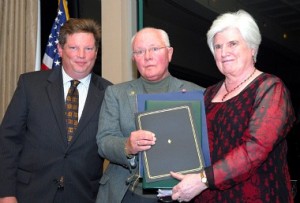
Anne O'Callaghan, right, with her award. To her left is Liam Hegarty, president of the Irish Immigration Center board, and Wendell Young III (center), retired union leader and Welcoming Center volunteer.

Nearly 200 people filled a ballroom at the Hyatt Regency on Penns Landing on Saturday, October 30, to see Anne O’Callaghan, founder of the Welcoming Center for New Pennsylvanians, receive the first ever Mathew Carey Hibernian Award in recognition of her years of service to the region’s immigrant communities.

The award was presented by Melissa Hancock of the Mathew Carey Association, whose late husband was a descendant of Carey, an Irish immigrant from Dublin, an American patriot, and publisher. A protégé of Benjamin Franklin, Carey also founded the Hibernian Society for the Relief of Immigrants from Ireland.

The award was the first ever to be given by the Irish Immigration Center of Philadelphia—and at its very first fundraising gala. Wendell Young III, longtime union leader and a Welcoming Center volunteer, brought the house down with his introductory speech in which said, “Nobody says no to this lady. When she sets out to get a program done it gets done. Her husband Sean said no to her once and look what happened to him.” He pointed to O’Callaghan’s husband, who was sporting a bandage around his eye. The crowd roared with laughter.

Accepting her award, O’Callaghan said it was “absolutely beautiful and quite, I believe, undeserved.” She thanked members of her staff and her clients, then made reference to Young’s introduction. “You can always count on Wendell to stir things up.”

O’Callaghan, a physical therapist who emigrated from Ireland in 1970, founded the Welcoming Center, which is a centralized employment and resource center for immigrants, in 2003. Since then it has served more than 7,000 immigrants from all over the world. She also founded a software company that serves the home health care industry. She is active in the National Alliance for the Mentally Ill and sits on the advisory board of the Southwest Community Enrichment Center.