News

A St. Patrick’s Day Present for the Philadelphia Irish Memorial

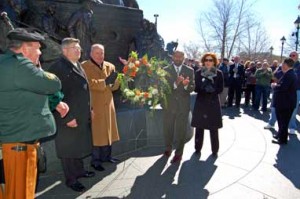
Philadelphia Mayor Michael Nutter joins in the wreath-laying ceremony at the Philadelphia Irish Memorial.

Philadelphia Mayor Michael Nutter joins in the wreath-laying ceremony at the Philadelphia Irish Memorial.

Last year, it snowed. This year, it was windy and vaguely arctic. However, the sun shone brightly as local irish, the great and the small, gathered to remember the Irish ancestors who overcame overwhelming odds and endured endless hardships to settle here in Philadelphia.

And the board members of the Irish Memorial, local dignitaries and just average Irish-American citizens gathered at the monument down at Penn’s Landing on a brisk St. Patrick’s Day morning had one other thing to warm their hearts: a three-year, $60,000 donation from the Board of City Trusts.

John J. Egan, chairman of the City Trusts board, said he got the idea from Irish Memorial board member Kathy McGee Burns over lunch one day. “You just can’t say no to that woman,” he told the crowd.

Irish Memorial Board President John F. Donovan note that “it was he fastest $60,000 we ever made.” The funds will be used to improve lighting and general maintenance and upkeep of the monument and its grounds, he said.

Philadelphia Mayor Michael Nutter—on that day going by the unwieldy moniker of “Michael O’Nutterman”—seemed genuinely delighted to attend the ceremony and take part in the wreath-laying. This is a man who apparently loves being mayor, and all the little ceremonies that go with the job.

And here’s another thing Mayor O’Nutterman said he loves: “We always love a generous contribution.” But he quickly added: “Just be sure to cash that check as soon as possible.”

No worries there, we’re sure.

Take a look at our photos from that day:

Arts

Irish Philadelphia Film Festival: The Butcher Boy

By Marianne MacDonald

The Butcher Boy

Released: 1997

Genre: Dark Comedy

Synopsis: “The Butcher Boy” is Neil Jordan’s adaptation of the shocking, award-winning novel by author Patrick McCabe. That book shook the modern Irish literary world on its publication in 1992.

I had read the book before seeing the movie, so I had some trepidation. I wondered whether the movie would accurately portray the vividly portrayed characters of McCabe’s novel. Never fear … the movie successfully captured, in rich detail, young Francie Brady (Eamonn Owens), his Da (Stephen Rea at his usual brilliant best) and his Ma (Aisling Sullivan).

Set in the uneasy early ’60s at the time of the Cuban Missile Crisis, the story depicts an Ireland quite unlike the Ireland of thatched cottages, peat bogs and fiddlers by the fireside.

Young Francie was a typical pre-teen lad bent on playing cops & robbers with his pal Joe, and tormenting the life out of prissy Philip Nugent and his mother, played with chilling acumen by Fiona Shaw. As the plot unwinds, we learn of the deadly illnesses inflicting Francie’s parents. Ma is a certifiable loon, listening to the song of the day, “The Butcher Boy,” over and over again, as she swings from manic bouts of baking to despairing depths of depression. Da is a washed-up musician suffering from the alcoholism all too common among Irish men. The best parts of their lives already seem to have passed them by.

Eventually tragedy strikes the Brady family and Francie begins his own descent into a life of violence and madness as he tries to make sense of what is totally senseless. He loses all that he loved, and so he comes to see the world as his enemy—and rightfully so. From the righteous prigs of the town who look down on Francie and his Da, to the pedophiliac priests, to the horrors of the mental hospital to which he is eventually consigned, Francie inspires in the viewer a righteous anger at a world too ready to dismiss the child as “evil, wicked and no better than a pig.” When Francie returns to the town that turned away from him, we find his escalating sense of anger and overwhelming need for revenge strangely comprehensible.

Why it’s one of the best: Watching “The Butcher Boy” is a bit liking watching an accident as it happens, but it is still an unforgettable film. I saw it first in the movies and then rented it to watch at home. I caught it on cable a few years later. I found myself telling friends about it. The movie shows a side of Ireland (and indeed, it could be small-town America as well) that Bord Failte would sooner you never saw, or were even aware of. As difficult as it is to witness Francie’s loss of innocence, there are memorable moments. For example, Sinead O’Connor turns up in an hysterical portrayal of the Virgin Mary, and veteran actors Brendan Gleason and Milo O’Shea portray pedophiliac priests in the boys’ home where Francie is sent.

There is surely a lesson to be learned from this film. Is the message that all children are a product of their environment, that it takes a village to raise or damn a child or that childhood is either hell or heaven? That’s up to the viewer to decide. What is certain, though, is this: Once you’ve seen the film “The Butcher Boy” you will remember the horrors that can be visited upon the young, whether here in the U.S., in “idyllic” small-town Ireland or in any corner of the globe.

Disclaimer: This film is rated R for profanity/violence/adult situations and is not for the faint of heart.

Marianne MacDonald is host of “Come West Along the Road,” broadcast Sundays at noon on WTMR-AM (800 AM), with archived shows available on the Web.

Arts

Irish Philadelphia Film Festival: Waking Ned Devine

Waking Ned Devine

Released: 1998

Genre: Comedy

Synopsis: Ned Devine, a bachelor farmer in the Irish town of Tullymore, wins the Irish National Lottery. His unbelievable luck is revealed to him one night as he sits in front of the telly, watching the numbered balls roll into place.

He’s thrilled. He’s shocked.

And, in moments, he’s dead.

Before long, word gets out that someone in the village has won the big prize—6.9 million pounds—but who is it? Ned’s not talking.

One of the elders of the village, Jackie O’Shea (Ian Bannen), sets about trying to find out. He enlists the aid of his wife Annie (the stunning Fionnula Flanagan) and his old chum Michael O’Sullivan (the diminutive David Kelly). In a campaign as cunning and subtle as the invasion of Poland (substitute a chicken dinner for the Stuka dive bombers) Jackie eventually rules out everyone in the village—everyone except one man.

Jackie and Michael go to visit Ned at his cottage—and there they discover the terrible truth. They find Ned in his comfy chair in front of the set, a smile frozen on his face, the winning ticket on the floor.

For a while, all seems lost. But then Jackie manages to convince himself that Ned would have wanted his two good friends in the village to share in his good fortune. He hatches a plot to persuade the lottery authorities that his pliant pal Michael is, in fact, the winner Ned Devine—but things rapidly spin out of control and, before long, the whole town is in on the action.

Will they be able to fool the lottery agent who comes to town in search of the winner? Will they persuade the town’s cantankerous, back-stabbing biddy to join the conspiracy—or will she turn them all in for the reward money?

Why It’s One of the Best: Written and directed by Kirk Jones, “Waking Ned” was one of the last films of veteran Scottish actor Ian Bannen. He died in 1999 in a traffic accident, just a year after this film was released. Let’s just say he saved his best for last. In the role of the conniving charmer Jackie O’Shea, Bannen is utterly convincing.

Then again, everyone in this fictional town seems real, from the grasping Lizzie Quinn (Eileen Dromey) to the tender-hearted but malodorous hog farmer “Pig” Finn (James Nesbitt, seen in “Bloody Sunday,” the first film we reviewed in this series). In a film that spans just an hour and a half, we somehow come to know everyone. It feels like we’ve always known them. Then again, if you grew up in a small town, as I did, then you probably have always known them.

Ultimately, “Ned Devine” is a charming confection of a film about friendship and the loving kindnesses of neighbors. It’s about the secrets we all know about each other, good and bad. It’s about community.

It’s also about lottery fraud, too, of course. Ah, but what harm is there in a bit of fraud among friends and neighbors? In the end, you’ll believe, as Jackie does, that Ned would have wanted it that way. So let’s all raise a glass to Ned Devine. And good night and joy be with you all.

Columns, How to Be Irish in Philly

How To Be Irish In Philly This Week

As the old saying goes, there’s no rest for the Celtic. We’ve barely put our “Kiss Me I’m Irish” beads away for another year and we’ve still got things to do.

This Wednesday, March 26, for instance, you can take a break from all things Irish and catch the Battlefield Band at the Sellersville Theater. They’re Scottish and Grammy-nominated too!

Then it’s back to Ireland on Thursday, March 27, when the first of the Irish Film Series debuts at the Irish Center in Mt. Airy. Jointly sponsored by the Irish Center, irishphiladelphia.com, and WTMR radio personality Marianne MacDonald, the first in a series of six great Irish films will be “The Boys and Girl from County Clare,” a romantic comedy centering on a ceili band competition. Fintan Malone, who knows more than a little about ceili bands, will be on hand to moderate a discussion afterwards. Malone, who plays in at least two bands (Blarney and the Malones) and anchors sessions at The Shanachie and McKinley’s Tavern, is a native of Milltown Malbay, County Clare, where his family’s pub is a hotbed of Irish traditional music. Admission is free. And unlike most movie theaters, you can watch the flick with your favorite brew in hand and some of Barry Club manager John Nolan’s world famous fries. You may never eat popcorn again. Read about it here.

On Friday night, March 28, legendary fiddler Kevin Burke and guitarist Cal Scott will appear at the Chester County Cultural Center in West Chester.

And though we usually wait to tell you about the next weekend, we want you to have a heads up: On Saturday, March 29, there will be a massive cook-in in Northeast Philadelphia to benefit the Hibernian Hunger Project. An estimated 10,000 meals will be cooked and frozen to feed the needy. This might be a good time to join the Ancient Order of Hibernians and the Ladies Ancient Order of Hibernians, who do this several times a year, God bless them!

This is also the weekend you can see:

•McDermott’s Handy at the Schwartz Center for the Performing Arts in Dover, DE
•Tiarna O’Duinnchinn and Stephanie Makem performing Irish music from Counties Monaghan and Armagh at the Coatesville Cultural Center.
And if you’re in a dancing mood, the Tyrone Society’s 99th annual Ball is on tap at the Irish Center.

Haven’t seen a St. Pat’s Parade yet? Allentown is bringing up the rear on Sunday with its parade, which is preceded by a Mass and a full Irish breakfast.

As usual, all the gory details are on our calendar, which is under consideration for a Pultizer, an Emmy, and the Nobel Peace Prize. Martha Stewart wants to decorate it with tiny little marzipan flowers for Easter too, but we said no.

News

We Celebrate St. Paddy’s Day

We don’t know how you celebrated St. Paddy’s Day, but our day ranged from the green beads/silly green hat/green beer experience to the richly moving remembrance of our courageous forebears whose struggles are carved in stone at the Irish Memorial in Philadelphia. From the wild Shamrockery of local group Blackthorn, to the old world fiddling of Danny Meehan of Donegal. From an Italian cook’s version of corned beef and cabbage (yum) to an Irish take on the traditional meal (your choice of beef, ham, or turkey, plus the cabbage).

However you did it, we hope you had as good a time as we did. Check out our photos:

An added treat: Celtic group Dervish appeared the Friday before St. Paddy’s Day at the Sellersville Theater. Photographer Gwyneth MacArthur was there. Here’s what she saw:

News

Irish Harper in Aisle Two!

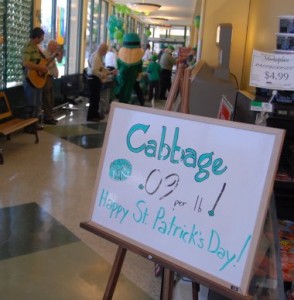
Customers came for the bargain cabbage and got live Irish music too.

Customers came for the bargain cabbage and got live Irish music too.

There was an Irish group playing tunes, corned beef and cabbage being served, and everyone was wearing those ubiquitous green Irish mardi gras beads and green derbys. Three guesses where I spent my St. Paddy’s Day.

That’s right—in a supermarket.

For the last 30 years, Murphy’s Marketplace in New Jersey has been marking St. Patrick’s Day with ever greater panache. This year, in his flagship store in Medford, owner Ron Murphy himself was handing out free beads, hats, teddy bears, balloons, and potted shamrocks while Blarney (Fintan Malone and Tom Brett with special guest on percussion, Father Jim Barry from St. Mary’s RC Church in Salem, NJ ) played at the front of the store and checkers handed every customer a green carnation. Ron’s wife, Kathleen, was busy cutting slices of cake (12 sheet cakes lined up to make one massive confection) that she handed out to customers who washed it down with “Irish coffee” – free coffee mixed with Bailey’s creamer and topped with whipped cream but, though it had to be 5 ‘clock somewhere, no Jameson. And the kids waited in line for their very own balloon animal twisted up to custom order by the pony-tailed and wisecracking Jack the Balloon Man. Later in the day, after school let out, there would be Irish step dancers, somewhere over in the bread aisle.

Of course, there’s a logical explanation for this. “Murphy’s, St. Paddy’s Day, all my stores are green, it’s a natural,” said Ron Murphy, wearing a green-and-white- striped cap and green-and-blue striped club tie with his smart business suit.

Murphy was in his Medford store “because if I’m not here, I get calls” from longtime customers who expect him to be orchestrating the ballyhoo. Just a few miles away, Dennis Gormley and Kathy DeAngelo, who work professionally as McDermott’s Handy, were marching to the deli counter at the Forge Murphy’s to the tune of “Lord Mayo.” There, deli clerk Chris Heide joined them in a song. “He sings all the time,” confided a co-worker. He just doesn’t usually have live accompaniment.

At each of Murphy’s five stores, there was some variation on live music, steaming trays of corned beef and cabbage, cakes of varying sizes, and Irish tschockes ranging from green wristbands and beads to teddy bears to Irish jewelry kits. A leprechaun—perhaps an employee of the month in costume—wandered the aisles, and staff dressed in green stocked shelves, sliced lunch meat, and occasionally danced with the leprechaun.

This was no ordinary day in the supermarket. But very few customers came through the automatic doors with a look of shock. For many, it’s an annual pilgrimage. It is for Monica and Danielle Jarrett. “I come here every year from Gloucester County,” said Danielle. This year, her two-year-old nephew, Cole, was the recipient of two balloon animals, some great Irish gear, cake, and a new appreciation for what happens when a Clare banjo player (Malone) and a Sligo guitarist (Brett) get together. “We come for the music, the balloons, and the nice people,” said Danielle who seemed to be one of the few people leaving without groceries.

Arts

Irish Philadelphia Film Festival: Bloody Sunday

Bloody Sunday

Released: 2002

Genre: Drama

Synopsis: A brilliant—though, at times, painful to watch—dramatization of the January 30, 1972, civil rights march in Derry, Northern Ireland, led by activist-politician Ivan Cooper. The march began peacefully, but it ended in a hail of gunfire. In just 10 minutes, 14 civilians lay dead in the streets, shot by members of the 1st Battalion of the British Parachute Regiment; 12 others were wounded. Two more were struck down by British armored personnel carriers. (And the official whitewash virtually on the spot.)

Why it’s one of the best: Written and directed by the innovative filmmaker Paul Greengrass, “Bloody Sunday” is shot in a documentary style, with handheld cameras. It’s all blur and herky-jerky motion, like Vietnam battle footage.

The technique yields a film of compelling immediacy. We feel as if we are all on hand in the Bogside on that awful day, marching alongside Cooper, Bernadette Devlin, Father Edward Daly—and young protestor Gerald Donaghy, who, with so many others, took a fateful wrong turn on a day when the British troops assigned merely to stop the illegal march turned instead, all too easily, to indiscriminate slaughter.

Donaghy died that day, shot in the belly.

Two performances are particularly noteworthy. The Northern Ireland (Coleraine) actor James Nesbitt—if you watch BBC America, you may know him as Murphy of “Murphy’s Law”—turns in the finest performance of his career as Ivan Cooper. Cooper was then a member of the Northern Ireland Parliament who led the ill-fated march.

The film turns on Cooper’s actions on that day—from the morning, when he and others still dared to hope that they might be allowed to march in peace, to the news conference in the aftermath of the massacre in which he warned the British government that its actions had “given the IRA the biggest victory it will ever have. All over this city tonight, young men, boys, will be joining the IRA, and you will reap a whirlwind.” Watch Nesbitt’s face as the names of the dead are read out. You’ll see why he just might be Ireland’s best actor.

The veteran British actor Tim Pigott-Smith plays the cold, pitiless Major General Robert Ford, the British Army’s most senior officer in Derry on the day the Paras ran rampant. He played a similar character, in a way, in the BBC mini-series “The Jewel in the Crown,” about the last days of the British Raj. Pigott-Smith masterfully portrays that odd combination of bloodlessness and bloody-mindedness characteristic of so many British military men, particularly in colonial settings.

As I say, “Bloody Sunday” is not easy going. But if you want to understand and appreciate the history of Northern Ireland and the “Troubles,” this film is indispensible.

Arts

Irish Philadelphia Film Festival: The Snapper

The Snapper

Released: 1993

Genre: Comedy

Synopsis: This is a story about babies, alcohol, and the connection between the two.

“The Snapper” is based on the second installment of Roddy Doyle’s Barrytown trilogy. (We’ve already talked about the first movie: “The Commitments.” The third, “The Van,” has its moments and, although accomplished, ultimately collapses under its own weight.)

For my money, “The Snapper”—that’s the Dublin slang term for “baby”—is the best of Doyle’s three stories. It documents the trying but ultimately triumphant pregnancy of Sharon Rabbitte (Sharon Corley, in the film). The central question is: “Who’s the Da?” (Or, as the residents of Doyle’s fictional Barrytown might put it: “Who’re yis havin’ it for?”)

The prime suspect is revealed to readers early on—but to Sharon’s family and friends, his identity is veiled in mystery. (Was it really, as Sharon coyly suggests, a Spanish sailor?) Sharon was flying high at the moment of conception, but she was just barely sober enough to remember who did the deed. And it was no Spanish sailor.

Of course, a secret like this one is too big and embarrassing to keep. It’s only after Sharon’s father, the irascible Jimmy, gets wind of a bit of barroom braggadoccio—Sharon, evidently, being reported as “a great little ride”—that the answer is revealed to all of Barrytown. And, as they say in the movies, hilarity ensues.

Why it’s one of the best: First, it’s a Roddy Doyle story. It would be hard to make a better start. All the characters are engaging. Even minor characters, like Jimmy’s pals, the barflies Bertie and Bimbo, are fully realized. At the center of it all is the relationship between Jimmy and Sharon. Let’s just say it’s complicated, but it is clear that this daddy-daughter bond is unbreakable—even when Sharon’s great secret is revealed, to Jimmy’s everlasting horror.

The dialogue, as is always the case with a Roddy Doyle yarn, is spot on. It’s salty, peppery, and any other kind of spicy seasoning you care to add. Most of what turns up in the book survives, mostly intact, in Doyle’s screenplay.

The cast is first-rate. The ubiquitous Colm Meaney plays Jimmy; the role of Sharon is played by Tina Kellegher, who would go on to play the part of Niamh Egan in the BBC Northern Ireland series Ballykissangel. The brilliant Ruth McCabe plays Jimmy’s long-suffering spouse Kay. All of the kids—and there are many—are well cast.

But of course, the story revolves around Sharon, and Kelleher shows herself more than equal to the task of slipping into Sharon’s skin. She’s a tough kid, this Sharon, and she accepts her fate with grace and ballsy good humor. She has moments of doubt—but doubt, so often described as “nagging,” never really gains a foothold here.

Finally, there is the masterful direction of Stephen Frears (“The Queen,” “Dangerous Liaisons,” “My Beautiful Launderette”) who mostly tries not to get in the way of great material and talented actors. Frears keeps the whole enterprise moving along at a fast clip, and he never descends into gross Hollywood sentimentality.

Oh yes … and you’ll love the theme music in the opening and closing credits. Elvis, wherever you are (and I’m pretty sure I saw him working in one of the toll booths at the Ben Franklin Bridge), eat your heart out.