Music

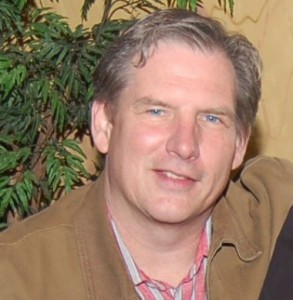
Finbar Furey in Concert

Fiddler Mary Malone came because, when she was a young mother, someone once gave her a homemade tape of Irish folk legends, The Fureys, a group of Dublin brothers that helped put Irish traditional music on the map.

Will Hill came because, as a teenager, he first heard the uillean pipes played by Finbar Furey on two now-collectible LPs, when Furey was young and still had a head of curly hair. Hill brought those albums with him to The Shanachie Pub in Ambler on Monday night to have them signed by Furey, who made a stop in the Philadelphia area while touring the east coast to promote his new CD, “No Farewells, No Goodbyes.” He was accompanied by performer Brian Gaffney.

And the actor, singer, poet, songwriter didn’t disappoint—not in any way. He signed the albums, performed the songs that first endeared the Fureys to American audiences, mesmerized the crowd with his intricate piping, and made everyone laugh with his stories. Like the one about how, as a young man, he asked famed ‘60s folksinger Tom Paxton if he would mind if he altered one of Paxton’s songs a bit. “I was cheeky back then,” he confessed. “Tom Paxton looked at me with his cold blue eyes and said, ‘What are you going to do with it?’”

He was going to rewrite it for banjo, Furey explained. Oh, and change the words a little.

There was a long, deadly gap in the conversation, Furey recalled. Then Paxton said, “Oh, go for it.”

So Furey did. And the Fureys recorded Paxton’s  “I Will Love You,” catapulting it to number one on the Irish charts. “Then one night I get a phone call. ‘Finbar?’ ‘Yes.’ ‘This is Tom Paxton, Finbar.’ ‘Yes.’ ‘Bastard! I’ve been singing that song for years and nobody’s hardly heard it!’” Furey roared almost as hard as the audience, who began singing with him at the first song and to the last.

Sports

Notre Dame “Fighting Irish 5K” Concludes Another Good Run

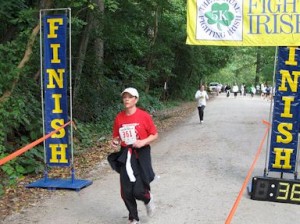
The big sign says: Finish. A welcome sight, no doubt, to runner Shauna Frye.

The big sign says: Finish. A welcome sight, no doubt, to runner Shauna Frye.

A new date and a new location brought good luck and good weather to the 2008 Fighting Irish 5K, sponsored by the Notre Dame alumni of Philadelphia.

More than 300 runners finished this year’s 5K down on Forbidden Drive in the Valley Green area of Philadelphia’s Fairmount Park last Saturday morning, and the alumni raised $21,000, for a total of $121,000 raised for St. Malachy’s School in North Philadelphia over the six years of the race, according to race organizer Frank McGuire.

Michael Kerrigan, 23, ran the course in 15:17, and Liz Haglund, 24, finished not far behind at 17:51, to win top honors. Runners up were Ryan Fennelly, 26, just 3 seconds behind the leader, and Kathryn Bowser, 22, at 19:07.

New pastor, Rev. Kevin C. Lawrence, took over the reins from Father John McNamee, who recently retired. And even though Father Mac graciously took morning Mass so Father Lawrence could be at the race, both were present at the finish, along with a delegation of St. Malachy students.

Providing the soundtrack for the morning was the Philadelphia Emerald Society Pipe Band.

In previous years, the race was scheduled for mid-March, for the obvious St. Patrick’s Day tie-in, at Chestnut Hill Academy. Last year, bitter cold caused a cancellation.

This year’s weather was brighter, sunnier, and a lot less cold.

Columns, How to Be Irish in Philly

How To Be Irish in Philly This Week

I sure hope you’re well-rested, because you have an lot of Irish stuff to do this week and you’ll need the energy.

Saturday is so jam-packed, it ought to have a few more hours. AOH Division 87 is holding its annual golf outing fundraiser Saturday at Byrnes Golf Course in Philadelphia, which includes a barbecue lunch. On Saturday night the Bristol AOH is holding a release party to celebrate its CD, Hibernian Sessions, a recording of all the great bands that have played at Bristol’s AOH. Some of those great entertainers will be there Saturday night: the Birmingham Six, The Shantys, Jamison and Bogside Rogues. There will also be Irish dancing and vendors. All proceeds go to AOH charities. See our story here.

Also on Saturday night: Join the Crossroads Irish Dancers at Our Lady of Grace School in Penndel where they’ll join up with local group, Celtic Crossroads, for an old-fashioned ceili. (Don’t know how to do ceili dances? Don’t worry, they’ll teach you!)

Or head over to Bucks County Community College for a night of Irish music, dance, and storytelling with the Martin Family Band and storyteller Tom Slattery.

Sunday, in the most Irish state in the US, Delaware, you can enjoy all the music, dancing, and great Irish wares at the 15th annual New Castle County Irish Festival in Wilmington. Things are bad all over—we all need to enjoy ourselves, and this is one way to do it.

On Monday night, you have a rare opportunity to hear legendary singer and piper Finbar Furey at The Shanachie Pub and Restaurant in Ambler. Read our exclusive interview with Furey here.

Next Friday, at The Irish Center in Mt. Airy, enjoy some great music at the Brian Boru Pipes and Drums Fundraiser to benefit the Fox Chase Cancer Center and Music Education Fund to Preserve the Music of Our Celtic Heritage. On the bill, Albannach, an energizing group that puts the perk in percussion. If you love drums, as some of us do, you gotta be there.

Arts

A Salute to the Flag

Filmmaker John Foley of Wayne.

Filmmaker John Foley of Wayne.

A few weeks after 9/11, you couldn’t buy an American flag in this country. They were sold out, flying from flag poles, porch roofs, even car antennas from sea to shining sea. Seven years later, where are they?

Wayne filmmaker John Foley asked himself that same question not long ago.

“I was listening to some people who’d gone on a holiday in Europe and they were joking about how they told everyone they were Canadian. I thought to myself, why? What are you ashamed of? And it dawned on me that what the flag represented had changed since it was hoisted over Iwo Jima in World War II or even over Ground Zero. It had gotten lost. To many people, it had been co-opted or hijacked by the religious right or the Republicans, and all the sacrifices people had made along the way faded into the past and it became a symbol of what’s wrong with this country.”

At the time, Foley was in the midst of filming what would later become “The Color Bearers,” a film examining the history of patriotism as embodied by the symbol of the flag, from the Revolutionary War to the present day, which he also produced with childhood friend Steve Newbert. He’d begun the documentary as a personal tribute to a distant relative, James Seitzinger, a 17-year-old from Schuylkill County who lied about his age to join the 116th Pennsylvania Infantry during the Civil War. On the first day of the battle at Cold Harbor, VA, in June of 1864, the unit’s color bearer—the soldier who carried the flag into battle in front of the troops—was shot down. The young farm boy rushed forward to seize the flag and raise it, dropping his rifle to do so. For his bravery, Seitzinger received the Congressional Medal of Honor.

“When I started looking into it,” says Foley, “I found that of the 3,500 soliders in the entire history of the Medal of Honor, most of those who received the award had something to do with the flag during the Civil War—they were either color bearers or had captured the enemy’s flag. I started asking the experts, what’s the big deal about the flag capture? What it comes down to is that carrying the flag was a dangerous job. It required an inordinate amount of bravery and courage heading into battle, holding just a flag. You’re stepping into battle six feet ahead of your troops, the battlefield is filled with smoke, and there’s the flag popping out of the smoke. There were no radios or telegraphs on the battlefield. The only way to communicate what you wanted your troops to do was, as an officer, position yourself behind the flag and tell the color bearer what you wanted the troops to do, go left, right, forward, or back, and they just followed the flag. You became a bullet magnet. The life expectancy of the average color bearer in battle was six months. They had to drop their rifles to pick up the flag, and that’s what Seitzinger did.”

Foley found three other color bearers from the Civil War and not only told their stories, but found living descendants who talked about how their courageous ancestors affected their lives today. For example, the descendants of Union color bearer Ben Crippen—who include a police chief and Desert Storm vet from Guyton, GA—ritually return to the battlefield at Gettysburg to take a family photo under the statue of Crippen, a member of the 143rd Pennsylvanians, who was killed while his regiment was attempting to keep the Confederate army from entering the town. Crippen lagged behind his troops, which were engaged in a rear guard action, and would periodically turn to face the Rebels, only a few feet away, and shake his fist at them. Crippen was gunned down, but it was his act of defiance that rallied his troops, who kept the Confederates at bay.

But Foley felt the focus on war heroes made the film “too dusty, too History Channel,” so he also talked to other people for whom the flag has held great significance beyond the battlefield, including singer Lauren Hart, who performs the Star Spangled Banner at Philadelphia Flyers home games and never fails to think of her father, announcer Gene Hart, the legendary “voice of the Flyers;” Tim and Brian O’Connor, owners of Humphreys Flags, located across from the Betsy Ross House, which has been making flags since 1805 and created an American flag so large it didn’t fit on a football field; and Scott LoBaido, a New Yorker who painted flags on 50 buildings in 50 states as a tribute to America’s soldiers. Former Eagles star Vince Papale narrates the one-hour film.

Foley, who grew up in St. Dominic’s Parish in Northeast Philadelphia and graduated from Father Judge High School, took a long, circuitous route back to one of his earliest passions, TV and filmmaking. When he entered Temple University in 1974, he was a physics major, but switched to the radio-television-film . Unfortunately, for financial and other reasons, he had to drop out. He never graduated from college, but wound up in the telecommunications business, eventually as the CEO of a company.

But a few years ago, when the telecom industry started to implode, Foley made what seemed to be a good business decision. “One thing that hasn’t imploded, but has actually exploded, is content,” he explains. “Content is on the rise. So about five years ago, I said to myself, ‘Do I want to be scraping by well into retirement in the telecom industry until it’s dead, or do I cut my losses now and chase my dream?’”

The dream won. Today, he’s director of business development for PMTV (Producers Management TeleVision) in King of Prussia, a 20-year-old company that provides mobile facilities and production services for clients as varied as Home Depot and ESPN. He had a brief stopover as the world’s oldest intern too—working gratis for another Philadelphia production company, Teamwork Productions, writing and producing documentaries and TV pilots with an African-American theme.

Life has changed dramatically—in many ways. “I had a little money for a little while, but it’s been scary,” Foley admits. “Right now I’m earning half of what I earned as a CEO. It’s hard. I had a lot of nice rewards rising to the top of the telecom industry, but I’ve shed them now, the boats, the cars. . . .But I have a nice condo in Wayne and where I didn’t see a future in the telecom industry, I see a future now. And did I mention that I’m having fun?”

“Color Bearers” became his resume piece, allowing him to convince his new boss that he should hire a guy for TV production who had no real experience. “If it hadn’t been for this film, I wouldn’t have gotten this job,” he says.

The film, which premiered on June 14 (Flag Day) at the Independence History Museum on Third Street, has also opened his eyes about the ambivalent relationship Americans have with the symbol of their nation, he says.

Some of that began to surface while he was filming. One of the questions he asked each of his interviewees was “What is patriotism?”

“Tim O’Conner of Humphreys Flag, when I asked him that question, Tim went off on this riff on how we were creatures in the trees in Africa, and when we came out of the trees, we got together and basically protected one another. A patriot was someone who gave up his life for his tribe,” recalls Foley. “Well that particular day, I shot the segment on my lunch hour and was dressed in a suit and a tie, and Tim assumed that I was a staunch member of the religious right making a film about the flag. He was convinced that what he said would never make it to the film and he was laughing to himself. Of course, it’s in there.”

Foley laughs, but then suddenly becomes serious. “The fact is, you’re prejudged if you have a flag out. To many people, you’re automatically a hawk, and that is one of the very things we’re trying to combat with this film. Republicans and the religious right don’t own the flag. Americans own the flag. It’s lazy to jump to assumptions about people because of the fact that they’re proud to be an American.”

He wanted “Color Bearers” to restore the flag to its historical significance as a symbol of freedom for people who longed for it where they came from, but never found it until they arrived here.

“I wanted people to make the connection, through the story of the color bearers, that the flag wasn’t something to be ashamed of, to remember what had gone into giving us the freedoms we have,” he says. “You can burn a flag in this country without going to jail. If you want freedom of speech, you have to accept people who don’t believe what you do.”

The film has had a profound effect on those who’ve seen it. At a Temple University “teach-in” conducted by history professor Ralph Young last month, a screening before an audience of students, professors, and non-students, provoked a spirited discussion that went on for 90 minutes. “It was very interesting,” notes Foley, who attended the screening. “The students responded very positively, but people in their 50s and older took us to task for doing anything that glorified America and the flag. They were upset with me that we didn’t show more of the Vietnam era antiwar movement with people burning flags in protest. But we wanted it to be a positive film, and frankly, we only had an hour.”

Foley admits he made a conscious decision not to show flag-draped coffins in the film. “I found a lot of those images on military websites of funerals at Arlington Cemetery, but I felt like I was intruding on people in their deepest pain ever in life To put that into the film and sort of exploit the image felt wrong, and I just decided I wasn’t going to do it.”

What you will see in the film are photos of Foley’s son, Sean, now a Philadelphia police officer, who was deployed to Iraq in 2003-2004. Sean (“now there’s an Irish name for you,” laughs Foley) joined the National Guard prior to the Iraq war, like many young men and women, to make some money for college. “Now, I firmly believe that we were sold a bill of goods by Bush who didn’t do enough work to determine if there were in fact weapons of mass destruction over there, didn’t have the support of our allies, and didn’t really have a good plan. But when I was standing with his sisters and his mother at Fort Dix as he was leaving, I didn’t want to say anything negative to him that might cause him to hesitate at a crucial moment, a hesitation that could cost him his life. You can hate the war and love the soldier—I hope that was the lesson we learned from Vietnam.”

Instead, Foley removed a Claddagh ring he bought in Dublin “that really means a lot to me,” and handed it to his son. “I said, son, you bring this home to me. A year later, he pulled me aside, took the ring off, and handed it to me and said, ‘I told you I’d give it back, Pop.’ I get choked up now as I say this. I will never take this ring off.”

Then Foley, the historian, brought it all back to the flag. Just as he gave his son the ring, historically, soldiers were often given flags sewn by the women of their towns so they could take a little “home” with them to war and they were admonished to “bring it home proudly,” says Foley. “I gave my son the ring for the same reason, to let him know I was with him.”

Carolyn Blashek, founder of Operation Gratitude, the nonprofit group that sends care packages to service people deployed overseas, wants to carry on the tradition in a more modern way. “She called me up and said she had just finished watching the film and couldn’t stop sobbing,” says Foley. “Operation Gratitude has already sent more than 350,000 packages to troops in harm’s way, and they are going to do doing another drive for the holidays and they start packing this month to send packages addressed to 70,000 individual soldiers nominated by people on their website. She wants to get as many copies of ‘The Color Bearers’ to stick into the packages. So far we’ve raised enough corporate and individual sponsorships to send 600 copies.”

Foley says he’d like to donate 70,000 copies, but doesn’t have the money to create that many duplicates. You can help. If you go to the “Color Bearers” website, you’ll find information on how you can donate a pack of 10 DVDs for just $25 (one copy normally costs $24.95). That small donation will help remind a solider that he or she is also a color bearer, a living symbol of the land of the free, the home of the brave.

News

Looking For the Next Conshy Grand Marshal

The Saint Patrick’s Parade Committee of Montgomery County is accepting letters of nominations for Grand Marshal of the
2009 Saint Patricks’ Parade in Conshohocken, to be held on March 14.

This will be the fourth year for the parade in Conshohocken, and it has grown each year. The parade is always the Saturday before Saint Patrick’s Day.

To be nominated for Grand Marshal you must be a resident of Montgomery County; be of Irish by birth or descent; and have contributed to the Irish community or the community at large.

All letters must be sent to Hibernian Hall, 342 Jefferson St., Swedesburg, PA 19405, in care of the Saint Patrick’s Parade Committee.

Deadline for letters will be December 12. The announcement will be made on December 20.

Arts

“Touch the Blind Man” and Other Poetry from Finbar Furey

Touch the Blind Man

Take my fiddle, take my bow
Use the gift to play them so;
Music spirit guard my son
Born of shadows—blind to some.
This fairy child, this fiddler boy
This music man of my gypsy kind.
God of trad protect his flame
And those who fall beneath his fame.

Beware gold bigots, pissy thorns
Rogues of nothing who cover all.
Distant peace hails in time
Future waiting, cradling mine.
Gifted nomad touching worlds,
This special man wrapped in curls
Sell your credits, lost your soul.

Touch the blind man
He’ll take you home.
Take my fiddle, take my bow
Use the gift to play them so.
Twist the keys and free my soul
And dark Rosaleen to wash us all.

—Finbar Furey, February 2008

Another Time

Slow days have passed us by
Foolish hearts how cruel to watch love die
Was it lies or just some stupid pride
When you were another woman
And I was another man
When life with so much love
Once filled another time

Staring out to empty space
Growing colder as the years increase
Getting old enough just not to cry
When you were another woman
And I was another man
Before the curtain closed
Forever on another time

The good times now rest in peace
With all the conversations one believed
It seems so long ago since we laughed or cried
When you were another woman
And I was another man
With all the dreams love promised
In our time.

—Finbar Furey

Columns, How to Be Irish in Philly

How To Be Irish in Philly This Week

Another big week for the Irish, with a great mix of events.

If I weren’t still laid up with a broken ankle, I might spend some of my weekend over at the Waterford Wedgwood Company Store in Limerick, where they’re having a pre-holiday warehouse sale. Since it’s a company-owned retail store, there’s already a 30% markdown, and store manager Andrea Vandervoort tells us some pieces are reduced an additional 50%. I’d go, but I’m in a wheelchair and the financial risk of “you break it you bought it” is too great. But you able-bodied people ought to take advantage. Christmas is coming, and if your investment account looks like you’re back down to the Holy Communion money, you can’t afford to turn down this kind of bargain.

This is also the weekend of some important good-deed doing. On Saturday morning, you can head over to Valley Green, part of Fairmount Park in Chestnut Hill, for the sixth annual Fighting Irish 5K and 1 Mile Walk. There’s a raffle prize of a free round-trip to Ireland (which can cost up to $1000 or more these days) and proceeds benefit St. Malachy’s School in North Philadelphia. Also on Saturday morning, you can help earn a place in heaven by helping the region’s Ancient Order of Hibernians assembled meals for shut-ins at Aid For Friends in Northeast Philadelphia. The AOHers collect the food and prepare it as part of the Hibernian Hunger Project, a local charity that has gone nationwide.

On Monday, all you McDuffers should be out at the Paxon Hollow Golf Club in Broomall for the Masters of the Green Golf Tournament. Proceeds from this charity even benefit the Philadelphia St. Patrick’s Day Parade. (Hey, all that green stuff costs green stuff.)

On Tuesday, British-but-Irish guitarist Ged Foley (Patrick Street) will be performing at The Blue Ball Barn in Alapocas Run State Park in Wilmington.

On Thursday, you can meet Irish crime novelist Declan Burke at Fergie’s Pub in Center City where he’s debuting his latest novel, “The Big O,” to the American public. We’re reading it now, and if you love Elmore Leonard, you’ll enjoy this Irish version of the marriage of humor and murder. Appearing with Burke is Canadian crime writer John McFetridge, author of “Everybody Knows This Is Nowhere” and “Dirty Sweet.”

On Friday, the Cavan Society holds its 101st Ball at the Springfield Country Club. Music will be provided by the Vince Gallagher Band.

All this week, you can also catch Eugene O’Neill’s “Long Day’s Journey Into Night,” at Villanova.

And a little bit of website business: You know you can add your own event to our calendar, right? Just click on the calendar on the home page, then click on the hotlink that says “Notify us about your Irish event” and it will take you to a page with a form you can fill out and some detailed instructions. And if you haven’t figured it out yet, we use the calendar to write “How to Be Irish in Philly This Week,” which covers the week from Saturday to Friday. Why? Because we usually write it early Friday morning (we do have day jobs). So if you have an event that’s going to occur on, say, Friday, you need to get it on the calendar or to us by the previous Friday at the latest. Thursday is even better. How To Be Irish In Philly is our best-read article every week, so it gets your event before more eyes.

It’s so popular, in fact, that the world’s best event calendar is a little jealous. So head on over there to make it feel better.

Music

Bristol AOH Is Alive to the Sound of Music

Jim Fowler grew up with Irish music. As a kid, he used to listen to the Wolfe Tones, and the Clancy Brothers and Tommy Makem, along with his grandparents James S. Fowler and Margaret (nee Hagerty).

Not surprisingly, all his life Fowler wanted to do more than just listen to the music—he wanted to play it, too. Although he only recently started picking up on tin whistle, bodhran and a bit of banjo, that part of his life never turned out quite the way he had hoped.

So Fowler, the entertainment chairman at Bristol Borough’s Division of the Ancient Order of Hibernians, came up with the next best thing—a project that would blend his love of the music with his love for the nation’s oldest continuing AOH clubhouse, founded in 1883.

It’s a benefit CD called “Hibernian Sessions No. 1,” and it featured live music recorded at the AOH hall and performed by some of the region’s top Irish bands: The Birmingham Six, Bogside Rogues, Jamison and the Shantys.

You can pick up a copy and listen to still more live performances by the very same hot bands on Saturday, starting at 1 p.m. at the AOH Hall on Corson Street in the borough.

“The CD is something I raised with the division about a year ago,” Fowler says. “It does a couple of things. It promotes our heritage and culture through music, and it makes some coin for Irish charities, such as the Hibernian Hunger Project, Project Children, Project St. Patrick and the division itself. It’s something I always wanted to do. Once I become involved with Division 1 in Bristol, this was the way to go, and we’re really proud of it.”

The CD also tied in with the division’s interest in boosting the level of entertainment at the hall. “Friday nights, it’s rockin’ there,” says Fowler. What the CD tries to do is capture the ambience of those rockin’ Friday nights.

The sessions were recorded throughout 2007 and 2008. All of the bands agreed to have their performances recorded, and Fowler, with recording engineer Chad Palmer chose the three performances they liked the best for the CD. “The bands had the final say on the mix,” he adds.

Fowler, who knows members of all the bands, can’t say enough about them: “The bands basically did this for free. They’re getting 20 CDs to sell at their shows. They dedicated their time and gave us the approval to do it.”

Of course, the CD is called “Hibernian Sessions No. 1,” which begs the question … will there be a Hibernian Sessions No. 2?”

In Fowler’s mind, there’s no question. “I want to keep this going,” he says. “In the end, once we get all the CDs sold, the division’s going to have to make the decision whether to do it again. If they don’t, I’ll put up my own money.”

Learn more at: http://hiberniansessions.com/Home.html