Music

New Band, New CD, New Bride: John Byrne’s on a Brand New Road

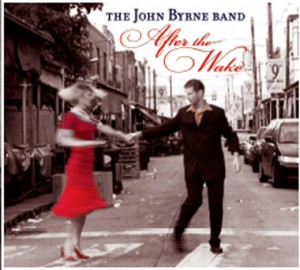
That's John Byrne and his new bride, Dorothy, on the cover of his new CD. Photo by Lisa Chosed.

That's John Byrne and his new bride, Dorothy, on the cover of his new CD. Photo by Lisa Chosed.

There’s a lot about John Byrne’s latest CD that’s autobiographical, but the line “I was a mediocre singer with a mediocre song” from his paean to Dylan isn’t. Not by a long shot. In fact, it’s hard to understand why Bryne, who grew up in a family of ballad singers in Dublin, didn’t come to music until he was in late teens.

“When I was a teenager, my obsession was playing football, which kind of gave me an out,” he says, explaining why he had no party piece when his parents and grandparents were warbling theirs in the parlor. “They just said, ‘He’s a footballer, that’s what he does.” He laughs.

Byrne has immortalized those evenings at his grandparents’ house in the track, in “Various Verses,” on “After the Wake,” his first CD effort since splitting from longtime partner (and brother-in-law) Patrick Mansfield with whom he was “Patrick’s Head,” a Philadelphia-based group that played to sold-out crowds in some of the city’s jewel-like acoustic venues like World Café Live and The Tin Angel.

From the opening chords, you know the song is going to grab your heart. In his handwritten liner notes on the song, Byrne admits, “the thing I miss most about being home are the nights when the whole family would gather and sing songs. There’d be parents, grandparents, brothers, aunts, uncles, and friends all singing their own versions of the songs they loved, the songs that spoke for them and through them. These songs and singers will always be my greatest inspiration.”

Those same inspirations appear again in other tracks, like Old Man’s Disguise, in which Byrne muses on how much like his father he’s become. “Like any teenage boy I butted heads with my dad,” he says. “But as you get older you get wiser and begin to see things from their perspective. You look in mirror and see you’re getting more and more like them physically. I have the same mop of curly hair as my dad. This song is about understanding what your folks are as people. You don’t often see them as people like you, but as you come to understand your own flaws, you come to understand theirs too. “

“Midnight in Dublin,” a song about wanting to call home but having to be mindful of the time difference, reinforced the idea that John Byrne gets occasionally homesick. “The homesickness is always there,” he admits. But he’s clearly put down roots in Philadelphia. Last year, he married Dorothy Mansfield and it’s his new bride—dressed in red—he’s dancing with in the Italian Market that serves as the cover photo of “After the Wake.”

“We took dance lessons for our wedding and it was amazing how much I reall enjoyed it,” he says, still sounding a little surprised. “It really fit the morning after feeling we were going for—‘after the wake,’ celebrating the life of somebody and hopefully moving on.”

Byrne first came to the Philadelphia area as a teenager. “I went where every Irish person went in the ‘90s—Wildwood,” he laughs. “The first stage I ever played on was in a bar at the shore.”

He didn’t arrive as a performer. His first job was running the go-kart rides on the boardwalk “14 hours a day, seven days a week, for minimum wage. And I thought it was a great job. You could go to the bar afterwards and the all-you-could-eat breakfast place after that.”

One of his songs, Already Gone, is set in Wildwood in the winter. It’s a “break-up” song with the memorable line, “I used to wallow here, with the men I followed here.” Anyone who’s ever gone to the Jersey Shore off season will pick up the mood immediately. “After I moved here and went to visit the shore towns in the winter, I felt that tremendous sense of melancholy and hibernation of the locals that exists for the months the tourists aren’t there. They’re sitting in the bar just getting through the winter, keeping tabs on Memorial Day,” says Byrne.

He caught the American folk music bug while he was here—he’s Dylanophile and one of his songs, Boys, Forget the Whale, is a tribute to his hero. After leaving college in Ireland (where he studied electrical engineering), Byrne returned to the US to try his hand at performing. But he didn’t want to be just another Irish act.

In fact, in the beginning, he tried to avoid Irish music altogether until bandmate Patrick Mansfield talked him into adding a few songs to their playlist. “Even now I’m very selective about the Irish songs I will and will not do,” Byrne says. “I won’t play ‘Oh, row, the rattlin’ bog’ for example.” He laughs. “At some gigs I was asked to play pro-IRA songs and I didn’t want to go down that road either. One of the ones that got me the most was ‘The Unicorn Song’ [by the Clancy Brothers and Tommy Makem]. I don’t know how a unicorn song got all mixed up with Irish music. I’d never heard it. I’d say, ‘I have no idea what you’re talking about. Are you sure you don’t mean ‘The Leprechaun song.’ Then I heard a tape of it. I was horrified.”

When he heard he was going to share a stage with Tommy Makem at the Long Island Irish Festival, he says he was ready. “I was going to say, ‘So, The Unicorn Song, lads. I have to ask and I hope you’re going to tell me this was your manager’s idea.” Unfortunately, we’ll never know: the festival was cancelled.

That’s not to say Byrne had rejected the Irish sound altogether. The most autobiographical songs on his CD have a Celtic lilt and one, The Ballad of Martin Doyle, is a trad song in the making. Traditional songs were all new once, after all.

“That song came from my uncle, David O’Brien, who works with a nonprofit organization in Northern Ireland that is trying to bring communities together,” he explains. “He tells this story when he’s trying to show people from different communities that they have more in common than they have differences.”

It’s the true story of an Irishman named Martin Doyle who joined the British Army to fight in World War I, lured by the promise the British made to the Irish that if they did the patriotic thing, the British would consider home rule. After his service, for which he was highly decorated, Doyle returned to Ireland—a post-Easter Uprising Ireland, where those who were martyrs to the free Irish cause made anything British very unpopular. He and the other World War I veterans from Ireland came home to less than a hero’s welcome.

Though Doyle joined the Irish Republican Army and again fought bravely—this time against the British–at his death he chose to be buried in his British World War I uniform. “When David was telling me this story, he asked me, ‘What do you think?’ What I think is that Doyle was trying to honor the Irishmen who fought in World War I and were betrayed by both the British and their own people,” says Byrne. He chose his British uniform, as Byrne writes, because it was “the uniform of another war that treated us like men.”

His uncle encouraged him to write a song about Doyle. “Usually, I can’t just write about something, but this one just came,” he says.

He’ll be playing it—and other songs from “After the Wake”—at his World Café Live CD party on February 20 (better get tickets now—it’s almost sold out). Joining him on stage will be recent transplant, singer-songwriter Enda Keegan, and Byrne’s brother, Damian, also a musician.

“After my grandfather passed on, those music nights at the house got less and less frequent, but Damian really took up the mantle and started them again,” says Byrne. “He and his group of friends get together at somebody’s house and do mostly ballad singing, like we did when we were younger. I’m really looking forward to performing with him onstage.”

You can also catch John Byrne and The John Byrne Band at O’Donnell’s at 139 North Broadway, Gloucester City, NJ, (just over the bridge from Philly) on Friday, February 12, and February 19, or at Slainte, at 30th and Market in Philadelphia, on February 15 and 25.
Columns

How To Be Irish In Philly This Week

Are you ready for some fun? Good, because we have it aplenty this week.

A concert with Albannach, Seven Nations, Jamison and other high-octane bands kicks off the 18th Annual Greater Philadelphia Mid-Winter Scottish-Irish Festival and Fair, an event whose name gets longer every year, held at the Valley Forge Convention Center. It’s two and a half days of total Celtic immersion—music, dancing, whiskey, beer, food, even medieval sword play. There are dozens of vendors who are hawking everything from bejeweled Claddaghs to goth kilts. See our story on the St. Paddy’s Day parade fundraisers to find out what we’ll be doing there. (And stop by, say hello, and enter our promotional contest for a chance to win tickets to see Scythian at the TLA or Ronan Tynan at the Keswick Theatre next month!)

If Irish tenors are more to your taste, St. Colman’s Parish in Ardmore is hosting renowned singer Mark Forrest in concert on Friday night, February 12. The same night, the Gloucester City AOH is offering a free Irish music night with Jerry and Shaun of the Broken Shillelaghs. We would say, “so much to do, so little time” but we’re saving that phrase for March when the events are stacked up like Legos.

A reminder for this weekend: The WTMR 800AM radio shows are holding their on-air fund drive. Last week, with the help of the Irish Club of Delaware County, they raised almost $1,000. Let’s see if we can double that this week. Hosts Vince Gallagher and Marianne MacDonald will be at the Mid-Winter Festival in Valley Forge this weekend, so you can stop by and slip them some cash and music requests.

Speaking of the Irish Club of Delco, they’re holding their monthly meeting on Sunday at the Irish Immigration Center in Upper Darby. In Whitemarsh, St. Thomas Episcopal Church is holding its monthly Celtic worship service.

A reminder on a couple or three new regular events on our calendar—a ballad session at Slainte with John Byrne, whom we just profiled, Irish music at St. James Pub in Bethlehem, and Irish Night at the Washington Crossing Inn with some of your and our favorites, including the Theresa Flanagan Band, Paddy’s Well,?the Boys of County Bucks,?Connemara Codfish Company, and?Tullamore Trio.

McGillin’s Old Ale House in Center City has posted a “Mardi Gras” event with loads of drink and New Orleans’ cuisine specials (Po’ boys, yum!).

Mardi Gras can only mean one thing—no, not show me yours and I’ll throw you these beads—and that’s that Lent is coming up. What are you giving up? Hope it’s not Irish music because Gabriel Donohue is making a return appearance at The Irish Center on Friday, February 19, with singer Marian Makins and Alaskan fiddler Caitlin Warbelow. The Irish-born Donohue is not only a well known singer and guitarist, he’s produced award-winning CDs for many of your favorite performers such as Joanie Madden (of Cherish the Ladies), Jimmy Crowley, Girsa, Dan Milner, and top fiddler Seamus Connolly.

Music

An Irishman, an American, and a Canadian Walk Up on the Stage. . .

Shannon Lambert-Ryan and RUNA.

Shannon Lambert-Ryan and RUNA.

What happens when the Celtic music of three artists (Shannon Lambert-Ryan, Fionan de Barra and Cheryl Prashker) from three different countries (the United States, Ireland and Canada) comes together? RUNA happens.The trio, in the relatively short time they’ve been playing together, has found a way to take traditional, and non-traditional, songs that haven’t been played in awhile and “Celtic them up,” in the words of singer Lambert-Ryan.

Take the song “Jealousy,” the title track from their recently released CD. “Jealousy was the first song we worked on last summer. Our arrangement isn’t the same as everything that’s out there…it’s edgy, quirky, fresh. All three of us have our own influences that include classical, jazz and musical theater. We don’t want to re-perform what’s already been done; we want to recreate the music and give it our own kick.”

The name RUNA means “mystery” or “secret lore,” and when the three are onstage together, there is truly a mystical quality to their playing. Prashker’s percussion, de Barra’s guitar and Lambert-Ryan’s vocals create a lyrical sound that is at once unique as well as seamless. Frequently joined by Isaac Alderson on the flute, whistle and uileann pipes, there’s a sense that the music is coming from one source instead of three different musicians.

Offstage, RUNA members share a similarly close connection with each other. Lambert-Ryan and de Barra were married in April of 2009. They met at the 2006 Philadelphia Folk Fest where de Barra was playing with the Scottish band Fiddler’s Bid.

“There was a performer’s party Saturday night and I bought her a lemonade. We met again on Sunday, and spent the day hanging out. We were friends for a long time, then when Shannon said she wanted to record a CD [her 2008 album ‘Across the Pond’], I said, ‘You have to come here [to Dublin] to record it,’” explained de Barra.

That could be arranged because de Barra, who has been Moya Brennan’s guitarist for over 10 years, had merged his own recording equipment with Brennan’s to form Mo Studios in Dublin.
“My first professional gig was with Moya and Riverdance, at Radio City Music Hall…it was purely by chance. I got asked to fill in for the guy doing it, and then got invited to play more afterwards.”

The Dublin-born de Barra claims a family full of musicians. Four out of the seven offspring make a professional living at it: brother Cormac plays the harp; Eamonn plays flute, whistle and piano and is part of the band Slide; and brother Ruairi plays guitar and whistle.

Lambert-Ryan is a Philadelphia native who spent a lot of time at The Irish Center growing up. “I took step dancing there, and then I studied voice and theater at Muhlenberg College. I fell in love with music and performing at an early age.”

It was while performing with Guy Mendilow that Shannon met up with percussionist Cheryl Prashker.

“Shannon and I both were a part of the Folk Alliance, and had met up a lot of times. I sat in with the Guy Mendilow Band, and I sometimes put together a little show where I invite other musicians to sit in. I asked Shannon to play because of her Celtic music,” explained Prashker.

Prashker, the Canadian native of the group, now calls Philadelphia home. She and husband Charles Nolan collaborated on songs that she performed while she was with the group CC Railroad. Prashker has an acclaimed background as a drummer with groups like Full Frontal Folk and Jonathan Edwards. Her CD, “It’s All About the Drums,” is a compilation of songs she’s performed with a multitude of artists over the years.
But it’s the three of them united as they play together that has created the RUNA sound.

“It’s how we play off one another, how Cheryl and Fionan play together,” Lambert-Ryan said. “Sometimes it’s changing the chord progression, or the rhythm. We’ll take something we like, and hasn’t been done too much, and change the arrangement to make it our own.”

Like, for instance, the song “Gypsies, Tramps and Thieves”
“I came home one day and Fionan said, ‘We’re going to do a Cher song,‘” Lambert-Ryan laughed. “It’s on the ‘Jealousy’ album.” And, as unexpected as it might sound, the song works completely, fitting in with the band’s repertoire and begging to be listened to on repeat.

One of RUNA’s most engaging and addictive songs can only be experienced live, it’s not on their album…a version of the traditional song “The House Carpenter” interspersed with the chorus of Dolly Parton’s “Jolene.”

“We were playing around with the ‘The House Carpenter,’ working through the verses. There are many versions of the song, and a lot of verses…we wanted to craft the song to fit our style without changing the song. At the same time, we were listening to ‘Jolene.’ One day Fionan and I were in the car and started chatting about what to do with them, and I started humming. I realized I could sing both of them in the same key, and Cheryl could add something percussive underneath,” explained Lambert-Ryan.

Fortunately, there are opportunities for the Philly audience to experience not only this version of “The House Carpenter/Jolene” but all of RUNA’s songs beginning Saturday, February 13th 8:00PM at Concerts at the Crossing, Titusville, PA. Tickets are $20, for further information call 609-406-1424.

And on Sunday, February 28th 7:30PM, RUNA will be opening for Maura O’Connell at the Sellersville Theater in Sellersville, PA. For tickets and other information, call 215-257-5808.

Columns, How to Be Irish in Philly

How to Be Irish In Philly This Week

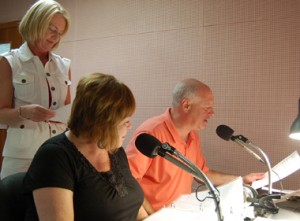
From last August's WTMR radio on-air fundraiser, St. Patrick's Day Parade Director Michael Bradley joins host Marianne MacDonald at the microphone. Volunteer Olivia Hilpl is at left.

From last August's WTMR radio on-air fundraiser, St. Patrick's Day Parade Director Michael Bradley joins host Marianne MacDonald at the microphone. Volunteer Olivia Hilpl is at left.

Snow may scotch your plans to be Irish at least part of this weekend. For example, the Rose of Tralee Winter BBQ, scheduled for Friday night in Villanova, has been postponed until Saturday, February 20. Make sure you call ahead before bundling yourself up and heading out.

The show will go on at the Irish Center on Sunday as WTMR radio hosts Vince Gallagher and Marianne MacDonald throw a Super Bowl party to help raise money for the St. Patrick’s Day Parade. Watch the game on one of the center’s three flat screen TVs, have a $4 pint of Guinness (or two), and choose from a buffet loaded with stromboli, wings, meatballs, hoagies, cheese and pepperoni, and chocolate cake. There will be door prizes and a raffle. All for $20. And forget the half-time festivities. You can dance to live music provided by Gallagher.

Don’t forget to tune in to the WTMR 800AM radio shows Sunday morning. They’re kicking off their on-air fund drive and offering some great prizes (we know, because we’re donating some).

In Phoenixville on Sunday, Theresa Kane and John Beatty will anchor a session at the great pub, Molly Maguire’s. If you haven’t been to Phoenixville for a while, you’re in for a surprise. There are several terrific Irish pubs and an Irish breakfast place as well as some interesting little stores.

On Tuesday, when the snow has likely melted, head down to the World Café Live in Philadelphia to hear two of the finest musicians working today. Karan Casey, former singer with the group, Solas, and sterling guitarist John Doyle have teamed up for an evening of Irish traditional and folk music.

Don’t forget the new addition to the Irish treats now on offer: Irish night at the Washington Crossing Inn in Washington Crossing (you Jerseyites can come right over the bridge) and live Irish music at Bethlehem’s St. James Pub on Thursdays at the Sands Casino.

Also on Thursday, Bob Hurst and Tim Murphy of the popular Bogside Rogues are taking a turn at Con Murphy’s Irish Pub on the Parkway in Philadelphia. We haven’t gotten there yet, but we eye it every time we’re in town. It’s perfectly located so you can watch the parade from there!

On Friday, the biggest weekend of winter kicks off with a night time concert at the Valley Forge Convention Center featuring Jamison, Rathkeltair, Seven Nations, and Albannach. These are popular groups and this will be a high octane night, so get there early for tickets. There’s music, food, drink, vendors, beauty queens, dancers, and lots of fun. We’ll be there all weekend. Stop by our table and sign up for our weekly e-newsletter, Mick Mail, and a chance to win tickets to hear those wild and crazy lads from DC, Scythian, at the TLA in March 11 or Ronan Tynan at the Keswick on March 6. We may even be able to score you some Altan tickets for Sellersville for March 13. All you have to do is allow us to come to your emailbox once a week. We don’t share our mailing list with anyone and we’ll even clean up a little while we’re there.

People

Everyone’s Favorite Leprechaun Gets a Big Honor as He Retires

Ed Slivak at the Penn's Landing Irish Festival.

Ed Slivak at the Penn's Landing Irish Festival.

The 2009 Conshohocken St. Patrick’s Day Parade was over. Ed Slivak had spent the afternoon traipsing up and down Fayette Street dressed up as Swedesburg AOH Division 1’s leprechaun—bent pipe, pointy ears, green top hat, orange beard and all. It had been a great parade, and Slivak was on top of the world.

“I was happy as hell,” he recalls. “I’d been waving to everybody. At the end of the parade, I stopped at a tavern for a beer, but I suddenly didn’t feel so good. I bumped into a friend, Jimmy Gallagher (the district justice in Bridgeport), and he got someone to drive me to my car. So I drove home, and I got out of my car. And that’s all I remember. The next thing I know, I was in Montgomery Hospital. I didn’t remember anything.”

Slivak, a member of the vibrant Montgomery County division of the Ancient Order of Hibernians since 2001, had suffered a debilitating stroke. What followed were five long, often discouraging months of hospitalization and rehabilitation. He’s back home now in Swedesburg with his wife Gi (short for Virginia) and their little pug General Patton, and slowly getting back on his feet again, seeing a physical therapist twice a week. Still, there’s no question that it’s been a long road.

“It scared the hell out of me—I’m lucky to be alive,” says Slivak, 68, who credits his wife for nursing him back from the brink. “If you met me today you wouldn’t believe how I’m getting around. You can hear I’m talking pretty good. Sometimes it takes me time to think a little more. At one point, I dropped down to 114 pounds; I had been up to 210. I’m back to 145 now. I think the Lord was calling me for judgment day, but St. Patrick, St. Brendan and St. Bridget all went to the Lord, and they gave me a little extra time on earth.”

Slivak’s abiding faith—he’s a member of Sacred Heart Parish near his home—gives him the courage to keep on going, to take what probably seem like giant steps toward recovery, like moving from a walker to the use of a cane. He treasures the loving support of his wife and children, which gives him additional strength. Without them, he confesses, “I would have given up.”

But Slivak has one other powerful incentive to get better. He is the grand marshal of the 2010 Conshohocken parade.

He’s known about the honor for quite some time. “Judge Gallagher told me about it while I was still in the hospital,” he says. Now he’s counting the days until March 6—the Grand Marshal’s Ball—and, finally, March 13, when he, his wife, grandchild Michael and great-grandchild Clare will hop into a convertible and slowly drive down Fayette Street at the head of the parade.

You might be wondering how a guy with the last name of Slivak gets to be grand marshal of a St. Patrick’s Day parade. Slivak, he explains, is his stepfather’s name. “He took care of me,” says Slivak, who was raised in Philadelphia’s Fishtown neighborhood and attended Immaculate Conception Church. “He was a good man.”

The Irish heritage is all on his mother Clare’s side. She was a Ward, and her father Bernard, a one-time boxer who fought under the name Joe Dougherty, was from Donegal. Slivak’s grandmother Marie was a Murphy, who came to the United States from Cork. He remembers spending a lot of time with her—and he fondly recalls her as a colorful, if plain-spoken character.

“Nana was born in 1875,” he says. “She just loved St. Joseph. She had an icon of him, and she said the rosary a lot. Nana often liked to have a cup of tea with me. One day when we were drinking our tea, I asked her: Do you hate the English? She said to me, you can’t get into heaven hating anybody—I just don’t like them. Nana had a great influence on me in life.”

So there was never really any question about Ed Slivak’s pedigree. But his Irish heritage never truly resonated with him until he retired from his job at the Philadelphia Inquirer—he was a tearsheets clerk—and moved to Swedesburg in 2001. That’s the same year he joined AOH Division 1 on Jefferson Street.

“It’s a big Irish family when you join the AOH,” Slivak says. “I remember, I didn’t know what the initials stood for. But in the past 10 years I’ve learned a lot more about being a Catholic and Irish.”

It was Slivak’s membership in the AOH that led to his star turn as a leprechaun. Pete Hand, president of the division, approached Slivak one day about six years ago and suggested that he dress up as a leprechaun. (Hand insists Slivak looks like a leprechaun even without the get-up.) That first year, Slivak recalls, his costume wasn’t very good: “I looked like an immigrant, just off the boat.”

He also wasn’t very comfortable in the role. “The first time,” he says, “it was for a St. Paddy’s parade. I felt a little goofy. I thought, here I am a grown man dressing up as a leprechaun.”

The next year, Hand and Slivak resolved to do better, and they purchased a costume on eBay for about $225. “After that I started hamming it up,” he says. “The next thing I know, people are coming up and wanting their picture taken with me.” (One of those leprechaun fans was former President Bill Clinton, who was in Girardville, Schuylkill County, for the St. Patrick’s Day parade in 2007.)

Slivak has settled into the part with great enthusiasm. He’s especially fond of kids, who are always astonished to find a real, live leprechaun in their midst—and a big one at that. “I tell them in a brogue that I’m from Donegal, and that leprechauns are bigger there,” he says. “They ask me how old I am. I tell them I’m 386 years old. I give them a lot of blarney.”

The self-proclaimed “Polish leprechaun” has also used his celebrity status to do a lot of good for kids. He takes up collections wherever he goes in his costume and raises money for St. Christopher’s Hospital and Ronald McDonald House. Every year, he manages to collect a couple of thousand dollars.

With all that has happened to him in the past year, though, Ed Slivak’s leprechaun days soon will be over. He’ll be handing over the duties to an apprentice—an 11-year-old boy.

On March 13, Division 1’s celebrated leprechaun will make one last appearance in full regalia, in the 2010 Conshohocken parade. After all, Slivak says, “That’s what got me there. I’m like a Santa Claus when there’s a parade.”

News

Philadelphia Backs Irish Unity Move

Liz and Pearse Kerr, at right, with Pennsylvania Supreme Court Justice Seamus McCaffrey at far left, and AOH National President Seamus Boyle with the city council resolution. Photo by Sarah Emenheister.

Liz and Pearse Kerr, at right, with Pennsylvania Supreme Court Justice Seamus McCaffrey at far left, and AOH National President Seamus Boyle with the city council resolution. Photo by Sarah Emenheister.

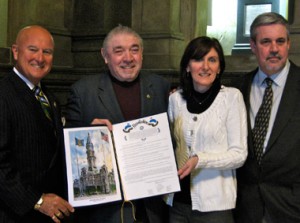
When Ancient Order of Hibernians (AOH) National President Seamus Boyle formally accepted a copy of Philadelphia City Council’s resolution calling for a united Ireland last week, it was a personal triumph for Jenkintown’s Liz Kerr and her husband, Pearse.

Each AOH division has an officer whose job it is to keep the dream of a united Ireland alive, and Liz Kerr is the Freedom for All Ireland officer for Ladies AOH Brigid McCrory Div. 25. The provision of the 12-year-old Good Friday Agreement–which brought peace to Northern Ireland and paved the way for the two Irelands to be rejoined– is never far from her mind. And there are things her husband of 28 years, Pearse, can never forget.

At the age of 17, Pearse Kerr was pulled from his home and held in a Belfast prison without being charged—legal in the 1970s under the Special Powers Act. Kerr, who suffered a broken wrist and rib while in custody, was released after the US Congress intervened: Pearse Kerr, his jailers learned, was an American citizen, born while his Irish parents lived in the US.

“So you can imagine why this issue is so close to our hearts,” says Liz Kerr. Both the city and national AOH pursued the resolution, turning to Councilman-at-large James Kenney to draft it; all 17 council members co-sponsored and voted for it in December.

“It really grew out of the Irish American Unity Forum that was held this summer in New York,” says Kerr. Hosted by Sinn Fein’s Gerry Adams, the event drew 700 participants, including representatives from dozens of Irish-American organizations, activists, and representatives of both the Irish and British governments who talked about what form a united Ireland might take.

One directive every group walked away with was to mobilize grassroots support in the US and ultimately internationally to end the partition “the same way the Sullivan principles brought down apartheid,” says Kerr. The Sullivan principles, an effort to put economic pressure on South Africa to end state-sponsored segregation, were introduced by Philadelphia minister, the Rev. Leon Sullivan. In the 1980s, more than 125 American businesses with operations in South Africa agreed to withdraw their divisions and investments until apartheid laws were appealed.

In this case, says Kerr, the AOH and other groups are working “city by city, group by group” to encourage American lawmakers to adopt resolutions similar to the one Philadelphia passed. “I think what really made the council pass it unanimously is that this is the 20-year anniversary of the Berlin Wall coming down and it’s been 20 years since South Africa abolished apartheid and they recognized that the separation of the two Irelands is just another artificial boundary that has to come down,” she says.

So far, San Francisco, Syracuse, and Cleveland have adopted united Ireland resolutions. “We’ve met with the Pittsburgh AOH and they’re actively working on it there,” says Kerr. “We really need to work on New York, Chicago, and Boston” which have large Irish-American populations.

Kerr, whose grandparents came from Galway, met her husband after reading about his ordeal in the newspaper. After his prison experience, he moved to the US to live with relatives in the Philadelphia area. “He was my high school history project at Cardinal Dougherty,” she explains. “He came to my current events class and talked about what he went through. I got an ‘A,’” she laughs.

News

For Local Filmmaker, Haiti’s Earthquake is Personal

A still from Maitre's film, "Fishing for Haiti."

A still from Maitre's film, "Fishing for Haiti."

Like most people, Philadelphia filmmaker Deirdre Maitre and her husband, Roosevelt, were glued to the television to watch the earliest reports of the devastating earthquake in Haiti two weeks ago.
But their interest was more personal than it was for most of us. They were scanning the screen for familiar places, familiar faces: Roosevelt’s family lives in Port-au-Prince, and Deirdre’s family founded a sustainable fish farming project on the property where the Daughters of Mary Queen Immaculate, a Haitian teaching order of nuns, operate several schools.

“It was horrendous not to know what had happened to our family and friends,” says Deirdre. “It was like walking around with a bowling ball in my stomach. We did not actually make contact with them on the phone until Friday, three days after the quake, and even then we were getting information little by little, various pieces of news from different people including my husband’s aunts, uncles and cousins here. He has a really close friend who was able to drive down via motorcycle to his mother’s neighborhood and check on them. They had a really close call. Some of their neighbors died.”

Dierdre and her husband are dealing with their grief by throwing themselves into the relief effort. Deirdre will be screening selections from two of the films she did as part of her master’s program at Temple University on Friday, January 29, at 7 PM, at the Irish Center, 6815 Emlen Street, in the Mt. Airy section of Philadelphia. “Fishing for the Future” documents the development of the Martha’s Vineyard Fish Farm for Haiti Project, founded by her aunt, Margaret Penicaud, whose family fishes on the island off the coast of Massachusetts. “Is God Sleeping?”, focuses on a young Haitian artist who is an illegal US immigrant.

She’ll be joined by Jean Marc Phanor, brother of Gilg Phanor, one of the first five Americans rescued from the rubble of the Hotel Montana in Petionville, who will tell his family’s story.

“What I want to do is highlight the organizations in my film and talk about their status to help personalize the situation,” says Deirdre. “Some of the NGOs in my film suffered significant damage. I’m hoping to help people learn about the various work people are doing there and hopefully give them some resources to help them decide where they want to help.”

Deirdre, who grew up in Massachusetts and is the granddaughter of Irish immigrants from County Cork, first traveled to Haiti in 1998 with her aunt, Margaret Penicaud. “She lived in France for many years and married a Frenchman,” Deirdre explains. “In her church, because she spoke French, she was introduced to a nun from Haiti, the mother superior of a teaching order of nuns. The Daughters of Mary Queen Immaculate invited her to Haiti to see their schools and she invited me to come along.”

From that visit grew the Martha’s Vineyard Fish Farm for Haiti Project, which, miraculously, survived the quake. Some of the schools and the nuns’ mother house were not so lucky. The buildings collapsed, and there was loss of life: one sister, one novice, a driver and his two children and 10 children living with the sisters. The nuns are sleeping in a tent in the courtyard. “My aunt has already started raising money for them,” says Deirdre, who fell in love with Haiti and its people during her first visit there.

“They are very authentic and vibrant,” she says. “They have a strong sense of community there. They are incredibly, deeply, profoundly spiritual. Not on an institutional level, not compartmentalized to church, but in their daily lives, in their dealings with one another. They’re very friendly, humanistic, and welcoming people. And with a profound sense of powerlessness, a complete loss of control of their destiny, in God’s hands completely.”

She met Roosevelt Maitre on that first trip and they became friends. Then, they became more than friends. The two were married in 2006. “Haiti has been very good to me,” she says with a smile. Roosevelt, now a buyer at Whole Foods, is a student at Community College of Philadelphia, studying management and business administration.

Like many who know Haiti well, Deirdre has been disappointed in the focus solely on the nation’s poverty, which, though real and vast, tells only part of Haiti’s story. The rest of the story is what she’s trying to relay through her films. “The NGOs I’ve been focused on aren’t relief efforts, they’re genuine partnerships with genuine leadership among Haitians,” she says.

Among them are Fonkoze, from a Creole phrase meaning “shoulder to shoulder,” that is Haiti’s largest microfinance institution offering financial services to the rural-based poor. Founded by a Catholic priest, Father Joseph Phillipe, and 34 other grassroots leaders and working with Peace Corps volunteer Anne Hastings, the little bank that could grew with fund supplied by investors from the US, the Netherlands, and elsewhere and now has millions of dollars—in part as the result of thousands of savings accounts established by Haitians.

Dr. Paul Farmer’s program, Partners In Health, has been bringing medical care to the poor for more than 20 years and is now in four countries. Farmer, a Harvard physician, is United Nations deputy special envoy to Haiti though he currently lives in Rwanda. After the quake, PIH set up field hospitals in Port-au-Prince and has 20 operating rooms up and running. Twenty-two planeloads of medical volunteers and thousands of pounds of medical supplies to support the more than 4,500 PIH medical personnel already on the ground. PIH medical personnel at the sister facility in Rwanda donated a percentage of their salaries to help.

The fourth NGO Deirdre plans to film is Cine Institute, Haiti’s first film school founded in the port city of Jacmel by filmmaker David Belle and supported by Hollywood money (director Francis Ford Coppola is on the board). “We were just in the process of setting up a time for me to visit when the quake hit,” she says. Cine Institute’s building was seriously damaged, but students dug through the rubble for their equipment and began roaming the streets to record the chaos. You can see their video reports and make a donation on their website.

“This has been a horrible, horrible tragedy,” says Deirdre, “but the focus on Haiti because of the earthquake could be a new beginning in so many ways. Time will certainly tell. Americans can play a big part in that.”

Learn what you can do to help Haiti on 7 PM Friday, January 29, at the Irish Center, 6815 Emlen Street, Philadelphia.

Music

Review: “The Turning Tide” by Solas

Solas keeps reinventing itself and yet somehow manages the trick of always staying the same: reliably, predictably brilliant.

This kind of success is all the more remarkable considering the number of personnel changes since the band burst upon the scene in 1994. Only multi-instrumentalist Seamus Egan and fiddler Winifred Horan are original members of the band. Over the years, though, the rest of the lineup has changed: three guitarists, two button accordion players and three singers. That’s not to suggest tumult is the inevitable result. On the contrary, every new musician has brought fresh perspectives to the party, and so the band and its sound have evolved. You can hear subtle changes in each of the nine albums Solas released between 1996 and 2008.

Now, along comes album No. 10, “The Turning Tide,” the second featuring singer Mairead Phelan. All of the essential elements you’ve come to expect from Solas are there. Start with mind-blowing, high-energy arrangements from Seamus Egan (“Hugo’s Big Reel”) and guitarist Éamon McElholm (“The Crows of Killimer”/Box Reel #2″/”Boys of Malin”/”The Opera House”). When the band performs at the World Cafe this St. Patrick’s Day, you can predict that those will inspire enthusiastic “whoops.” The band has been cranking out bread and butter numbers like that from day one. Add in a clever confection from Winifred Horan—”A Waltz for Mairead,” which reminds me a bit of “The Highlands of Holland” from the 2003 album, “Another Day.” Now tack on the happily tangled rhythms of box player Mick McCauley’s “Trip to Kareol” (which reminds me vaguely of “Who’s in the What Now” from “Edge of Silence”).

It could all seem formulaic, but if it is, it’s a formula for sure-fire success. At its core, regardless of who is playing the guitar or accordion—and Solas attracts the best—the band remains consistently excellent. And even if some of the selections seem familiar, Solas infuses fresh new energy and excitement into them.

Into this dependable mix steps Mairead Phelan, who joined Solas in 2008, replacing Deirdre Scanlan (who replaced Karan Casey). Phelan made her debut on the last CD, “For Love and Laughter.” Her first outing provided a tantalyzing clue as to what was to come. On “The Turning Tide,” she really comes into her own, and adds her own special imprint on the band.

It helps that she has great material to work with. I’d love to know the process Solas follows for picking tunes. On “The Turning Tide,” as always, the band has discriminating taste—for example, “A Sailor’s Life,” the old English folk song popularized by Sandy Denny and Fairport Convention; Bruce Springsteen’s “Ghost of Tom Joad”; and “Girl in the War” by Josh Ritter, whose writing invites comparisons to Springsteen and to the young Dylan.

But great tune selection can only take you so far. The singer has to be up to the task.

Mairead Phelan is there.

I was prepared to like “Ghost of Tom Joad”—it’s a great song to begin with—but Solas adds its own intriguing interpretation. Seamus Egan opens on banjo, and what follows is an arrangement that sounds more like a slow march than a folk tune. Phelan’s soft, sweet voice lends a plaintive quality to the Springsteen lyrics. The Boss would be pleased.

“A Girl in the War” was an interesting choice. Posters on the lyrics boards seem hopelessly divided on the song’s meaning. Does it have religious overtones, or is it an explicit anti-war tune? I’ll side with the latter. Check out to the lyrics and draw your own conclusions: “Peter said to Paul/You know all those words that we wrote/Are just the rules of the game and the rules are the first to go/But now talkin’ to God is Laurel beggin’ Hardy for a gun/I got a girl in the war, man I wonder what it is we done.”

Phelan’s reading of the song is spot on. She draws you in and makes you feel every note of this gorgeous, haunting song. And, again, it helps that she has a superb band behind her—on this tune, including the Philly dobro player Mike “Slo-Mo” Brenner—and the advantage of a lovely, restrained arrangement to match her delivery.

So what’s new about this version of Solas is clear in the form of a talented singer whose talents are really still just emerging.

Along with Brenner, “The Turning Tide” features contributions by long-time members of the Solas extended family—drummer Ben Wittman (he blows the doors off in “Hugo’s Big Reel”) and bassman Chico Huff, with percussion by John Anthony, who also recorded, mixed and mastered the CD.

Take a listen to “The Turning Tide.” (You’ll hear tracks on Marianne MacDonald’s radio show “Come West Along the Road” on WTMR AM 800 Sunday at noon.) I promise you’ll hear something new. And yet the same.