Genealogy

Finding Where the Faerie Folks Hid Our Ancestors

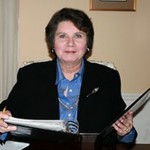
Deborah Large Fox

Deborah Large Fox

As anyone who has ever started down the road to discovering their Irish ancestors knows, it’s a path that’s beaten, fraught with stones, at times narrow and crooked, never the one of least resistance. Aand every once in a while a black cat will cross it in front of you.

In other words, Irish genealogy is a challenge.

I, myself, have been known to muse on occasion that clearly my missing ancestors discovered the portal to hell in a cave in County Roscommon, and a few of them liked it so much they stayed.

Deborah Large Fox, former-prosecutor-turned-family-historian, has a kinder, gentler theory to explain the difficulty in locating her forefathers and mothers: this past January she began writing a blog titled “Help! The Faerie Folk Hid My Ancestors!”

The blog developed out of classes and talks that she’s been facilitating over a number of years. Fox explains that she‘s always “receiving new information and research tips…and blogging might be the best way to pass these tips to a larger audience.”

Interestingly, when Fox first began teaching genealogy classes, it was on the general topic of family research. But she noticed a trend developing: the majority of her attendees were focused specifically on their Irish ancestry. And, fortunately for all of us here in the Philadelphia area, that’s a road Fox has been traveling for years.

She started her own family research back in the days before the Internet, making several trips to Ireland in her quest. Her visits included trips to her family townlands, as well as time spent researching at The National Library of Ireland in Dublin.

Locally, she did a lot of investigating through the resources at the Family History Center in Cherry Hill. When they approached her about facilitating a monthly group for Irish researchers about a year and a half ago, she was happy to do so.

The group meets on the first Thursday of every month, and as I discovered for myself a few weeks ago, it’s a magical place where folks can go and share information, brainstorm together about brick walls, discover new avenues to research, and sometimes even chance upon relatives.

“I had cousins meet here a few months ago,” Fox told me. “I love the people that come.”

Each month, Fox introduces a different theme, “something out of the ordinary, like music.” April’s topic was “Irish Culture,” and it centered on how to pick out cultural clues. “Many Irish family history researchers become frustrated when they can’t find the county or townland of origin of their ancestors,” without realizing that things like special recipes passed down within the family, or childhood games taught to them as children, hold an association with a particular county or region of Ireland.

“People talking about songs and poems…these are cultural hints to rely on, any little clues you can grab onto, which sometimes in Irish research is all you have to work with,” says Fox.

One woman had an immigrant grandfather who wrote poetry, so she brought copies of two of his poems to pass around the group. Even though it didn’t lead back to Ireland, the knowledge shared that day gave her some new inspiration. One of the poems, when decoded by new eyes, appeared to be telling a tale from the days of Prohibition; she remembered that her grandfather had owned a pub in Philadelphia back during that era–a light bulb moment.

“It’s the hobby that never ends,” Fox laughed. “It’s just amazing. And I’m having so much fun with it.”

Fox’s blog has many fabulous resources linked into it, far too many to even begin to try to re-list here. You simply must check out her site for yourself. But, I have coerced a promise out her that as I stumble down my own path of research, she will ably assist me, so look forward to more genealogy articles at irishphiladelphia.com in the near future.
Arts

Review: “Bedbound” from the Inis Nua Theatre Company

Bedbound

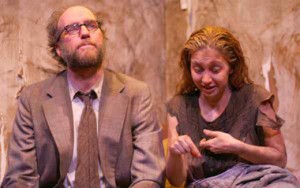
Brian McCann and Melissa Lynch star in the Inis Nua play. (Photo by Katie Reing)

For an actor, playing a part in Enda Walsh’s “Bedbound” must be like running a marathon every night. For an hour and 10 minutes, its two players—a father and his crippled daughter, trying to sleep in the same cramped, filthy bedroom—are ranting, keening, or reacting silently to each other’s torrent of words with an intensity that seems ultimately unsustainable.

“Bedbound,” a production of the Inis Nua Theatre Company now playing at the Adrienne in Philadelphia, is the story of a man whose ambition, formed when he is very young, is to be king of the furniture business in Cork and, later, in Dublin. And he is willing to do anything, including the most unspeakable acts of perversion and violence, to achieve his desires. He delivers the story of his life—the violence, calculated sex, even marriage in the service of his dream–in agitated monologues aimed at the audience while his daughter, bedbound by polio as the result of a freak fall into a sewage tank, acts them out, playing the roles of the boss and the underlings her father has killed. Or has he? The unbelievable is somehow believable in this brutal and, yes, often funny play.

He had been grooming her to follow in his footsteps when she contracted the disease that has left her with a still, twisted arm, a hunched back, and paralyzed legs. His shame led to his nightly ritual of remodeling his home so that her room has become progressively smaller and smaller, as though he were building her a coffin. In that room, her now dead mother once slept beside her and read to her from romance novels, hushing her fears that the walls are closing in on her by telling her that it was “all a fairy tale.”

For the young girl, played in the Inis Nua’s production by Melissa Lynch, the stories, as horrifying as they are, are life to her. “What am I if not words? I am empty space is what I am,” she says. And it’s the empty spaces, the rare moments of silence, that bring the most terror to these two tortured characters who, in the end, turn to talk to one another, ending this emotionally exhausting play with an unexpected and poignant note of redemption and hope.

Brian McCann, who plays the father, deftly draws a character who is both despicable and strangely endearing, a psychopath with a sense of humor and, as McCann subtly suggests, perhaps even a heart of gold. Melissa Lynch’s performance as the physically twisted daughter of an emotionally twisted man is a tour de force. She ranges from helpless cripple to crotchety boss to obsequious underling to angry daughter so seamlessly that it’s as if she has multiple personalities constantly jockeying for center stage. Even when the father is raving loudly, your eyes are riveted to her face for her reaction, as though everything you needed to know was there.

Director Tom Reing has done a masterful job in bringing a difficult and demanding play to the stage. “Bedbound” is an emotionally taxing play for both actors and theater-goers, but is ultimately touching, satisfying, and memorable in the best possible way.

“Bedbound,” by Enda Walsh, runs through April 25 at the Playground at the Adrienne, 2030 Sansom Street, Philadelphia, PA. For tickets, call 215-454-9776 or order online at the Inis Nua Theatre’s Web site.

People

Three New Honorees for AOH Joseph E. Montgomery Division 65

Kathy McGee Burns and Mickey Walsh

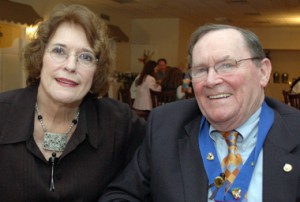
Kathy McGee Burns and her "date" Mickey Walsh.

As she received the third annual Joseph E. Montgomery Award from Ancient Order of Hibernians Div. 62 on Sunday—the first woman to be given the award—Kathy McGee Burns joked that the event was her “second date” with another award-winner, Mickey Walsh, former president of the division.

The two had actually met when she was 16 and he was 20 and a lifeguard at the Jersey shore. She explained that he had invited her to his 21st birthday party as his date, though because she had lied about her age, he didn’t know how young she was. They didn’t meet again for several decades when she saw him sitting on a stool in the bar at the Irish Center—a home away from home for McGee Burns, who was the first woman president of the Donegal Association and current president of the Delaware Valley Irish Hall of Fame, just two of the many organizations in which she takes a leadership role.

“I went up to him and asked him if he was Mickey Walsh,” she told the crowd at the Spring Valley Banquet Center in Springfield on Sunday, April 11. “He said, ‘Yep.’ Then I asked him, ‘Do you remember your date at your 21st birthday party. He said, ‘Nope.’”

The man of few words laughed heartily along with the rest of the audience.

The AOH—the Joseph E. Montgomery Division, the only AOH named for a living person—is in its third year of its Fleadh an Earraigh, honoring those who live the AOH motto of friendship, unity and Christian charity.

Also honored this year were James Feerick, a 43-year member of AOH Div. 65. The eldest of six children born to James and Anne Frank of County Mayo, Feerick, a lawyer and graduate of Villanova Law School, is also a musician who played with the All Ireland Orchestra and with local musicians Tommy Moffit and Joe Burke. He has served on the board of the Philadelphia Irish Center, and is a member of the Friendly Sons of St. Patrick the Knights of Columbus Trinity Council in Upper Darby, the St. Thomas Moore Alumni Association, and the Mayo Association, for which his sister, Sister James Ann, serves as chaplain.

Harry “Mickey” Walsh, also the son of Irish immigrants, a Navy Reserve veteran, ran the family business, Walsh’s Classic Tavern in University City, until 1996 when the business was sold. He is a former Democratic ward leader in Philadelphia’s 27th Ward and worked as a liaison between the juvenile courts and parents of troubled teens to help keep families together. He was the first president of the Haverford Hawks Youth Ice Hockey Club and has volunteered at the Irish Immigration Center in Upper Darby.

People

2010 Easter Rising Commemoration

Easter rising

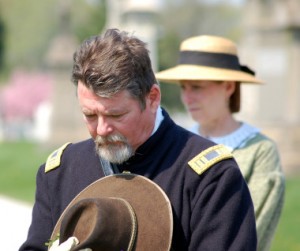
An officer of the 69th Pa. Irish volunteers bows his head in prayer. (Click photo to view slideshow.)

It happened nearly a hundred years ago.

It lasted only seven days.

The good guys lost, and their leaders were imprisoned or executed.

It was the 1916 Easter Rising, a bloody, brave but unsuccessful attempt to expel the British from Ireland and to establish a sovereign republic.

Today, more than a few Delaware Valley Irish-Americans remember, and their goals are substantially unchanged from those of the patriots of 1916.

On Sunday, several Delaware Valley Irish groups gathered once again at Holy Cross Cemetery in Yeadon to commemorate the abortive (but successful in the long run) Rising. Led by the 69th Pennsylvania Volunteers and members of the Philadelphia Emerald Society Pipe Band, the group marched to the gravesite of Joseph McGarrity, the County Tyrone-born Philadelphia businessman and a leader of Clan na Gael. They reaffirmed the Easter proclamation’s “right of the people of Ireland to the ownership of Ireland.”

McGarrity holds a special place in the republican heart. The one-time successful entrepreneur was involved in efforts to arm the forces arrayed against Great Britain. He published a fiercely pro-republican newspaper called the Irish Press. He was a friend to Irish leader Eamon de Valera (with whom he later parted company). He never gave up on the armed struggle for independence and unity.

It was a brief ceremony, but moving, as always.

People

A Night of Celebration for St. Patrick’s Day Award Winners

St. Patrick's Day Parade awards

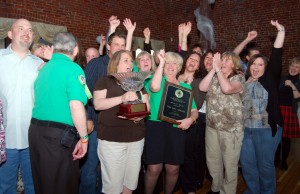
Tara Gael dancers relish their big win. (Click on photo for slideshow.)

It was an exciting night all ’round at Finnigan’s Wake as the Philadelphia Saint Patrick’s Day Observance Association finally put the 2010 parade to bed. (Not that parade planning and fund-raising ever really stops.)

Anyone who won was plainly pleased to have been chosen. But if there was a prize for over-the-top enthusiasm it would have to go to the Tara Gael Dancers, who won the Marie C. Burns Award for Outstanding Adult Dance Group. They also won in 2008 and 2007, but clearly, winning never gets old for this group.

There were several repeat winners as well. 2nd Street Irish Society was the winner of the Msgr. Thomas J. Rilley Award for Outstanding Fraternal Organization for the third year running. Rince Ri dance school won the Walter Garvin Award for Outstanding Children’s Irish Dance Group for the second year in a row. St. Katherine of Siena N.E. Philadelphia picked up the Father Kevin C. Trautner Award for Outstanding School or Religious Organization that displays their Irish Heritage while promoting Christian Values for the third year since the prize was established.

Here are this year’s award winners overall:

Honorable James H.J. Tate Award
Group that Best Exemplified the Spirit of the Parade
McDade / Cara Championship Dancers

Msgr. Thomas J. Rilley Award
Outstanding Fraternal Organization
2nd Street Irish Society

George Costello Award
Organization with the Outstanding Float in the Parade
Cavan Society

Hon. Vincent A. Carroll Award
Outstanding Musical Unit Excluding Grade School Bands
Philadelphia Police & Fire, Pipes & Drum Band

Anthony J. Ryan Award
Outstanding Grade School Band
Catholic Elementary Schools Marching Band

Walter Garvin Award
Outstanding Children’s Irish Dance Group
Rince Ri School of Irish Dance

Marie C. Burns Award
Outstanding Adult Dance Group
Tara Gael Dancers

Joseph E. Montgomery Award
Outstanding AOH and/or LAOH Divisions
All AOH & LAOH Divisions

Joseph J. “Banjo” McCoy Award
Outstanding Fraternal Organization
Cairdeas Irish Brigade

James F. Cawley Parade Director’s Award
Outstanding Irish Performance or Display
2010 Cardinal O’Hara High School Marching Band

Father Kevin C. Trautner Award
Outstanding School or Religious Organization that displays their Irish Heritage while promoting Christian Values
St. Katherine of Siena N.E. Philadelphia

Maureen McDade McGrory Award
Outstanding Children’s Irish Dance Group Exemplifying the Spirit of Irish Culture through Traditional Dance
Coyle School of Irish Dance

Genealogy

Calling All Gallaghers!

Our friend, Nancy Lyons, a Delaware-based genealogist, tells us that there’s a big Gallagher Clan Reunion taking place July 12-19 in Maryland, Washington, DC, and Adams County, PA. Last year, the Gallaghers (try saying it with the second “G” silent and you’ll have the Irish pronunciation of your name) met their Irish cousins in County Donegal, where the Gallagher name originates.

They’re expecting Gallaghers from all corners of the globe to descend to learn about the Gallaghers who served in the Civil War, attend the Adams County Irish Festival, see a baseball game, and enjoy some fireworks.

Of course, there’ll be plenty of sessions to discuss and share Gallagher genealogy and hear an update on the Gallagher DNA project.

For more information, contact:
Timothy P. Gallagher
5496 Ross Court
New Market, MD 21774 USA
Phone: 301-831-3994
E-mail: spqr753@msn.com

You’re a Gallagher if you have Gallaghers in your family tree—and the name can be spelled many different ways, including but not limited to these spellings: Gallagher, Galagher, Galaher, Galigher, Gallaghar, Gallagher, Gallahar, Gallaher, Gallaugher, Galliher, Gallihur, Gallocher, Gallogher, Galloher, Gallougher, Galligher, Goligher, Gollagher, Gollaher, Golliher, Gollocher, Gollogher, Golloher, Gollougher, Goloher.

Music

Review: Ceol & Cuimhne (Music & Memory) by Téada

Teada

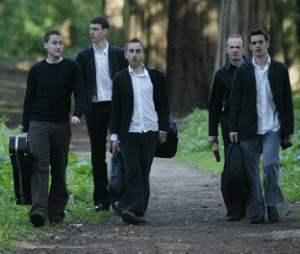
The band Teada in a pensive pose.

We’ll start with track 4 from the new Téada CD, Ceol & Cuimhne. It’s a set of reels including “The Russians Are Coming,” “The Miller’s Daughter” and “The Boston-Sligo Reel.”

The set begins with a few bars of airy bouzouki flatpicking by Seán Mc Elwain. It’s a deceptively light introduction to a sudden, frenzied duel between flutist Damien Stenson and Tristan Rosenstock, the band’s bodhrán player. By the time fiddler Oisín Mac Diarmada and Paul Finn on button accordion jump into the set, just before the transition to the second reel, things are already rocketing along. If there is some physical law of music that says a performance cannot exceed the speed of sound or light, or the bounds of good sense, these boys just broke it.

They can get away with it. Téada is just that good.

Whether they’re playing the foot-stomping “Circus Polka” or the tender “Sligo Air” (accompanied by the gifted County Mayo harper Gráinne Hambly, who has performed with the band on its annual Christmas tour), these five young exponents of traditional Irish music don’t make artistic compromises. Expect excitement, expect invention, but don’t expect trade-offs. They’re like the Blue Brothers of trad–they’re on a mission from God.

“Ceol & Cuimhne”–Irish for “music & memory”–is all about fidelity to tradition. Téada is demonstrably bound by an obligation to the past, but with their exuberant style of play and the sheer force of their virtuosity, the band succeeds wonderfully well at making the old tunes revelant and compelling here and now. For Téada, temporal convergence seems to be a recurring theme. Their 2006 album, “Inne Amarach” means “yesterday tomorrow.”

Like “Inne Amarach,” “Ceol & Cuimhne” is also a loving tribute to the legends of traditional Irish music, like Junior Crehan, Paddy Fahy, Michael Coleman and Philadelphia’s own Ed Reavy. Diehard traditionalists will find a lot to like in tunes like “Paddy Cronin’s,” “All Around the Room” and “Seamus McKenna’s.”

There are many standout performances on this recording. Fiddle fans will savor Oisín Mac Diarmada’s fresh interpretation of “Clothiers,” a march here presented as an air. “All Around the Room,” the middle tune in a set that includes “Miss Cassidy’s” and “The Ballingra Lass,” showcases the fine talents of Paul Finn, as does “Merty Rabbett’s.” And of course, Damien Stenson is everywhere, generally setting things on fire.

A comment or two on Rosenstock and McElwain. (Sounds like a law firm.) Rosenstock is like the Ringo Starr of the bodhran. (Which would make John Joe Kelly, what … Keith Moon?) As with Ringo, I think it’s easy to underrate Rosenstock. He just sets down a rock-solid rhythm, really knows the tunes well, and sticks to the other players like glue. Do I like the flashier stuff? You bet. But I can also appreciate the artistry and sensitivity with which Rosenstock plies his trade.

In much the same way, I think it’s all too easy to overlook McElwain. He’s always in the background. But if you listen to what he’s up to, you realize that the question of whether a tune holds together or falls apart often hinges on how well he plays. A band couldn’t have a better backbone.

The point is, they’re all world-class. And “Ceol & Cuimhne” is a world-class contribution to the tradition.

Food & Drink, People

Stew Cook-Off Winners Rise to the Top

Hibernian Hunger Project

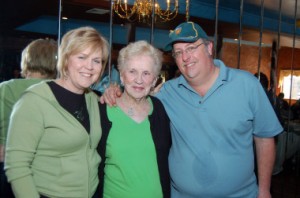
Tom Coffey, right, Mary Carr, and daughter Bernadette. (Click on photo for more.)

On one side of the table, Mary Carr. On the other, son-in-law Tom Coffey. In front of each: a foil tray filled with simmering Irish stew. Her stew. His stew. And only one stew can be … the best. It’s Mom vs. Tom.

On this Sunday afternoon at Finnigan’s Wake in Northern Liberties … Tom is the winner. His Irish stew is judged the best in the amateur category at the Sixth Annual Great Irish Stew Cook-Off, sponsored by the Hibernian Hunger Project.

Tom Coffey accepted his award with grace. Of Mary Carr, he said, “She needed a good ass whuppin’.”

But seriously, now, folks … “She (Mary) is a good sport,” says Tom. “I didn’t marry my wife. I married a family, and they’re a very social group.”

So no worries about where Tom Coffey will have Easter dinner. Rivalry aside, Tom’s making dinner. “And I always invite myself,” he says.

Here are the other winners:

  • Hibernian: Maryanne Burnett (LAOH 87)
  • Irish Organization: Helen DeGrand (Mayo Association)
  • Professional: Josh Landau (a 2007 winner)
  • People’s Choice: Team Kerrigan (a 2009 winner)