News

2nd Annual Brittingham’s Irish Festival

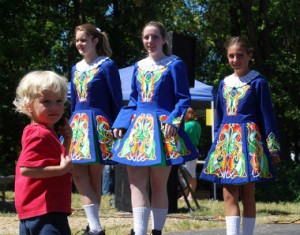
Little Daniel wants to get in on the act.

Little Daniel wants to get in on the act.

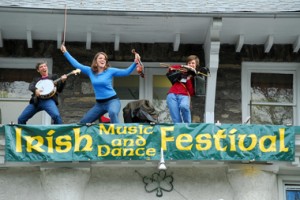
It would have been hard to find a better day for this popular little event at Brittingham’s in Lafayette Hill.

Bright and sunny, but not too hot, and breezy. Bands and dancers all afternoon, Hot dogs and burgers hot off the grill … and cold beer to wash it all down. It’s always hard to see summer ending … but if it has to end, this is the way to do it.

The main attraction was the music: Paddy’s Well, Jamison, Oliver McElhone, all taking turns on the stage, with the Coyle Dancers performing in between sets. It was bright and warm enough for pale-skinned Celts to do a slow burn, but the promoters made sure there was a big tent, and plenty of room underneath.

Several vendors also seemed to attract their fair share of attention throughout the afternoon—as did Yo-Yo Man (“Tim,” for short), who had no shortage of kids buying his toy.

We have photos and lots of videos.

Check out the videos:

Sports

A Labor Day of Love for the Region’s GAA Teams

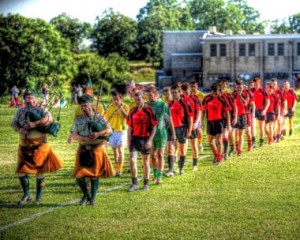
The Young Irelands (in red) and the Kevin Barrys (in yellow) are piped onto Cardinal Dougherty Field for Sunday's championship. Photo by Eileen McElroy.

The Young Irelands (in red) and the Kevin Barrys (in yellow) are piped onto Cardinal Dougherty Field for Sunday's championship. Photo by Eileen McElroy.

While the rest of us are having burgers and corn on the cob and not going in the ocean (thanks, Earl) this Labor Day weekend, many of the region’s Gaelic Athletic Association players are in Chicago at Gaelic Park for the 2010 North American County Board championship playoffs.

There are 78 teams representing 22 cities—including Philadelphia and Allentown—in Chicago today (Friday, September 3) for the games, which is the biggest GAA playoff event ever in the US.

The teams from the region participating include:

  • The Philadelphia Shamrocks, Junior B Hurling
  • The Kevin Barrys, Men’s Senior Football
  • Young Irelands, Men’s Intermediate Football
  • St. Patricks, Men’s Junior A Football
  • Young Irelands, Men’s Junior B FootballSt. Patrick’s Men’s Junior C Football
  • Allentown Hibernians, Junior C Hurling
  • Mairead Farrells, Ladies Sr. Football
  • Notre Dame, Ladies Intermediate Football

Philadelphia’s teams will also participate in All-American teams in several rounds of football (including against the Chicago Fire Department team!).

Check out the action from last Sunday when the Kevin Barrys won the city championship over the Young Irelands in these photos by Eileen McElroy, who is both a talented photographer and a player (she’s with Notre Dame ladies’ football club).

Music

Gary Quinn: He Keeps Her Lit

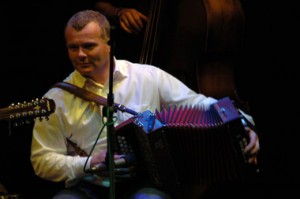
Accordion player Gary Quinn from Galway.

Accordion player Gary Quinn from Galway.

There’s just no way around the truth of it—life and Facebook, they work in mysterious ways. One minute, you’re updating your status, and the next Facebook friend whom you’ve never met invites you to fly into Philadelphia to play the Philadelphia Ceili Group’s 36th Annual Traditional Irish Music and Dance Festival. (It starts this coming Thursday and runs through Saturday night at the Irish Center.)

For former All-Ireland Champion Accordion player Gary Quinn, this is exactly what happened a few weeks ago when a last minute change was made to the Festival’s line-up, and a spot became open for the Friday, September 10 Fireside Concert.

The County Galway musician was happy to take the gig. Since his debut cd, “Keep Her Lit,” launched in 2008 to critical and popular acclaim, Quinn has seen his music career take off. A performance stateside is a natural progression.

“A few years ago, I was getting near to turning 40, and I began to take my music more seriously. I’d always been playing, and writing tunes, but I decided that I mean to go out of this world the way I came in—playing music.”

Quinn isn’t kidding. He began taking accordion lessons at age 4, but a deeper interest in the chips at the nearby take-away shop caused his mother put a stop to the lessons. A year later, at age 5, Quinn was listening to the radio when a tune came on that hooked him, and he sat down and played it on his accordion.

“That was my first reel, ‘Bonnie Kate,’ and it’s still my favorite tune,” Quinn recalled. “I’ll play it next Friday night at the concert.”

“I realized that music is the international language of the world. If you can play music, you can communicate with anyone. It doesn’t matter if you can’t speak the same language … if you can sit down together and play the same 8 notes, then you can understand each other.”

Quinn immediately knew who to call to bring with him for the trip: Derry-born guitar player Anthony McGrath. “He’s a fantastic guitar player, and a really good guy. He’s played with all sorts of people.”

In fact, Quinn and McGrath joined forces recently with Limerick fiddle player Kevin Farrell and Dublin singer and bodhran player Joyce Redmond to form the band Eriuna. The name is derived from that of the celtic goddess Eriu, also the source of Ireland’s identity as Erin.

Quinn, who hails from Brierfield near Moylough in County Galway, where he still lives now with his wife and two young children, grew up in an area infused with brilliant music and brilliant musicians. His first influence was Joe Cooley, “who was a revolutionist when it came to accordion playing. You could hear his personality in his music. He played with such feeling.”

Joe Burke and Finbarr Dwyer, “both technically brilliant and fantastic players,“ also left an imprint on Quinn’s style. But it is Mairtin O’Connor that Quinn holds up as “a total gentleman. He gave me permission to record a few of his tunes on my cd.” And after the album was completed O’Connor had this to say about it: “The spirit of joyful music is alive and well in his hands and on this recording he keeps our spirits well buoyed … He is joined by some wonderful players and the overall result is a pleasure to listen to.”

Quinn could not have been more elated by this endorsement from his hero.

Many of the tunes on “Keep Her Lit” are Quinn’s own compositions, including the title track. A mechanic by trade, Quinn hears music in the whole world around him.

“I get inspiration from everything. Good feelings, happy feelings, sad feelings. For instance with “Keep Her Lit,” I could hear the tune in the lorry engine as I was working on it. I’m so fortunate to be able to combine these two things I love, playing music and working on cars.”

“I’m very, very happy right now. It’s a bit too late for me to get famous now, at 40, but my life is exactly where I want it.”

Gary Quinn and Anthony McGrath will be performing at 8PM, Friday, September 10 at The Philadelphia Ceili Group Festival, and will be teaching workshops on Saturday, September 11th from 11AM to 1PM. The Irish Center is located at 6815 Emlen Street, near the Carpenter Lane SEPTA station, in Philadelphia.

News, People

Dance Fever!

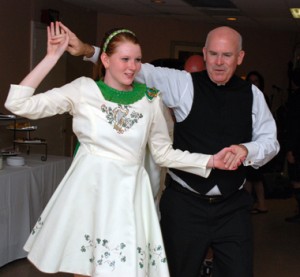
Father Ed Brady picks up a few steps from one of the Timoney Dancers.

Father Ed Brady picks up a few steps from one of the Timoney Dancers.

There sure was a lot of dancing at Sunday’s “Spirit of the Fallen” fundraiser at the Philadelphia Irish Center. And how appropriate—dance photographer Brian Mengini planned the event to raise money to produce a calendar featuring some of the region’s finest dancers who volunteered their time to pose wearing angel wings to commemorate the city’s fallen policemen. Proceeds from the sale of the calendar will benefit the Philadelphia Police Survivors’ Fund.

Rosemarie Timoney brought her Timoney School dancers who not only performed but taught a few step dance steps to audience members. They included musicians Joe Hughes and his wife, Laine Walker Hughes, of Paddy’s Well. With a friend, the Hughes provided the music, along with Mark O’Donnell, a piper with the Emerald Society Pipe Band. Father Ed Brady of St. Ignatius Parish delivered the invocation—and he danced too.
Representing the Philadelphia Police Department was Joseph Sullivan, chief of the department’s counter-terrorism unit and a police academy classmate of Officer Chuck Cassidy, who was shot to death in 2007 when he interrupted a robbery at a West Oak Lane store.

The 2011 calendar will go on sale after a release party at Finnigan’s Wake in Philadelphia on October 2, starting at 7 PM.

Mengini didn’t make his goal at the fundraiser, although, he says, “we had a blast.” To make a donation, buy an ad in the calendar, or become a sponsor, go to the calendar Web site.

We also have videos: 
Columns, How to Be Irish in Philly

How to Be Irish In Philly This Week

Expect a lot of exuberance at this year's Ceili Group festival.

Expect a lot of exuberance at this year's Ceili Group festival.

Welcome to September! Dust off your shamrock deely bobbers, folks. You’re going to need them.

In a couple of weeks we’ll be halfway to St. Paddy’s Day and this is the month where we all start practicing because we have plenty—and I mean plenty—of opportunity. I don’t want to say there’s an Irish festival every week, because I think we’re skipping a week this year. But there are some weekends when there are two or three to make up for it.

[A brief pause to air a pet peeve: Now, seriously, folks, can we get some coordination here? Before you decide on a date for your event, check our calendar. It’s the only comprehensive Irish events calendar in the region and you’ll get more people at your fest if it’s not scheduled say, when most of the Irish people in Philly are in Wildwood destroying their livers or heading to a festival where, in addition to hearing great Irish music, they can see half naked men in kilts throwing telephone poles around. Now, back to our regularly scheduled column.]

First festival of the season award goes to Brittingham’s in Lafayette Hill where East of the Hebrides launched a nice, kid-friendly Irish fest last year in Brittingham’s parking lot. On Sunday, September 5, there’s great music from Paddy’s Well, Jamison, Oliver McElhone, Seamus McGroary, and Whiskey Folk; a beer garden (I’m having one of those next year); Irish dancers and bagpipers; and vendors and delicious food both inside and out (for those of you who’ve been to Ireland, Brittingham’s serves authentic toasties!).

The Saturday before, you can see the Samuel Beckett play, “First Love,” at the Suzanne Roberts Theater in Philadelphia. It stars Irish actor Conor Lovett in his 19th role in a Beckett play. And boy, is his sense of the absurd tired.

Then, come Thursday, gear yourself up for three days and nights of the Philadelphia Ceili Group’s annual festival of traditional Irish song and dance at the Irish Center in Philadelphia.

This year could be one of the best years ever: Remarkable fiddler Liz Carroll will be joining forces with Altan’s Daithi Sproule on stage on Saturday night., September 11. Irish Philadelphia will be there on Saturday afternoon with a table filled with fun for the kiddies, so stop by and see us. (And bring the kids: We have free Silly Bandz and tattoos.) There will be other vendors too, as well as food, drink, Irish dancing, and classes on everything from the Irish language, to making a St. Brigid’s Cross to genealogy (our own resident genealogist Lori Lander Murphy will be giving a talk on how to find your Irish ancestors).

But before that, you can see “The Yellow Bittern: The Life and Times of Liam Clancy,” a much-heralded documentary on the life of this Irish music legend who died last year, on Wednesday night at the Irish Center. On Thursday night, the Singers Circle brings some of the best voices in the area to one place (and if you have a nice voice, come on down and add it!). And on Friday, kick up your heels for a ceili (set dance) featuring legendary Kevin McGillian (on accordian) and Friends along with a Fireside room concert featuring Galway’s finest, Gary Quinn on accordian and Anthony McGrath on guitar.

There are some other amazing musicians who will be performing and/or offering workshops, including Myron Bretholz (bodhran) from Baltimore; Dave Abe (fiddle) from Washington, DC; singers Karen Boyce McCollum and Michael Boyce of Blackthorn; guitarist John Brennan; Cara Frankowicz from New England, who will be teaching fiddle; Dave Hanson (bodhran); and Tim Hill, who, at 17, is an up-and-coming uillean piper.

Also on the bill: Tom Reing, director of the Inis Nua Theatre Company, will be offering an acting workshop for kids aged 8-14; Paraic Keane, from the well-known Keane family in Ireland (dad Sean was with The Chieftains, uncle James is a celebrated box player), will be performing; the Jameson Sisters (angelic voiced Terry Kane and the very funny harper, Ellen Tepper) will be performing and offering workshops in sean nos singing and harp; singer Marian Makins (she of the unbelievably beautiful voice); uillean piper Dan McHugh; flute player Paddy O’Neill; and the irrepressible Gerry Timlin, musician, publican (he’s co-owner of The Shanachie Pub in Ambler, which serves as the occasional home office of irishphiladelphia.com) and comic.

The Ceili Group’s festival will be overlapping on Saturday, Septmber 11, with the Green Lane Scottish-Irish Festival. Music will be provided by the Martin Family Band, the Hooligans, Burning Bridget Cleary, Tree, and Norsewind. There will be pipers of every strip, Highland and Irish dancers, great food, kids activities, and, of course, the big sea monster in the middle of the Green Lane reservoir.

The Young Dubliners are also coming to town on Saturday, September 11, playing the Sellersville Theatre with The Barley Boys and later, on September 14, with the John Byrne Band at the World Café Live in Philadelphia (an Irish Network-Philadelphia get-together and the informal founding of Philadelphia’s new Dublin Society).

Speaking of the Jameson Sisters, they’ll be playing on Friday, September 10, at the Meet The Artists night at Villanova University, where the works of a group of Irish artists in London, “The Quiet Men,” are on exhibit through October. The London Irish co-curator and painter Thomas Whelan will be speaking on the topic, “Who are the Quiet Men?” — referring to the artists who, like many Irish-Americans, have Irish roots but grew up or live in England.

On Saturday, September 11, The Gloucester County AOH will conduct a wreath-laying and short ceremony honoring Commodore John Barry, father of the U.S. Navy and Wexford-born American Revolutionary War patriot, at the monument at the Commodore Barry Bridge. A mass will follow at the AOH hall, with a free luncheon afterwards and music by The Broken Shillelaghs.

There’s more heading our way, so stay tuned!

Columns

Aon Sceal?

[cincopa 10740797]Well, she may not have brought home a third crown (the London Rose took it for a second year in a row), but the Philadelphia and Mid-Atlantic Rose of Tralee, Mairead Conley, made a big impression when she competed a week ago in the international Rose of Tralee pageant, one of the largest festivals in Ireland.

Maureen O’Dwyer, who lives in Galway, emailed www.irishphiladelphia.com to praise Mairead. Here’s what she wrote:

“I have been watching the Rose of Tralee here in Galway with family, and all of us just think the Philadelphia Rose has been the most refreshing and brilliant ever. Never mind the Rose of Tralee: She just shines as a fab and great person … if you don’t win you have really won in other ways … good luck, Mairead!”

We agree. Mairead, who holds a degree in sociology from Temple University, serves as deputy director of community programming at the Irish Immigration Center, is on the board of directors of Irish Network-Philadelphia and is a singer, was feted by her friends this week at the Immigration Center. But, as you can see from the picture, she was back at work immediately—sashed, but no tiara.

In this video, Mairead reprises her talent.

Taking the Mommy Track
We recently ran into Laine Walker Hughes–she of the 1000-watt smile and the killer fiddle playing—who told us she’s left Paddy’s Well to concentrate on being a mom (she and bandmate/husband Joe Hughes have a young son) and her job as music teacher and band coordinator at Norristown Area High School.
“I even have a little group of fiddlers who are really great,” she said.
Paddy’s Well’s new fiddler is Paraic Keane, a Dubliner who comes from a noted Irish musical family: His father, Sean, was a member of The Chieftains, and his uncle James is such a well known box player, there’s even an instrument named after him (the Keane box).
Penn State Vs. Notre Dame
We happened across a rousing locker room speech video from Penn State on Facebok and had to find out more about it.
No, it wasn’t JoePa.
Turns out, there’s a serious rivalry brewing between Penn State and Notre Dame–at least, among the managers and staff at the Kildare’s Irish Pubs that have opened up in State College and in Indiana near the two big football schools.
So we asked Kildare’s marketing guy, Frank Daly, who is also a member of the Celtic rock band, Jamison.  “This is a pretty cool story,” he told us. “The GM of Kildare’s at Notre Dame, Jay Murphy, was a peer of the GM of Kildare’s Penn State, Eric Humphrys, when both of them worked for Molly Branigans. We ended up hiring both of them to run locations that are close to two of the most competitive football schools in the nation. They have been going back and forth on who’s pub will do better, so I thought I’d stir the pot a bit. “
Expect a Notre Dame response soon.
It’s an Irish Thing
 
Conan O’Brien (no, he’s not from here) told reporters that he dropped his last name from  his new late-night show—calling it simply, “Conan”—because he wants to “get away from the whole Irish thing.”
Of course, he’s kidding. That’s what he does for a living.
What’s Aon Sceal? It’s pronounced ay-n sh-kayl and it’s Irish for “what’s new” (or, technically, “any story”). It’s your chance to see your name in bold face print. Send your news to us at denise.foley@comcast.net.
Music

Solas in Concert at Longwood Gardens

Seamus Egan last played in the Open Air Theatre at Longwood Gardens about 20 years ago when he accompanied Mick Moloney and Eugene O’Donnell. Let’s hope it won’t be another 20 years before he plays there again.

Egan and his Solas bandmates closed out the summer with a memorable performance in one of the Delaware Valley’s prettiest places. At Longwood, the theatre itself is part of the show. Lush, tall arborvitae flank the stage. Flagstone walls and and lacy wrought iron gates form the backdrop. The place holds 1,500, but it seems more intimate than that. No roof … just cool breezes, dark skies, chirping crickets, bright stars and, on this night, a creamy gibbous moon.

All that atmosphere, and a big, splashy fountain show worthy of Esther Williams at the finale … fans will be talking about this one for a long time.

Egan on flute, joined by Eamon McElholm on guitar, took the stage first and set the tone with a sublime version of the slow air “An Buachaill Caol Dubh (The Dark Slender Boy).” The mellow mood didn’t last long, though. A slimmed-down Mick McAuley on button accordion (I heard someone near me ask “Who is that guy?”) and fiddler Winifred Horan joined Egan and McElholm, and launched into the band’s trademark “Wiggly Jigs” set. They moved on from there to a smoking set of reels. Joining them onstage for the reels was another skinny guy, Lord of the Dance star Jonathan Srour, who popped out of the hedges at stage right and had the audience clapping right from the start. He made two more appearances later on in the night.

Another surprise—a different singer, Niamh-Varian de Barra from Cork, practically just off the plane and making her first appearance with the band. Regular lead singer Mairead Phelan was off that night.

de Barra seemed a bit tentative on her first tune, “The Gallant Hussar.” By the time she made her second appearance, singing “The Ditching Boy,” she seemed to have shed any first-night jitters she might have had. She sang “Seven Curses” with the same confidence and energy.

McAuley and McElholm sang harmony in support of de Barra’s efforts, but it was hard to hear them. Sound quality was a bit out of whack throughout the night. de Barra sounded just fine; McAuley and McElholm were underamplified. Horan’s fiddle came through loud and clear; Egan’s guitar at times was barely audible. On balance, though, everything else about the concert was just so blissful—Horan’s tender rendering of “My Dream of You,” McAuley’s performance of the John Martyn tune, “Spencer the Rover,” and “Vital Metal Medicine,” Egan’s knuckle-busting banjo piece—it’s impossible to get tied up in knots over such a minor point.

It’s easy to forget tiny imperfections, too, when your favorite Irish band appears to be caught up in the middle a massive MGM water ballet. A bit campy? You bet. But the band seemed to be enjoying it, and who were the rest of us not to join in the fun?

[amazon_link id=”B0031Y4AJE” target=”_blank” ]Purchase “The Turning Tide”[/amazon_link]

History

An Echo Through Time: The Lost Irishmen of Duffy’s Cut

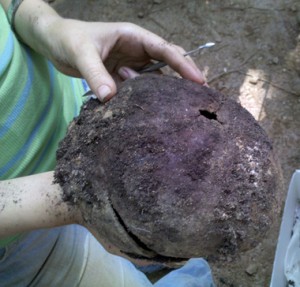
A hole in the back of this skull is being carefully examined.

A hole in the back of this skull is being carefully examined.

On April 13, 1832, the John Stamp set sail from Ireland bound for Philadelphia. Among the passengers were a group of young laborers, men between the ages of 18 and 30, set to work upon a track of railroad known as mile 59 in what is now Malvern, PA. Within two months of their June 23rd arrival, they would all be dead, buried anonymously and without ceremony, in a mass grave in Duffy’s Cut.

For over 170 years, these men, 57 in all, were lost to history.

Local archeologists Frank and Bill Watson, along with their dedicated team, have found them.

It’s a still unfolding tale ready-made for “History’s Mysteries:” Irish immigrants, prejudice, cholera, murder, cover-ups, secret files, ghosts and 21st century technology.

My visit to the Duffy’s Cut site came just a little over a month after the discovery of two more bodies, identified as Skeleton #6 and Skeleton #7. This is exciting stuff, with #6 almost in its entirety, only the right arm and ribs lost to decay. They know the man was very tall for his day, about 5’8, and around 30 years of age. His wisdom tooth, which was intact, will be sent off for DNA testing.

Skeleton #7, on the other hand, was a much shorter man, around 5’2. But his skull tells a very big story: the crack shows he was hit on the head, and there’s a hole in the back that is being examined very carefully by Janet Monge, Adjunct Associate Professor in the University of Pennsylvania’s Archeology Department. It’s presumed to be a bullet hole.

What has become increasingly clear is that these Irish immigrants did not all die from the cholera that attacked them; at least some of them were murdered because of fears they would spread the disease, and because they were considered dispensable.

Cholera in the 1830’s was a source of mass hysteria in communities. Its cause was unknown then, but it would have been communicated by contaminated drinking water. It killed about 30-40% of its victims, so the 100% mortality rate at Duffy’s Cut has always been suspect.

The surrounding community would have been afraid of the outbreak spreading from the railroad workers to the general population, and the men would have been quarantined to their site. They would have been turned away from any homes they approached for help.

However, it’s known that they did receive care from a local blacksmith, tentatively identified as MalachI Harris, and four nuns from The Sisters of Charity.

Seven men attempted to escape from the site, but were hunted down by The East Whiteland Horse Company, a group of farmers acting as local vigilantes whose mission was “to track down horse thieves and other breakers of the law.” Those seven men are the only ones to have been provided coffins before their burials; coffins that have mostly disintegrated due to time and the particular composition of the local soil.

“When we first started the dig at the site, there was no sign of life here. Nothing. And now, living creatures are coming back,” Frank Watson, who has a Ph.D. in historical theology, said as we watched a beautiful blue butterfly hovering for several minutes, flitting from one place to another almost as a guide to what discovery will be made next.

It was the file that Frank inherited from his grandfather, Joseph F. Tripician, that was the key to discovering these men. “Our grandfather was the personal assistant to four different presidents at what was The Philadelphia and Columbia Railroad. He was an immigrant from Sicily, who worked his way up.“

Since the 1830’s folktales and ghost stories had circulated locally about the deaths of the railroad workers. One tale, recorded in an area newspaper in the 1880’s, told of a man walking by Duffy’s Cut in the fall of 1832 (on the way home from the pub), who saw Irishmen dancing on graves. In 1909, there was a railroad marker placed there, but without details.

In other words, an urban legend with no corroborating evidence.

Except for the detailed documents that were hidden away in the secret file kept by each of the presidents of the P&C Railroad, amassed and passed down over a period of 100 plus years. The file began with information from the time of Philip Duffy, the man who was charged with the building of the railroad, and the man who was cited in an 1829 issue of the “American Republic” as “prosecuting his Herculean task with a sturdy looking band of the sons of Erin.”

These documents revealed beyond a shadow of a doubt the existence of a mass unmarked grave along mile 59.

The last president that Tripician worked for was Martin W. Clement, who died in 1966. It was Clement who had the 1909 marker erected at the site, and who actively worked to acquire a lot of the information stored in the file. In 1968, when the railroad was bought out two years after Clement‘s death, Tripician ended up with the file. And after his death, his grandson Frank Watson inherited it.

In 2002, Frank and his brother Bill, who is Professor and Chair of History at Immaculata University, were finally sorting through their grandfather’s papers, and Frank pulled out the file. Reading through it, they were struck by what they found there, including the account of the dancing Irish ghosts; two years before, Bill and his piping buddy Thomas Conner had experienced the same phenomenon on the campus of Immaculata College. The college is located about one mile west of Duffy’s Cut.

That was the start of The Project. They began assembling a team that now includes geophysicist Timothy Bechtel and forensic dentist Dr. Matt Patterson. Dr. Janet Monge and Samantha Cox from The University of Pennsylvania are key to “cracking the whip in terms of archaeology.” Immaculata College has supported them, even providing the insurance and a grant this summer that has paid for new tools and food for the volunteer crew. Norman Goodman, a former deputy coroner from Chester County, has pledged to help obtain death certificates for the men. East Whiteland Township, as well as the residents of the development surrounding Duffy’s Cut, have all been cooperative. Former students like Robert Frank, Patrick Barry (Frank and Barry found the first bone) and Earl Schandelmier have stayed with the project beyond graduation from Immaculata.

As the momentum has built over the past few years, following the initial discovery of artifacts like a Derry pipe stem and a bowl marked with a harp flag and the words “Flag of Ireland,” the story has garnered international attention. Tile Films in Dublin began filming the dig, and when the documentary aired on RTE in 2007, it was one of the highest rated programs in Irish history. They sold the rights to the Smithsonian for broadcast in the U.S., and continue to film as the story unfolds. They were onsite when Skeletons #6 & #7 were uncovered.

“The story of Duffy’s Cut has gathered a huge amount of interest in Ireland,“ Frank explained. “We’ve done a lot of radio interviews. “

In fact, it was because of one of the radio interviews that the body of John Ruddy was able to be positively identified. He was the first man discovered, in March of 2009, and with a very distinctive dental characteristic: he was missing his right front molar. Missing in the sense that he never had one. After hearing about the genetic quirk on the radio, members of the Ruddy family still living in County Donegal (where the ship’s manifesto revealed John had been from) contacted the Watsons and told them that many members of their family are also missing their right front molar. And, they offered to pay for their DNA testing in order to provide a definitive match.

The fascination that Duffy’s Cut holds is in large part due to the sense of a great injustice finally being righted. According to information revealed in the file, the extreme lengths that the railroad company went to in suppressing the story continued for well over a century. In 1927, local reporter Royal Shunk sent a letter to a clerk at the railroad thanking him for the loan of a file in conjunction with an article Shunk was writing for a local paper. The story never appeared, most likely suppressed when higher-ups got wind of it.

A diary kept by the daughter of local militiaman and 1832 local cholera victim, Lt. William Ogden, was noted in the file as having information pertaining to the death of the men. The diary disappeared sometime after the death of the last sister in 1913.

As recently as four years ago, an unofficial and unauthorized visitor to the site tried to convince the Watsons that they didn’t have the proper authorization to continue with their excavation. Completely untrue, as the brothers have gone to extraordinary lengths to insure that every i is dotted, and every t is crossed.

So, when Christy Moore recorded the song “Duffy’s Cut” written by Wally Page and Tony Boylan, on his 2009 album, “Listen,” Frank Watson sent him a message telling him how much the song meant.

The men, who were once victims of the kind of injustice that history is peppered with, are now the stuff of legend. It’s been a long time coming, but it’s an amends that could never have been made without the advances in technology available today, as well as the unique set of circumstances that put The Duffy’s Cut file in the hands of the Watson Brothers.

As Bill Watson said, “It’s like an echo through time. There was something so right about removing those men. They weren’t meant to die here.”