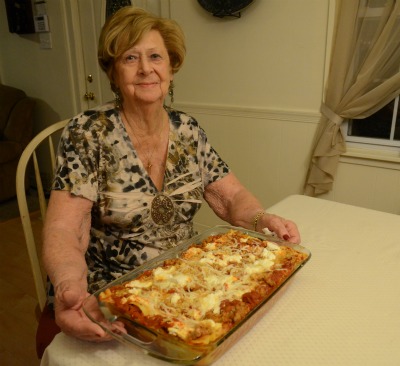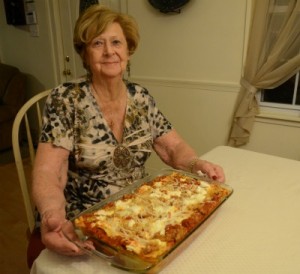
My mom Jean Catherine McNulty Meade, with her famous lasagna.
Judging by all the “mixed” marriages we run into, it’s a pretty safe bet that there are a lot Irish families out there with Italian relatives, and vice versa.
Several months ago, we celebrated “Gaelic and Garlic” heritage by posting several really scrumptious Italian recipes. Columbus Day is celebrated on Monday, so it seemed like a good idea to resurrect that story.
e-ryan/” rel=”attachment wp-att-7643″>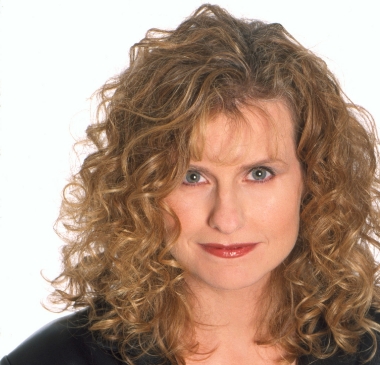
Cathie Ryan of Cherish the Ladies will debut her new album at the Tin Angel this week.
Incredible weekend ahead!
Clannad, the family band that was formed in Gweedore, County Donegal, in 1970—Moya Brennan is their voice—will be appearing at the Keswick Theatre in Glenside on Saturday night.
And FullSet, a brand new ensemble—named “new group of the year” at the 2012 Live Ireland Music Awards—is at the Annenberg Center for the Performing Arts in Philadelphia.
As they say on the late-night infomercials, “but wait, there’s more!”
Timlin and Kane are playing at St. James Pub in Bethlehem on Saturday night.
On Sunday, catch the wonderful little Irish movie, “Once,” that won its stars an Oscar for best movie theme (“Falling Slowly”) at Villanova’s Connelly Center Cinema. Look for our friend, Fergus O’Farrell singing his song, “Gold,” during the session scene.
On Wednesday, Cathie Ryan of Cherish the Ladies will be performing tunes from her new CD, “Through Wind and Rain,” at the Tin Angel. Marianne MacDonald of WTMR 800FM’s Irish music show, “Come West Along the Road,” interviewed Cathie last week and played some cuts. Cathie’s voice will pierce your heart.
On Wednesday, the Brehon Society is starting a three-day symposium on doing business in the US and Ireland. Registration closes on Monday, October 8, so get your dibs in quick. Tickets are available for breakfast with Ireland’s Prime Minister Enda Kenny at the Rittenhouse Hotel in Philadelphia at 8 AM on Friday. Contact Siobhan Lyons at 267-702-5771 for details.
Another plug for our self-service calendar—you can put your own events right on there without any interaction with a human whatsoever by clicking on the Irish Events Listing in the orange bar at the top of our home page and following directions. We’re frequently not home, so we leave the door open for you, our friends to let us know what you’re doing. Don’t make us come after you.

Recognize this dance? It's the Siege of Ennis.
Mary Lou Schnell McGurk was five years old when she took her first Irish dance lesson with Maureen McDade. Like most kids, she sampled just about everything else life had to offer, from ballet and tap to sports. But in the end, she settled on a single activity. Irish dancing won.
“It was the only thing I was really good at and liked,” laughed McGurk, who was one of hundreds of people who filled the ballroom at the Springfield Country Club on Sunday, September 30, to celebrate the 50th anniversary of the founding of the McDade School of Irish Dance by a young Philadelphia woman, the granddaughter of Irish and Scottish immigrants.
But when she was 18, McDade, then Maureen McGrory, gave McGurk a gift. “She told me that I was getting to be too old to be taking lessons with her and that I should go to the Irish Center where I would be with other people my own age,” says McGurk, who is president of the Philadelphia Ceili Group, the organization that ran those dances at the Irish Center that McGurk attended. “So I went to the Irish Center,” she said, “and I never left. To the people who like me, that’s why. To the people that don’t, Maureen’s to blame.”
There were plenty of stories, punctuated by dancing, throughout the night as Irish group after Irish group presented awards to Maureen McDade McGrory’s family. That included daughters Sheila McGrory Sweeney and Maureen Heather Lisowski who, as teenagers, took over their mother’s school with friend, Bridget O’Connell, after Maureen McGrory’s tragic death from cancer. O’Connell, frequently tearful, remembered the early days. “Maureen turned my life upside down and inside out,” she said to laughter. To allow the school’s students to continue to compete, O’Connell got her certification as an Irish dance instructor. Sheila, the oldest McGrory daughter, was only 18, and instructors had to be 21 to become accredited.
At one point, O’Connell looked at the two McGrory sisters and smiled. “Thank you both for being the sisters I never had,” she said. She then directed her attention at the two McGrory boys, John, the oldest, and Jim. “And thank you for going to dances with us when we didn’t have a date!”
Barney McEnroe, an old family friend, took the microphone from event host Tom Farrelly and recalled taking Maureen McDade to her first Irish dancing lesson with noted teacher Sean Lavery, who had a school in West Philadelphia. “She came to me and said she wanted to take Irish dance lessons but she was wondering how she could get to Lavery’s school. I told her I’d take her though I didn’t know where he lived. I dropped her off.” He paused slightly. “I don’t know how she got home,” he said, as the crowd started to laugh. He paused again, until it got quieter. “But there’s no good worrying about it today,” he continued, to renewed laughter. He looked up and smiled. “But I think she was a success,” he said.
That’s abundantly clear. McDade dancers regularly qualify for both national and world competitions. In fact, there are so many students that the McDade School merged with the Cara School of Irish Dance to accommodate the crowds. And, 50 years later, students from year one gathered with current students—some, their grandchildren—to say thank you. And happy birthday.
under takes to the field.” src=”http://irishinphilly.com/wp-content/uploads/2012/09/fallfestival2012home-300×238.jpg” alt=”Irish Thunder takes to the field.” width=”300″ height=”238″ />
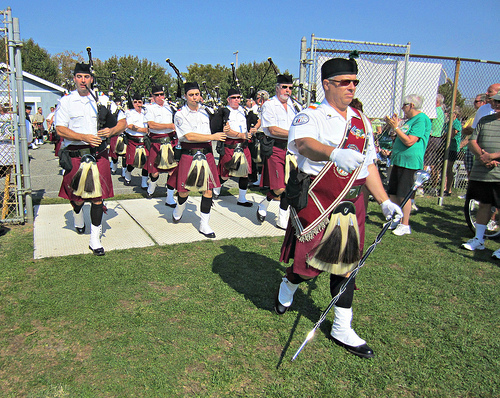
Irish Thunder takes to the field.
The t-shirt you see pretty much everywhere says it all: “What happens in Wildwood, stays in Wildwood.”
Which is not so suggest that the Irish Fall Festival is some kind of South Jersey Irish bacchanal. OK, so there are bars, and let’s face it, there is drinking, but … for the most part the festival is G-rated, with lots of music, dance, endless rows of vendor tables, and enough food to sink a battleship. Think of it as an excuse to wear a ridiculous leprechaun hat. (And pray the guys back at the office don’t see the picture we took of you.)
The 2012 festival, hosted by the Cape May County Ancient Order of Hibernians, lucked into some picture perfect weather, with sparkling blue skies, a gentle caressing wind, and temperatures in the 70s.
Hundreds of Irish folks flocked to the Wildwoods, in the way that swallows return to Capistrano, to take in the Irish pipe band exhibition on Saturday, and the big parade on Sunday.
We have the pics. Maybe you’ll see yourself. And don’t blame us … the hat was your decision.
delphia.com/wp-content/uploads/2012/09/marykaymann-300×300.jpg” alt=”Mary Kay Mann” width=”300″ height=”300″ />
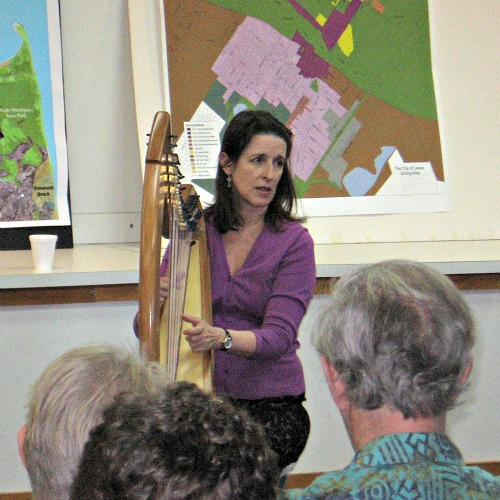
Mary Kay Mann
If an 11-year-old could compete in the world championships of Irish traditional music, harpist Mary Kay Mann reasoned, then so could she.
In this case, the then-fifth grader was Keegan Loesel, who took up the tin whistle at about 5 years old, and Mann was his teacher. Keegan is one of a small posse of incredibly talented local kids who have competed at the Fleadh Cheoil (pronounced flah KEE-ohl) on one or more occasions. Keegan put his skills to the test last year in County Cavan, Ireland, where the Fleadh was held.
Keegan played well but didn’t place in the under-12 whistle event, but it takes incredible talent, discipline and determination to get even that far. Inspired by her student, Mann decided to give it a shot.
Give it a shot she did … and even better than that: She came in third in over-18 slow airs.
It wasn’t easy. Unlike the local Fleadh kids, Mann, who lives in Media, has grown-up responsibilities.
“I have a day job, and students, and gigs, and a lot of things going on,” she says. In order to compete and have a snowball’s chance in Ireland, Mann knew she would have to choose the event best suited to her talents.
“I chose slow airs. I would have to really work to compete with 16-year-olds on jigs. I thought that, as a person who is not exactly young, slow airs might be something I could do. Slow airs don’t take speed; they take maturity. They’re slow and emotional and not rhythmic, and they are ornamented. I could probably study them for the rest of my life. I like challenges like that.”
Even then, Mann says, it was tough going. In order to compete in Ireland, Mann needed to know eight slow airs, and her playing of those eight airs needed to be bulletproof. “It takes a lot of time,” Mann says. “Once you get there, you have to play three of them … except that you don’t know which three, so you have to prepare all of them.”
Unlike other Fleadh contests, which can attract large numbers of contestants, over-18 slow airs for harp drew only six contestants. Mann thinks that might have improved her odds, but all the same—all six players were world-class.
“I think I was the only American … and these girls were incredible. Really young and really good. They’re driven, they’re self-driven, they practice all the time, and they love it.”
To her surprise, Mann more than held her own. But that’s not to suggest her third place medal was some kind of fluke. Mann, who took up Celtic harp in the mid-1990s, has always been a deeply committed performer and teacher, with a bachelor’s degree in instrumental music education. She already played classical flute and piano before she added the Celtic harp to her repertoire. (She also plays tin whistle.)
As for how Mann got her start, she blames another well-known local harpist, Ellen Tepper. “”I was playing flute in a duo with her, and at one point she just handed me the harp and said, ‘Try this, it’s easy.'”
It wasn’t all that easy, but it wasn’t all that hard, either. Celtic harp is often taught “by ear,” without aid of sheet music.
For Mann, that was just fine.
“I already played piano by ear,” Mann says. “I had already learned how to do that before I transitioned to the harp. It’s fun without all the little dots on the page. And it really is nice to start when you are older because you sound decent right away. If you started on fiddle, you’d probably sound pretty bad, but a lot of people start learning harp in midlife because it’s gratifying right away.”
After years of learning and trying to perfect her craft, competing and placing at the Fleadh is icing on the cake. For now, Mann is content to return to her teaching and performing life. She’s not sure the Fleadh experience she will repeat any time soon. “It costs a lot of money. I didn’t do benefit concerts; I had to pay for it. It’s a lot of money and time … and it’s exhausting.”