Browsing Category

News

News

Irish Harper in Aisle Two!

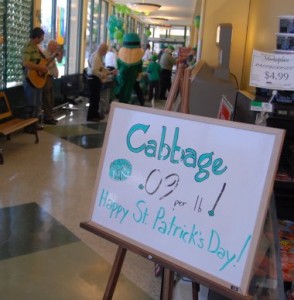
Customers came for the bargain cabbage and got live Irish music too.

Customers came for the bargain cabbage and got live Irish music too.

There was an Irish group playing tunes, corned beef and cabbage being served, and everyone was wearing those ubiquitous green Irish mardi gras beads and green derbys. Three guesses where I spent my St. Paddy’s Day.

That’s right—in a supermarket.

For the last 30 years, Murphy’s Marketplace in New Jersey has been marking St. Patrick’s Day with ever greater panache. This year, in his flagship store in Medford, owner Ron Murphy himself was handing out free beads, hats, teddy bears, balloons, and potted shamrocks while Blarney (Fintan Malone and Tom Brett with special guest on percussion, Father Jim Barry from St. Mary’s RC Church in Salem, NJ ) played at the front of the store and checkers handed every customer a green carnation. Ron’s wife, Kathleen, was busy cutting slices of cake (12 sheet cakes lined up to make one massive confection) that she handed out to customers who washed it down with “Irish coffee” – free coffee mixed with Bailey’s creamer and topped with whipped cream but, though it had to be 5 ‘clock somewhere, no Jameson. And the kids waited in line for their very own balloon animal twisted up to custom order by the pony-tailed and wisecracking Jack the Balloon Man. Later in the day, after school let out, there would be Irish step dancers, somewhere over in the bread aisle.

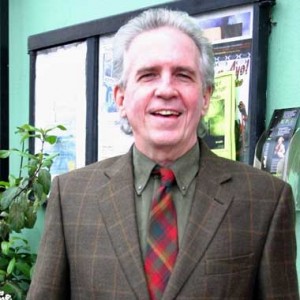
Of course, there’s a logical explanation for this. “Murphy’s, St. Paddy’s Day, all my stores are green, it’s a natural,” said Ron Murphy, wearing a green-and-white- striped cap and green-and-blue striped club tie with his smart business suit.

Murphy was in his Medford store “because if I’m not here, I get calls” from longtime customers who expect him to be orchestrating the ballyhoo. Just a few miles away, Dennis Gormley and Kathy DeAngelo, who work professionally as McDermott’s Handy, were marching to the deli counter at the Forge Murphy’s to the tune of “Lord Mayo.” There, deli clerk Chris Heide joined them in a song. “He sings all the time,” confided a co-worker. He just doesn’t usually have live accompaniment.

At each of Murphy’s five stores, there was some variation on live music, steaming trays of corned beef and cabbage, cakes of varying sizes, and Irish tschockes ranging from green wristbands and beads to teddy bears to Irish jewelry kits. A leprechaun—perhaps an employee of the month in costume—wandered the aisles, and staff dressed in green stocked shelves, sliced lunch meat, and occasionally danced with the leprechaun.

This was no ordinary day in the supermarket. But very few customers came through the automatic doors with a look of shock. For many, it’s an annual pilgrimage. It is for Monica and Danielle Jarrett. “I come here every year from Gloucester County,” said Danielle. This year, her two-year-old nephew, Cole, was the recipient of two balloon animals, some great Irish gear, cake, and a new appreciation for what happens when a Clare banjo player (Malone) and a Sligo guitarist (Brett) get together. “We come for the music, the balloons, and the nice people,” said Danielle who seemed to be one of the few people leaving without groceries.

News, People

It Was Pete’s Day

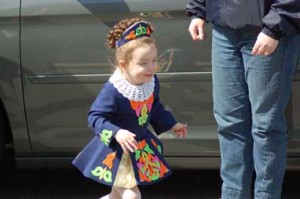
Tess, from the Caitrin dancers, is still learning all the steps.

Tess, from the Caitrin dancers, is still learning all the steps.

For Pete Hand, it was the ride of a lifetime. The president of the AOH Notre Dame Division and drum major for the division’s Irish Thunder Pipes & Drums has certainly marched down Fayette Street for the Conshohocken St. Patrick’s Day Parade.

But this was his first as grand marshal. He was joined on his journey by a few hundred of his nearest and dearest friends—pipe bands, high school bands, AOH and LAOH divisions, hordes of dancers … and one leprechaun.

Check out our photos, below.

And in the meantime, here are the winners:

  • Best Adult Band South Philadelphia String Band
  • Best Youth Band Cinnaminson High School Band
  • Best Pipe Band Delaware Pipes & Drums
  • Best Irish Dance School Coyle School of Irish Dance
  • Best AOH Presentation Girardville Jack Kehoe Div. 1
  • Best LAOH Presentation Girardville Daughters of Erin
  • Best Firemen Marching Springmill
  • Best Overall Unit Montgomery County Sheriff’s Dept.
  • Judge’s Award Elks Lodge 714

The Montgomery County Saint Patrick’s Parade Committee, the AOH and LAOH members of the Notre Dame Divisions thank all those who took part in this event to make it a success.

News

Bucks County Throws Its 20th Great St. Paddy’s Day Parade

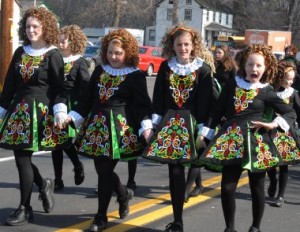
One of the McCoy Dancers breaks with decorum on New Falls Road in Levittown.

One of the McCoy Dancers breaks with decorum on New Falls Road in Levittown.

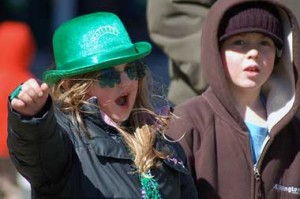
So much candy is flung, tossed, or handed out along the route of Bucks County’s St. Patrick’s Day parade, local kids know enough to bring bags with them to stash it in. Probably heard it from their parents–Bucks County’s annual Irish fest turned 20 this year with one of its best parades ever.
 
So what could be bad? There were pipe bands, military bands, Shriners bands, and two–count them, two–Mummers bands, including the Uptown Mummers brigade dressed as big colorful bugs. And you have to love a parade where the kids can pile into the street and talk to the marchers like the little girl who approached the Uptown captain and wanted to know, “Are you an alien?”

There were literally hundreds of dancers,  including the adult Ireland dancers who caught the imagination of at least one Little Leaguer in the crowd.

News

Philly Gets Its Irish On!

We rock!

We rock!

The weather was sunny and bright, not a cloud in the sky—an auspicious day for Philadelphia’s 238th Annual St. Patrick’s Day Parade. Oh, except for one thing. On Sunday, March 9, someone mistakenly sent us the weather meant for Fargo, North Dakota. 

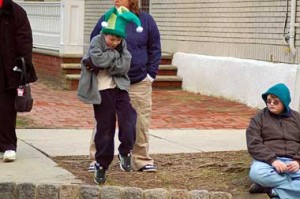
It was cold, cold, cold. How cold was it? It was so cold that the skyscraper canyon on the Parkway became an icy wind tunnel that had the crowds on the sidewalk scurrying off in search of a patch of sun or, better yet, a steam grate. So cold that the tiniest little step dancers were cranky and whiney before they’d even gotten to midpoint ofthe four-hour event, the oldest parade of any kind in the US.  So cold that hundreds of fine-looking Irish men were rethinking that kilt thing.  And some, that under-the-kilt thing.

But there wasn’t a soul there who wasn’t having a good time. Even those little dancers got their groove back every time the music cranked up, and especially when they hit the reviewing stand.  

Don’t believe us? Check out the pictures! We’ve divided them into six files so the slideshow doesn’t take all day.

 Philly Parade photos

The Mass 

Want more? Check out these photos from our flickr friend, Chris Woods.

And these from self-proclaimed “frozen long-marcher” Margaret King.

News

Holy Moly! I’m Speaking Irish!

Daniel Cassidy, author of "How the Irish Invented Slang."

Daniel Cassidy, author of "How the Irish Invented Slang."

More than 1.6 million people in the world speak Irish, and if you’re not one of them, there’s a guy named Daniel Cassidy who begs to differ.

If you’ve ever called someone “dude,” said “holy moly,” told a “babe” you were going to plant a “smack” on her lips, or taken a “slug” of whiskey, you were speaking Irish, says Cassidy, co-director and founder of the Irish Studies Program at New College of California, a filmmaker, folk singer, and now famous around the world for writing the American Book Award-winning ”How the Irish Invented Slang: the Secret Language of the Crossroads.” The book, from the tiny publisher CounterPunch, is in its fifth printing.

Americans speak Irish all the time without even knowing it, says Cassidy, just the way any Italian-American who calls his buddies “goomba” (from the Italian word meaning “friend”) speaks Italian, or a Jew who liberally uses the words ‘chutzpah” (both Hebrew and Yiddish for “nerve”) or “mensch” (meaning “a good person”) speaks Yiddish.

I talked by phone to Danny Cassidy—that’s how he identifies himself—a week ago from his home in San Francisco. A native of the Irishtown neighborhood of Brooklyn, he hasn’t let a few years on the west coast steal his accent nor mellow out his attitude. “I’m hyper,” he says, and proceeds to give me his spiel (that’s from an Irish word speal, meaning to mow down with words) like a carnival barker in overdrive.

“Dude (spelled dud or duid) means a foolish-looking fellow,” he explains. “Dude” was a name New York’s Five Points Irish gave the dapper, wealthy young men of the 1880s who went slumming (another Irish word, from ‘s lom, meaning “an exposed, vulnerable place”) in their neighborhood where there was plenty of poteen and gambling to be had. The word first appeared in 1883 in the Brooklyn Eagle newspaper as a “new word” to refer to these well-dressed sons of New York’s elite.

It may have been a new word to Americans, but it was a familiar one to the recent immigrant Irish speakers who populated so much of the city. And yet, all of those words and hundreds more than have slipped into the American lexicon are often grouped under the umbrella of “origins unknown,” Cassidy claims.

“H. L. Mencken said that the Irish were the only ethnic group that had no influence on American English, except for smithereens, speakeasy, and shillalegh,” he says. “When I read that it seemed to me that that would be an anomaly, a serious irregularity. I know my people can talk the paint off a wall, as well as write the paint off a wall. It doesn’t make sense that there are no Irish words in our language.”

How Cassidy discovered the Irish contribution to American slang involves a book—which he didn’t really want–left to him by a Philadelphia friend. “A dear dear young friend, Kevin O’Dowd, from Philadelphia died suddenly at the age of 37 in 2000,” Cassidy explains. “He left me a box of Irish books in his will. One of the books was a pocket Irish dictionary, a focloir poca. I was in Ireland making a film at the time and thought ‘I’m too old to learn Irish, it’s too hard.’ But I told my wife, Clare, ‘I can’t throw that away. It was a sacred gift from Kevin.’”

So Cassidy put the focloir poca by his bedside and read a little every night. “I found the word ‘snazzy’ in three days. It was the word snasach, pronounced snaseh, which means glossy, polished, neat, elegant, wealthy. Look it up ‘snazzy’ in the dictionary and what does it mean? Glossy, polished, neat, elegant. . . “ And there were more, many more. Cassidy was even able to divine for the first time why his family called him “Glom.”

“I once asked my mother why they called me ‘Glom’ and she said ‘it’s because you’re always glomming on to other kids’ stuff.’ I asked her where the word came from and she said, ‘I don’t know. Maybe it’s Yiddish.’ I said, ‘Mom, we’re not Jewish.”

But there it was, right there in Kevin O’Dowd’s gift folcloir poca: Glam, to grab, snatch. And in the American dictionary: glom, to grab, to snatch. Cassidy nearly cried “Eureka!” which isn’t Irish at all. He might have shouted “Gee Whillikers,” which is Irish, from the word Dia thoilleachas, prounounced jia hoill’ah’cas, meaning God’s will. Or Holy Gee, from Holy Dia, meaning Holy God. Or Holy Mackerel, from Holy Mac riuil, meaning Holy Noble Son.

It took Cassidy seven years, but he managed to track down Irish sources for hundreds of slang words Americans use every single day, from jazzy (teasai, pronounced j’asi or chassi, meaning passionate and exciting) to yellow, as in cowardly. That comes from the Irish word ealu, meaning “sneaking away. “

Cassidy’s book is filled with the language of gambling. Faro itself comes from an Irish word Fiar araon, meaning to turn two together. In Faro, the main move is called “the turn” and happens when the faro dealer turns two card together in the card shoe and places them face up on the faro layout. Even the words scam, gimmick, and baloney (beal onna, silky talk) are derived from the “secret brotherhood of gamblers,” many of whom were Irish, says Cassidy.

So, the question remains, if so many words in the American dictionary have Irish origins, why didn’t anyone else discover it before now?

“There are a couple of reasons,” Cassidy says. “Let me first contextualize it. The Oxford English Dictionary began in 1870 at the highest point of British, let me use the word, imperialism. And over here, even though Webster was trying create a new, more democratic dictionary, Mr. Webster had no Irish. When he was writing his dictionary, how were the Irish people regarded? They were the maids, the laborers, the people of the slums. They were not looked at as a people who had a classic literate language of the Atlantic world. Yet, Irish was the first literate language in Europe after Latin and Greek. In his book, ‘How the Irish Saved Civilization,’ Thomas Cahill recounts how the Irish monks of the 6th century translated hundreds of ancient texts—not just the Bible, but ancient epics of many cultures, including pagan—and recorded them during the Dark Ages.”

The language was nearly lost, Cassidy says, when the British conquered Ireland and set out to destroy the culture. “To destroy the Irish nation, they had to destroy the Irish language,” he says. It became illegal for the Irish to speak their own native tongue.

Eventually, Irish became the language of peasants, the poor, the rebels and the immigrants. “In the 17th and 18th centuries, you could go into the fields of Ireland and hear peasants who couldn’t read or write reciting beautiful passages of poetry that they’d memorized,” says Cassidy. “It’s such a great irony that the language of the great scholars of Ireland was saved by the poorest of the poor in the Gaeltacht (the Irish-speaking areas of Ireland). When the Irish came to America, as early as the 17th century, they could speak it but most couldn’t write it. But it’s there in the air. In the 19th century, more than 7 million poured into the greatest crossroads cities in the US and that language was scattered across America.”

Buckaroos in Montana were Gaelic bocai rua, Irish and Scottish Gaelic-speaking cowboys who called themselves “wild rogues” in their own language. Political ward heelers in New York derived their handle from the Irish word eilitheoir, meaning one who demands or charges. Chicago gangsters took monikers—nicknames, like Bugsy—from an Irish traveler word, munik, meaning name. “Irish was slowly absorbed into the vernacular speech of American language but it’s absorbed anonymously, much like much of our music is absorbed anonymously,” says Cassidy.

And speaking of music, Cassidy’s second book will unravel the mystery of some of the supposed nonsense words in many Irish traditional tunes. Like the oft-sung tune, “Pat (or Paddy) Works on the Erie,” that begins:

“In eighteen hundred and forty one,
I put my corduroy breeches on
To work upon the railway.”

It’s followed by a chorus that goes, “Fil-i-me-oo-re-i-re-ay, Fil-i-me-oo-re-i-re-ay, Fil-i-me-oo-re-i-re-ay, To work upon the railway.”

It sounded silly to Cassidy too, until he started learning Irish.

“I was about three and a half years into the project, and I’m not a fluent Irish speaker, but I am a folk singer and I’d been singing that song since I was a boy,” Cassidy says. “One day it hits me: This is a song about a guy who’s putting his pants on to go to work, and the words he sings, as it turns out, are an Irish phrase that means ‘I’ll go back.’ He’s putting his pants on to go back to work! ‘Filimeooreireay. . .to work upon the railroad.’”

You can almost hear the “eureka” in his voice. So, I asked, “What about tooralooraloora? What’s that mean?”

He laughed. “I’m getting close to figuring that one out. It will be in the next book, I promise.”

News

A Day of Ceremonies

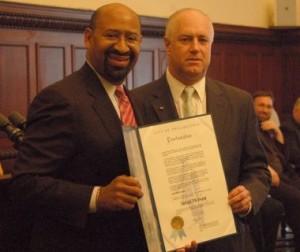
Mayor Michael Nutter and Parade Director Michael Bradley.

Mayor Michael Nutter and Parade Director Michael Bradley.

For the day, said Philadelphia’s mayor of less than two months, he would be known as “Micheal (pronounced Mee-hawl) O’Nutter.” He got an appreciative laugh from the nearly 100 people who filled the richly decorated meeting room at City Hall after the annual wreath-laying ceremony by the Friendly Sons of St. Patrick on Thursday, March 6.

The Friendly Sons—an organization that pre-dates the signing of the Declaration of Independence by 5 years—honors Philadelphia’s Irish past where Philadelphia itself honors it: beneath a plaque erected on the west side of City Hall that contains the names of prominent Irish Philadelphians of the past.

Mayor Michael Nutter seemed to enjoy the event, which brought pipers and Irish dancers to the heart of city government for an hour. He grinned broadly as Rosemarie Timoney’s step dancers jigged across the navy and gold carpet in front of him, and later singled out the one young boy in the troupe. He didn’t say it, but it sounded like it was for his bravery. Irish Center President Vince Gallagher sang the national anthem, and Karen Boyce, whose parents, Barney and Carmel, are part of the St. Patrick’s Day parade’s Ring of Honor, sang the Irish national anthem in both English and Irish. The events at City Hall were followed by a luncheon at the DoubleTree Hotel on Broad Street to recognize the parade’s 2008 Grand Marshal, former restaurateur Jack McNamee, and those named to this year’s Ring of Honor.

News

Partying at Finnigan’s Wake

Campbell School dancers Stephanie Miller and Alison Silverman step lively.

Campbell School dancers Stephanie Miller and Alison Silverman step lively.

Local supporters of Hillary Clinton were gathering downstairs at Finnigan’s Wake to await the outcome of the primaries. They probably had a happy night.

Meanwhile, local Irish were up on the third floor with the primary purpose of celebrating their own special month. And was there ever really any question that they would have a great night?

The Philadelphia St. Patrick’s Day Parade Observance Association, under the leadership of director Michael Bradley, gathered with their partners from CBS3, for one last big blowout. (There’ll be a luncheon later, too, of course.)

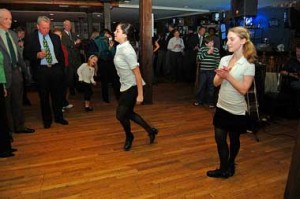
There was, as always, some fabulous Irish music and some great dancing. (The food and the drink were pretty good, too.)

News

Mount Holly Celebrates St. Patrick’s Day

He can't stop dancin'.

He can't stop dancin'.

The folks who run the Burlington County St. Patrick’s Parade can breathe a sigh of relief: The 2008 parade is history, and it went off without a hitch.

Was it fun? It always is. But this is the first year I can recall running into Ian, a kid who just can’t stay still when there’s a tune playing.

Saturday afternoon in Mount Holly, there was almost always music as pipe bands seemed to march by about every five minutes. Local shamrock ‘n roll groups on floats played from one end of High Street to the other.

Consequently, Ian was almost always in motion, his feet a blur. If he’s any indication, the Mount Holly parade was a roaring success.

Check out our photos (lots of ‘em) and video—including crazy legs Ian.