Browsing Category

News

News, People

Little Boys Lost

He doesn’t remember the first beating he had at the hands of his mother. It happened before he was born. “My older brother Patrick told me that he saw her punching her stomach over and over when she was pregnant with me,” says Ken Doyle, 44, sitting in his Gloucester City, NJ, row home, his arms around his blue-eyed white husky, Lobo. “She was shouting, ‘I don’t want this f——-g child.’”

And it was clear she didn’t want him. Or Patrick either. In the book the brothers wrote—“Mother from Hell,” published last month by O’Brien Press in Dublin—chronicles the horrific abuse the two boys underwent growing up in Tullamore, County Offaly, in the 1960s and 70s. While their father, Patsy, was away in America working, they say, their mother Olive starved, beat, and humiliated them on a daily basis.

She stuffed tea towels or nylons into their mouths to muffle their screams, tied them to a chair, then beat them senseless with a wooden cheese board. To hide the bruises, she would plunge them into a cold bath and then lock them in their bedroom—which they called “the torture chamber”—until the bruises faded. They were forced to cook the meals every day, but not permitted to eat anything. To prevent them from sneaking food while she took her afternoon nap, she tied them to her bed. In the morning, she sent one or more of their other seven siblings with them to school to make sure they didn’t get food from anyone—or from the trash bins they would creep from their room at night to raid.

Though she had a perfectly good vacuum, she made them pick up dirt from the rugs with their hands, scrub the linoleum floor with a toothbrush, and the toilets with their fingernails. She would strip them naked and pin on a homemade diaper made of woolen cloth with a plastic trash bag over it, sometimes sewn to their shirts so they couldn’t take it off, parading them in front of the other children and encouraging them to laugh. Many days, they were forced to sit in their own urine. There was one thing that could sometimes protect them from their mother’s wrath –the things they stole for her. Jewelry, rose bushes from a neighbor’s yard, food from the supermarket, cut glass from shops, even money from the church poor box. Their mother would hand them cash, tell them what she wanted, and then send them out with the admonishment, “ and bring back the money.”

It was all a secret. She kept it from their father, they say, only abusing them when he was an ocean away. She kept it from the neighbors and the teachers at the National School by imprisoning the boys until they bore no marks of their torture, feeding them and giving them drinks only when they looked so ill they might need to be hospitalized. She kept them quiet with threats. Even when she stomped on nine-year-old Ken’s leg and broke it, fear of her retaliation kept him from telling doctors in the emergency room what really had happened. Instead, he gave them the story she told him to tell–that he had fallen down the stairs.

But it wasn’t a secret, something Ken and Patrick didn’t find out until a few years ago. When Ken, then living in Arizona, was undergoing treatment for serious spinal problems brought on by his early injuries, he wrote to Ireland for his medical records. Instead, he received his childhood history from 1965 to 1980, as recorded by the country’s social service system. It was in those records that they learned that their father had reported the boys’ torture at the hands of their mother to the authorities. “In 1969, my father went to the courthouse and reported that his six-year-old son—me—was wasting away,” says Ken. One document that appears in their book reads, “Father says child is neglected and is only getting one meal a day. Hospital admittance for malnutrition.”

“Until we saw that, we had no idea that our father knew,” says Ken, a former house painter who is now unable to work and runs a small, online Irish gift shop. Other documents—and there were more than 200 pages of them–revealed that many people knew, including Child Protective Services, local priests, doctors, teachers, neighbors, the boys’ paternal grandparents, their school mates, even the police whom Ken believes turned a blind eye to what was going on because their parents had friends on the force. Ken and Patrick were occasionally removed from their home by one authority or another and sent to boarding schools (in one, Ken was raped). But what respite there was, was cruelly abbreviated: They were always sent home on the weekend, and the abuse would continue.

“Nobody ever came to save us,” says Ken, whose dark eyes are both sad and wary at the same time. One of his teachers came forward, but only after Ken contacted the gardai a few years ago with the trail of evidence that had come to him by accident. “He told them he knew it was going on but by the time he realized it I had already been expelled from the school for stealing other children’s lunches and eating out of the bins,” say Ken. “After I was expelled, all the other boys came forward and told him what my mother was doing to me. But he thought it was too late to do anything.”

Ken eventually filed suit to force the Irish government to compensate him for his medical treatment, a case that dragged on for six years “because the government’s lawyer refused to speak to us.” It resulted in a small settlement that pays for his psychiatric treatment for post-traumatic stress disorder, but nothing else. Ken is on six medications that he pays for out of pocket, and he can’t afford the spinal operation that might allow him to live without constant physical pain. Patrick, a father of seven who lives in Wales, has a congenital heart problem and needs a transplant, but his treatment is covered under the UK’s health care system.

In 2002, the Sunday World, Ireland’s largest circulation newspaper, wrote about the Doyles’ case in a story headlined, “The Most Evil Mum in Ireland.” It drew the attention of O’Brien Press, and Ken and Patrick, working with writer Nicola Pierce, spent two years composing their brutal memoir, in part to help deal with their lingering demons: Both men have a history of alcoholism and substance abuse; both have contemplated suicide. A younger brother who was not abused did kill himself several years ago. “We were all living under the same roof,” says Ken, by way of explanation. “There was a lot of damage to the rest of the family.”

Ken has only returned once to Ireland since he left in 1980—to deal with his case against the government. And he hasn’t seen his mother since then either, though they spoke on the phone and he asked her pointblank why she abused him. He recalls that conversation dispassionately, though it is chilling.

“I asked her, ‘Why did you do what you did to me as a child?’” Ken says. “’Why did you starve me?’ She said, ‘You didn’t like food.’ At one point I was diagnosed with celiac disease which was the only way they could explain my symptoms, though they were caused by starvation. Then I asked her, ‘Why did you break my leg?’ She said, ‘It was self-defense.’ When I talked to my father, his response was, ‘I don’t want to talk about it. It’s all water under the bridge.’”

But for Ken Doyle and his brother, their ruined childhood, no matter how many years pass, is as present as the nightmares, the rage, the physical pain they deal with every day. “I walk around every day in pain knowing who is responsible for my pain,” he says.

Ironically, those reams of paper that unraveled their story served only to deepen Ken’s anger, and not just at his parents. “What I have had trouble coping with is that other people knew and could have saved me, but they did nothing to stop it,” he says. “In my mind they are as evil as my mother. I wouldn’t have minded so much the little bit of money the Irish government gave me if there had been a little apology. ‘We’re sorry, we screwed you over, we failed you.’ But there was nothing.”

His book, which his mother has told him she won’t read, is his attempt to make something good out of the life he believes she destroyed. “I hope people read it and if they see a child who is hungry or in pain that they’ll do something,” says Ken. “Children have the right to be nurtured, educated, safe at home—things that we didn’t have. They have the right to survive.”

“Mother from Hell” will be in Irish bookstores in June and is available in the US on Ken Doyle’s website at www.emeraldisleirishfoodsandgifts.com or by calling 1-856-456-8959. You can read more about Ken and Patrick’s ordeal at http://home.comcast.net/~cooffaly64/ .
News

Mayos Usher in Spring

Mayo president Maureen Brett Saxon embraces her nephew and godson Christopher Brett.

Mayo president Maureen Brett Saxon embraces her nephew and godson Christopher Brett.

They gathered at Ambler’s Shanachie Pub on Sunday to recall where they came from and to celebrate their longstanding friendship. The Mayo Association’s spring social filled a room of the pub with members of the county group, and with lots of laughter.

Perhaps not surprisingly for this group, there was also a fair amount of singing and, eventually, dancing.

Check out the videos:

News, People

AOH 65 Recognizes Some Special People

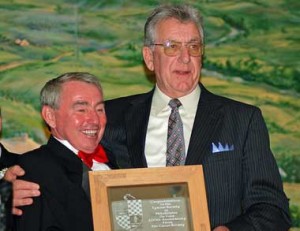
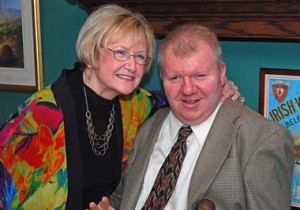
Tommy Moffit with Vera Gallagher, left, and Kathy McGee Burns.

Tommy Moffit with Vera Gallagher, left, and Kathy McGee Burns.

Many Irish Philadelphians of a certain age will remember dancing or singing to the music of Tommy Moffit, the Roscommon man who came to America as a 16-year-old in the 1950s, learned accordian, then started playing at every house party in Philadelphia by the time he was 18. For many years he played every Sunday night in the Fireside Room of the Irish Center then at Emmet’s Place—which closed this year—every weekend, pausing for an hour to do his own Irish radio show on Sunday.

There are a lot of Irish Philadelphians who know Jack McNamee too. They might have eaten at his Springfield restaurant, C.J. McGee’s, or know him from the many St. Patrick’s day parade events and other fundraisers he’s hosted to raise money for charity. They might not know about all the generosity he’s shown over the years to those charities and his alma mater, Cardinal Dougherty High School. McNamee is the community’s own “quiet man” who prefers his good deeds unsung.

And anyone who doen’t know Blackthorn, the high-energy Celtic rock band, has been in a coma for years. Blackthorn spells instant success when it’s booked for a benefit–as every Irish organization and charity in the Philadelphia region is aware. John McCroary, John and Michael Boyce, Michael O’Callaghan and Seamus Kelleher make up the band that has recorded five CDs and continues to pack them in wherever they appear.

On Sunday, May 3, AOH Joseph E. Montgomery Division 65 of Springfield honored these stalwarts of the Irish community at its third annual Fleadh an Earraigh event, held at the Knights of Columbus Hall in Springfield, Delaware County.

McNamee, who is recovering from treatment for leukemia, was represented by his wife, Loretta.

We were there and took lots of photos.

News

Notre Dame Division to Host Irish Festival

At a past festival, a roving leprechaun hitched a ride.

At a past festival, a roving leprechaun hitched a ride.

The Ancient Order of Hibernians Notre Dame Division of Montgomery County will host its annual Irish Festival at St. Michael’s in Mont Clare on June 5, 6 and 7.

Mont Clare is located off Route 422 and 29 South, just before Phoenixville. The festival site is a large, open space with a very large pavilion that will keep you comfortably out of the sun. The quiet surroundings of the festival grounds will be alive with upbeat music all weekend long.

Under the pavilion on Friday night at 6 you will be able to dance to the traditional music of Tom McHugh and Company, together with John McGillian.

At 2 o’clock on Saturday, Timlin and Kane will entertain you at the festival until 5 p.m. Then the pipes and drums of Irish Thunder will come marching in, followed by the very upbeat sound of The Bogside Rogues until 9 p.m.

Sunday under the pavilion the Rev. Andy McCormick will celebrate an outdoor Mass at 10:30. Sara Agnew will be the vocalist, with Irish Thunder leading the opening procession. Coffee and donuts will be provided by the festival after Mass.

Oliver McElone will come on right after Mass and perform until 2:30. Irish Thunder will again hit the stage and, to finish off the festival, everyone’s favorite Paddy’s Well will be on until 6 o’clock.

During the festival there will also be Irish dancers when the bands go on break. Vendors will be on location, as well as a moon bounce and slide for the children. There will be a washer’s tournament during on Saturday and Sunday for the adults.

Food will available all weekend with $2 pints at the beer wagon.

Over the years the Notre Dame Division has donated thousands of dollars back to the community, cancer victims, fire companies, police departments, school scholarships and others in need. This festival supports the Charity Account of the AOH. It’s not just a money-maker to fill somebody’s pockets. All proceeds go to those in need. So while you’re having a good time you are also helping someone, maybe somebody you know.

Entrance fee is $5 on Friday and $7 for Saturday and Sunday. There is also a $15.00 weekend pass. For more info and tickets call (610) 277-4868 or log onto www.aohnd1.com.

News

Recalling the Lessons of History

Remembering the martyrs.

Remembering the martyrs.

It was 93 years ago, long enough so that you might suppose the Easter Rising to be largely forgotten.

Suppose again.

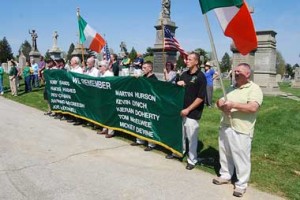
This past Sunday, a group of local Irish and Irish-Americans gathered, as they always do, at the graveside of Philadelphia’s Joseph McGarrity, lifelong physical force republican and ardent fund-raiser for the cause of Irish freedom.

Things are better in the North now, as most people seem willing to admit, but in this group the separateness of the British outpost still grates. Unity is still the goal.

So they marched to that headstone, and they recalled the long-ago words of Pearse on that day in 1916:

Having organised and trained her manhood through her secret revolutionary organisation, the Irish Republican Brotherhood, and through her open military organisations, the Irish Volunteers and the Irish Citizen Army, having patiently perfected her discipline, having resolutely waited for the right moment to reveal itself, she now seizes that moment, and, supported by her exiled children in America and by gallant allies in Europe, but relying in the first on her own strength, she strikes in full confidence of victory.

Victory didn’t come as quickly or in precisely the form as many would have liked. Some would argue that the job is still not done. But clearly, in Philadelphia the 1916 sacrifice won’t be soon forgotten.

  • View video of the procession.
  • View video of the ceremony.
  • News, People

    Remembering Michael Donnelly

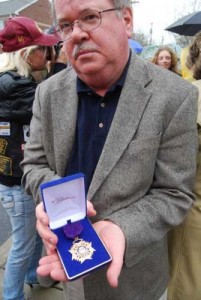
    Nephew John Boyle displays Donnelly's medal of valor.

    Nephew John Boyle displays Donnelly's medal of valor.

    His friends called him “Smilin’ Mike.”

    Eighty years after his line-of-duty death, they still remember that smiling and brave Philadelphia Police Officer, Michael Donnelly. On April 12, 1929, the County Leitrim native and World War I U.S. Navy veteran was gunned down by a robber he had chased down an alley following the holdup of Sobel’s Candy Store, just a few blocks from his headquarters at 4th and Carpenter. It was nearly midnight. He had less than 15 minutes to go on his shift.

    On Wednesday, Donnelly’s surviving nieces and nephews from both sides of the Atlantic joined with Philadelphia police and local dignitaries to dedicate a sidewalk plaque in his memory near where he fell, at 921 South 4th Street.

    Michael Donnelly has been gone a long time, but his relatives have never forgotten his bravery. One of those relatives, Sr. Peg Boyle, had heard about a program to honor Philadelphia’s fallen police officers with commemorative plaques. Lawyer Jimmy Binns oversees the Hero Plaque program and he remembers talking to Sr. Peg about it six months ago. “She asked me whether we would do a plaque for Michael Donnelly,” Binns said.

    Soon, more and more relatives from the United States and Ireland joined the effort to memorialize Michael Donnelly. And the more they dug, the more they learned about him. “We all knew a little bit about Michael,” said nephew and plaque sponsor John Boyle of Hatboro. “We just had the family lore. It wasn’t until we started talking to Jimmy Binns that we were able to pull together the whole story.”

    The story that emerged is one of extraordinary courage and self-sacrifice. In those days, cops’ uniforms were decorated with lots of shiny metal buttons. The light from nearby streetlamps evidently glinted off those buttons and Donnelly’s badge as he attempted to scale a fence in his pursuit of the suspect. The gunman aimed for those shining buttons, police reports from the time indicated. But Donnelly was undeterred. “He kept going over that fence,” said Boyle. “He was shot three times. But they (the police) expect you to stay in the fight, and he did just that.”

    One of Donnelly’s relatives from across the pond, Tony Boyle of Kildare, was most impressed by the commemoration, which featured a police honor guard, the Philadelphia Police and Fire Pipe Band and a bugler to play taps. “We absolutely cherish every minute of this trip,” he said.

    The skies threatened throughout the ceremony, and in the end finally opened up. Donnelly’s plaque was adorned with roses and spattered with raindrops. The plaque reads:

    In Memory of
    Police Officer
    Michael Donnelly #1951
    Died In The Line of Duty
    Protecting the Citizens
    of Philadelpha on
    April 12, 1929
    Dedicated by
    His Family and Friends

  • News

    Happy Birthday, Tyrone!

    That's the Cavan Society's Tom Farrelly, right, with Tyrone's Joe Trainor.

    That's the Cavan Society's Tom Farrelly, right, with Tyrone's Joe Trainor.

    The band was playing “Pretty Little Girl from Omagh,” and the dancers were eating it up as the Tyrone Society celebrated its 100th anniversary in a big bash Saturday night at the Philadelphia Irish Center.

    The ballroom has never looked prettier, and it’s probably never been so crowded. Kudos to all the folks who brought it all off and made it look easy.

    There was lots to celebrate, although bragging rights over the county’s ownership of the Sam Maguire Cup (and the cup was there!) seemed to figure prominently. Tyrone Irish football captain Brian Dooher was a guest of honor.

    We were there, of course, and have the photos and video to prove it.

    News

    St. Paddy’s Day Parade Award Winners Honored

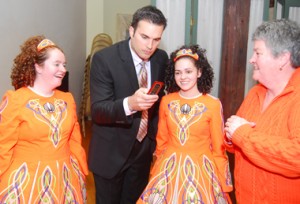
    CBS 3's meteorologist Doug Kammerer checks out a cellphone picture with award-winning Rince Ri dancers Katie McGlynn and Marielle Baird.

    CBS 3's meteorologist Doug Kammerer checks out a cellphone picture with award-winning Rince Ri dancers Katie McGlynn and Marielle Baird.

    It may be April, but the St. Patrick’s Day festivities weren’t over till this week, when parade award winners were given their plaques, trophies, and crystal bowls at a banquet upstairs at Finnigan’s Wake in Philadelphia.

    Vince Gallagher and Karen Boyce McCollum provided the music, parade association President Michael Callahan was master of ceremonies, and the CBS3 crew who do the play-by-play during the parade, which is televised live on Channel 3, acted as presenters.

    But you can see it all here, via our photos and video.