Browsing Category

News

News

A Torrent of Talent Comes to the Aid of the Sunday Irish Radio Shows

Gerry Timlin, your emcee.

Gerry Timlin, your emcee.

And, lo, the clouds masseth in the sky and unleasheth a whole heap o’ water. Yea, verily, the water did riseth up to filleth up Bethlehem Piketh and lots of other roadth. Lightning and thunder was there, and hailstones and winds, even. And the Lord looked down from on high and said, to no one in particular, “Holy cow … did I do that?!”

You betcha. No one would have been surprised if frogs and locusts had suddenly showed up. It was that bad.

Did any of the flooding stop dedicated Irish music fans as they made their way to Shanachie Pub on Sunday for a benefit to support local Irish radio shows? Well, maybe it stopped some, but lots of other people just strapped on their water wings and floated on into Ambler for an afternoon jam-packed with local musical talent.

Gerry Timlin, your genial emcee and co-owner of the Shanachie, presided over the entertainment, which included the Bogside Rogues, the King Brothers, McDermott’s Handy, members of the Morrigan, the Jameson Sisters (Maura and Lessa, also known as Ellen Tepper and Terry Kane), and more.

And, yea, the fans hung around for the fun and saw that it was good.

We’ve captured lots of the aforementioned fun.

News, People

Frank Malley: A Tribute

“The person of a man may leave, or be taken away, but the best part of a good man stays. It stays forever.”
— William Saroyan, The Human Comedy

Frank Malley didn’t just have a zest for life, he had a hammerlock on it. The doctors who diagnosed his cancer gave him 18 months to live. He turned it into five years of “not doing anything I don’t want to do,” as he told me about a year ago, standing at the bar at the Irish Center, nursing his Guinness.

He was a singer, story teller, world traveler, and as organized as the blueprints he worked on as an architectural steel detailer, which stood him in good stead when he joined the Philadelphia Ceili Group in the 1970s. He chaired its annual festival of Irish traditional music and dance for the last decade, even while enduring grueling rounds of chemo. When it came to labors of love, he couldn’t stop, not even for cancer.

“A few years ago, when he had just finished up a round of chemo and was still recovering and very weak, he came to do my radio show and talked for a solid hour about the upcoming festival,” recalls Marianne MacDonald, host of the WTMR radio show, “Come West Along the Road.” “I told him that he shouldn’t do it if he wasn’t up to it, and he really wasn’t, but he did it. He was such a fighter, so totally dedicated.”

Malley was at his draftboard—where he worked on high profile architectural projects such as the Philadelphia Art Museum expansion and the Academy of Music restoration—until a few weeks ago. “Most people didn’t even know he was sick,” says his daughter, Courtney, a singer who inherited her love of music and Irish culture from her father, the son of immigrants.

Frank Malley, 67, died this week at home, surrounded by his family. “He was my best friend,” says Courtney who, like her father, serves on the board of the Ceili Group. “I keep telling my family, yes, this is a huge loss, and that’s the double- edged sword. With my father, there were no boundaries between generations. We were friends as well as family, and that makes it even harder to lose him.”

Many of those who knew him for a long time considered him family as well as friend. Robin Hiteshew, a contractor and photographer who co-chaired the Ceili Group Festival with Malley in the 1980s, traveled with him to Ireland, and commiserated with him about living with cancer.  “That was another thing we had in common,” says Hiteshew, a cancer survivor who records and archives performances at the Irish Center.

He admitted that the two occasionally butted heads. “Frank was a bull,” he says, fondly. “But he was straight up. You always knew where you stood. He blew steam out his ears like most Irishmen, and you didn’t want to be on the wrong side of his temper, but his motivation was always the best. He wanted the best for the festival. What can I say? That was Frank. He was my friend. And in the end, our friendship held us together.”

With Frank Dalton, a Ceili Group member and founder of the Coatesville Traditional Music Series, Malley shared a love of Irish and old-time music. And they didn’t always agree either. “But Frank was really open-minded,” says Dalton.  “He knew he didn’t know everything there was to know about traditional Irish music but he listened. He listened to whatever anyone was saying and he took advice, something most of us have trouble doing. He was one of the sharpest, most intelligent guys I ever met.”

It safe to say that many never knew what Frank Malley did for a living, except for the steel erectors in the city who “came to him when no one else could figure out a job,” says Hiteshaw. “Everyone would come to him because he was accurate. He was the master of his trade. He was the best structural steel detailer around. He made the actual nuts-and-bolts drawing that tells steel erectors how to bolt beams together so they fit correctly and look like the architectural drawing said they should look.”

A few weeks before his death, says his daughter, she helped him put his office in order. “I have about 50 of his drawings, which he did by hand, not by computer, that are works of art.”

Most people knew Frank Malley as as a singer and storyteller. He made two CDs, “Live at the Mermaid” and “The Captain’s Old Dog.” He performed regularly at the Ceili Group Festival, the Philadelphia Folk Festival (he was also a member of the Philadelphia Folk Song Society), and the Heritage Dance Festival.

“He didn’t get involved in music till he was a teenager and he loved listening to Big Band and jazz, classical music and folk, and he was always an opera fan,” recalls Courtney. “He loved old cowboy tunes and bluegrass, but with Irish music he found the love of his life.”

Malley was born in Norristown to Patrick and Katherine Duffy Malley. His father was from Coor Point, Donegal, and his mother from Skaheen, Kilmove, County Mayo. His father was the resident farmer on the Highlands estate in Whitemarsh, a Georgian house dating to 1794, which now belongs to the state and is open as a museum. Malley’s father worked for the Roosevelts, relatives of President Teddy Roosevelt, who owned the property for many years.

“He seemed to get a lot of nurturing from his parents in the Irish culture,” recalls friend Jim McGill, a Ceili Group board member. Once, he said, Malley organized an Irish event at the Highlands. “He had tried to set up a museum there to honor the Irish domestic people who came over and worked for people around the Hill, but the hobnobbers wouldn’t have anything to do it. When we had our festival there, Frank said the former owners ‘would be turning over in their graves if they knew the Irish were having fun on the lawn.’”

If he were writing Frank Malley’s obituary, Hiteshew says, “I would have to call Frank a seanchaí, a modern seanchaí, a storyteller, and a hardworking man, someone you could depend on who gave you his word and stuck to it. I think he would want to be remembered as the guy who worked hard for the Ceili Group, an active member of the Folksong Society, who was devoted to his family.”

In addition to his daughter, Frank Malley is survived by a son, Bryan Patrick Malley; brothers John and James Malley; his longtime companion, Connie Koppe; his former wife, Rose Marie Burke Malley, and five grandchildren.

A memorial service will be held at 3 p.m. Saturday, August 1, at the Irish Center, Emlen Street and Carpenter Lane in Mt. Airy. Memorial donations may be made to any member of “Team Canada” for the Breast Cancer 3Day walk at www.the3day.org.

Listen to a few tracks from Frank Malley’s CDs, thanks to Frank Dalton.

See a compilation of photos of Frank Malley. 

View photos as a slide show.

What others have to say:

Anne McNiff, Philadelphia Ceili Group Member

I unfortunately only knew Frank a short time. We met the summer of 2007. As a relative new-comer to Mount Airy, I attended a Ceili Group meeting thinking that I might be interested in volunteering a time or two, given that I loved Irish traditional music and was looking for a way to become more involved in the local community. Little did I know how going to that meeting would change my life!

Frank was festival chair and spoke passionately about what still needed to be done to prepare for the festival and I remember thinking that he was getting quite riled up about what seemed to me, at the time, to be a relatively uncomplicated event. (Ha! Little did I know!) There was concern at that time about e-mails going out about the festival in a timely manner and the Web site. I tentatively raised my hand and said I would be happy to help out with both those things if I could. I was immediately put on a committee and plans were made to meet with Frank about the issues specific to the festival. We met up a short time later and so it began.

There are some people that you meet that you immediately are drawn to their commitment and passion about what they are doing. Frank was that kind of person. Don’t get me wrong, Frank had no delusions about the festival, the people working on it, or the people attending. As a matter of fact, he had a few pithy remarks about all three groups!  His dry, somewhat cynical, wit but obvious love for the event and the people involved really drew me in.

And so, after doing what I could to help in advance, I showed up on the Saturday of the festival and reported to Frank. He told me, “Annie (one of the few outside my immediate family who calls me that), I have someone I want you to meet, I think you will both like each other very much.” This was quite a intimidating introduction to his daughter, Courtney Malley, who amidst running the door, chasing after twins, and generally being second in command, took the time to get my story and tell me it didn’t matter if I didn’t really know anyone and didn’t have much to do outside of work. That would now all change, starting on Thursday nights. I think Frank may have had a small, self-congratulatory smile.

And so because of Frank Malley and his uncanny way of bringing people together, I found my community, a group of friends I have come to love and care about more then I can say.  A group of people that Frank and his family are at the center of.

I loved the “Renaissance man” aspects of Frank’s personality—the man who would tell me a bawdy story as easily as he would discuss fine French and Italian wines; who talked about theater we had both seen (or been in) and the World Series; who made me laugh and think and mostly just smile to be in his company.

Because of his death, it feels like there is a hole in the fabric of so many of our lives. I will miss him very much.

Mary Lou McGurk, President of the Philadelphia Ceili Group:

I don’t remember when I met Frank. It’s been so long that I feel that I have always known him.

I was a teenager when I joined the Ceili Group in 1976. They had already held one festival that I missed, and I can’t remember if Frank was involved, but I do remember the next couple. They were held at Fisher’s Pool in Lansdale, and it was the boonies. It was a big, open place. It was hard to believe that a festival would be there.

Frank had a crew of workers that would go there a few days in advance and change it from an open field to a concert area. He had plans and sketches! He rented flatbed trucks and turned them into stages. On the day of the festival he was like magic. Anything that you needed, he was there: fix a sign, move a speaker or rig up a hospitality area for the musicians. He was all ready to help and so were all the people on the committee. He had the attitude that he was there to make things run smoothly and he wanted his people to have that attitude also. He was a great leader.

I remember when we were trying to set the prices–most of the people on the festival were young and single. We didn’t know how to price tickets for children. Frank used Courtney as the measure for the cut-off; anyone Courtney’s age or younger got in for free. Of course, every year the age limit went up until she was 17, I think.

People drifted in and out of the PCG as their lives made different demands, but Frank was a constant. He even talked me back onto the board a few years ago, and I don’t regret it. He was a good man.

News

A Warm Philly Reception for the Irish Navy

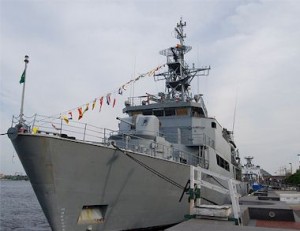
The Eithne, at Penn's Landing.

The Eithne, at Penn's Landing.

In Ireland, the traditional greeting is céad míle fáilte: A hundred thousand welcomes.  

When the Irish Naval Ship Eithne docked at Penn’s Landing early Tuesday morning—the first Irish navy vessel to visit Philadelphia—the city returned the favor.

Eithne’s Cmdr. David Barry remembers the scene: “We were met by Irish dancers, the USO, the Navy League … We damn nearly had a party on board at 8 a.m.”

The rest of the week, those welcomes just kept rolling in. On Wednesday night, hundreds of local guests crowded aboard ship for a cocktail party and reception. Thursday, there was a raucous Irish football game between the crew and local players at Cardinal Dougherty field. Also Thursday night, the Philadelphia Irish Center played host to the officers and crew.

Of course, the people of Philly—especially the merchants—offered their own welcomes. It wasn’t unusual to see groups of Irish sailors in Phillies T-shirts heading back to the ship with bags of locally-purchased loot. One of the crew speculated that the ship will weigh a lot more going back.

We’ve captured memories of the visit in photos.

Check them out.

News, People

His Friends Come Out for Paul Sheridan

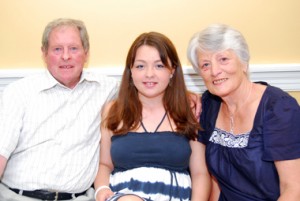
Paul's family: His father, Tommy, daughter,  Shauna, and mother, Lily.

Paul's family: His father, Tommy, daughter, Shauna, and mother, Lily.

Paul Sheridan has a lot of friends.

Many of them came out to the Philadelphia Irish Center on Sunday afternoon to help raise money for the Havertown painter/carpenter from County Cavan who is undergoing treatment for lung cancer. 

Check out the photos.

News, People

Rosabelle Gifford: Woman of Spirit

When she was looking for the right candidate for the first annual Mary O’Connor Spirit Award to honor a woman from the local Irish-American community,   Karen Conaghan says Rosabelle Gifford came to mind immediately.

“She’s very brassy, but not abrasive. Opinionated, spirited, courageous,” says Conaghan, who, with her sister, Sarah, coordinates the Philadelphia Rose of Tralee pageant, of which the award is now a part. “She’s better dressed than anyone we know. She enjoys life. She’s a total inspiration.”

I met Rosabelle Gifford this week. It’s all true.

Named for the original “Rose of Tralee,” who refused to marry her true love because she knew it would tear him from his disapproving family, the first Mary O’Connor Spirit Award is going to a woman who knows intimately how love can go wrong—and the meaning of courage and self-sacrifice.

She was Rosabelle Blaney of Gortward, Mountcharles, County Donegal, when she married Edward Harvey of Castleogary. The couple moved to post-war London where they went on to have five children, including a set of twins. But the marriage was not to last.

“It was a very bad marriage,” says Giffor. “He was drinking, running around with other women, and a wife-beater. I had to go.”

At a time when there was little help for abused women and families—and there was almost no housing in bombed-out London—Gifford had to plan her own escape. She sent two of her five children back to Ireland to live with her parents and one to Scotland to stay with her sister. “I knew they would be well cared for and I had to do it—I had no place to live,” she recalls.

In the early 1950s, when her oldest son, Ted Harvey, was considering enlisting in the British military, Gifford suggested that he go to America instead. “My two older sisters were living here and I told him that if he went, we would follow.” He did, and in 1958, his mother and his siblings moved into the apartment in Bryn Mawr he had rented and furnished for them.

“I got a job taking care of children. I was good at it,” chuckles Gifford. In fact, some of the children she cared for will be attending the award ceremony on Saturday night, June 27, during the 2009 Philadelphia Rose of Tralee Selection Gala.

While at a New Year’s Eve party at a friend’s house, Rosabelle met Charles Gifford, who worked in the accounting department of a steel company. They fell in love and married. She has been widowed for more than 20 years. “He was a good man. I needed that,” she says wistfully. “He was so good to my children too—so good to them.”

Her son, Ted, died many years ago of brain cancer. Three of her four remaining children, Rosemary McCullough, Kathleen Harshberger, Frank Harvey, and assorted grandchildren and great grandchildren will be attending the event. The fourth, son James Harvey, an educator, will be in China at the invitation of the Chinese government.

You’ve probably noticed that I haven’t mentioned Rosabelle Gifford’s age. That’s because she doesn’t. “I don’t think it’s anyone’s business,” she says. “I think you’re just as old as you feel.”

Indeed.

News

So You Think You Can Write …

If you got this far, we know you’re interested. We can offer you a totally laughable fee, at least for the summer or until our meager funds run out. What we can offer is some free entertainment. People actually let us in to stuff for nothing! Of course, we have to write about it, photograph it, and lately, video it. But it’s always fun, and you meet the nicest people.

If you want to take a stab at journalism (while it lasts), send a note and some of your work to us at denise.foley@comcast.net. J-students welcome! We used to be J-students too, back when dinosaurs roamed the earth.

History, News, People

Relive the Story of the Molly Maguires

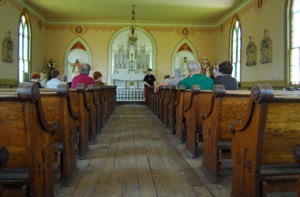
The restored Irish church in Eckley is now a museum.

The restored Irish church in Eckley is now a museum.

At the edges of Pennsylvania’s coal region, the tiny village of Eckley, population 21, preserves the memory of a time and place that many immigrant families wished they could forget.

In the mid to late 1800s, the Irish, Welsh, Germans, and Slovaks from all over Eastern Europe worked side by side in the mines—dank, dark, and dangerous places where they could be killed at any moment by a cave-in or fire. If they were, their bodies were carried to their shanty, dumped on the front doorstep, and their widows were warned that if they didn’t find someone to work for them in 48 hours, they would be evicted from their company-owned homes. If a man survived the 12-hour days, the six-day work week deep below the earth, the coal dust imbedded in his lungs would take him before he was 50. 

Boys as young as 9 and 10 worked as “breaker boys,” squatting over the conveyor lines filled with coal, cracking them into smaller pieces and winnowing out the slate. They were prone to a condition called “red top”—bleeding finger tips. Most had lost fingers before they were out of their teens.

The miners and laborers had to pay for their own tools and supplies, including lamps, picks, and explosives. Food and clothing was available at exorbitant prices at the company store. The rent on their homes was taken out of their $3 a- day-pay.  

Into this picture came the Molly Maguires, a violent secret society, an outgrowth of the Ancient Order of Hibernians, that laid the foundation for the labor unions that eventually changed conditions for Pennsylvania’s miners. Though they were ultimately put down and their leaders hanged, they made their mark. And places like Eckley, with its social stratified layout (shantys for the laborers, larger homes for the miners, mansions for the owners) have become like fossils, preserved remains of a time when corporate greed brought unimagined misery to those who had fled thousands of miles from conditions they believed could not have gotten worse.

Eckley, purchased by the state of Pennsylvania in 1971 and now operating as a miners’ museum, has become a mecca not only for Irish and Irish-American history buffs, but for movie fans who love the romanticized version of life in Eckley in the Sean Connery movie, “The Molly Maguires,” filmed in the village in 1968. A group of young Irish immigrant footballers from Philadelphia appeared as extras in the film, including Vince Gallagher, president of the Commodore Barry Club (The Irish Center). Last Saturday (June 6), Gallagher and 50 other people made the trek from Philadelphia to Eckley and on to Jim Thorpe, where some of the Molly Maguires were held in the Carbon County Prison and hanged there in June 1871.  It was Gallagher’s first trip back in more than 40 years. 

In the movie, Gallagher was part of a scene in which the miners play a version of Gaelic football, using a round ball wrapped in what looked like rope. “It weighed about five pounds and you couldn’t throw it. It was more like a bowling ball,” Gallagher recalled. “Everyone went home with sprained fingers. They brought us in because they wanted to make it all look authentic, but it didn’t. And they shot the same damn scene 72 times.”

But the movie seemed to make less of a lasting impression on Gallagher than the shameful story of Eckley and other coal “patch towns,” where human beings were treated only slightly better than the mine mules who went blind and lost their hair because they spent their entire lives underground.

“I hope there’s a special place in hell for the mine owners,” said Gallagher, “and they burn there forever.”

Check out our photo essay, and learn more about the story of Eckley and the Molly Magures.

News, People

Second Annual Mass at the Irish Memorial

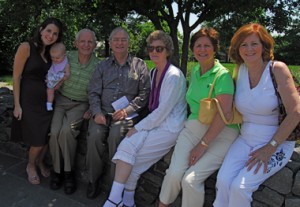
Lord Mayor of Cork

Lord Mayor of Cork Brian Bermingham and his wife, Elma, center, flanked by Karen Boyce McCollum and daughter Sarah; Barney Boyce, Mary Crossan, and Carmel Boyce.

Under a blue sky and hot spring sun, Father Edward E. Brady of St. Isidore’s Parish in Quakertown celebrated the second annual Mass of Thanksgiving at the Irish Memorial on Penn’s Landing in Philadelphia on Sunday, June 7.  Karen Boyce McCollum sang, and music was provided  by Jeff Meade, Dennis Gormley Kathy DeAngelo and Phil Bowdren.

It was a lovely and poignant start to the day of the Penn’s Landing Irish Festival.

AOH Division 88 lowered both the American and Irish flags they erected several months ago, and the Irish Society took its turn supplying the banners for the Memorial.

The Lord Mayor of Cork, Brian Bermingham, made a surprise visit–a surprise even to himself. In Philadelphia to meet with City Council to discuss common interests between his city and ours (William Penn lived in Cork and sailed to Philadelphia from its port, among other things), he said he was passing by on a tour bus and saw the sign for the Irish Memorial “and thought I’d have a look.”  He admired the monument, created by sculptor Glenna Goodacre. “A few weeks ago we had a ceremony marking the famine,” he said. “But we have nothing like this.”

He joined members of the Irish Memorial committee in front of the statue to have his photo taken.

See our photo essay.