All Posts By

Denise Foley

Music

Mum’s the Word: The Irish Roots of Mummery

The Irish-American String Band struts its stuff in Philadelphia.

The Irish-American String Band struts its stuff in Philadelphia.

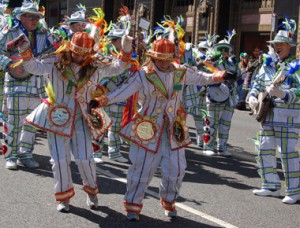
Mummery has been a tradition in Philadelphia since the late 17th century—in celebration if not in name.

Mummers’ historians say that the Swedes extended their tradition of “Second Day Christmas,” when they visited friends, into New Year’s Day, throwing in some masquerades and noisy revelry (which later erupted into musket fire, bells and noisemakers.)

But mummery, which some say dates back to ancient Egypt, is also a 2,500-year-old tradition in Ulster, the northernmost counties in Ireland and Northern Ireland, so Irish immigrants to the US found a little bit of home every New Year’s Day. And just a little bit. In medieval Ireland, mumming meant plays, both religious and secular, often presented by local trade unions. Even today, when the “mummers” appear in Ireland, it’s to tell a story.

In Wexford, for example, mummers take to the streets to perform original plays (since none of the play scripts from yore have actually survived) about heroic figures from the Celtic past, like S. Patrick, Brian Boru, Wolfe Tone, and Owen Roe O’Neill. (Originally, the play’s characters were British figures such as St. George and Cromwell, but clearly that didn’t play nearly as well.) The plays are always in verse and swordplay is inevitably involved, as is death and rebirth.

Wexford mummers are so well known there’s even a song called “Wexford Mummers Song,” once recorded by Mary O’Hara, which tells the sad story of two maids of Shroden, in Derry Town, Patty Grey and Nancy Hogan, who “lead an awful life, an awful life and dreary.” It involves pig mutilation, death, and some cheery fa la las.

Like Philadelphia’s Mummers Parade, the Irish mumming street plays are performed as part of an annual competition. However, there are no banjos, feathers, sequins, and golden slippers. But there are disguises (mummers are also called guisers, as in “disguise”), usually intricate masks, much like the tall, conical masks worn by the chief entertainers of King Conor, legendary king of Ulster, at his palace in Eamhain Macha. In rural areas, like one small town in County Fermanagh, the mummers traditionally wear costumes of straw (giving rise to the name, “straw men”), largely because it’s cheap and available. Another parallel to the Philadelphia Mummers: In Ireland, it’s also traditional for men to dress up as women.

While the Irish didn’t bring mumming to Philadelphia, they certainly supported it. In his book, “The Irish in Philadelphia,” the late historian Dennis Clarke wrote that the Irish took immediately to the “generally uninhibited frolic” of the Mummer’s Parade.” Such displays were compatible with the Irish propensity for enjoyment. The folksy pantomime, the jingling music, and the ardent defiance of freezing winter weather made the Mummers famous, and the Irish were an eager part of the tradition.”

Mummers factoid: The word “mummer” is thought to stem from a German word meaning “disguised person.”

News, People

Being Irish In 2009: The Year in Pictures

By now you’ve probably read a dozen stories that recounted who died last year and the highlights of the aught decade. This is not going to be the unlucky 13th.

I was doing a little photo housecleaning when it occurred to me that I recalled the Irish part of my year in pictures. Not the big events so much, but the small things—the babies, the smiles, the laughs, the photos I just thought were damned good.

So I put them all together in one slideshow to share with you on this last day of 2009 (or in first days of 2010, depending on when you’re finally getting around to reading this).

Many of them are from parades. We must see a good six or seven, most of them over a three-week period in March. Jeff and I can probably make it into the Guinness Book of World Records for most shamrock deely bobbers spotted in one year, were that a legitimate entry. In 2000, Jeff (who plays the bodhran, an Irish drum) participated in an international event in Killarney during which 2,000 pipers marched on to a field and played together (so, if you call to him and he doesn’t answer, you know the reason why: Chronic Pipe and Drum Band Hearing Loss. I’ve had it since he forced me to listen to the 25 bagpipers from Irish Thunder playing “Amazing Grace” inside). Since we started this Web site in 2006, we’ve probably heard three times that number and believe me, we have pictures to prove it. I didn’t include them all. You’ll thank me later.

But I could barely stop myself when it came to Irish dancers. And kids. And babies. We love them. We can’t help ourselves. We’re total suckers for cute. If you hate cute, just move along.

Some of the photos are there because they touched my heart. Gwyneth MacArthur’s shot of a photo of the late and great Frank Malley, for example. There were photos of Frank, longtime director of the Philadelphia Ceili Group’s annual festival, scattered everywhere at his standing-room-only wake at the Irish Center. In this one, he’s wearing one of his famous hats, on one of his famous trips, with his friend, Connie. Maybe it’s because I knew Frank and liked him, but this photo of a photo is the one that “got” me.

One of my all-time favorites is the picture I snapped of Angela Mohan, coach of the Mairead Farrell Ladies Junior Football Club with Sinn Fein MP Gerry Adams, who met with members of the team when he came to Philly this fall. Adams knew the late Mairead Farrell, an IRA member killed by British troops, and wanted to thank the team for remembering her. And, of course, he’s a football nut himself. He was warm and gracious, patiently posing with every team member for photos and talking unhurriedly with each of the footballers—and not, like many politicians, like he was running for something or playing it up for the press. We were the only media outlet that knew he was in town.

Football. Hurling. Cardinal Dougherty field in the blazing sun. Trash talking. These are a few of our favorite things. We love Gaelic sports. We don’t understand why more people aren’t out there with us on the sidelines, not comprehending the rules or scoring but enjoying the most exciting games in the world and the unrelenting but charming cursing. (The Irish invented trash talking—don’t let anyone tell you anything different.) Oh, and when it rains? Check out the photos. There is joy in mudville.

Well, enjoy the show, and as we say good riddance to the past year, let’s raise our glasses to toast the new one. Athbhlian faoi mhaise!

Columns, News

Guest Editorial: Immigration–Do the Math

By Stephen Dunne, Esq.

The United States is a nation of immigrants which historically always had a liberal U.S. immigration policy. During the seventeenth, eighteenth, and nineteenth centuries, immigration to the United States was essentially open, and, at times, immigrants were even recruited to come to America to help with the settlement of undeveloped areas of the country. Until the 1920’s, no numerical limits on immigration existed in America.

What happened? Racial theories based on junk science began to influence U.S. immigration policy. The U.S. House Judiciary Committee employed a eugenics consultant, Dr. Harry H. Laughlin, who asserted that certain races were inferior. Within a short time, the Immigration Act of 1924 set new numerical limits on immigration based on “national origin.” Taking effect in 1929, the law imposed annual immigration quotas for the first time, essentially closing the door to many immigrants.

The United States, a nation of immigrants, has continually been dependent on successive waves of immigration to grow it economy. It is in large part thanks to these immigrants that the United States has prospered over the past few centuries.

I am not an economist but I am an Irish immigrant who has owned and managed a landscaping company, a real estate company and presently, a law firm and it seems to me that this country needs a multifaceted solution to solve our current economic crisis and Immigration Reform could very well be part of that solution.

According to most calculations, twelve million illegal immigrants (12,000,000) reside in the United States. Assuming that a two thousand dollar ($2,000.00) application fee is charged to twelve million illegal immigrants (12,000,000) that would generate approximately twenty-four billion dollars from this one time application fee that could be used to stimulate the U.S. economy.

More importantly, the twelve million illegal immigrants would now be paying taxes for the first time and assuming that each individual is taxed in the 15% tax bracket and earning an annual income of $25,000.00, the Internal Revenue Service (IRS) would collect $3,750.00 per person which would amount to forty-five billion dollars per year in new taxes from these immigrants.

Immigration reform would stimulate the U.S. economy by generating sixty-nine billion dollars in application fees and taxes in the first year alone and forty-five billion dollars each year thereafter. Now that’s a stimulus package!

It goes without saying that Immigration Reform needs to be addressed immediately as an integral component of a strategic plan to resuscitate the stagnant US economy.

Bio: Attorney Stephen Dunne is originally from Dublin, Ireland. He has a Bachelor of Science in criminal justice and sociology from Pennsylvania State University, a Juris Doctor from New England Law in Boston. He also served in the U.S. Army as an Infantry Sergeant in the Pennsylvania Army National Guard. Dunne’s legal practice, which is based in Philadelphia, focuses on immigration, estate planning, family law, DUI’s and bankruptcy law. Mr. Dunne is actively involved in community service initiatives, volunteering weekly at the Philadelphia Irish Immigration Center, Philadelphia Senior Law Center, Pennsylvania Consumer Bankruptcy Assistance Project, Philadelphia Mortgage Foreclosure Diversion Program and the Immigrant Migration Service of Philadelphia.

Music

Irish Christmas in Philadelphia

If you missed either “Once Upon a Winter’s Night” or “An Irish Christmas in America…” well, you shouldn’t have. But you’re lucky—we were there and have some videos to prove it.

“Once Upon a Winter’s Night’s” Gabriel Donohue, Caitlin Warbelow and Marian Makins have developed a lovely chemistry among their trio, both musically and as they interact with the audience. Their selection of songs for the Christmas holiday included the sublime ( “Christmas in the Trenches”) and humorous (“Miss Fogerty’s Christmas Cake), and their December 6 concert at The Irish Center set the mood for the season beautifully.

And then pair that with Teada’s “Irish Christmas in America” at The Annenberg Center 5 days later, and you have a feast of riches. Oisin MacDiarmada returned with Tristan Rosenstock on the bodhran and performing the role of master of ceremonies to great audience delight; Tommy Martin on the pipes and whistle, Grainne Hambly on the harp, with special guest Seamus Begley on the accordion and vocals. The extra special guest was guitarist Sean Earnest, who hails from Bethlehem and has made the transition to the big time.

Oh, and lest we forget, sean nos dancer Brian Cunningham with some wicked dance steps. Not for nothing that among the comments overheard at intermission were: “Oh, my…the ENERGY!!!” and “the funniest concert ever” (that was a nod to Seamus Begley who could entertain an audience with stories and limericks alone).

Watch Brian Cunningham’s dancing feet.

Two great evenings, two great reasons to be Irish in Philly at Christmas time!

Columns, How to Be Irish in Philly

How To Be Irish in Philly This Week

Karan Casey will be at the Sellersville Theatre.

Karan Casey will be at the Sellersville Theatre.

This will be a double-stuffed “How to Be Irish” this week since the entire staff of the website voted to take Christmas off this year.

Lots of folks must be finished with their Christmas shopping because there are plenty of events this weekend. Don’t let a little snow stop you!

In Upper Darby, the Mairead Farrell Ladies Gaelic football club is holding its holiday party fundraiser at Cawley’s Pub in Upper Darby. The Mairead Farrells competed in the national championship games in Boston this fall, but the highlight of their year was meeting Sinn Fein MP Gerry Adams this fall—at his request.

The phenomenal Irish singer Karan Casey (late of Solas) will be performing at the Sellersville Theatre on Saturday night. Also on the bill: Buille, a boundary-pushing Irish trio.

In Allentown, the O’Grady Quinlan Academy of Irish Dance is presenting its Celtic Christmas show featuring the very funny Seamus Kennedy and the school’s championship dancers.

On Sunday, piper Scot Walker will perform with harpist Carole Thompson at Moravian College in Bethlehem, a show produced by the Celtic Cultural Alliabce and the Donegal Square Irish shop.

On Wedneaday, The Morrigan Traditional Irish Band featuring fiddler Mary Malone will be performing at the Mermaid Inn in Chestnut Hill, and a session will follow.

After Christmas, get ready for the Comhaltas annual Wren Party, New Year’s Eve at the Irish Center, followed by Barleyjuice at the Sellersville Theatre on January 2. That would be 2010.

And make your reservations for “The Irish and How They Got That Way,” the popular play by the late Frank McCourt, which opens at the Kimmel Center on January 7.

We appreciate that many of you have been doing some of your shopping on our Irish gift store guide (yes, we can tell). We hope you’ll continue to support the Irish community throughout the year.

And from Jeff, Lori, and myself, may we say, “Nollaig Shona agus Athbhliain faoi Mhaise Daoibh!” Well, none of us can actually say that, but we do wish you a very Merry Christmas and a Happy New Year.

People

At Christmas, He’s Helping Spread the Warmth

Two years ago, Mike Sheridan of Drexel Hill was in Boston on a job, painting the outside of a Holiday Inn, when the unthinkable happened. It was the end of the day, he was cleaning up and took a step backwards and found himself hurtling through the air into an empty swimming pool.

Sheridan remembers the fall. He clearly remembers trying to move his body so he wouldn’t land on his head. “I wanted to land on my feet,” he says. Instead, he landed on his back, sustaining the descriptively named burst fracture of his L3 vertebrae. His back bone literally exploded, shooting shards of bone into his spinal column.

After the impact, he lay motionless, his mind probing the sensations—or lack of them—in his legs. “I couldn’t move,” he says. “I couldn’t feel my legs.” His brother jumped into the pool after him. “ I asked him to move my legs for me and he said he was already moving them. But I couldn’t feel it.”

Doctors at Massachusetts General Hospital operated several days later—making no promises that Sheridan would ever walk again. But the operation was successful. The removed the bone fragments from his spinal column, shored up his back with titanium rods and sent him home, after a stint in rehab. He still has no feeling in his left leg and, except for that leg, he’s in constant pain.

But Mike Sheridan isn’t telling his story for sympathy. He doesn’t think he needs any. “I consider myself lucky,” he says. “People have been really good to me over these past two years.”

He’s recounting it to explain why, this year, he has the time to travel all over Delaware County collecting coats for the needy. “I have all the time in the world now,” he says. “I haven’t been able to work since I was injured. I just wanted to spend my time doing something good.”

So he launched “Mike Sheridan’s Winter Warm Up,” a campaign to collect new and gently used coats for the homeless and the people who have fallen down on their luck in what seem like luckless times. “I’ve thought about doing this before, but his year with way the economy is, I know people don’t have a whole lot of money and one thing that really hurts is the cold,” he says.

It was a seed sown many years ago when Sheridan was a child. A sixth grader like himself, a kid named Trevor Ferrell, came to his school to talk about how he went out one “code blue” night in Philadelphia to give a blanket to a homeless person and began a campaign that eventually became a multimillion dollar nonprofit. Along with food and warm clothing, Trevor’s Campaign provides transitional housing for the homeless in the city and through 19 affiliate chapters across the country.

If you’re from Philadelphia, you may remember Trevor’s Campaign and Trevor’s Place. Mike Sheridan never forgot it.

And he’s discovered, as Trevor Ferrell did, that some seeds that are sown, spread. Mike Sheridan’s Winter Warm Up has quickly gone “viral.”

“I posted it on Facebook and it started to spread by word of mouth,” he explains. “Some people said they’d put bins in their offices. We started out with bins at Brian McCollum’s Insurance Agency, Maggie O’Neill’s pub and Main Line Sound and Video. Friends are calling their friends. Everyone’s getting involved. One friend decided to put up a bin and sign at the Marple Recreation Center. Another put a bin in the Aston police station. The owner of Kid to Kid consignment shop donated five trash bags of kids jackets alone. I’m afraid I’m going to get overloaded, but that’s a good thing.”

Right now, he has about 75 coats, some stored in his garage, some at friends’ houses. He’s planning to distribute them by January 12, some to teacher friends who told him about the many kids who come to school coatless because their parents are too poor to afford them, others to an agency like Philadelphia Cares, a clearinghouse for volunteers all over the region. “We haven’t contacted them yet because we wanted to see how it went and I’m really glad to see how it’s taken off,” he says.

Mike Sheridan’s future is uncertain. He’s had two careers. A graduate of the Restaurant School, he’s worked as a pastry chef. He’s been a painter. But his injuries make it impossible for him to stand for long periods and he can’t lift anything over 30 pounds.

But if there’s one thing he does know, it’s what he’s going to be doing next year at this time. Collecting coats. “It’s a way to help,” he says. “You can’t put oil in everyone’s house, but you can give them a jacket. It’s a small thing, but it’s the small things that help out.”

Help Mike spread the warmth. Donate new and used coats for men, women, and children at any of these locations:

McCollum Insurance Agency in Manayunk
4109 Main Street
Philadelphia PA 19127

Maggie O’Neills Pub
1062 Pontiac Road
Drexel Hill, PA 19026

Main Line Sound and Video
503 West Lancaster Avenue
Wayne, PA 19087

Marple Newtown Recreation Center
20 Media Line Road
Newtown Square, PA 19073

Aston Township Police Department
5021 Pennell Road
Aston, PA 19014

If you need a pick-up, email Mike at sheridanswinterwarmup@yahoo.com.

Music, News, People

RIP Liam Clancy: “We Won’t See the Likes of Him Again”

Liam Clancy at the Milwaukee Irish Fest. Photo courtesy of Sean Laffey, Irish Music Magazine

Liam Clancy at the Milwaukee Irish Fest. Photo courtesy of Sean Laffey, Irish Music Magazine

Liam Clancy, the last surviving member of The Clancy Brothers and Tommy Makem—possibly the best known of all the Irish folk groups—died on December 4 at the age of 74 in Cork, Ireland, of pulmonary fibrosis, a lung disease.

A celebrated balladeer—friend Bob Dylan called him the best he’d ever heard—Liam and older brothers, Paddy and Tom, a friend Tommy Makem appeared on the Ed Sullivan Show in March 1961, wearing their matching Aran sweaters (reportedly sent to them by the Clancys’ mother, Johanna), a performance that catapulted them to fame. By the following year, they had played Carnegie Hall and for President John F. Kennedy at the White House. The Clancys and Makem are widely credited with making traditional Irish music popular during the ‘60s folk revival both in the United States and in Ireland, and with influencing more than a generation of Irish musicians.

Liam Clancy was born on September 2, 1935, the youngest of 11 children in a musical family, in Carrick-on-Suir in County Tipperary. Along with music, the Clancy brothers loved acting. They immigated to the United States where they staged plays at the Cherry Lane Theatre in Greenwich Village, New York, raising money by holding midnight folk concerts after their productions. Liam even shared the stage with Walter Matthau and the young Robert Redford. Even though music called, Clancy always enjoyed reciting poetry as much as singing ballads.

We asked a number of Irish musicians and music lovers—some of whom knew Liam Clancy—to share their memories and their tributes with us. Here’s what they had to say:

Gerry Timlin, musician, Tyrone native, and co-owner of The Shanachie Irish Pub & Restaurant in Ambler

Liam Clancy, like his brothers and Tommy Makem, were my musical heroes, and like many a young folk music lover of the late 50’s and the early 60’s it was so refreshing to hear these new voices and songs coming from the wireless and records. The Clancy Brothers and Tommy Makem Live at Carnegie Hall is my favorite Irish album of all time. Liam Clancy’s versions of “The Patriot Game” and “The Parting Glass” will live on for ever, for me at least, as the best renditions of these two songs I’ve ever heard. Liam had a quality to his voice that was second to none and what struck me most was his diction and his unbelievable phrasing. The clarity of his voice was such that whether on not you’d heard the song before you could understand every word; his interpretation of songs and poems was impeccable. I know of no other singer, and I’ve worked with many, who could put a song across as well as Liam.

I had the pleasure of working with Liam on many occasions and I never knew him to be anything but the real deal when he stood under the lights. He was the consummate performer, the poet, the storyteller, the actor and the singer. He brought it all to the stage like no other performer I’d ever seen before in any genre. He knew his craft better than anyone and he loved his audience with a passion. He had that look in his eye and sincerity when singing a ballad that held you captivated and on the edge of your seat while he bought you to that place as only he could.

We have lost the last of a long line of great singers and entertainers. Tom, Paddy, Bobby, Tommy Makem and now Liam. The trailblazers who made the stage for all the rest of us. Now all gone. Who will carry the torch now? I’m not sure, but one thing is for sure—we’ll never see the likes of them again.

Onward and upward, Liam.

Paul Keating, director of the Catskills Irish Arts Week and a columnist for the Irish Voice newspaper

Liam Clancy described himself the last man standing among the Clancy Brothers and Tommy Makem, so amidst all the tributes to him are the declarations that it is the end of an era with them all gone now. I don’t share that view because what they did was release the great power of Irish music to the world and that can never be restrained now. They literally opened the doors for thousands of Irish musical artists including the Chieftains and inspired many careers and gave the Irish a confidence boost that predated the Celtic Tiger by thirty years. Liam Clancy continued to do that and encourage groups like Cherish the Ladies and Danu in the traditional realm for which he had great respect and appreciation for their talent.

A half century ago the Clancy Brothers and Tommy Makem were in the vanguard of the Greenwich Village Folk Music Boom that vied for attention with rock and roll and held their own. Even as he turned 70 some years ago, I was reminded when watching him at the Milwaukee Irish Fest that Liam Clancy still had magnetism and stage command. Celtic rock is the rage at most festivals these days and ironically its stage adjoined that of the Roots Stage where Liam’s solo act was slotted. With humor, poetry, prose and one of the greatest voices ever, Liam Clancy once again held his own that day, with a multigenerational crowd totally mesmerized by his charm and talent. His performance and many like it will never be forgotten by those who were fortunate to see him over the years and I am quite certain that I couldn’t say that about the other stage guests.

Sean Laffey, musician and editor of Irish Music Magazine

Liam was just the business, nobody ever like him, now then or in future, he just had it.

There is great sadness in the Laffey house today, but joy too that we got to know him personally and we had some time over our Saturday breakfast recalling the great times we had back in ’96 when we worked on his “Wild and Wasteful Ocean” album with him.

We had such fun in Helvic, singing into the rainy morning under an umbrella in front of Mooney’s pub, the table littered with pint bottles of stout and Liam egging me on to sing another verse and another verse of “Essequibo River,” which he really loved. Such generosity of spirit, the mark of a true gentleman.

Then there was a night in Dublin, at the Tall ships, when he and [nephew] Robbie O’Connell brought a dockside pub to life, the afternoon gig we had all done was by any standards mediocre, but that night’s music was beyond doubt special, and no one got it on tape or poked a camera phone in his face. It was singing for pleasure and right now it’s the best way I can think of
remembering him.

There will be much more written about Liam in the coming weeks, but for now we send our deepest condolences to his wife Kim and all his children. And thank God for the blessing that was Liam Clancy.

Judy Walsh, active on the Irish music scene in DC, now living in Milltown Malbay, County Clare

Years ago in Washington, DC, I was asked by a friend to chauffeur Liam and Tommy Makem to a concert he was putting on. I took them to The Dubliner Pub for an early supper. While we were eating, a man walked by, stopped suddenly and said to Liam, “I know who you are! Christy Moore! Can I have your autograph?” He grabbed a paper napkin from a nearby table and Liam signed it “Christy Moore”. Years later when I met Christy’s sister Anne here in Miltown Malbay she got a big kick out of the story, as did her brother when she told him.

Gabriel Donohue, Irish singer, musician, producer from Anthenry, County Galway, now of New Jersey

The first time I met Liam was in New York at Tramps Club in the village. I was playing with Eileen Ivers and Joanie Madden.We opened for him and when he walked in there was a very small crowd. He didn’t go on stage at all that night but got the small crowd to encircle him as he reigned over a world class session. Danny Quinn was there and Pat Kilbride (Battlefield band) also Martin Murray (Chieftains sound man and fiddler).

Liam was a very open individual who didn’t mind sharing his philosophy and his poetry to whomever would listen. He taught me more about Yeats, Shakespeare, Baudelaire and Tennyson than I ever learned in school. I went out and bought the poetry afterwards to get a little deeper, but he was the catalyst for me getting into those poets.

I was spellbound by his reading of Mary Hynes and suggested it to Joanie Madden for the CD I was then producing for her. I played piano on that track and he teased me about using a diminished chord on that which he thought was jarring and of course he was right. Those chords are rarely heard in traditional music or folk. Still he chose it for his collection Liam Clancy favorites. Needless to say I was delighted.

He and Paddy would often come to visit in New York city when I played at the South Street Seaport or Rosie O’Grady’s. Liam would sing a few songs and bring an otherwise indifferent audience to their senses. Afterwards we’d retreat to the Glocca Morrah on 23rd Street and more stories of Leadbelly or their tenure at the Playboy Club in Chicago would ensue.

They never took for granted the richness of their lives and the characters they met along their journey as evidenced by the stories they told over and over. I remember most of them. About passing a guitar around a circle in New York and singing songs but passing over this one young man all night. Finally Liam says “Do you sing at all? ” The young man says “a little” and sings a song he just wrote, “Mister Bojangles.” Jerry Jeff Walker was willing to sit silent and soak all the magic up in silent awe at the culture these Clancys carried with them.

Just this January I spent a week in Mexico with Liam and the Makem Brothers and a fine entourage of musicians. Liam was no longer willing to sit and recite poetry or sing songs until the dawn. Nevertheless, one night he called me over to a quiet corner in one of the lounges and began philosophizing on a few different topics. Words were the most precious thing to him. He said he loved them even more than music. He spoke of the closing scene of the movie, “The Night of the Iguana,” about a man at the end of his rope. I was saddened to hear him talk this way as he was as powerful performer as ever. Still I knew he was tired.
Thousands of performances had taken their toll as had the hardship of a less than ideal childhood in Carrick on Suir in Tipperary. His lungs were not able to power that godlike voice of his, though his shows were still brilliant. He was ready for a good long rest it seemed.

He was my hero, probably the greatest hero I ever had. A nice man too, who welcomed people into his circle with that great big Clancy heart that they all had. Their voices thundered out of our small record player we had back in Athenry with few discs except theirs to play on it. We learned of heroes like Roddy McCorley and the street songs like “Tell Me Ma” and “Finnegans Wake.”
Can we imagine a childhood without the sweater men? Inconceivable as a playground without the laughter of children.

Slán Liam and thanks for all you did for the music and us the purveyors of the ancient art of balladry.

Fil Campbell, Irish folk singer, of Rostrevor, County Down

I had the pleasure of meeting him on a couple of occasions at parties here in Rostrevor but sadly only as a passing acquaintance.

Liam had a huge influence on Irish music and on me personally—one of the first concerts I ever went to see was Liam Clancy and Tommy Makem as a duo in the Astoria Ballroom in Bundoran. I had been more into pop and rock music up until that time but they changed my focus—they sang so may songs that I knew and loved, songs that have stayed in my repertoire over the years. Ironically the guitarist who played with them that night was Brendan Emmett who now plays with Tom [McFarland, her husband and partner] and myself.

The Clancy brothers and Liam in particular had the flamboyance of superstars and an energy that made Irish music a force to be reckoned with on the world stage. They were fiercely proud of their heritage and the legacy of their recordings will be with us for a very long time to come. You’ll be sadly missed Liam—RIP.

Matt Keane, Irish singer, County Galway

I didnt know Liam, but without knowing it, he was the cause of me trying to learn to play guitar and sing. Sometime in the ‘60s, himself and Tommy came to play in my local town, Tuam, Co. Galway. He played and sang, “The Band Played Waltzing Matilda” to a spellbound audience in the Odeon Cinema. My sister Dolores [Keane] and brother Sean would have met Liam at various venues all over the place. I played Galway last night and sang ” Matilda” and “Will You Go Lassie Go.” All the audience joined in, which is an indication of the appreciation and respect in which he was held.

Carmel Gunning, composer and musician from County Sligo

I didn’t know Liam personally but I had great respect for his talent as a ballad singer and the way he put a song across to his audiences. He had a lovely sweet velvet voice, so easy on the ear and very tuneful. It’s the end of an era really. The group sang and jelled very well together simply because they knew each other so well and they were all equally as good as each other, be it on their instrument or voice. Rest in Peace.

Columns, How to Be Irish in Philly

How to Be Irish in Philly This Week

Oisin Mac Diarmada of Teada at last year's "Irish Christmas in America" show at the Irish Center.

Oisin Mac Diarmada of Teada at last year's "Irish Christmas in America" show at the Irish Center.

Snow or no snow, we’re knee deep in Christmas season. This is how we know:

Teada, Matt and Shannon Heaton, and tenor Michael Londra are bringing their Christmas shows to the area in the next few days.

Teada’s “Irish Christmas in America” with Seamus Begley and dancer Brian Cunningham (and local musician Sean Earnest on guitar!) will be at Penn on Friday night. We hear through the grapevine that they might be on the prowl for a session afterwards so if someone wants to direct them to the appropriate pub. . . .

Two wonderful singer-musicians from the Boston area, Shannon and Matt Heaton, will perform at Godfrey Daniels in Bethlehem on Friday night and at Trinity Church in Swarthmore on Saturday.

Michael Londra, who makes the angels sound like a neighborhood choir, will be at Sellersville Theatre on Tuesday, surrounded by Irish musicians and dancers.

On Sunday evening, St. Thomas Church in Whitemarsh will hold a Celtic worship service.

On Sunday afternoon, the Mayo and Donegal Associations are holding their Christmas parties at the Irish Center with arts and crafts and face painting and a visit from Santa for the kids and some vendors for the grownups. A special holiday mass will be said at 4 PM, prepared by Sister James Ann and celebrated by Father Ed Brady of Quakertown. Dinner will be available for purchase. The Mayo Association is collecting donations for Project Rainbow, for homeless and abused women and their families.

Also on Sunday, The Irish Club of Delaware County has its monthly meeting scheduled. Good Deed Doer alert: This club is conducting a gift drive this holiday season to benefit an Irish family in need. They’re accepting any unwrapped gifts, gift cards, toys, or clothing gift cards. They’ve roped Santa into helping them deliver the gifts—after all, he has the experience.

You can drop off your donations at two places:

The Irish Immigration Center
7 South Cedar Lane
Upper Darby, Pa

Knights of Columbus
18 Baltimore Pike
Springfield, PA

Looking for a good Christmas gift for a first-year Irish language student? On Sunday, Penn Professor Rosalyn Blyn-LaDrew will be autographing her new text, “Colloquial Irish,” at Catherine Rooney’s in Wilmington, DE.

Don’t forget to patronize your local Irish gift shop, pub, restaurant, and event. Shop Irish!