All Posts By

Denise Foley

Music

A New Voice You Won’t Forget

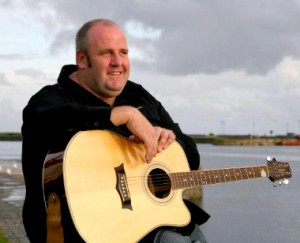
Don Stiffe

Don Stiffe

A few months ago, a friend gave me a stack of Irish CDs she liked. “You have to listen to Don Stiffe,” she said as she handed them over. “You’ve never heard a voice like his.”

It was a busy time so I stuck the CDs in a cabinet and didn’t pull them out till a few weeks ago when I was taking a car trip. I unwrapped Don Stiffe’s solo CD, “Start of a Dream,” and popped it in the CD player. Stiffe, a singer-songwriter from County Galway, was barely through the first few bars of the first track– Richard Thompson’s “Waltzing for Dreamers”– when I realized I had goosebumps. And it wasn’t the air conditioning.

Virtually unknown in the US, Stiffe is an up and coming folk singer in Ireland where he’s worked with the likes of Frankie Gavin (who produced and played on his CD), Sharon Shannon, and Lunasa’s Kevin Crawford. He’s poised to join the Keane family (Dolores and Sean), Dessy O’Halloran, and Sean Tyrell as Galway’s gift to Irish music.

Stiffe will be sharing that gift with Philadelphia audiences for the first time on Tuesday, July 20, at the Irish Center, accompanied by Gabriel Donohue, another of Galway’s finest.

“Dolores Keane was a big influence on me growing up,” he told me a few weeks ago on the phone from Ireland. “I don’t live far from the Keanes—maybe 15 miles. I also loved Luke Kelly [one of Ireland’s greatest folk artists] though I would never try his approach to the music.”

Yet, like Keane and Kelly, Stiffe’s voice has that same complex mix of smooth and rough, like an Aran sweater. Like them, no matter what he’s singing—there are a couple of Richard Thompson tracks on his CD, four of his own songs, and even his take on Nat King Cole’s classic “Mona Lisa”—it becomes an irresistible siren song, rich with emotion, stirring, soul-satisfying.

Unlike many Irish singers, Stiffe does not come from a family of musicians. “Oh, my Mum and Dad will sing a song if they’re out at function, but I’m not from a musical family,” he says. “My Dad bought me a guitar when 7-8 years old. I had two lessons. I kept thinking, how am I going to get around all the stringy things on the guitar? After a few years came together. But I was always singing. I played in a local brass band in Galway City and I was always listening to an abundance of music.”

I asked Stiffe about the songs he chose for “Start of a Dream.”

“Most of them are diaspora songs—songs about longing for home,” I said.

“I lived in the States in the 90s,” he told me. “I was in Boston for two years and in St. Louis for a few months. I worked for a few different companies, doing landscaping, doing contruction as we all do.” He laughed. “But while I was there I was playing the circuit around the Boston area and in St. Louis.” While in St. Louis, he played with legendary accordian player Joe Burke who dubbed him “The Bard of Bohermore,” acknowledging the poetry of Stiffe’s lyrics.

Take, for example, “Grosse Isle,” which tells the story of the Irish immigrants, fleeing Ireland’s An gorta mor—the Great Hunger–who landed on this little island (Grosse-Ile) 30 miles east of Quebec City that was designated a quarantine station to prevent the spread of cholera. Today, a tall Celtic cross greets visitors to the island where an estimated 6,000 Irish are buried.

“In their thousands they died on the island of sorrow
Not from the under, but the feverish course
They left pillage behind them, in the land they loved dearest
But to land is Gross Isle, to die in the dirt.”

“I had been reading about the people who left Ireland in the coffin ships, only to land in Gross Isle and die there,” he explained. “I was really moved by it. . . I could go months without writing a song because it can’t be fictitious. It has to be the truth of the story.”

It’s my favorite track on the CD—that and Stiffe’s take on Richard Thompson’s poignant, “Dimming of the Day.” I first heard the song on a Bonnie Raitt album and loved it. Stiffe’s version is just as good. He’s joined on the track by singer Fionnuaula Deacy.

“That one got an award from Irish Music Magazine,” he acknowledges. “It’s a tricky slope doing a cover song. People listen to it and they want it to sound like the version they heard.”

Even if it’s your favorite song, Stiffe—who promised to sing it on Tuesday—you won’t be disappointed. And even if it’s 98 degrees and steamy, don’t forget your sweater. For the goosebumps.

Columns

Aon Sceal?

 
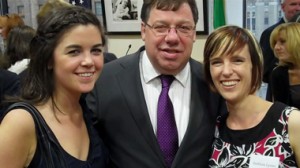
Ireland Taoiseach Brian Cowan with Mid-Atlantic Rose of Tralee Mairead Conley, left, and Siobhan Lyons, executive director of the Irish Immigration Center of Philadelphia.

Ireland Taoiseach Brian Cowan with Mid-Atlantic Rose of Tralee Mairead Conley, left, and Siobhan Lyons, executive director of the Irish Immigration Center of Philadelphia.

Siobhan Lyons, executive director of the Irish Immigration Center of Philadelphia, was named one of the Irish Voice’s 2010 Women of Influence. She received her award on July 12 at the Irish Consulate in New York. Ireland’s Taoiseach, Brian Cowan, attended the event.

Lyons was also recipient of the Irish Echo’s 40 Under 40 Award this year. Sarah Conaghan, who founded the Rose of Tralee Center in Philadelphia in 2002, was also honored at the Echo’s annual event. In the past few years, Philadelphia has been represented on this prestigious annual list by Karen Boyce McCollum, associate director of corporate communications at Cephalon and well known Irish singer formerly with the band Causeway, and Theresa Flanagan Murtagh, an attorney and former president of the Donegal Association who has her own band (The Theresa Flanagan Band).

Irish Consul Leaving

Irish Consul General Niall Burgess will be leaving his post in August to take a top position at the Irish Department of Foreign Affairs Anglo Irish Division where he’ll play a role in the Irish peace process and in relations between Dublin and London. Burgess took a circuitous route to the foreign service—he trained as an archeologist. He and his wife, Marie, have two school-aged children.

A Baby Boy for Barnett

St. Patrick’s Day Parade TV anchor Susan Barnett of CBS3 gave birth on July 13 to a baby boy, Steele Thomas Persichetti, 6 pounds, 5 ounces, 20 inches long. Steele joins big brother Blaise, 3 ½. Barnett, a native of Levittown, PA, is married to Greg Persichetti, a dermatologist and surgeon.

Ed Reavy to Be Honored in Cavan

Celebrated Irish musician and composer Ed Reavy will be honored at a tribute concert on August 21 at the Cavan Crystal Hotel in Cavan Town, where the 2010 Fleadh Cheoil is being held. The late Reavy, who was born in Cavan, is widely considered one of the most important composers of Irish music. He made a living, however, as a plumber in Philadelphia. His son, Ed Reavy Jr., will read a tribute to his father at the event, the largest Irish music competition in the world.

Enda Goes Live Online

Last week singer-songwriter and Philly transplant Enda Keegan debuted his new online TV show featuring–you guessed it–Enda Keegan, singing and playing. You can watch it every Tuesday at 9 PM at www.endakeegan.com/live.htm and post your requests on Facebook. Last week, his tune, “Say Goodbye” was #14 on the Reverb charts.

Local Author Shortlisted for Frank O’Connor Prize

“If I Love You I Would Tell You This,” a book of short stories by Philadelphia-area writer Robin Black, was shortlisted for the Frank O’Connor Prize, established in memory of the noted Irish short story writer. Black’s book, which is also an Oprah selection, is one of five American works on the six-book list. The final winner, who will receive a prize of 35,000 Euro, will be revealed in September at the end of the Frank O’Connor short story festival in Cork.

Go See the Flyers, Help People with MS

Team Ratty Shoes—that’s a reference to a Blackthorn songis raising money for research into multiple sclerosis. They’ve scored some $30 tickets to see the Flyers face off against the New York Islanders on September 29. Out of that $30, $15 goes to Team Ratty Shoes—a ragtag bunch of Blackthorn fans who do the MS Walk every year. As a bonus, each ticket earns you a chance to watch pregame warm-ups from the best seats in the house—the Flyers’ penalty box! You can also meet Flyers alum! “Bernie (Parent) is awesome,” says Lisa Hunt of Team Ratty Shoes. “He gives the best hugs.” For tickets call Lisa at 267-626-6916 or email lsimoni11@msn.com.

Do you have some news to share? Send it to us at denise.foley@comcast.net.

Columns, How to Be Irish in Philly

How To Be Irish In Philly This Week

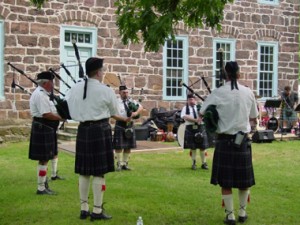
The pipes are calling at Graeme Park in Horsham.

The pipes are calling at Graeme Park in Horsham.

Picnic!

We love picnics, especially when there’s a pool nearby. And there will be at the second annual Irish Club of Delaware County event at the Knights of Columbus De La Salle Pool in Springfield. The terrific local group, Round Tower, will be providing the musical accompaniment along with a DJ and the Celtic Flame Irish Dancers (who have the coolest sparkly red outfits). No need to bring a pic-a-nic basket, Yogi: It’s catered and beer and other drinks are available. Costs $20 for grown-ups, $7 for kids.

Other than that it’s a relatively slow week for big events (though there’s something Irish to do every day of the week—don’t believe me? Check the calendar!). One new entry to our calendar is open mic night at Downey’s Irish Restaurant at Front and Second, home of the famous Downey’s Irish Whiskey Cake on Mondays. Kevin Ricci is the host this Monday—so bring your party piece all you singers, musicians, and songwriters (doesn’t have to be Irish either). There are cheap drink specials ($2 shots of Jagermeister, so you know they’re catering to a young crowd because, ewwww, I’d rather chug vanilla extract and Scope).

Also, just a plug for a local musician: John Byrne (The John Byrne Band) has been getting boffo reviews for his first CD, “After the Wake,” and getting airplay on WXPN (he’s doing World Café Live Friday night, July 9). We think that someday you’ll be paying loads to see him on stage, so grab your chance to see him for free on Monday nights at Slainte, the great pub on Market Street across from 30th Street Station.

Likewise, newly local musician Enda Keegan is burning up the Internet with sales of tracks from his new CD, The Bridge. He’s still playing mostly in New York, but some smart publican in our area ought to snag him while it’s still possible. Just a thought.

Next Saturday, at Graeme Park in Horsham, celebrate your Celtic heritage with the Martin Family, the Hooligans, the Bucks Caledonian Band and other musicians, dancers, and vendors at this historic, Colonial-era home.

And on Tuesday, July 19, plan on heading to the Irish Center to hear Galway singer-songwriter Don Stiffe in his first Philadelphia showing, performing with Gabriel Donohue. Stiffe has a distinctive, goose-bump-raising voice and an eclectic playlist that includes everything from traditional ballads to Richard Thompson, his own tunes, and even some surprises (if you liked Nat King Cole’s version of “Mona Lisa,” wait till you hear Don’s take on this Jay Livingston song!). We talked to him this week and we’ll have an interview up next time.

Columns, How to Be Irish in Philly

How to Be Irish in Philly This Week

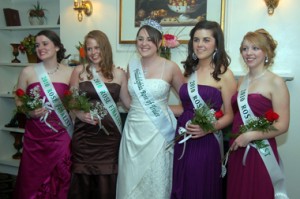
The Roses

The Roses

Yet another festival this weekend, this one Scottish (but hey, a Celt’s a Celt). The Celtic Fling and Highland Games goes on in Manheim, in Lancaster County, on Saturday with music, dancing, craftsmen and big, beefy athletes who toss things that look like telephone poles into the air to see who can heft them the farthest. Trust us, this is way fun.

Closer to home, you can watch a group of smart, talented, lovely young women compete for the coveted Mid-Atlantic Rose of Tralee crown. There are four Philly entries (good luck, girls!) plus young women from up and down the eastern seaboard vying for the chance to compete for the international title in Ireland. It all takes place at the Irish Center on Saturday night. The bargain price of $35 per tickets gets you dinner, dancing, and a chance to play along (come on, we know you pick the winners when you’re watching Miss Universe at home!).

AOH Black Jack Kehoe Division is holding its annual Night of Irish Music at the Briarcliffe American Legion Hall in Glenolden on Saturday night. The Shantys and other local groups are on the bill, and there’s food and drink as well.

Then, can you take another festival? Sure you can! On Sunday, Bristol Borough holds its annual Celtic Day on the waterfront, featuring the Irish American String Band, bagpiper Ian Ferrick, McHugh and Company, Paddy’s Well and the Fitzpatrick School of Irish Dance. BYO lawn chair, but there’ll be food and goodies to buy and entertainment for the kids.

Other than the sessions just about every night of the week, it’s a bit slow, probably because of the July 4 weekend coming up. We’ll peek a little ahead because there’s some fine stuff coming up, including a free concert with Barleyjuice in Galloway, NJ, on July 3.

Later in July, the incredible Don Stiffe, a singer-songwriter from County Galway, is coming to the Irish Center. You won’t believe this voice! You’ll probably be hearing it on Marianne MacDonald’s “Come West Along the Road” radio show on Sundays at noon on WTMR 800AM since she’s bringing this enormously talented musician to the area. Writing about Stiffe’s first release, “Start of a Dream,” Sean Laffey of Irish Music magazine said “the album is in the premier league… style, taste, pace and final execution are flawless and his choice of songs is inspired … a class act, with a class album.”

Later in the summer, the fiddle-playing Kane sisters, Liz and Yvonne, from Connemara, will be on stage at the Irish Center for a Philadelphia Ceili Group concert.

Dance, Music, People

A Flood of Generosity for Flood Victims

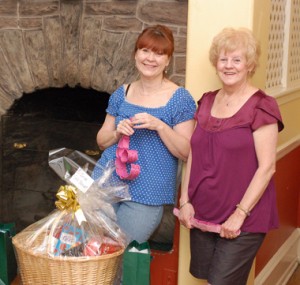
Rath deHouth and Ann McGee sold tickets for some beautiful baskets.

Rath deHouth and Ann McGee sold tickets for some beautiful baskets.

An evening of music and dancing at the Irish Center last week raised more than $2,000 for the people of Kingston Springs, Tennessee, who lost their local elementary school in the floods that wreaked havoc on Nashville and the entire Cumberland River area in May.

It was a gesture of thanks from a group of 52 Irish Philadelphians who found themselves in Kingston Springs after last May’s flooding turned back their tour bus which was taking them to Memphis for a visit to Graceland.

When the group holed up at a BP station, the tour band—local musicians Fintan Malone, Luke Jardel, and Pat Kildea—set up their instruments and started to play. Many of the Philly tourists were dancers, so an impromptu ceili went into full swing—and it was recorded for YouTube by a Texas tourist who was also stranded.

A nearby merchant sent sandwiches and cases of water to the dancers and some of the local residents joined in the fun, dancing and singing as the rain fell.

To repay the kindness, tour coordinator Marianne MacDonald and musician Luke Jardel planned a benefit (“The Gas Pump Ceili Benefit”) at last Thursday’s Rambling House event at the Irish Center.

The people of Kingston Springs responded when photos from the benefit were posted to the city’s Facebook page. Here are a few examples:

“Fabulous!! We heard so much about your visit, yet no one could really tell us who you were or where you came from! Thanks so much for your positive approach during the flood and leaving a positive memory behind. Thanks for entertaining the stranded.”—Laurie Cooper, City Manager

“Thank you… I wish the flood didn’t happen but it was wonderful for us all to come together. Seems like things stopped ( everyday worries) and people came together like they should. What beautiful hearts you have!”—Jennifer Baer Reese

“Thank you all so much for your generosity, kindness and those much needed smiles your created May 2!”—Marie Spafford

We have photos from the benefit. Click on the photo at upper right to view a photo essay.

Arts

Celebrating “Ulysses”

“Mr. Leopold Bloom ate with relish the inner organs of beasts and fowls. He liked thick giblet soup, nutty gizzards, a stuffed roast heart, liver slices fried with crustcrumbs, fried hencod’s roes. Most of all he liked grilled mutton kidneys which gave to his palate a fine tang of faintly scented urine.”

~ James Joyce, “Ulysses”

His name is Hamlet, but his passion is “Ulysses.”

Bloomsday

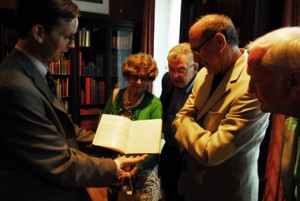
Lucky luncheon goers get up close and personal with Joyce's handwritten manuscript of "Ulysses," which is owned by the Rosenbach Museum. Director Derek Dreher holds the manuscript in the library, which remains dark to protect the books.

For the past seven years, Jim Hamlet, CPA, has served on the committee—two years as its chairman—that brings the marathon June 16 Bloomsday reading of James Joyce’s “Ulysses” to the Rosenbach Museum in Philadelphia.

“Ulysses,” considered one of the best English-language novels of the 20th century, chronicles one ordinary day—June 16—in the life of Joyce’s main protagonist, Leopold Bloom, a modern-day Odysseus who wanders the streets of Dublin, encountering character after character. Its 18 chapters each bear the title of one episode in the life and adventures of Homer’s epic hero, Ulysses, on which Joyce based his work.

While the National Library of Ireland is one of the major repositories in the world for all things Joyce, there’s a coveted, autographed, handwritten copy of the manuscript that calls the Rosenbach Museum home, making it particularly suited to hosting the yearly readings.

Hamlet, his late father, and his son, Michael, have been volunteer readers in past years. This year, he knew he was going to miss it because of an out-of-town work commitment.

So instead, the day before Bloomsday, he was tucking into steak and kidney pie—a tribute to the breakfast enjoyed by Bloom—and other Joycean-inspired dishes prepared by the chef at The Bards for a luncheon at the Rosenbach, sponsored by the John Henry Newman Foundation and Joyce’s alma mater, University College Dublin. Each year, the Rosenbach focuses on a theme related to the novel; this year’s was food, a logical choice for a book that’s a feast of words, many of them about food. Guest speaker for the luncheon was Professor Declan Kiberd, chair of Anglo Irish Literature and Drama at University College Dublin, who explores Joyce’s food themes in his book, “The Art of the Everyday in Joyce’s Masterpiece.”

Hamlet, who does audit work for the Rosenbach and several other museum clients, is keenly aware most people consider a CPA rubbing elbows with Joyce scholars as surprising as finding capers instead of raisins in your oatmeal.

“Most people ask me why I’m so dedicated to Ulysses because I’m a CPA and mostly English majors read the book, but I love Irish literature,” says Hamlet. He had read Joyce, but, he confessed, until he became involved with Bloomsday had never tackled the door-stop-sized “Ulysses” which is famously considered difficult to read, in part because of its stream-of-conscious form and the hundreds of puzzles and allusions that Joyce deliberately inserted “keep the professors busy for centuries arguing over what I meant,” guaranteeing his “immortality.”

But when Hamlet volunteered at the Rosenbach, he jokes, he felt he “had to” read the book, as daunting as it seemed. To make it a little less of the chore he thought it was going to be, he took a class with then University of Pennsylvania Joyce scholar, Vicki Mahaffey, PhD, author of “Reauthorizing Joyce” and “States of Desire: Wilde, Yeats, and Joyce and the Irish Experiment.”

“It took us eight months to read it, chapter after chapter, and Vicki helped us get the references and when we got to parts where we had no idea what was happening, she’d help us get over them. The best advice she gave us was ‘If you don’t understand it, keep going, keep going.’”

He was glad he did. Today he describes the novel that probably thwarts more than it impassions in the same way some people describe the latest Michael Connelly thriller. “It’s really a great yarn,” Hamlet says. “It has so many moving parts. Each chapter reflects the story of Odysseus, but what sets it apart is how he tied that story back to ordinary Irish life.”

And seven years of planning the Rosenbach’s Bloomsday festivities has altered how Hamlet looks at the book’s complexity. “In the past we’ve shown movies, had plays, and one year we had a dance troupe do an interpretive dance of the novel. If you think the book’s confusing,” he said with a laugh, “try looking at a modern dance interpretation.”

News

Local Reaction to “Bloody Sunday” Report

This week, the British government released a report on the 1972 Bloody Sunday shootings, placing the blame for the 14 deaths that day squarely on British soldiers.
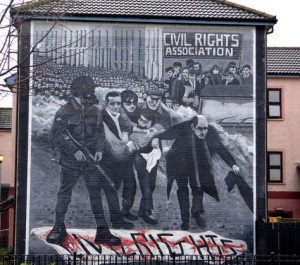
Bloody Sunday

A wall mural in Derry created by Bogside artists commemorating Bloody Sunday.

In an unequivocal apology, British Prime Minister David Cameron called the shootings “unjustified and unjustifiable,” noting that the demonstrators marching through Londonderry that day were unarmed and that the soldiers, who fired more than 100 rounds and killed some wounded marchers at point blank rage, acted in violation of their orders.

This one day of violence led to an escalation of “the troubles” in Northern Ireland which raged on for decades, leaving more than 3,000 dead.

In Derry, the release of the Saville report—which cost $280 million and involved more than a dozen years of testimony from thousands of witnesses—was greeted by cheers. Family members of the slain demonstrators, many of them teenaged boys, expressed relief that, as one said, “the truth has been brought home at last.”

In the Delaware Valley, many Irish-Americans, particularly those with a link to Northern Ireland, were also relieved—but with reservations. We asked some of them to share their feelings on this landmark event.

Seamus Boyle, Philadelphia, national president, Ancient Order of Hibernians

A native of County Armagh who emigrated to the U.S. in 1954 as a young boy, Boyle returns every year to march in the Bloody Sunday commemoration parade and has come to know some of the families of the slain protesters.

“[The Report] is great news but it’s about 38 years too late. It’s something that at least gives the families closure and now they can rest in peace. It’s good that it did come out, and great that we got an apology from the British government—the first ever—but at the same time they give you an apology they said that [former Provisional IRA leader and current Deputy First Minister of Northern Ireland] Martin McGuinness was there with a submachine gun. [The Saville Report, which raises the possibility that McGuinness was armed, said there was insufficient evidence to make any finding on the claim, other than McGuinness did nothing to justify the actions of the British soldiers that day.]

“While it will help give closure to the families, so much has happened over there in past 30 years during the Troubles, it’s hard just to give up and say this is fine. It’s hard to forgive and forget. A guy I know, TJ Carraher, his son was killed at a roadblock. For no reason at all, the soldiers opened fire and killed one son and wounded another. It’s hard for that man to forgive and forget. There was an awful lot of damage and hurt done by British soldiers that wouldn’t have been done if there hadn’t been British soldiers on Irish soil. I know that people say they were there to protect us, but they weren’t there to protect the people; they were there because the British government thought it was their country.

“I was over there in the late ’60s early ’70s. I got married over there in 1970 and built a house. It [the Irish civil rights movement] was just starting when I left to come back here in 1971. Every year, twice a year, my wife and I would go back and we’d be subject to harassment because, I believe, I was very active here and come from a big Republican family. One of the things that sticks out in my mind, is that every time I went home I would say to my mother-in-law, ‘When was the last time there were soldiers on the road,’ and she would say, ‘The last time you were here.’

“When you’d go out to Mass on Sunday they would stop you and hold you back so you would be late. Once, a soldier stopped me and asked for my license. I showed him my license and he didn’t look at it. He looked at me and said, ‘Well, Mr. Boyle, where were you headed for?’ Afterwards, my daughter, who was only five at the time, said, ‘Daddy, did you know him?’ I said, ‘No.’ And she said, ‘Well, he knew you. He didn’t look at your license and he knew your name.

“But the Saville Report is what we’ve been waiting for. The families have been waiting so long and the government kept putting it off, putting up, just hoping it would go away. But the families didn’t want it to go away. They wanted the world to know what happened. Now we do.”

Pearse Kerr, Jenkintown, Freedom for All Ireland officer, Pennsylvania Ancient Order of Hibernians

Pearse Kerr, who was born in the U.S. to Irish parents, was raised in Belfast. One morning around dawn when Kerr, then 17, was sleeping, British soldiers came to his home and dragged him away without explanation. He spent the next week in Castlerea Prison, unable to see family or an attorney, while he was interrogated and tortured.

“The only thing good about [the report] is that it brings some closure for the families. But there’s nothing new about it to the Irish people. They knew it was a murderous action. On both sides of the divide they knew. They were talking about the youths of Derry as though they were a bunch of hooligans when they were a group of young people who had enough of political turmoil. There was such a depth of bigotry and discrimantion, at that point they didn’t have an option except to protest.

“The fact that it took the British government so long to admit it shows what we’re dealing with. Think of how hard it’s going to be to make them hold up to the Good Friday agreement [the peace accord that calls for an eventual united Ireland]. It’s great that they admitted their problems, but at the same time they have nothing to be proud of. It went on for so long and those families suffered.

“When I was 17 I was taken out of my home, yanked out of my bed and they didn’t even let me put on my clothes. My mother was passing my clothes to me as they were taking me down the stairs. I got into a Jeep with just my boxers on. But that wasn’t anything out of the ordinary. There were probably six or seven taken from my neighborhood that morning. I was taken under Section 13 of the anti-terrorism act that allowed them to keep me for seven days for questioning without any legal representation or family visits. That was all part and parcel of the Separate Powers act, laws that they didn’t use anywhere else but in Ireland that allowed for internment without trial. In some cases they would release people and once they were outside the gate they would re-arrest them and hold them for another seven days. This was at the height of their torture program in 1977.

“I suffered a broken wrist, a dislocated neck, fractured ribs, multiple bruises. But in some cases they killed people. They’d be found hanging in their cells and they would claim it was suicide. In on case they threw a guy out of the window three stories up and said he tried to escape. He was beaten so bad his own mother couldn’t recognize him. My perspective of it is that it’s a day late and a dollar short.

“I’m glad it’s finally out in the open. But I don’t have any kudos for them—those families suffered way too long. It makes you wonder how long is going to take to heal the whole situation. After all, that’s just one incident.”

Liz Kerr, Jenkintown, Freedom for All Ireland officer, LAOH Brigid McCrory Division 25

“If you read the report, it’s almost hard to believe—how bad it was, how deep the cover-up was, the lengths that they went to lie for 38 years, while those families suffered for 38 years.

“The worst part was when the Queen gave Derek Wilford [commander of the 1st Battalion of the Parachute Regiment in Derry that day, whom the report says disobeyed direct orders not to send troops into Bogside that day] a knighthood within a year, and the parachute regiment were given medals. If there’s really going to be closure, they’re going to strip them of their honors. Those honors were given to them based on a lie. And the moment they got those awards was truly insult to injury to those families. It’s one more thing that will have to happen for them to be completely honest. The victims were mostly high school age boys, 17 years old, and probably looked younger. They were executing teenaged boys.”

“I was glad to see David Cameron’s coming out with the report, especially since he hasn’t been in office long. It’s a good sign. I’m hoping it’s a good sign. He was pretty harsh in his comments—that it was unjustified and unjustifiable—and I’m glad it took it to that level.

“Bloody Sunday really moved the civil rights movement into a war, and I’m hoping the release of this report can be another watershed moment, and that based on this we can move toward a united Ireland.”

Patricia Noone Bonner, Longtime Member of Irish Northern Aid and Clan na Gael

“I don’t care how long a time it’s been. They had to get it done.

“People were killed for no reason. They (the protesters) didn’t start it. They were not carrying weapons. They were just struggling for civil rights. I remember that time well. I’m sure I heard about it on television. We were all up in arms. In my opinion, I am sure that’s why the armed struggle started.

“From the point of view of the families, it (the report) may help move things forward. but still … how do you ever get over losing anybody, especially a child?

“Should there be prosecutions? I don’t know. I don’t think the soldiers should be. It’s the higher-ups who should be prosecuted. Those soldiers would not have fired if someone had not told them to.”

John Ragen, President of the Irish Club of Delaware County

“For my generation (he’s 32), we’re learning about it. It’s our history and definitely something we should all know. Why do I care? It’s’ something that was such a travesty, it should be made public. And if you don’t learn about it, history has a tendency to repeat itself.

“The report coming out shows that the British were not there for the people, they were there for the land. I’m sure it (the report) will bring people together. The Protestant ministers have already extended their hands out to the families of the people who were killed or injured. (Read the story in the Irish Times.)

“The prime minister’s apology was well-written. It may be enough for a lot of people, but the military who were involved should be held accountable. The soldiers should be brought up on perjury charges, at the very least.”

Jeff Meade also contributed to this report.

Columns, How to Be Irish in Philly

How to Be Irish in Philly This Week

Irish Network

Some serious networking going on here—at the first get-together of the Irish Network-Philadelphia at Tir na nOg.

Irish Ambassador Michael Collins makes an appearance in Philly this week at the official launch of Irish Network-Philadelphia, an organization that brings together Irish and Irish-Americans from every walk of life for networking of every stripe. It all takes place on Thursday night, June 24, on the rooftop of the Phoenix Building at 16th and Arch. The first round of tickets ($50) were sold out, so a second batch was issued and they’re going fast.

Don’t forget—this weekend is the 10th annual Penn-Mar Irish Festival in Glen Rock, near York. Enjoy music by Amhranai Na Gaeilge, Barleyjuice, Irish Blessing, Martin Family Band, Raining Hearts, Rossnareen, The Spalpeens, and Susquehanna Pipes & Drums. Irish dance performances will be presented by Broesler School of Irish Dance, Hooley School of Irish Dance, McGinley School of Irish Dance, Ni Riain School of Irish Dance, and Oh! Gill’s Irish Dancers. There are children’s activities, vendors, prize, food, and you get points because the proceeds goes to fund Penn-Mar Human Services, a nonprofit that provides support for people with disabilities and their families.

On Tuesday, go to happy hour at the AOH Div. 87 hall on Wakeling Street in Philadelphia and help supply food for the needy: To get in, you need to bring a food card or a money donation for the Hibernian Hunger Project.

On Wednesday, author Tom Lyons will be at the Irish Immigration Center in Upper Darby to talk about his new book, “You Can’t Get To Heaven on the Frankford El” during the regular 12:30 lunch.

On Friday, Green Willow is bringing Scottish musician Paul McKenna and his band to Timothy’s at Wilmington Hall on the riverfront in Wilmington. This is the first U.S. tour of this band that combines traditional music with original songs and tunes. You can have your dinner at Timothy’s and enjoy the river breezes while listening to the music.

And don’t forget—get your tickets now for the 2010 Mid-Atlantic Rose of Tralee Selection Gala on Saturday, June 26, at the Irish Center. Four Philadelphia-area women will be competing with Rose winners from the Mid-Atlantic states to be crowned the Mid-Atlantic Rose. The winner will go to Ireland this summer to vie for the international crown on national TV in Ireland—it’s the most watched program on Irish TV!

The 2009 Rose of Tralee, Charmaine Kenny, of London, will be coming to Philadelphia for the event.

For $35, you get a buffet dinner, entertainment, and a chance to be part of a real reality show! And you can order your tickets online.