All Posts By

Denise Foley

News, People

Hundreds in Philadelphia Mourn Michaela Harte McAreavey

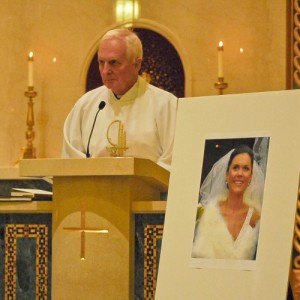
Father John McNamee offers a eulogy for Michaela Harte McAreavey, whose photo is in the foreground.

Ciara McGorman carefully set the large wedding photo on an easel at the front of the chapel at the Cathedral of Sts. Peter and Paul in Philadelphia. It showed her friend and neighbor, Michaela Harte McAreavey, from the little village of Ballygawley, County Tyrone, Ireland, beaming and radiant, as only a bride can be, in her wedding dress.

The dress in which the 27-year-old teacher was buried this week.

Friends, family members, and representatives from the organizations Michaela Harte McAreavey loved so much—the Gaelic Athletic Association, the Tyrone Society, and the Rose of Tralee—gathered at the Sunday evening Mass, concelebrated by poet-priest Father John McNamee of Philadelphia with Father Gerard Burns, formerly of St. Cyril of Alexandria Parish in East Lansdowne and now a parish priest in County Mayo, Ireland.

Michaela Harte McAreavy, married on December 30, 2010 to noted Down footballer John McAreavy, was found brutally murdered on January 10 while on her honeymoon in the Indian Ocean nation of Mauritius. She had been strangled in their hotel room, apparently after surprising hotel employees who used a key card to enter the room to burglarize it. Five men have been charged in connection with the killing of the only daughter of popular Tyrone senior football manager, Mickey Harte. Michaela McAreavy was buried on January 17th after a funeral mass at St. Malachy’s Church near Ballygawley.

Father MacNamee, pastor emeritus of St. Malachy’s Church in North Philadelphia, opened his remarks with a sigh. “This is the week that was,” he said, noting it was also the week the death toll from cholera was rising in Haiti and in which a 9-year-old girl, Christina Green, granddaughter of former Phillies Manager Dallas Green, was killed in Tucson, Arizona, along with five others in a shooting that wounded Arizona Congresswoman Gabrielle Giffords.

Christine Green had been featured in a book on babies born on September 11, 2001. “Her parents had her as a sign of hope to all us in time of sorrow,” said Father McNamee. She had been “as innocent and fragile and vulnerable as the beautiful Michaela,” he told the more than 200 mourners who lined the chapel pew. “Life is a terrible beauty, as Yeats called it.”

Michaela was also eulogized by Sean Breen, president of the Philadelphia Gaelic Athletic Association, Angela Mohan, coach of the Mairead Farrells Ladies Gaelic Football Club; Mairead Farrell footballer Orla Treacy, whose father, Mick, is a friend of the Hartes; and McGorman. Music—including a heartbreaking rendition of Sarah MacLachlan’s “In the Arms of an Angel”—was provided by Karen Boyce McCollum, who, like Michaela, was an International Rose of Tralee contestant, as well as Roisin McCormack and Raymond Coleman.

Father McNamee twice quoted Irish poet William Butler Yeats in his eulogy, reciting from “The Stolen Child””

“Come away, O human child!
To the waters and the wild
With a faery, hand in hand,
For the world’s more full of weeping than you can understand.”

“The world,” he said, “is both a beautiful place and a tragic place. . .and more full of weeping than we can understand.”

Click here to see photos from the mass.

Arts

Review: A Skull in Connemara

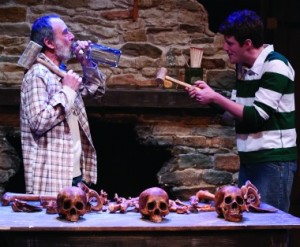
Stephen Novelli as Mick Dowd and Jake Blouch as Mairtin--and skulls. Photo by Mark Garvin.

The Lantern Theatre Company’s production of “A Skull in Connemara,” is, to quote one of its quirky main characters “a great oul night. Drinking and driving and skull batterin’. . .”

In fact, if you happen to be in the first row, you might want to bring some protection—a la watermelon-smashing comic Gallagher—from the flying bone shards during the hilarious scene as two drunken Irish gravediggers with wooden mallets make sure that two skeletons do indeed return to dust.

In the second part of Martin McDonagh’s Leenane trilogy (“Beauty Queen of Leenane” and “The Lonesome West” bracket it), “A Skull in Connemara” tells the story of Mick Dowd (Stephen Novelli), who picks up the odd piece of change from the parish priest by digging up bodies in the church graveyard and disposing of them so there’ll be room for the newly dead. We arrive as Mick is within distance of the lovely bones of his wife, Oona, who died, we learn, as the result of a “drink driving” accident seven years earlier with the poitin-addled Mick at the wheel. He paid his debt in prison, but returned home to be haunted by the rumor that he’d murdered her and used the accident to cover it up.

Assisting Mick is a local young miscreant and dimbulb, Mairtin (Jake Blouch), whose granny MaryJohnny (Ellen Mulroney), likes to saunter down to Mick’s cottage after a successful night of Bingo for a sip of the good stuff that Mick has aplenty, trade a little gossip, and nurse old resentments (she still has it in for the boys who, as five-year-olds, went “wee” on the concecrated ground of the graveyard. And for the children who called her names: “When I see them burned in hell, that’s when I let bygones be bygones,” she tells Mick). The fourth character is her other grandson, the local garda Tommy (Jered McLenigan) who makes Barney Fife look like a candidate for Mensa. At one point, when Mick makes a comment about Tommy’s having seen plenty of dead bodies, the copper admits that he hasn’t. “I would like there to be dead bodies flying about everywhere, but there never is,” he says wistfully.

As in many Irish plays, there are horrifying moments tempered by humor. In this one, it’s death that loses its sting to hilarity, much of it physical. The skull batterin’ is done to music—an insipid tune on a 45 record by a female Irish popstar whom Mairtin admits to fantasizing about.  And Mairtin’s other fantasies contribute to the laughs, as when he’s making two skulls kiss and one perform a sex act that we can’t describe here.

Jake Blouch as Mairtin occasionally loses his accent but never his comic timing. He brings such a wonderful childlike innocence to the character that it never occurs to you to wonder why you find this boy so adorable and funny even after he admits to cooking a live hamster in a microwave, wishing only that there had been a glass door so he actually could have seen what happened.

Stephen Novelli’s Mick is a finely nuanced character, acerbic as hell but nursing an inner turmoil that feeds the suspicion that his neighbors—particular the garda Tommy—are right about his wife’s death. Novelli hints at but doesn’t hit the audience over the head with the simmering violence inside him. Because he actually does hit someone else over the head, his guilt remains a question, but by the end you’re laughing so much it doesn’t really matter.

“A Skull in Connemara” is directed by M. Craig Getting and Kathryn MacMillan. The inventive set, which combines Mick’s home with the graveyard where he spends many minutes on stage digging into real dirt, is the work of scenic designer Dirk Durossette. And major props to the prop people on this production (Tim Martin is props designer). Every night, two plaster skeletons are smashed to smithereens and since the nearly sold-out play is extending its run through February 13, we figure that, including matinees, they’ve got more than 50 skeletons in their prop closet.

“A Skull in Connemara” is part of the Philadelphia Irish Theater Festival. Save 20 percent on tickets by ordering tickets to two or more plays at the Theatre Alliance of Greater Philadelphia website.

Columns, How to Be Irish in Philly

How to Be Irish in Philly This Week

Two thirds of the Clancys here--Aoife and Robbie O'Connell, far right--will be in Ambler this week. The extra Clancy is Donal.

Round up the usual suspects—there’s a Blackthorn concert this weekend! The popular local Celtic rock group is playing a benefit for AOH Black Jack Kehoe Division 4 on Saturday night at the Knights of Columbus Hall in Springfield.

And that’s just one of many enticing events this weekend. For example, they’ll be kicking up their heels at the AOH Notre Dame Hall in Swedesburg Saturday night at their annual ceili. And multi-talented trad performer Gabriel Donohue and singer Marian Makins will be performing the same night at the Shanachie Pub and Restaurant in Ambler.

On Sunday, fiddler Brian Conway will be holding a traditional fiddle workshop at West Chester University and you can catch him later that night at a special session at Kildare’s Pub in West Chester.

More big doings at Shanachie: Robbie O’Connell and his cousin, Aoife Clancy, will be celebrating the Clancy legacy (he’s a former Clancy Brother though his mom was a Clancy sister, and her dad was one of the Clancy Brothers) at the Ambler pub on Thursday, January 27.

On Friday, a freebie from Jamison—a thank-you show (they were voted best Irish band in the US in the Strangford Lough Brewing Company’s annual battle of the bands) at the AOH Div. 39 Hall on Tulip Street in Philadelphia.

And all this week—“Pumpgirl,” Abbie Spallen’s play about dark deeds in a Northern Irish border town and Martin McDonagh’s darkly funny “A Skull in Connemara” are on stage. “Pumpgirl” is produced by the Inis Nua Theatre Company and is at the Adrienne at Sansom and 20th, while “Skull” is at the Lantern Theater Company’s location at St. Stephen’s Church at 11th and Ludlow Streets in Philadelphia. We’ve reviewed them both.

Check out our calendar for all the details.

Arts, People

Review: Inis Nua’s “Pumpgirl”

Playwright Abbie Spallen

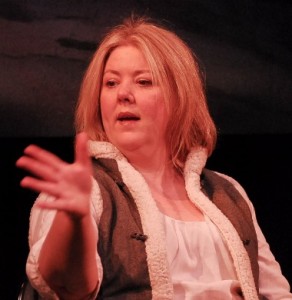
Northern Irish playwright Abbie Spallen was explaining how “Pumpgirl,” her award-winning play now in a two-week run at Philadelphia’s Adrienne Theater, can explore gang rape, infidelity, physical abuse, and suicide, and yet still get laughs.

“It’s the Northern Irish sense of humor,” said Spallen, a native of Newry, County Down, who appeared on the spare stage after the January 13 performance of her play, which is being produced by the Inis Nua Theatre Company. “People outside of Northern Ireland go, ‘Wow. That’s really mental.’ But it’s much darker than other humor, and it’s cruel. I have a friend who had a cold sore and had just had surgery on her foot. She walked into a bar with her crutches and then had to go to the bathroom. When she got back someone at the bar said, “Oh look, it’s hopalong herpes head’ and he didn’t even know her. There really isn’t any respect.”

But it’s clear that Spallen respects her characters, from the eponymous “pumpgirl,” Sandra (Sara Gliko), who works at the local petrol station in a Northern Irish border town, to her “pure class” lover, Hammy (Harry Smith), a part-time stock car racer whose moniker “No Helmet,” suggests that brain injury may be at least partially responsible for his oafish behavior, to Sinead (Corinna Burns), his long-suffering wife to whom Spallen gives her best lines. (“Sinead is me if I’d stayed in Newry,” Spallen confessed.) When Hammy slinks into bed beside her, Sinead notes that his lower lip puckers when he snores, something she used to find endearing but now makes her want to “put the hatchet through his head.”

In her monologue to the audience, Sinead wonders aloud: “How’s that for a country-and-western song, Hammy? I could call it, ‘And I’m Praying for a Female Judge.’” Spallen actually wrote two verses for the song which she sang for the Thursday night audience.

To Spallen, these three characters, who tell their stories in monologues, are “outsiders” in a place with a long history of intolerance for the different. The pumpgirl, described by one local as walking “like John Wayne” and looking “like his horse,” is frequently asked if she’s a boy or girl. (Gliko, who would never be mistaken for a boy, does manage to pull off “butch.”) Though his stock car wins ought to make Hammy the hometown hero, his name is butchered at the awards ceremony and his best mates ridicule him. One, an ex-con brute nicknamed Shawshank, is never seen but is an evil presence who orchestrates the ultimate betrayal. Sinead, the wife, is the sharpest of the three, funny, feisty, and full of potential that’s been snuffed by marriage to a callous, womanizing idiot.

The play is taut, made so by Spallen’s intent to reveal all to the audience before the characters themselves know what is happening. Spallen worked with the actors and with director Tom Reing during rehearsals, so this production may hit its mark better than some productions of “Pumpgirl” around the country. And it does hit its mark—as well as leave one.

Inis Nua Theatre Company’s “Pumpgirl” by Abbie Spallen will run through January 23, at the Adrienne Theater, 2030 Sansom Street, Philadelphia. Go to
http://inisnuatheatre.ticketleap.com/pump-girl/ to order tickets. This play is one of eight Irish plays that make up Philadelphia’s first Irish Theater Festival. You can save 20% by ordering tickets to two or more plays at the website, http://www.theatrealliance.org/irish-theatre-mixtix .

Arts, News, People

“You Could Almost Feel the Sparks Crackling In the Air Around Her”

Melissa Lynch

Melissa Lynch

“When it’s over, I want to say all my life 
I was a bride married to amazement.
I was the bridegroom, taking the world into my arms.
When it’s over, I don’t want to wonder
 if I have made of my life something particular, and real.
I don’t want to find myself sighing and frightened,
 or full of argument.
I don’t want to end up simply having visited this world.”

~ Mary Oliver

Melissa Lynch wasn’t here long–she died in a car accident on December 30 at the age of 27–but no one would ever call her a visitor to this life. She grabbed it, embraced it, and, on occasion, frog-marched it where she wanted it to go.

A prolific actress—she appeared in more than 17 productions in Philadelphia—the Mayfair native was poised on the brink of her best year ever. She was engaged to be married on June 18 to William Seiler, a man, friends say, “she adored.” She had roles in four major plays, including one in which she was to play 8 different characters. Directors had started calling her. Even when she played smaller parts, reviewers couldn’t help taking note of her performances. In fact, said a college friend, Rebecca Godlove, “she could have a nonspeaking role in a play and still get noticed. In college, she played a mute child in a play and got rave reviews.”

Critics called her “dazzling,” “sparkling” and “luminous,” descriptions echoed by those who knew her, a powerful reminder of why actors have come to be called “stars.” But a reminder, too, that there are those among us who harbor an unquenchable inner light.

“She just radiates,” says Kathryn MacMillan who directed Lynch in her last play, the highly acclaimed production of Chekov’s “Uncle Vanya” for the Lantern Theatre Company. In fact, MacMillan says, she hesitated inviting Lynch to audition for the role she played, the “plain” Sonya, because Lynch was “too beautiful.

“She shone and there’s no dimming that and there’s no way I would want to,” said MacMillan. But MacMillan had seen Lynch play against type before—as the matted-haired, dirty invalid in Inis Nua Theatre Company’s production of “Bedbound,” a powerful work by Irish playwright Enda Walsh. “I could barely breathe all through that show, and yet through all the perfectly awful, disturbed misery, I found myself thinking, ‘she’s so amazing, she’s so amazing.’ For the first time I started to appreciate the range of things she could do. And I thought, if [Inis Nua artistic director] Tom Reing could make her ugly, why not?”

Her friend and frequent co-star, Doug Greene, who last appeared with Lynch in “The Duchess of Malfi” for the Philadelphia Artists’ Collective in September 2010, says that Lynch didn’t seek out the glamour roles, though they could have been hers for the asking. She was petite, with blue eyes and long blonde hair that she was perfectly willing to dye or hack if the character called for it. In “Bedbound” her face was smeared with sooty makeup and her usually sparkling teeth looked like a brush hadn’t been near them in a decade.

“She was a really beautiful girl and could have taken an easier road playing the beautiful girlfriend and wife, but she had a lot of depth as an actor and wasn’t satisfied just playing the girlfriend,” says Greene. Tellingly, though she was playing such a glamour role in “Duchess,” what reviewers saw in her portrayal of the conniving mistress of a Cardinal was “evil.”

But off stage, the only thing wicked about Melissa Lynch, her friends and colleagues say, was her sense of humor. “The first thing she would want me to say was that she was hilariously funny,” says Jared Michael Delaney, assistant artistic director of the Inis Nua Theatre Company, which produces modern plays from the UK and Ireland. “She had a really wicked and sharp sense of humor that could at times be terribly crude and at times incredibly clever.”

When her co-stars recall a performance with Lynch, it’s always marked by the memory of a recurring joke, usually made at their expense. Brian McCann, who played Lynch’s father in the poignant, violent, demanding play “Bedbound” last year, says she cracked him up before every performance when she would turn to him and mutter, “Now don’t f— this up for me.”

The other thing they recall is an outsized personality. “She was loud. She was opinionated. She loved to laugh and cause a scene. She could be as proper or as unladylike as you could imagine, depending on her mood,” her Clarion College classmate Rebecca Godlove wrote on her blog shortly after Lynch’s death.

And there was magic: “The girl was so passionate about everything you could almost feel the sparks crackling in the air around her,” Godlove wrote.

“I spent most of my time with her laughing and having a good time,” says Greene. “She was effervescent—and I don’t know too many people I would describe as effervescent. She had that ‘life of the party’ personality.”

She was also a true and loyal friend, a rare find in a world—the theater—that can be competitive, even cutthroat, and soul-crushing. “She was everything you want a friend to be—deeply loyal, but someone who would always tell you the truth, what you needed to hear whether you wanted to hear it or not,” says Delaney.

Many of those friends repaid that loyalty by waiting for hours on a cold winter evening in a line that stretched outside the Wetzel and Son Funeral Home in Rockledge and around the block, just to express their sorrow to Lynch’s family—father, Michael, mother, Madeline, and siblings Tina, Michael, Joseph and Theresa, and Lynch’s fiancé, Bill. And they were there the next day, at the gravesite in Whitemarsh Memorial Park in Horsham, where they joined her brother Joe in an impromptu and tearful version of “Danny Boy.”

Those who knew her as a friend admit that it’s been difficult coming to grips with the sudden finality of her death. “I’ve lost a lot of family members but this is the first friend,” says Delaney. “This is a new kind of grief for me personally.”

Those who knew her as a colleague, a co-star, or a character struggle with other feelings: Who will replace her? “To work with her is to love her instantaneously,” says MacMillan. “There are people who just saw her on stage and feel this loss. I know lots of actors who were looking forward to working with her. After ‘Uncle Vanya’ she came up to me and grabbed me by the shoulders and said, ‘I f’n love you. Can we do this again soon?’ And I said, ‘Yes, as soon as possible, please!’ I was so filled with the potential for this new friendship and a new collaborative relationship that I feel something important has been stolen from me, something that I wanted really bad.”

A remarkable, generous actress, Melissa Lynch was above all dedicated to her craft, one she chose as a child after seeing an ad for auditions for a local community theater. She starred in several musicals while she was a student at St. Hubert’s Catholic High School for Girls and in 25 productions while she was an acting major at Clarion.

“In school, most actors portrayed different intensities of themselves,” says Godlove. “Not Melissa. She had these moments of introspect when she was finding a character and it was magic. She could play anything and anyone. My last play in college was [Shakespeare’s] Henry V and the cast was almost all female. Melissa played Henry V and I played her comedic foil, her loyal Welsh sidekick who hated the Irish which was ironic since she played so many Irish roles. Watching her, you forgot she was a woman. You didn’t look at her and think, ‘that’s a girl playing a King.’ You thought, ‘that’s the young Henry V.”

Though she made it look seamless on stage, acting wasn’t effortless to Lynch. Inis Nua’s Tom Reing recalled her getting “crazed and panicked” by a part at first, “then she would see the humor in it and calm down.”

For her performance as a medical student in Inis Nua’s production of “Skin Deep,” by Paul Meade, Reing recalled, she had to jump rope while trying to memorize medical terms. “One day during rehearsals she came to me and said, very seriously, ‘Tom, I gotta talk to you.’ I thought she was going to tell me she got another gig with a bigger company, but she says, ‘I can’t jump rope.’ So she took the jump rope home and practiced memorizing her lines for that scene while jumping rope. I kept asking her about it and she said, ‘I’ll be ready for opening night, I’ll be ready for opening night.’ And she was.”

Lynch wasn’t above using the same methods that charmed critics and theater-goers to get what she wanted off stage either. Recalls Jared Delaney: “If she wanted something from you, you’d better do it. I wasn’t going to see her in her last play, ‘Uncle Vanya,’ because I don’t like the play and it’s 2-3 hours long. I told her, ‘Lynch, I’m sorry I can’t make it.’ She stood there looking at me, this tiny, beautiful blond girl. She put her hands on her hips and pointed at me and said, ‘You have to, I’m your girl.’”

He paused for a few seconds. “That’s why we’re dedicating the rest of our season to her,” he said softly. “She was our girl. And we loved her.”

See photos of Melissa Lynch both off-stage and on. Thanks to Doug Greene and the Lantern Theatre Company for their help in assembling these photos.

Columns, How to Be Irish in Philly

How To Be Irish in Philly This Week

Radio hosts Marianne MacDonald and Vince Gallagher

There are two Irish plays running this week—The Lantern Theatre Company’s “A Skull in Connemara” by Martin McDonagh and Inis Nua Theatre Company’s “Pump Girl” by Abbie Spallen—starting the 2011 theater season off to a Celtic start. As we told you last week, there’s an Irish Theater Festival going on in Philly and this is your chance to experience the works some of Ireland’s finest playwrights.

This Saturday, you can show your support for the WTMR 800AM Sunday Irish Radio Shows at J.D. McGillicuddy’s in Kirklyn while enjoying an evening of music and dancing (and singing if you feel like it). Hosts Marianne MacDonald and Vince Gallagher need to raise more than $30,000 a year to keep the shows on the air.

Also on Saturday, all-Ireland piper Michael Cooney and guitarist and singer Pat Egan will be perfoming in one cozy venue—a livingroom in Lansdale. The two “boys from Tipperary” will be performing at a house concert in the Spring Hill House Concert Series. To get directions, you’ll have to email Bette Conway at bette@betteconway.com because it’s her livingroom.

On Sunday, AOH Div. 87 is having its beef and beer at Finnigan’s Wake at 3rd and Spring Garden Streets starting at 3 PM.

At 6 PM Sunday, poet-priest Father John McNamee will celebrate a Mass at the Cathedral Basilica of Sts. Peter and Paul  in Philadelphia to remember Michaela Harte, daughter of Tyrone football coach Mickey Harte, who was murdered while on her honeymoon just two weeks after marrying football star John McAreavey. The 28-year-old teacher has family and friends in the Philadelphia area who are organizing the memorial.

Next weekend alert: On Saturday, January 22, AOH Notre Dame Div. 1 is holding a ceili at the AOH Hall in Swedesburg and Blackthorn is playing its annual benefit for AOH Black Jack Kehoe Div. 4 at the Knights of Columbus Hall in Springfield. That’s also the evening you can hear popular local performers, Gabriel Donohue (late of County Galway) and Marian Makins at The Shanachie Pub and Restaurants in Ambler.

And big news: Coming to the Shanachie on January 27 are Robbie O’Connell and Aoife Clancy with their Clancy Legacy Show (his mother was a Clancy and her father was Bobby Clancy of the famed Clancy Brothers). They’re two remarkable performers in their own right.

As usual, you’ll find all the details on our interactive calendar.

News, People

Mass Planned at Cathedral to Remember Michaela Harte

Michaela Harte shown with her father, Mickey.

She was a beautiful girl, a beauty queen described by a childhood friend as “elegant.” Earlier this week, Michaela Harte, 28, daughter of popular Tyrone Gaelic football coach Mickey Harte, was murdered in her hotel room in a resort on the Indian Ocean nation of Mauritius where she was honeymooning.

On Sunday, friends and family members from her hometown of Ballygawley, County Tyrone, members of the Philadelphia Gaelic Athletic Association and the Philadelphia Rose of Tralee organization will mourn her death at a mass at the Cathedral of Sts. Peter and Paul in Philadelphia. Father John McNamee, the poet-priest who is pastor emeritus of St. Malachy’s Parish in North Philadelphia, will celebrate the Mass which starts at 6 PM.

Ciara McGorman, a childhood friend who grew up with the Hartes in the small Northern Irish village near the Donegal border, has been helping to organize the memorial.

“We grew up in the same parish and I knew her and her brothers,” says McGorman, former manager of the Sligo Pub in Media and resident of Drexel Hill. “Her father Mickey was involved in everything before he became a manager. He had a shop locally, ran the youth club—he was part of everybody’s life. They’re a very close family, religious people with a great faith, and this is the only thing we can for them. It’s a heart-rending story and everyone wants to help.”

On December 30, Michaela Harte married John McAreavey, 30, a Down senior footballer. Bishop of Dromore, John McAreavy, officiated at the wedding of his nephew. Her husband of two weeks found the young woman’s body face up in a bathtub full of water. “She was a gift from God and I now have an angel,” he said in a statement. Three employees of the resort have been arrested for her murder. Published reports say that evidence, including skin tissue taken from beneath her nails, indicate that Michaela Harte interrupted the men as they were burglarizing her room and fought back. Death was caused by asphyxiation.

“The saddest thing is when we heard she had died on her honeymoon we all assumed it was natural causes,” says McGorman. “No one had heard why or how. When we heard what happened. . .it was just heart-breaking.”

Harte, says McGorman, had represented Ulster in the Rose of Tralee pageant. She taught Irish and religion to students aged 11-18 at St. Patrick’s Academy in Dungannon in County Tyrone.

The last time she saw her neighbor and friend was about five years ago, when the Hartes came to the US for a football match-up in New York and traveled south to Philadelphia to see friends. “I hadn’t been home in five years at that time so it was so good to see her again,” says McGorman who, with other members of the Philadelphia Tyrone community, is planning the music and readings for Sunday night’s Mass.

After the service, participants are invited to Con Murphy’s Pub, across the street from the Cathedral at 1700 Benjamin Franklin Parkway, for tea and sandwiches.

News

Irish American Business Chamber and Network Announces 2011 Awards

Timothy R. Lannon

Timothy R. Lannon

Aramark, which is headquartered in Philadelphia but provides food services, facilities management and career apparel in 22 countries, including Ireland, is this year’s recipient of the Irish American Business Chamber and Network’s annual Ambassador’s Award.

The Irish Ambassador to the United States, Michael Collins, will present the award to Joan O’Shaughnessy, CEO of Aramark Ireland, which was a 2010 finalist in the Chambers Ireland’s Corporate Responsibility Award, at a luncheon on Friday, February 25, at the Crystal Team Room at the Wanamaker Building in Philadelphia.

Aramark Ireland employs more than 4,000 people and provides contract catering, facilities management and property management services to more than 400 operations in Ireland. Under Ms. O’Shaughnessy’s leadership, Aramark Ireland serves more than a quarter million customers daily.

Also being honored at the luncheon will be Timothy R. Lannon, president of St. Joseph’s University who will become president of Creighton University in Nebraska—his alma mater—in July. Father Lannon began his term as St. Joseph’s president in 2003, after a stint at Marquette University. A Jesuit, he holds three master’s degrees, a doctor in administration, planning and social policy from Harvard and a professional diploma from Fordham. He will receive the annual Taoiseach award, given to people of Irish descent who exemplify leadership and compassion. Last year’s recipient was WaWa’s cultural ambassador Harry J. McHugh.

The Uachtaran or “President’s” award this year goes to James Hasson, president of Hypex, an international provider of custom engineered solutions headquartered in Southampton, PA, and his wife, Sarah, a prominent leader in many non-profit organizations in the area.

For more information about the event, contact Alanna Barry McCloskey at abarry@iabcn.org or irish_event@iabcn.org .