All Posts By

Denise Foley

Columns, How to Be Irish in Philly

How To Be Irish In Philly This Week

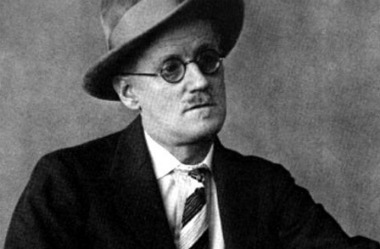
James Joyce Himself.

It’s Bloomsday week—the annual event celebrating the day (June 16) in the life of Leopold Bloom, chronicled in James Joyce’s “Ulysses.” The Rosenbach Museum on Delancey Street in Philadelphia has a copy of Joyce’s manuscript so it’s the perfect venue for a day of readings by local actors, celebrities, and ordinary Joyceans. You can also go inside and take a peek at the manuscript.

Before that—on Monday, June 13—you can spend an evening with Irish author Jamie O’Neill. His stream-of-consciousness style novel, “At Swim, Two Boys,’ tells the story of two 16-year-olds caught up in the 1916 Easter Rising in Dublin and owes something to Joyce, O’Neill admits.

Quick, get your reading done! Fergie’s Pub is holding a Bloomsday 101 Quiz with James Joyce experts Melanie Micir and Lance Wahlbert on Tuesday, June 14. Not your usual Quizzo, but we happen to know that owner Fergus Carey is a serious literature fan and is usually one of the readers on June 16.

Speaking of literature, this is also the week to catch “Stoker’s Dracula,” a play adapted and performed by Philadelphia actor Josh Hitchens at the Ebenezer Maxwell Mansion in Philadelphia. Setting: a dark, candle-lit room, perfect for this tale of horror. And there’s another Rosenbach connection. This wonderful little museum-library also owns a copy of the Dublin-born Stoker’s handwritten notes to Dracula, his best known work.

There’s plenty more going on this week that doesn’t require any extensive reading:

Sunday, June 12. An Evening at the Races at the Philadelphia Irish Center will benefit the family of Lori Kiely, who died last August leaving four small children. Kiely was involved in kids’ sports, particularly Gaelic sports, so many of her friends from the fields are sponsoring this event to help out her young family.

Thursday, June 16. After a day of Joyce, drop by the Camden Riversharks stadium. It’s Irish Heritage Night there, with Irish music, dancers, and probably a few surprises. (Order tickets for as little as $5 in advance by using the secret discount code: IRISH. Oops, guess it’s not a secret anymore.)

You can also hear Shaun and Jerry of the Broken Shillelaghs at the Blue Monkey Tavern in Merchantville, NJ, that night. Why do we know this? Because Shaun and Jerry wisely put this on our calendar themselves, knowing we would mention it here, in our most-read feature. You can do this too. Simply go to the orange bar at the top of the page, click on Irish events listing and you’ll see the words, “Submit Your Irish Event.” Fill in the blanks and submit! See, it’s so easy, even Shaun and Jerry can do it.

Check said calendar for all the details and, if people put addresses in correctly, even a map!

History

The White Walls of Malin Town

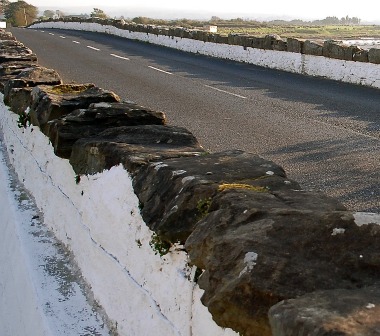
The white-washed walls of the Malin Town bridge.

By Tom Finnigan

You know that summer is approaching Malin Town, when white-wash appears on the bridge’s parapet and brushes scrub walls. Other places count swallows; we look for immaculate stones. When the rim surrounding our triangular green gleams white, the matter is fixed: summer has arrived.

I carry a pint from Maclean’s and sit on a bench near the Food Store and watch sunlight coax colour from the flowerbeds on the green. Outside the Malin Hotel, a couple sprawl under an awning and smoke. Beech trees cast shadows across the green. Seated majestically on a mower, Hughie sweeps past me and waves. A smell of cut grass follows him.

A van turns from the Glengad road. The enlarged face of a politician grins from its panels. In a stink of exhaust fumes, a microphone blares and a voice bleats for support in the coming election. The van circles the town and exits across the bridge to annoy sheep on the Carn road.

On August 7th in 1843, it was reported, thousands of people assembled near the Green Hill, outside Malin, to listen to Daniel O’Connell. The authorities feared violence and hid behind the muskets of the military but all passed quietly and J. McSheffry Esquire had no regrets about allowing his land to be used for a political gathering. “But,” a local historian remarked: “The great agitation has gone for naught…and Ireland groans under the burthen of her sorrows.”

The Psalmist says that man is like grass in a field. He grows in the sun, then withers and dies. Shinnere and Finners; Blueshirts and the Loose-your-shirts; Labour and Independents: they are blades of grass. Their sun has set. Who will remember the names of the defeated when the placards rot and the loud-speakers are silent? A few lines in the local papers, comment on Highland radio, an argument over drinks. For a few weeks their faces haunt us from telegraph poles and lamp-posts. Votes cast, they are lifted down and thrown into the back of a van to be re-cycled at ten euro a time. Those left hanging, wait for wind or rain to throw them into the dirt under a whin bush. Remember man that thou art dust and to dust thou shalt return…

Free of electoral blather, Malin resumes the tranquillity of summer. A swallow flits under oaks. The church of Ireland raises its castellated tower behind a copper beech as it has done since 1827. Outside Maclean’s, two old carousers sit on the wall by the bridge and watch a girl in shorts fill her car with petrol.

Politicians lick wounds, newspapers castigate the clergy and the banks are bust. Let the world go about its business. Be still, relax; sit on a bench under a sycamore tree at the edge of the green with a pint to hand and listen to a tractor lifting silage along the Lagg road. Gaze at what a Planter built and be thankful for white-wash and brushes – those perennial signs of summer in Malin.

Tom Finnigan writes his essays from his home in Malin, Inishowen, County Donegal, Ireland.

How to Be Irish in Philly

How To Be Irish in Philly This Week

Blackthorn's Michael Boyce at a prior Penns Landing fest.

This is one jam-packed weekend if you like rugby, Irish music, dancing, and fun. Surely, one of those things will entice you out either to the 2011 USA Sevens Collegiate Rugby Championships in Chester on Saturday and Sunday, the Irish festival in Mont Clare throughout the entire weekend,  or the Irish Festival on Penns Landing on Sunday.

Notre Dame is one of the teams competing over the weekend at the Philadelphia Union’s waterfront soccer stadium during the sevens—so-called because the team is made up of only 7, rather than 15 players, which amplifies the action. The matches will be televised by NBC, but only if you go out can you also enjoy the Saturday night concert by the Dropkick Murphys.

Speaking of Notre Dame, the AOH Notre Dame Division 1 annual Irish festival is this weekend too. The fun starts Friday night at St. Michael’s Picnic Grounds under the pavilion in Mont Clare, PA. Enjoy the music of Jamison, the Belfast Connection, Misty Isle,  the Bogside Rogues, and a ceili with Tom McHugh, Kevin and Jim McGillian.  There’ll be food, vendors, pipers, Irish dancers, $2 pints all weekend long and tickets are only $15 for the entire weekend. Doesn’t get any better than that. Oh, wait, yes it does. All proceeds from this annual festival go to support AOH charities.

It’s year 13 for the Penns Landing Irish Festival which draws thousands to the Delaware River for free music and entertainment along with plenty of vendors selling beer, food, and Irish stuff. This year, Blackthorn, the Hooligans, and Jamison will appear on the main stage. There will be nonstop Irish dancing and kids activities.

The events simmer down during the week (though there’s a session every night somewhere) until Friday, when the Ebenezer Maxwell Mansion and the Rosenbach Museum present the world premier of “Stoker’s Dracula,” adapted and performed by Philadelphia actor Josh Hitchens. The story by the Irish writer will be told by candlelight in a dark room. Sounds like spooky fun!

Also on Friday night, catch Philly-based, Dublin-born singer-songwriter John Byrne with jazz vocalist Lili Anel at Milkboy Café on Lancaster Avenue in Ardmore. Byrne has received accolades for his debut album, “After the Wake,” and Anel, who grew up in New York but now makes Philly her home, was recently honored as best female singer/songwriter and best female jazz vocalist in the prestigious New York Music Awards.

As always, there’s more information on our calendar, the cutest, most cuddly calendar in the entire Delaware Valley.

History

History’s Back Story: Douglass and O’Connell

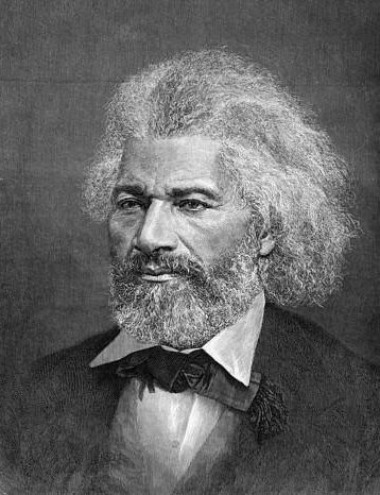
Frederick Douglass, a former slave and eloquent social reformer.

By Michael Carolan

The Dublin crowd last week was undoubtedly grateful to have once again—after Kennedy, Reagan, and Clinton to name a few—a U.S. President proclaim his Irish roots and with such precision.

Thanks to an internet genealogy service, the missing apostrophe in Obama has been located: his maternal great-great-great grandfather is Fulmuth Kearny, a Protestant bootmaker from Moneygall, County Offaly, who left Ireland during the Famine in 1850.

The President provided the throngs of well-wishers at College Green genealogical context by paying fitting tribute to a contemporary of his ancestor: Daniel O’Connell, the Irish patriot who profoundly influenced Mr. Obama’s own historical hero—the great black abolitionist Frederick Douglass.

It was, as Mr. Obama noted, an “unlikely friendship” forged between the two men. The Irishman peacefully worked for the self-rule of millions of Irish; the former slave pushed for the freedom of millions of African Americans in bondage.

What Mr. Obama failed to note was that 166 years ago the “Emancipator” Douglass and the “Liberator” O’Connell were not always so friendly. In fact, their respective peoples had a tumultuous relationship fraught with labor politics, hatred, and violence, and right here in Philadelphia.

It is true that Douglass, born into slavery himself, escaped to Ireland in 1845 where he met his hero O’Connell, then in his 70s. The two men were fond of one another, to sure, both hating the institution of slavery. But Douglass returned to a country soon besieged by nearly two million Irish Catholics fleeing centuries of religious persecution and more immediately, the horrors of the Famine.

What they wanted in America were jobs. But African Americans in mid-19th century Northern cities had the run on the economy’s low-paying menial jobs and hence, there was competition.

Douglass complained in a speech to a New York anti-slavery society nine years after he returned from Ireland: “Every hour sees us elbowed out of some employment to make room for some newly-arrived emigrant from the Emerald Isle, whose hunger and color entitle him to special favor.”

“These white men are becoming house servants, cooks, stewards, waiters, and flunkies,” Douglass told the audience. “…I see they adjust themselves to their stations with all proper humility. If they cannot rise to the dignity of white men, they show that they can fall to the degradation of black men.”

“In assuming our avocation,” the Irishman “has also assumed our degradation,” he added.

Indeed the Irish “laborers,” like Obama’s ancestor, were often called “white negroes” to denote the exploitative, backbreaking jobs at which only blacks were previously willing to work. It was not always clear on which side of the color line an immigrant like Fulmuth fell.

Was he black or white?

Sidney Fisher, a prominent Philadelphian of the time, wrote that the Irish did not get along with blacks “not merely because they compete with them in labor, but because they are near to them in social rank. Therefore, the Irish favor slavery in the South . . . it gratifies their pride by the existence of a class below them.”

Meanwhile, the newly arrived Famine Irish for whom Daniel O’Connell spoke had little sympathy for the anti-slavery cause itself. That’s because they mistrusted the Protestant majority of the same ilk that had persecuted them for centuries in Ireland.

The gulf between the average Irishman and the Yankee Abolitionist leader was too great to bridge: their link to antislavery circles there (Britain abolished slavery in 1833) further alienated the Irish. The sudden British moral reformers were, after all, hypocrites, blind to their own centuries old, slave-like oppressive practices in Ireland.

In Philadelphia, the African-Irish problem dated back to early 19th century when Ulster (Irish) Protestants and free blacks arrived in the city in great numbers. The firehouse was the social and political center of neighborhood life and African Americans were refused their own department. Then one night in August 1834, a group of young black men attacked the Fairmount Engine Company, running off with equipment. Three days later, the city’s first full-scale riot erupted.

What newspapers called a “lunatic fringe” attacked an amusement hall that housed a carousel called the “Flying Horse,” a popular entertainment for both blacks and whites living crowded together in the working-class boarding houses near 7th and South Streets.

Correspondents claimed that a mob threw a corpse from its coffin, cast a dead infant on the floor, “barbarously,” mistreating its mother. By the end, two were dead, many beaten, and 20 homes and two churches destroyed. Twelve out of the eighteen arrested had Irish names.

A committee assigned the cause to employers hiring blacks over whites, with many “white laborers out of work while people of color were employed and able to maintain their families.”

The labor, racial and economic strife continued periodically in Philadelphia’s urban immigrant enclaves—in places like Kensington and Southwark and Moyamensing—through the 19th century.

In 1842, mobs burned down the Second African Presbyterian Church and Smith’s Hall on Lombard Street—the site of abolition lectures since Pennsylvania Hall was destroyed in the riots of 1838. A plaque today commemorates the event.

But there was also the established nativists—English and Scotch-Irish Protestants and Quakers (who had their own political party for a time “the Know-Nothings”) who disliked the new Irish Catholic immigrants and associated them with the African Americans as well, exploding into the 1844 Nativist Riots in which 2 were killed and 23 wounded.

“The City of Brotherly Love” Frederick Douglass found not, proclaiming that one could not find anywhere “a city in which prejudice against color is more rampant than in Philadelphia.”

For Daniel O’Connell’s part, the Repeal movement for Irish freedom from England needed capital and Southern slave-backed money poured in. This had O’Connell waffling between speaking for the anti-slavery cause and alienating his Irish-American support and keeping the tainted donations.

At one point, anti-slavery advocates were furious with O’Connell. The prominent abolitionist Wendell Phillips called him “the Great Beggar man,” fuming that the O’Connell “would be pro-slavery this side of the pond. He won’t shake hands with slaveholders, no—but he will shake their gold.”

So when President Obama proclaimed in Dublin that “When we strove to blot out the stain of slavery and advance the rights of man, we found common cause with your struggles against oppression,” that common cause—both of them—was hard fought, and indeed eventually successful. African Americans and Ireland were eventually free.

And while the President’s words were profound at just the right moment in history—his Irish and African roots unified—they didn’t tell the whole history.

Michael Carolan teaches literature at Clark University in Worcester, Massachusetts. His father was born in Philadelphia, the great grandson of a Famine emigrant who arrived in 1847 from County Meath and lived in Feltonville. His story can be found here. Michael is the recipient earlier this year of the first annual Crossroads Irish-American Writing Prize. His website is michaelcharlescarolan.com

Music, People

Heading to the All-Irelands

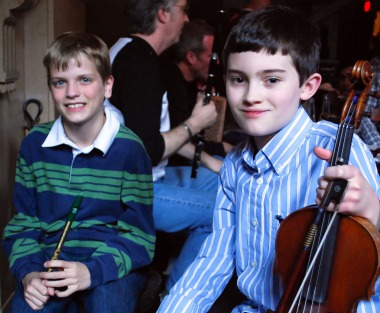
Keegan Loesel, left, and Alexander Weir: Headed to the Fleadh

The table in front of the musicians is crowded with pint glasses in various shades of beer and tenses of the word, “drink.” But the youngest musicians at the Sunday session at Philadelphia’s The Plough and the Stars pub aren’t imbibing. After all, fiddler Alex Weir is only 12, tin whistle player and piper, Keegan Loesel is 11, and little Emily Safko, barely bigger than her Irish harp, is 9.

Still, they spend so much time playing in bars, Emily’s mother Amy says that when her third grader assembled a poster for her “spotlight” day at Cranberry Pines Elementary School in Medford, NJ, “it was full of pictures of her in pubs.”

Of course, they’re Irish pubs which are usually family friendly and the weekly sessions–well, think of them as free music lessons. Sessions (seisiuns, in Irish) have long been a traditional way for Irish traditional players to jam informally and maybe learn a new technique or a tune or two, often in the dark corner of a pub or a cottage kitchen.

There’s little tolerance for the novice player at most sessions, and although one adult musician at the Sunday session refers to the three as “the leprechauns,” he says it respectfully. These “leprechauns” are solid trad musicians who are all going to Ireland in August—one for the second time—to compete in the All-Ireland Fleadh Cheoil na hÉireann in Cavan Town.

Alex Weir, of West Chester, is a  fleadh veteran. He got his start on the violin as many American children do—with Suzuki, a method developed in Japan that puts tiny violins in the hands of children as young as three and nurtures them in a positive environment where they’re expected to pick up music as naturally as they acquire language. Pretty soon, the violin became a fiddle–Alex wanted to learn some Irish tunes to play accompaniment  for his dance school friends at Do Cairde School of Irish Dance in West Chester.   “Once he started learning the fiddle there was no turning back,” says Alex’s father, Carl.

For several years, Alex has been part of Next Generation, a group of young players organized by veteran Irish musicians Dennis Gormley, Kathy DeAngelo, and Chris Brennan-Hagy. They meet the second Sunday of every month for a session at the Philadelphia Irish Center and have performed at the Garden State Discovery Museum, the Philadelphia Ceili Group Traditional Irish Music and Dance Festival, and the Celtic River Festival in Gloucester, NJ, among other venues. The group has produced another veteran fleadh competitor—9-year-old Haley Richardson from Pittsgrove, NJ, who has been playing fiddle since she was three.

Alex, who  continues to study classical violin, is an Irish music sophisticate: He doesn’t just play Irish tunes on the fiddle, he plays “Sligo-style,” like his teacher, Brian Conway of New York. Sligo style is brisk and elaborate—featuring what’s called ornamentation (trills, slides, and extra notes) with both left and right hands. It’s the lively, toe-tapping, uplifting style that most Americans associate with Irish music. “It picks you up,” says Alex, during a lull in the Sunday session. “I feel happy all the time when I play it.” Competing in this year’s Comhaltas Ceoltori Eireann Mid-Atlantic Fleadh, he came in first in fiddle slow airs under 12, first in duets with Emily Safko, and second in fiddle under 12 (Haley Richardson took first in that category).

Keegan Loesel was only three when a CD his mom had popped into the car changed his life. “I picked out this noise I heard on the CD. I found out later it was a uilleann pipe [pronounced ill-in, a small, Irish bagpipe],” explains Keegan, a fifth grader at Hillendale Elementary School in Chadds Ford, PA. At three, he was barely bigger than a set of pipes, but he told his mom, “I want to do that.”

“I thought that would go away, but it didn’t,” says Keegan’s mother, Lynette. “Two years later, I emailed a pipe maker to find out how to get him started and they told me to get him a whistle.”

It wasn’t long before Keegan was taking lessons on both the pipes and the tin whistle. He got his first set of pipes in January. This is his first year qualifying for the All-Irelands on whistle—not bad for a kid who was so shy about performing in public that his sister offered him money to play a tune at a session. “He did it and as we were going out the door he turned to us and said, ‘When are we coming back?’” says Lynette. That’s when she knew he was hooked.

Like Keegan, Emily Safko got off to an early start—and with an instrument that really was bigger than she was. She comes from a musical household—her father, Greg, is a classically trained pianist—that isn’t very Irish, “I think I’m Irish, but we don’t really know,” says Amy, her mom. “I don’t know exactly where it came from, but she started asking for a harp when she was four. I think she’d seen a harpist at Longwood Gardens.”

Emily begs to differ. She says she was bitten by the harp bug at 3. She got her first Irish harp at the age of 6 and at 9, travelled to the Mid-Atlantic Fleadh in Parsnippany, NJ, and came in first in harp slow air under 12, first in duets (with Alex) and second place in harp under 12. Kathy DeAngelo is her teacher. Emily says she takes every opportunity to play. “I got to play the harp at my school in first grade, second grade, and third grade,” she says, her child’s harp leaning against her shoulder. She’s even becoming a regular at the Irish session at the Treehouse Café in Audubon, NJ. “It’s like practice for the fleadh,” she says.

Like getting to Carnegie Hall, as the old joke has it, making it to the fleadh takes practice, practice, practice. But it also takes fundraising, fundraising, fundraising.

Keegan and Alex have taken to the streets of West Chester where they employed that age-old Irish musician money-making technique—busking–a couple of weeks ago to the accompaniment of passing cars. They also have some more official events coming up:

On Sunday, June 5, starting at 5 PM, Alex and Keegan will be playing with teacher/performer Mary Kay Mann at the BBC Tavern and Grill at 4019 Kennett Pike, Greenville, DE. If you write IRELAND on your bill, the BBC Tavern will donate 10 percent of those purchases to the boys’ travel fund.

On Friday, June 3 and Friday, July 1, you can see the boys outside the Longwood Art Gallery, 200 East State Street, Kennett Square, during the First Friday Kennett Square Art Strolls.

On Saturday, July 23, they’ll be performing at the West Chester Growers Market from 9:30 to 11:30 AM at the corner of North Church and West Chestnut streets in downtown West Chester.

If you’d like to hold a benefit for any of these talented young musicians, email lymabusi@yahoo.com.

See our photos of all of the children here.

Columns, How to Be Irish in Philly

How To Be Irish in Philly This Week

Rugby!

If the St. Patrick’s Day Irish Wolfhounds vs. the US Tomahawks rugby match whetted your appetite for this exciting blood sport, then you’re in for a treat. Coming next weekend: The 2011 USA Sevens Collegiate Rugby Championship to be held at Chester’s 18,500-seat soccer stadium on the waterfront, home of the Philadelphia Union.

NBC is televising the games, but don’t be a wuss: Get out there and see it live for yourself. Your ticket will entitle you to a free post-match concert on Saturday June 4 by the Dropkick Murphys, the Boston born and bred Celtic punk band who do a pretty cool version of one of our favorite songs, “The Fields of Athenry.” They’re better known for “Kiss Me, I’m —-faced,” but there you have it.

Why are we telling you about an event that’s actually not happening this week in Philly? Because you have a chance to mix and mingle with the Notre Dame team at a reception at Finnigan’s Wake this week–Wednesday, June 1, from 6:30 to 10:30 PM (and we wouldn’t be surprised if it went a little longer). If you pony up a sponsorship, you get to have a private dinner with the team. Think of it—dinner with a bunch of college-age rugby players. How can you pass that up?

If you’re a Blackthorn fan, you already know that your boys are celebrating Monday, Memorial Day, the same way they always do–at Canstatters German Club in Northeast Philly for a day-long feast of Irish music and German beer. The Hooligans are joining them as is Sparkle the Clown. Kids under 14 get to be scared for free. Um, we mean they get in for free. (Did we mention that we have a little problem with clowns? Mimes creep us out too.)

Also this week, an annual treat for young and old: The AOH Notre Dame Div. 1 is holding its Irish Festival at St. Michael’s Picnic Grounds in Mont Clare, PA. The three-day festival kicks off on June 3 and features entertainment by Jamison, the Bogside Rogues, Tom McHugh with Jim and Kevin McGillian, Misty Isle, and The Belfast Connection (which just released a fabulous new EP that we’re sure they’ll have on sale—buy it!). Of course, the Irish Thunder Pipes and Drums band will be there—that’s their home turf. And you can see the wonderful little dancers from the Coyle School with their curls bobbing as well. There’s food, vendors, and an outdoor Mass on Sunday. And recession friendly prices: A three-day pass is only $15. It’s all for a good cause: Everything the Hibernians raise goes to charity. They’re like that.

One big change in a regular event on our calendar: Radio host Vince Gallagher’s weekly Sunday Irish music show has moved to a new station, WNJC 1360 AM. Same time—11 AM—and same Vince. Marianne MacDonald’s “Come West Along the Road” show remains at WTMR 800 AM. Michael Concannon’s weekly show on WVCH 740 AM is also staying where it is. You can hear Mike (when he’s not playing with Round Tower) on Saturday starting at noon.

Taking a peek ahead on the calendar—mark the date, Sunday, June 12, from 4-8 PM—for a Evening at the Races fundraiser for the Kiely Family to be held at the Irish Center in Philadelphia. Lori Kiely, mother of four small children, died last August. A Cardinal Dougherty graduate, Lori was a tireless supporter of Gaelic athletics—she was an officer on the Philadelphia Youth Board of the Gaelic Athletic Association as well as being active in the Fox-Rok and Fox Chase Athletic Associations. “She made all children feel important,” a friend told us. A worthy woman and a worthwhile cause.

Sports

Footballers Raise Money on the Links

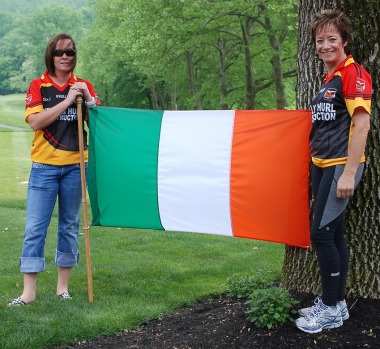
Ciara Moore, left, and Angela Mohan, right, of the Mairead Farrells Senior Ladies Football Club--preparing to defend their championship status.

To borrow from an old ‘60s song, if you’re going to San Francisco, you should start fundraising now. And that’s what the Mairead Farrell Ladies Gaelic Football Club is doing.

Last Sunday, 43 golfers ponied up $100 each—and more than 100 businesses and individuals kicked in donations—for a golf outing at the Edgmont Country Club, a bucolic private 18-hole club in Newtown Square. The money they contributed will help send the Mairead Farrells, the reigning national ladies champs, to the west coast this summer to defend the senior ladies title.

“This is the biggest fundraiser of the year for us,” said Angela Mohan, coach and manager of the team that she helped found in 2008 with players Siobhan Trainor and Orla Treacy. She estimated that it raised about $10,000, putting them about halfway to their target.

Last year, the Mairead Farrells tore up the fields at Cardinal Dougherty High School to earn a spot in the national championship, held at Gaelic Park in Chicago. They’ll be defending their title in San Francisco in August.

Unfortunately, their main opponent—the second ladies team from Philadelphia, the Notre Dames–is taking a breather this year. The Notre Dames are also national champs—they brought back the 2010 junior ladies title from Chicago. So the Mairead Farrells will be traveling to New York, Washington, and Boston to play teams there. It’s rumored that the home games in Philly will remain on the Cardinal Dougherty fields for the time being. The archdiocese closed the high school, but still hasn’t sold it. And the Philadelphia Gaelic Athletic Association fields in Limerick haven’t been completed.

Mohan says they need two more fundraisers—a beef-and-beer night and a raffle—to get the team on the plane to San Francisco. And, she says, “the lassies are coming in”—Irish players who spend the summer in the US, playing Gaelic football in the hot summer sun.

Check out our photos of the golf outing.

How to Be Irish in Philly

How to Be Irish in Philly This Week

Paraic Keane will perform at the Philadelphia Ceili Group benefit on May 21.

Blockbuster weekend at the Philadelphia Irish Center—too bad you can’t sleep over.

On Saturday night, the Philadelphia Ceili Group is hosting a benefit concert featuring the region’s top trad talent to raise money for the 2011 Ceili Group Irish Traditional Music and Dance Festival, scheduled for September 8-10.

On the bill are Erin Shrader, US Irish fiddle champ, teacher, bow maker, and writer, and recent transplant from California; fiddler Paraic Keane, a Dubliner and son of The Chieftains’ Sean Keane and nephew of noted box player James Keane, also a recent transplant; Ellen Tepper, harpist and historian who plays a variety of harps, including medieval instruments and the Irish wire strung harp; Tim Hill, who has been part of the Philadelphia Irish music scene since he was 9 (he’s 17 now), an uillean pipe and whistle player; Paddy O’Neill, flute and tin whistle player from Derry City; Caitlin Finley, a 20-year-old Columbia University student from King of Prussia who is one of the most highly regarded fiddle players on the East Coast; Andrew Boyd, a fiddler from Cape Breton; and Dan McHugh, an uillean piper who plays in the Philadelphia/Baltimore areas.

It promises to be a foot-tapping, hard-shoe-dancing, clap-till-it-hurts kind of time.

This weekend is your chance to see the Druid Theater’s version of Martin McDonagh’s play, “The Cripple of Inishmaan,” at the Annenberg Center. It is, like all of McDonagh’s works, darkly comic.

On Sunday, the Irish Center and the Irish Immigration Center of Philadelphia honor 12 women of Irish descent whose lives serve as an inspiration to others. The Inspirational Irish Women Awards will be presented at a cocktail reception hosted by CBS3 reporter Kathy Orr, herself a 2010 recipient of the award.

Two remarkable musicians—multi-instrumentalist and singer, Gabriel Donohue, who has toured with The Chieftains, performed at the White House, and at Carnegie Hall (five times—that’s a lot of practice, practice, practice), and singer Marian Makins—will be performing. The Rince Ri Dancers will open the awards presentations and there will be a tribute performance by Dennis Gormley and Kathy DeAngelo (McDermott’s Handy) for the late Liz Crehan Anderson, one of the honorees and well known in Philadelphia’s Irish traditional music community. Photographer Brian Mengini’s portraits of the women will be on display.

For more information, go to the Inspirational Irish Women Awards website.

Oh, and there’s more going on elsewhere. On Sunday at Molly Maguire’s Pub in Lansdale, our friend Bill Reid of East of the Hebrides Entertainment is bringing in those wild barbarians of drum solos, Albannach, and Paul Moore and Friends for “Molly’s Music Fest,” in the streets. Should be a good time.

The Bucks County Irish Center Festival is also taking place on Sunday at Park Polanka in Bensalem. And The Old Blind Dogs, a Scottish group, will be performing at Hockessin Memorial Hall in Hockessin, DE, the same day.

On Thursday, the 22nd Annual Cape May Music Festival kicks off with an all-star Irish band. The Pride of New York features some of the greats of Irish traditional music, including Cherish the Ladies’ own Joanie Madden, fiddler Brian Conway; accordion player Billy McComiskey (whose son, Sean, was recently on stage at the Philadelphia Irish Center and who, we hear, will be there himself for the Ceili Group festival in September) and keyboardist Brendan Dolan. Opening for this Irish supergroup is our own local McDermott’s Handy (Dennis Gormley and Kathy DeAngelo).

Check out our calendar for all the details.