All Posts By

Denise Foley

Arts

Love Stories

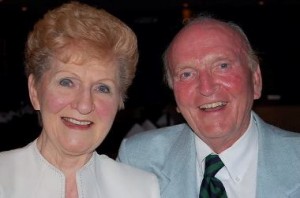
Anne and Joe Hill at Joe's book signing in Ambler.

Anne and Joe Hill at Joe's book signing in Ambler.

It’s hard to know which of Joe Hill’s love stories to tell first, the one he wrote about in his novel, “The Irish Rose,” which celebrates the life and mourns the death at 59 of his wife, Lillian, or the one he’s living with his second wife, Anne.

“I met two beautiful women in my life and I married both,” Hill said, laughing, at a recent book signing at the Shanachie Pub and Restaurant in Ambler.

We’ll start with Lillian, who is Tara O’Shea O’Malley in “The Irish Rose,” A Dublin-born 24-year-old who emigrated to the US and married at the age of 29, bearing four children. In his book, Hill starts this love story with the beginning of its end, when Tara–Lillian–learns she had breast cancer. As it does in life, the diagnosis tinges everything, even the recounting of the happy days of their marriage to the last pages, when both husband and wife come to grips with the inevitable.

“Lillian died in 1994,” says Hill, who was an elementary school English teacher, now retired from the Philadelphia schools. “I thought my life was over.”

Not long after her death, Hill began writing their story. “When I’m by myself I’m either reading a book or writing. Writing this was a catharsis for me. I wrote it in longhand and went over it many times over the years. Every time I made changes. I’m not computer literate so my kids typed it for me.”

While the writing tempered some measure of his grief, Hill still felt like a shell of a man. “I was a biological, functioning person. My wife died. My life died. But. . .” he smiles. “Then I met Anne and I learned that you can live again. Anne brought me fully back to life.”

Anne, who is 12 years Hill’s senior but looks 20 years younger than her age (83), was a widow, a business owner, and, most important, the head of the St. Christopher Singles Social Support Club. She was, as one of Hill’s friends, who urged him to attend one of the club’s dances, called her, “the redhead who runs the place.”
The dance where they met was actually Anne’s last. “I’d been head of the group for 10 ½ years and I’d stayed too long at the prom,” explains Anne, whose penchant for wisecracking is reminiscent of Myrna Loy’s sparkling, snappy dialogue in the “Thin Man” movies of the ‘30s. “This was Joe’s first dance. In my job, I made a point to go over and greet anyone who was alone, so I approached him and we chatted. Then he asked me, ‘Are you allowed to dance?’”

She was, and they did. And they talked. “It wasn’t love at first sight,” admits Anne, “but there was something there. I knew this man was special. After that night he kept calling and calling. He was determined.”

In fact, Joe called Anne on the anniversary of her husband’s death. “It was July 21 at 11:20 AM and Joe remembered that,” she says, clearly awed. “He talked to me for a half an hour and I asked him at one point, ‘Where are you calling from?’ He said, ‘Rome.’ I was amazed. But that’s the way he is. When he got off the plane he called and asked if he could come over. I had a date that night and I cancelled it!”

He remembers their first kiss. They were standing near the river, looking out at the lights on the water. “Anne was talking and talking, as she does,” he recalls. “I looked at her and I thought, ‘I have to stop those lips from talking!’ So I kissed her.”


He also entrusted her with his book. “I wanted her to read it,” he says. She found it heartbreaking. “When I got to the end I couldn’t read anymore. It was like my husband, John’s dying all over again. It was so real,” says Anne, who later helped her husband by editing the last draft of the manuscript before it was published.

In fact, the last few chapters of “The Irish Rose” are so compelling and sad, it’s as difficult to put the book down as it is to read it. Hill leaves Tara’s husband and family on the morning of her funeral, at that time after a death when the polarities of finality and uncertainty both clash and meld.  In the last paragraph, Hill writes, “From my bereavement will I one day awaken reconciled to a new life?”

Clearly, yes.
News

Gather Ye Rosebuds

On June 22, first grade teacher Christine Frawley of Yardley will hand over her tiara and sash to a new “Rose of Tralee” who will compete with Roses from Ireland to Australia at the popular international festival held every year in Tralee, County, Kerry Ireland. It’s one of the most-watched shows on Irish television and draws big-name celebrity guests. In Philadelphia, the Rose is selected at a dinner-dance in the Grand Ballroom of the Hyatt Penn’s Landing, this year on Friday, June 22.

But the Rose candidates don’t meet for the first time in their ball gowns. On Sunday, June 3, they met at a tea given in their honor at the Glen Mills home of Tom and Mary Conaghan. Tom Conaghan is executive director of the Irish Immigration and Pastoral Center in Upper Darby, the nonprofit organization that helps Irish immigrants with housing, employment and immigration issues and sponsors the Rose of Tralee pageant. The Rose of Tralee Selection Ball is the IAPC’s sole annual fundraiser.

This year, the organizers have added a little extra zip to the pageant: the Rosebuds, girls 13 and under who will attend to the Rose candidates during the ceremony. “This is something they’ve done in other cities and we decided to add it this year,” says Rose candidate coordinator Karen Conaghan.

Cuteness and beauty–it should be an unbeatable combination.

The 6th Annual Philadelphia Rose of Tralee Selection Ball will be held on Friday, June 22, at the Hyatt Penn’s Landing. Cocktails start at 7 PM, dinner and dancing at 8 PM. Music will be provided by the Andy Cooney Band.

Tickets are $100 and include dinner and open bar all night. They must be purchased in advance. To order yours, call 610-789-6355.

Arts

How to Celebrate Bloomsday in Philadelphia

On June 16 every year, millions of James Joyce aficionados around the globe flock to hear readings of their favorite Joyce work, “Ulysses,” which chronicles a day in the life of a Dublin man, Leopold Bloom. And Bloomsday is no ordinary day in Philadelphia either. After all, the city’s Rosenbach Museum houses a copy of Joyce’s original manuscript of the novel, which was widely banned in its day and continues to flummox college literature majors with its highly stylized form and language. This is not beach reading, folks.

But Joyce fans are like Deadheads (fans of The Grateful Dead, not Joyce’s short story, “The Dead)”: They love this book, possibly enough to camp out to get the best seat at the readings.

That said, there’s something for everyone in the city’s celebration of this literary landmark. You don’t even have to know how to read to go on a pub crawl. But to help you get up to speed, Fergie’s Pub at 1214 Sansom Street (owner Fergus Carey is a perennial reader at Bloomsday) is sponsoring a Bloomsday 101 at 6 PM on Friday, June 15, before sending you off for a pint at their bar or the following fine establishments with Bloomsday specials:

Irish Pub
1123 Walnut Street
$2.00 pints of Miller, Miller Lite, Bud, Bud Lite
$2.50 mixed well drinks

Nodding Head
1516 Sansom Street
Reasonably priced and great fries!

McGlinchey’s
259 S. 15 th Street (corner of 15th and Manning, between Spruce and Locust Streets)
20 oz. mugs of Rolling Rock for $2.35

By then you should have boned up on another Joyce classic, the aforementioned short story, “The Dead,” from the book, “Dubliners. ” On Wednesday evening, June 13, at the Union League, 140 South Broad Street, barrister Brendan Kilty, who owns and has restored 15 Usher’s Island in Dublin–the setting for the story–will discuss the 1987 John Huston film version of “The Dead,” which will be screened following cocktails and hors d’oeuvres at 5:30 PM. Cost is $40. RSVP to Katelyn at 215-546-9422 or email her at katelyn@expertevents.com.

Kilty will also appear at a free screening of the film at 2 PM Friday, June 15, at The City Institute Library at 1905 Locust Street on Rittenhouse Square. No cocktails and hors d’oeuvres at this one.

On the day itself (Saturday, June 16), readers from all walks of life, including local TV personalities, politicians, and at least one publican, will read selections from “Ulysses” at the Rosenbach Museum and Library, 2008-2010 Delancey Place, starting at noon and going on into the evening. Rain location is First Unitarian Church of Philadelphia, 2125 Chestnut Street. For more information, call 215-732-1600, email info@rosenbach.org, or visit the website at www.rosenbach.org. The Rosenbach will also be exhibiting selections from the original “Ulysses” manuscript; the museum will open at 12 PM.

You’ll be “tirsty” after all of this literature, so head over to McGillin’s Olde Ale House at 1310 Drury Street where on Saturday night they’ll be having live music by Baby Brother and the High Five and offering a free beer to anyone carrying a book by Joyce with them. There will be no pop quizzes.

News, People

Philadelphia Says Goodbye to the Irish Ambassador

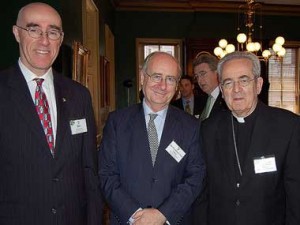
Chamber president Bill McLaughlin, left, Irish Ambassador Noel Fahy, and Philadelphia Cardinal Justin Rigali at the farewell luncheon for the ambassador at the Union League.

Chamber president Bill McLaughlin, left, Irish Ambassador Noel Fahy, and Philadelphia Cardinal Justin Rigali at the farewell luncheon for the ambassador at the Union League.

One thing he discovered about Americans in his five years as Irish ambassador to the United States, Noel Fahy told a group of Philadelphia business leaders last week, is that they’re doers, not whiners.

“In Europe, we see a problem and say, oh my, that’s a very big problem,” he told the delighted crowd at the Union League in Philadelphia. “Americans see a problem and they genuinely try to solve it.

“I know that America has been criticized about Iraq, but beyond that criticism, we still look at all the contributions the United States has made to the world, to Ireland.”

Technically, the luncheon given in his honor was a farewell party from the Irish-American Chamber and Business Network, a non-profit membership organization in Philadelphia that promotes the development of economic, commercial, financial and educational relationships between the United States and Ireland. Fahy was recently named Ireland’s ambassador to the Vatican. But in his goodbye speech, Fahy waxed more patriotic than many Americans about the place that was his home for half a decade.

“The US role in the new shared government in Northern Ireland was crucial,” he said. In fact, former US Senator George Mitchell received the Presidential Medal of Freedom in 1999 for the pivotal role he played in convincing Protestant and Catholic leaders to sign what is known as The Good Friday Accord, which paved the way for peace in the war-ravaged North.

“The US government and private American groups have contributed nearly $1 billion for reconciliation projects in Northern Ireland. President Clinton was there when we needed him, and in the run up to the final stages in March, President Bush did make some phone calls,” said Fahy.

As a parting gift, Chamber President Bill McLaughlin gave Fahy a bound copy of the manuscript of James Joyce’s “Ulysses” from the Rosenbach Museum in Philadelphia, which houses an original. Accepting the two-book set, Fahy joked, “I don’t know if I’ll have time in the Vatican to enjoy ‘Ulysses’ for the second time.”

History

Two Revolutionary Era Irishmen Remembered

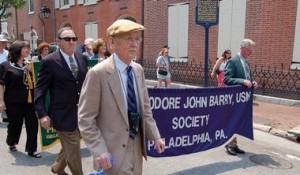
The Barry Society was well-represented.

The Barry Society was well-represented.

The doctor was concerned. The cop who pulled him over on 4th Street and told him he’d have to wait till the parade went by was reassuring. “Don’t worry,” he said. “It won’t take long.”

In fact, the parade, led by a handful of pipers from the Philadelphia Emerald Society, lasted less than 10 minutes, winding its way from Old St. Mary’s Church to the south side of Independence Hall where the statue of Commodore John Barry, father of the US Navy, stands perpetually pointing to some distant place.

But it was long enough to attract the attention of Memorial Day patriots exploring the cradle of American democracy, many of whom lingered around the statue to listen to speaker after speaker teach a history lesson about a man of heroic proportion in life who is spectacularly little known in death.

The son of an Irish farmer, John Barry captured the first ship during the American Revolution and fought its final sea battle. He couldn’t be bought: Although he went unpaid (by about $6,000) by the Continental Congress for his service, he turned down a financial offer from British Lord Howe to change sides. “Not the value or command of the whole British fleet,” Barry replied, “can lure me from the cause of my country which is liberty and freedom.”

As commander of naval operations for the new nation, he supervised the building of the American fleet.

But he wasn’t above using some cunning when ships weren’t available: On January 5, 1778, while the Delaware was occupied by the British fleet, Barry organized the famous Battle of the Kegs, in which small kegs loaded with explosives were sent floating down the river at the British ships and fired upon, exploding them and throwing the British into a panic.

That same cunning came into play on land too. In 1787, when a minority of federal convention members opposed to the new constitution decided to go into hiding to prevent the formation of a quorum, Barry organized a group called The Compellers and physically forced enough of the seceding members back to form a quorum. The vote was taken, and the constitution was finally approved.

In his private life, he and his second wife, Sarah, had no children, but happily adopted Barry’s two nephews after his sister died. He was active in the Friendly Sons of St. Patrick, the Hibernian Fire Company, and the Ancient Order of Hibernians. “He was a faith-filled person,” Father Ed Brady told the congregation at Old St. Mary’s Church on 4th Street. Barry and his family are buried in the churchyard, along with half a dozen other famous Revolutionary era heroes, including Col. George Meade.

The day–which commemorated the erection of the Barry statue by the Friendly Sons of St. Patrick 100 years ago–started with a Mass and a ceremony honoring not only Barry, but his contemporary, Matthew Carey, who, like Barry, was Irish-born (a Dubliner) and a Philadelphia transplant. Carey used money loaned to him by the Marquis de Lafayette to start a newspaper in the city and later published the first Catholic Bible in the new world.

Though Carey was buried at Old St. Mary’s, his body and gravestone were relocated by his family to Holy Sepulchre Cemetery in Cheltenham. Concerned about setting history aright, a local amateur Barry historian, John Barry Kelly, contacted John Houlihan of the Barry Club of Brooklyn to help bring back Carey’s memory to his not-so-final resting place. Houlihan, a native of Dublin like Carey, decided to contact the board of the Dublin Society of New York to “get the ball rolling” to erect another memorial, which was unveiled on Sunday. Irish Deputy Consul General Brendan O’Caollai, also a Dubliner, took part in the ceremony. A portrait of Carey will hang in the church, where the Founding Fathers met to pray on July 4, 1779, the third anniversary of the signing of the Declaration of Independence.

And on this Memorial Day weekend, with history hanging heavy in the humid air, it repeated itself. Ten-year-old Morgan Hepburn of Phoenixville, whose great-great aunt Elise Hazel Hepburn helped dedicate the Barry statue in 1907 on the south side of Independence Hall, laid a wreath at the memorial of their common ancestor.

Music

Orange, Green? Does It Make A Musical Difference?

The concert title is intriguing: The Orange and the Green: A Night of Traditional Music and Song from the North of Ireland.

Is there really a difference in Irish music if it’s sung by Catholics or Protestants in Northern Ireland, I asked Gary Hastings, one of the two performers (the other is singer Brian Mullen), who’ll be demonstrating those traditions on Friday, June 1 at the Irish Center in Philadelphia.

“It’s perceived by people both there and outside that there are two separate traditions, while really there are lots of very messy traditions,” says Hastings, who has played the flute on celebrated recordings by the Chieftains and Seamus Quinn, and shared the stage with DeDanaan. “People use music for their identity. It’s about who you are and where you come from. All traditional music has a political genre in it and Irish music is usually seen as a national thing. An Orange band is presumed to be different from a Green band. It’s not especially, but you can have the two bands playing the same tunes and thinking different words to them. And there are some tunes you don’t want to sing in the wrong place. For example, you don’t want to play ‘The Sash,’ anywhere but a Loyalist area.”

That’s the tune that starts, “Sure I’m an Ulster Orangeman,” a lyric that won’t have the bar patrons buying you a pint in Cork or Galway, but might keep your glass full at any pub in the Waterside section of Derry. “Play the wrong tune, sing the wrong lyric, in the wrong place, and you’re dead,” says Hastings.

I guess I must have been fooled by the images of Loyalist leader Ian Paisley and the Sinn Fein’s Martin McGuinness practically in each other’s arms–or, at least, sharing a laugh–as they took over the new power-sharing government of Northern Ireland a month ago. “It’s still like that?” I asked Hastings. “Aye,” he responded. “It hasn’t gone away.”

But don’t expect Friday’s concert to be freighted with politics. It’s music, says Hastings, and they’ll keep it fun and light, but informative. Hastings and Mullen, a Derry native and acclaimed singer who was Northern Ireland first full-time Irish language radio producer, are in the US to perform at the Library of Congress, which has been hosting a series of lectures by scholars and performances by well-known Northern Irish musicians and singer to build up to this summer’s Smithsonian Institution’s Folklife Festival. The festival is held every year for two weeks overlapping the Fourth of July on the National Mall in Washington, DC. This year’s theme is Northern Ireland.

I caught up with Hastings not long ago in his rectory–in his other life, he’s archdeacon at Holy Trinity Church, Church of Ireland, Westport, County Mayo –as he was preparing for a wedding.

Which came first, the flute or the ministry?

The flute. I’m an ordained flute player, not the other way around. I’m only 14 years ordained; I’ve been playing for a long time before.

How did you wind up playing the flute? Was your family musical?

Not especially. I grew up in East Belfast and music was big thing in Belfast anyway. I started on tin whistle so the flute was sort of a natural progression. I learned the Scots pipes when I was 11 or 12. When I went to university–that would have been around 1974-5–it was the start of the folk revival here in Ireland, so it was fashionable at that stage to play. Over the years, I played with different groups like De Naanan at one stage, did a CD with The Chieftains, but never intentionally. I was asked to do it for the craic. It rarely involved any worthwhile amount of money.

How do you “unintentionally” wind up playing with some of the biggest names in Irish traditional music?

I attended Coleraine University County Derry where I met Brian Mullen, Ciaran Curran from Altan, Cathal McConnel of the Boys of the Lough, and Father Seamus Quinn, who was in the same class as me at university. A wave of good musicians passed through all within a few years of each other. People used to come from all over to play tunes with us.

That must have been an incredible experience.

It was, though it was very bad for your liver.

You were teaching Irish studies when you seem to have gotten “The Call.’ How did you wind up a minister?

It wasn’t money either. Another dream shattered. It was just one of those things, a notion that I heard in my head that I knew I would have to do something about someday. Then one day it made more sense.

How’s it working out?

So far so good.

You can hear the Reverend Gary Hastings and his friend, Brian Mullen, performing at The Irish Center, Emlen and Carpenter Streets, Philadelphia, on Friday, June 1, at 8 PM. Tickets are $12, $10 for Philadelphia Ceili Group members.

History

Commodore Barry: More Than Just a Bridge

He stood about 6’4”, had a square jaw, and a good sense of humor. During the American revolution, Commodore John Barry was hailed by British frigates as he sailed into the West Indies. When they questioned him about the name of his ship and its captain, he quipped, “The United States ship, Alliance, saucy Jack Barry, half Irishman, half Yankee—who are you?”

Just like an Irishman—answering a question with a question (and some sarcasm thrown in there for good measure).

Though to most Philadelphians, Commodore Barry is just a bridge crossing the Delaware, the man for whom the span is named was a superhero of his day. The County Wexford-born son of a subsistence farmer and an émigré to Philadelphia was tapped by the Continental Congress to launch the new nation’s Navy. “Saucy Jack Barry” (better known to others as “Big John Barry” because of his imposing height) took over the merchant ships Congress acquired in 1775 and fitted them as vessels of war. The British were better equipped and more experienced, but Barry had Irish cunning on his side. After several of his ships were lost to the enemy, Barry turned to small craft that allowed him to sneak up on the British and capture their store ships, intercepting needed supplies.

“In the middle of winter, he attacked the British in the lower Delaware with a bunch of rowboats he commandeered from various vessels,” explains John Barry Kelly, a Drexel Hill man who shares a family tree with the naval hero. “He was very daring and aggressive, unfazed by adverse odds. He once successfully fought a frigate (ironclad war ship) and ship of the line (a large, powerful battleship) simultaneously off the coast of Maine.”

While John Paul Jones (“I have not yet begun to fight”) eventually became more famous for his own daring exploits against the British in their own waters, Barry kept his eye on the U.S. East Coast, traveling from Newfoundland to the Florida Keys, engaging the enemy whenever he encountered them. “His celebrity came when brought the first captured British ship into Philadelphia harbor in 1776, the early part of the revolution, which was a source of pride to new Americans,” says Kelly, who works for Independence National Historical Park just a couple of blocks from the statue of his famous relative. (It’s on the south corner of Independence Hall.)

Barry also captured two British ships after being severely wounded in battle. (In a show a gallantry, he returned the surviving British commander’s sword. “I return it to you, Sir,” Barry said after meeting the commander in his cabin, where he was recovering from his injuries. “You have merited it, and your King ought to give you a better ship. Here is my cabin, at your service. Use it as your own.”)

“In the 18th century, he was known as top-notch mariner apart from his military activity,” says Kelly. “He set a speed record never duplicated in 18th century. By dead reckoning, he was able to traverse 237 miles in 24 hours, which had never been done. He was also quite composed in dire circumstances. For example, when taking American ministers to Europe, a terrible storm blew up, and he was able to maintain control of the ship. [Founding father] Thomas Paine commented on how well he handled the vessel. He seemed to have great ability to handle crises.” And he had plenty of them. By the time the battle for independence was won, Barry had put down three mutinies, captured more than 20 ships, and fought the last naval battle of the American Revolution aboard his frigate, Alliance, in 1783.

On Sunday, May 27, the Friendly Sons of St. Patrick (a local organization of which Barry was a member), honored this amazing Revolutionary War hero in a day-long ceremony, starting with a commemorative mass at 11:30 a.m. at Old St. Mary’s Church—Barry’s parish church and where he was buried in 1803, at the age of only 58. After a wreath-laying, representatives of the Friendly Sons, the Ancient Order of Hibernians, the Commodore Barry Club of Philadelphia (The Irish Center) and the Barry Club of Brooklyn and others processed to Independence Hall where a statue of Barry stands, his right arm pointing into the distance. A reception and luncheon followed at the Commodore Barry Club in the Mount Airy section of the city.

For those who took part, it was a great opportunity to get to know a local Irish-American hero. And they’ll never look at that bridge the same way again.Read a history of Commodore John Barry by John Barry Kelly at www.ushistory.org/people/commodorebarry.htm

People

Meet the New Mary from Dungloe

Meagan McGough

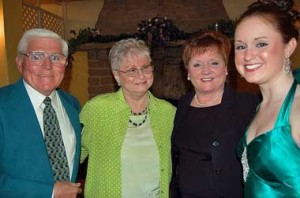
The new Mary of Dungloe, Meagan McGough, takes some time with her family: grandfather Ed Brennan, grandmother Dolores Brennan, and her mother, Barbara McGough.

The latest Philadelphia Mary from Dungloe knows how to get to Carnegie Hall. Meagan McGough performed there for five years and discovered, as the old joke goes, the secret is to “practice, practice, practice.”

From the time she was 10 till she was 15, this award-winning Irish step dancer and her parents, John and Barbara, traveled to the Bronx every Sunday after church–four hours up, four hours back from their home in Downingtown– where she would rehearse the routine she performed in an annual show with the late Irish tenor Frank Patterson.

Ranked third nationally among US step dancers, Meagan, who performs with the DeNogla School in Verona, NJ, came in third place at the All-Ireland Championships two years ago–on her 18th birthday. “It’s always the beginning of July so I’m always dancing on my birthday, which is July 6” she laughs. “I guess it’s good luck.”

But her luck hasn’t always been “of the Irish.” She excels in an art form where you break bones almost as often as a linebacker. Meagan has fractured her foot three times since she started dancing at the age of 5. “It’s always been my left foot too,” she says with a wince. “I even danced at the world championships with a broken foot. I just kept wrapping it and taking Vioxx. I broke it the week before the competition and I figured the ticket was booked, the hotel was paid for, and I was going to go. I made it to the last eight bars of the song and didn’t stop but I definitely made a mistake. At World you have to be flawless, the best of the best. Afterwards, I put a cast on my foot.”

Which tells you a lot about Meagan McGough. Challenge? Bring it on! A marketing major at Fordham University, Meagan took a summer job last year that’s sent her in another career direction, one not for the faint of heart. “I got a call over Easter break from an oral surgeon at last year from The Main Line Oral and Facial Surgery Center in Exton,” she explains. “I thought I was going in to interview for a receptionists’ job. I always had interest in the sciences and those gory things, and thought this is so cool. “

It got cooler. They didn’t want her to be their receptionist. They wanted to offer her a surgical assistant internship. She wouldn’t be answering the phones. She’d be assisting in oral surgery–doing suction, helping with IVs, suturing, administering medication. “I thought I’d be wearing suits every day,” she laughs. “Instead, I was wearing scrubs and masks. I loved it. In fact the experience inspired me to go on the medical track at Fordham and go to medical school one day.”

But she didn’t want to give up her marketing major. So she went to the dean of the business school and worked out a plan that allows her to pursue her business degree with a minor in science. “Instead of taking the liberal arts or fun courses in addition to the business classes, I’m on the premedical track which is more challenging than the core courses. When I’m a senior I’ll have most of the prerequisites I need for medical school, though I may have to take summer classes.”

There’s a method to this madness. She thinks her marketing skills will marry well with her medical skills if she’s able to work with Operation Smile, a nonprofit, volunteer organization that provides medical treatment to children in Third World countries born with facial deformities, like cleft lips, that often leave them ostracized in their communities. Its secondary mission: to raise awareness–and money. Irish actress Roma Downey is the international spokesperson for the organization. “I’m going to be interning again this summer and with that extra experience I can apply to work with them next year,” says Meagan.

And in the middle of all this, she’ll be competing in Ireland at the end of July into early August in the International Mary from Dungloe pageant in Donegal. She hadn’t even considered entering the local competition, which is sponsored by the Donegal Association of Philadelphia. The free trip to Ireland? She’s been traveling to Ireland since she was very young, mainly with her maternal grandparents, Ed and Dolores Brennan of New Jersey, who paid for her step dancing lessons and chaperoned her to international competitions. In fact, it wouldn’t have occurred to her to enter if a Donegal Association member hadn’t approached her on St. Patrick’s Day, after she’d done an impromptu “Irish dance battle” with a six-year-old boy during her family celebration at The Plough and the Stars in Philadelphia. (No doubt dazzled by this redhead with flawless skin and sparkling dark eyes who can dance the heck out of a jig.)

“Grace Flanagan, the sister of Theresa Flanagan Murtagh who is the president of the Donegal Association, came up to me and asked me if I’d be interested in entering,” says Meagan. “So my Dad and I went down to the Irish Center and I applied. I really didn’t expect to win. They were all incredible girls. But I’m really excited. I’ve never done a pageant before and even though I’ve been to Ireland so many times, I’m excited about experiencing a whole different aspect of the culture. When you’re dancing in competition, any spare time you have you’re practicing. ”

It won’t be her only trip either. She’ll be competing at the 38th World Irish Championship in Belfast over Easter break in 2008, but for the last time. (The World Championships come to Philadelphia the following year.) “After this World, I’m hanging up my shoes,” she says. “I’m getting certified as a teacher, and as successful as I’ve been as a dancer, I think I’ll be an excellent coach. In fact, I might even be a better coach.”

She’s already the mentor of a younger dancer whose dream was to place in the Irish nationals. “I worked hard with her and she placed 35th, which is a huge deal for her,” says Meagan. “I’m finding it more rewarding to work with kids and see them grow as individuals and see them win. I’ve learned to love the spotlight. Now I’m learning to love the behind the scenes stuff. But this is my last year in the spotlight.” She grins. “I guess I’m going out with a bang.”

Check out Meagan’s competition at the recent Mary from Dungloe Pageant held at the Irish Center.