All Posts By

Denise Foley

News

A Day of Ceremonies

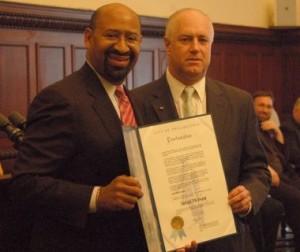
Mayor Michael Nutter and Parade Director Michael Bradley.

Mayor Michael Nutter and Parade Director Michael Bradley.

For the day, said Philadelphia’s mayor of less than two months, he would be known as “Micheal (pronounced Mee-hawl) O’Nutter.” He got an appreciative laugh from the nearly 100 people who filled the richly decorated meeting room at City Hall after the annual wreath-laying ceremony by the Friendly Sons of St. Patrick on Thursday, March 6.

The Friendly Sons—an organization that pre-dates the signing of the Declaration of Independence by 5 years—honors Philadelphia’s Irish past where Philadelphia itself honors it: beneath a plaque erected on the west side of City Hall that contains the names of prominent Irish Philadelphians of the past.

Mayor Michael Nutter seemed to enjoy the event, which brought pipers and Irish dancers to the heart of city government for an hour. He grinned broadly as Rosemarie Timoney’s step dancers jigged across the navy and gold carpet in front of him, and later singled out the one young boy in the troupe. He didn’t say it, but it sounded like it was for his bravery. Irish Center President Vince Gallagher sang the national anthem, and Karen Boyce, whose parents, Barney and Carmel, are part of the St. Patrick’s Day parade’s Ring of Honor, sang the Irish national anthem in both English and Irish. The events at City Hall were followed by a luncheon at the DoubleTree Hotel on Broad Street to recognize the parade’s 2008 Grand Marshal, former restaurateur Jack McNamee, and those named to this year’s Ring of Honor.

Genealogy

The Lazy Person’s Guide to Genealogy

I like to say that I compiled my family tree without ever leaving my chair. Not quite true, but close. I’ve been extraordinarily lucky using the Web to find my ancestors, and not because I’ve become some genealogical e-virtuoso.

As my Aunt Mary used to say about catching a husband, “You have to put yourself out there.” I put myself out there and was rewarded richly: Using clues I found on the Web, I connected to a cousin I didn’t know I had, and her research led me to relatives in Ireland. Then, after several years of relentless posting on site after site, I heard from an in-law of a distant cousin who had already done what I was trying to do: traced my Foley ancestors back to the early 1800s in Newfoundland, Canada.

When I first hooked up to the Internet back in the mid-90s, one of the first things I did was start posting as much information as I had on both sides of my family on every genealogical site I could find. I decided to focus on the Hearys, my mother’s Philadelphia family, because I knew more about them and thought the unusual name might attract attention. I was right.

One day, shortly after my first round of posting, I got an e-mail from a woman in North Jersey who wondered if the Cornelius Heary mentioned in a 1955 note to her grandmother from her grandmother’s uncle, John McDevitt, might be one of my Hearys. I was shaking with excitement as I typed my reply, “That’s my grandfather!”

As it turned out, our great-grandparents were siblings. Her great-grandfather was William McDevitt, and my great-grandmother was his sister, Mary McDevitt Heary. Fortunately for me, her family was more sentimental than mine—they actually kept things like photos and family documents—so she had her great-grandfather’s baptismal certificate that listed the place where he was baptized (Culdaff, County Donegal) and his parents’ names, Cornelius and Grace McDaid (the alternate spelling of McDevitt).

Another Internet find—a woman who sent me photos of all the McDaid graves in a churchyard near the town—suggested that there were family members still living in the Culdaff area. One picture showed fresh flowers on the grave of Edward McDaid, another of my great-grandmother’s siblings.

I knew the rest of the story wasn’t going to come to me over the Internet. In 2000, to celebrate a big birthday (mine), my husband, 13-year-old son, and I went to Culdaff, on the Inishowen Peninsula. It didn’t take a lot of legwork—just asking some questions at the local post office the night we arrived—and I located my great-grandmother’s niece, Grace McDaid Doherty, who was living in the same house where my great-great grandparents raised their nine children.

Though it sounds effortless, my family search took many years and some creative Googling. And it hasn’t always been fruitful. I still haven’t been able to trace my Heary ancestors back to Ireland—though, thanks to a directory I found on Ancestry.com, I know my great-grandfather Matthew operated a bakery on Haines Street in Germantown in the 1890s. And while my Canadian cousin’s wonderful sister-in-law traced the Foleys back to the early 1800s, I don’t know where in Ireland they came from either. But thanks to some persistent Canadian transcribers who have been posting birth, marriage, and death records online for years, I do know that my great-great grandfather Michael died a centenarian (a really big birthday!) I’ve even been offered a house to stay in if I ever get back to Newfoundland—by a total stranger from the Midwest who bought the house from one of my cousins. I met him … on the internet.

The Web is a great place to take your second step towards uncovering your roots. (Your first is to pry every last bit of information out of your family members). Though there will always be legwork, if you’re as lucky as I was, you might connect to a long-lost cousin in a far-off place who is waaaay ahead of you.

Best Web Resources

www.corkancestors.com

Pop on Over to This Cork Resource

Here’s a real find if your people are from Cork: city directories from the 1700s, names and photos of Corkmen in World War I and at Gallipoli, a list of surnames from the Presbyterian Meeting House, and transcriptions as well as actual clips from local newspapers, all lovingly preserved by the generous Jean Prendergast. Made me wish that Pearce Foley, ostrich and fancy feather maker, on Fish-Shamble-Lane, was one of mine. If your family is from Cork, this is a must-see. There are some wonderful etchings reproduced on the site that give you a flavor of the past and a gripping account—from the actual newspaper—of the Fenian uprising in Cork in 1866-67. With names!

www.ulsterancestry.com

Is Your Family From Ulster?

They are if they come from the counties of Antrim, Armagh, Cavan, Donegal, Down, Fermanagh, Londonderry, Monaghan, or Tyrone (six of those in Northern Ireland, three part of the Republic). And, unless your family emigrated from Cavan and Monaghan, you might find some great information at this site—everything from a list of 18th century “vagabonds” to passenger lists of ships headed for Philadelphia and elsewhere in the US. Some of the records are quite old—from the early 1600s, God bless those transcribers. If you find anything pertinent that old you surely have the luck of the Irish because most records stop somewhere mid-19th century.

One must-see: the Irish surnames lists where you can learn, for example, that the name “Bunyan,” as in Paul, comes from Bunnon, which in turn derives from a word meaning “lump of dough.” Generally that referred to an occupation (in this case, baker), not a person’s general temperament or appearance. If you’re a Bell—a common name in Tyrone—you can feel proud that you were part of “an uruly clan” driven out of its Scottish border home by James I. There’s also a great list of Irish family names from the 1600s which includes non-Ulster names as well. Click on “Old Irish Names History” and translate your name into old Irish. Foley, for example, is either O’Fodhladha or O’Fuala. I’ve heard it pronounced “Fow-loo.”

Other freebies worth grabbing: Ulster maps and Irish e-cards. There’s also a free newsletter, genealogy forum, and a great piece on Ulster-Scots who emigrated to Pennsylvania. For a fee (from about $52 to $315), Ulster Ancestry will search the records for your family and produce a report. You can also buy certain records, such as marriage, birth, and death certificates, and the usual tithe and valuations books. But you need accurate information: They won’t do “wild card” searches.

Death, Where Is Thy Record?

If you’re just starting to track down your ancestors, as one of your first stops you’ll want to visit the Social Security Death Index. One of the better search engines is on Rootsweb. You’ll be poking through more than 75 million records, and that’s just for people who died since 1962. It’s a good place to find birth and death dates, maiden names, where your ancestor lived when he got his Social Security card, where he lived when he died (both of these residences are listed by zipcode), and where his lump sum benefit (for burial) was sent. If you find something, it’s a great site. But it can be frustrating: Not everyone is listed, even those who had Social Security numbers and died after 1962. Rootsweb has a great tutorial for newbies. Check it out before you check out the index.

Roots.Net Cousin Calculator

First Cousin, Twice Removed … from Where?

Possibly the most confusing thing about ancestor-hunting is figuring out how you’re related to your great-great grandmother’s granddaughter. (I mean, if she’s not your grandmother.) Most cousin charts are too much like the math portion of the SATs for me. But I found one I like (and can understand). You can actually download it so you can use it when you need to know how you and your great grand-uncle Eddie’s daughter are related. You just type in your common ancestor, list the daughter’s relationship to the ancestor, and then your relationship: Et voilà! Discover that she’s your first cousin, twice removed—a blood relative, but not so close you could give her a kidney if she needed it.

U.S. Railroad Retirement Board

Got the Disappearing Railroad Worker Blues?

If your ancestor worked for the railroad after 1936 and covered under the Railroad Retirement Act, you may be able to find out more about them from the U.S. Railroad Retirement Board. It helps if you know your ancestor’s Social Security number, but it’s not necessary. You should have the full name, including middle name or initial, and complete dates of birth and death. For a nonrefundable fee of $27, the RBR will search its records.

www.familysearch.org/

The Church of Jesus Christ of Latter Day Saints—you know them as the Mormons—have what may be the largest collection of free records available in the US today. They operate hundreds of Family History Centers throughout the country where you can look at records, most of them on microfilm. Their interest in ancestor hunting is, well, a kind of post-mortem proselytizing (they explain it on the site), but even if you don’t want your great-great-grandmother to be a Mormon, you can benefit from their work. Type in your ancestor’s name on the home page form and it will take you to all sorts of records. Confused? The little lady at the bottom of the site home page asks you to click on her link—she’s your research assistant who will guide you through the search.

You can find your local FHS here, talk to other ancestor hunters, and download free geneaology software. Their geneaology primers are first rate. They even have Canadian records. I’ve used the Philadelphia FHS for research and found the volunteers extremely helpful and knowledgeable. If they don’t have the records you want in the office, they’ll get them for you. And there are always other, more savvy amateur genealogists there to help you out if you’re a newbie.The Philly office is located at 2076 Red Lion Road. Phone: (215) 673-2770. It’s not a 9-to-5 kind of place. At this writing, hours are Wednesday, 9 a.m. to 3 p.m.; Thursday 6 p.m. to 9 p.m., and Saturday, 9 a.m. to 2 pm. Call first to make sure the hours haven’t changed.

Genuki

Contains a “virtual reference library” of information to help you get started digging up your Irish family roots. You probably won’t find your ancestors anywhere on this site, but you’ll get most of the information you need to start making connections.

Rootsweb and Rootsweb Mailing Lists

Rootsweb is an invaluable resource in your search. Many a match has been made on Rootsweb mailing lists (click on the second URL). Trust me, you could find a cousin. I did. The lists are both general and unbelievably specific. For example, if your ancestor was a coal miner, as was my husband’s, you can find a mailing list for miners’ descendants. There’s a list for cemetery groupies (actually very helpful, since many of them transcribe headstones and share their information), convicts, specific Irish counties and cities, and American locales, including Philadelphia. Rootsweb also has surname mailing lists, so you can connect to all the enquiring Rooneys or McDevitts out there. And don’t forget to post, post, post. Rootsweb has message boards for surnames, states, counties, and countries.

Cyndi’s List

A few years ago, Cyndi Howell started building a Web page of genealogy resources and today there are more than a quarter million links on what may be the largest one-stop shopping site for amateur genealogists on the Web. The Ireland section is vast, with 1,869 links. Through this portal, I found what may be my great-great-great grandfather listed in a tithe applotment (a kind of tax on farmland) book for Culdaff, County Donegal, in 1829, eliminating my need to visit the National Archives in Dublin for the information.

US GenWeb

Maintained by a great group of volunteers dedicated to keeping genealogy free on the Web (frequently it isn’t), this site provides free sites for every county and state in the U.S. This is where you go when you want to find, say, your great-Aunt Agnes’s obituary from Carbon County.

Access Genealogy

While I couldn’t find anything about my family here, largely because of the eclectic nature of the information, you can download free genealogy and family tree charts, a research log, a family group chart so you can organize the information you find here or, more likely, elsewhere.

Ancestry

For serious chair-bound genealogy buffs only: It costs anywhere from $14.95 to $34.95 a month to access most of the databases on this site, which also owns the freebie site, rootsweb.com. It’s worth it if you root around in your very spare, spare time and can’t do the legwork—check the archives, go to the Family History Center, spend a few days in the library—you need to get the kind of information you want. I found access to city directories helpful, though they’re located at the Philadelphia City Archives.

Ellis Island Foundation

If your family arrived via ship at Ellis Island in 1892 or thereafter, you may be able to find a record at this site. The first passenger registered through the immigration station when it opened January 1, 1892, was a 14-year-old Irish girl, Annie Moore, who had traveled from Queenstown, County Cork, with her two brothers, to reunite with their parents who were already living in New York. I found my great-great Uncle John on this site—the record gave me his age and his occupation (laborer) when he arrived in 1897. For a fee, you can also order a copy of the ship’s log where your ancestor appears.

Philadelphia City Archives

Do yourself a favor. Check out this guide to the Philadelphia archives before you get into your car to drive downtown. Depending on where and when your ancestor was born, married, bought or sold a house, was naturalized, lived in Philadelphia, and died, the records may be at the Archives at 3101 Market Street (Suite 150) or available in another office or by mail from the state. This site will help you figure that out.

Pennsylvania State Archives

A number of military records are searchable online (if you’re looking for the elusive Spanish-American war vet or World War I medal winner). So far the state has posted about 1.5 million records and there are more to come. This is also where to find out how to get state records (not to mention what records the state holds). It’s important to explore this site when looking for your Pennsy ancestors. Some records, such as birth and death certificates, are held in different places, depending on dates. For example, if your ancestor was born or died between 1893 and 1906, those records are at their county courthouse (a hot link on the site will take you to addresses and phone numbers for every county courthouse in the state). Records from 1906 and afterwards are available from the state’s division of vital records (you’ll learn how to contact them on the site).

National Archives, Regional

The Web site of the Philadelphia regional branch of the National Archives will provide you with information on periodic workshops, including some on Irish genealogy, that are available for free (though a donation is a nice idea). The site isn’t searchable, but will tell you what federal records are available (such as censuses, ship passenger lists, naturalizations, military information etc) and how to access them. To view some records, you need to register as a NARA researcher, which isn’t a big deal. Read the FAQs on the site and check the hours before you head down there.

19th Century Immigrant Roots: Record for Wilmington, DE, USA, and Vicinity

A real find for those whose ancestors lived in Delaware or nearby. More than 30 volunteer transcribers have posted Catholic sacramental records, city directories, census reports, gravestone inscriptions, passenger lists for ships arriving from Londonderry into New Castle in the years 1831-1841—and much, much more. You’ll also find ship passenger lists from 1846-1851 from Galway to New York, the Griffiths Valuation of Tenements in Ireland 1855-185, and the 1901 Census of Ireland returns. And they’re still transcribing! The Catholic Diocese of Wilmington (and its archivist Donn Devine) worked with the Wilmington Irish group to provide such genealogical bounty.

Delaware Public Archives

You can search probate records and a limited number of naturalizations online (they’re listed alphabetically), as well as use the search engine to find out what records are available and, best of all, how and where to get them.

Under “Services,” click on “Public/Finding Aids” and go to it. DAP also holds workshops to help you find your way through the confusing world of ancestor tracing. Check the events calendar frequently and read the FAQs.

The Genealogical Society of New Jersey

Call them the Tombstone Raiders. This group was started in the 1920s as a regular “tombstone hunt” among Jersey’s graveyards. Nothing ghoulish—just genealogy. It’s still an active group, but now they’ve put their focus on education. There are two lecture series coming up. “Exploring Your New Jersey Roots III,” co-sponsored with the New Jersey State Archives, will run every Wednesday from April 26 to May 24, 2006. The all-day 2006 Spring Genealogical Program, also co-sponsored with the New Jersey State Archives, is on Saturday, June 3, 2006, at New Jersey State Museum Auditorium, 225 West State Street, Trenton, NJ. The Web site contains a list of the substantial number of records the society holds. They are being housed at the Alexander Library, 169 College Avenue, Rutgers University, New Brunswick, N.J. You can also find a professional genealogist on the site.

The New Jersey State Archives

Like most archive Web sites, this one will tell you what state records are available—and how to get them. It’s about to go searchable with marriages (1848-1867), Civil War payment vouchers (1861-1866); East Jersey Proprietors Loose Surveys (1786-1951) and name-change judgments (1876-1947). Stay tuned! In the meantime, for a fee, you can have a state employee do a search for you from certain records.

National Archives of Ireland

This is your Web portal to Ireland’s National Archives. While it’s not searchable, it’s vital to read before you travel to Ireland to do your digging. You can find out, for instance, what Tithe Applotment books are and why they’re so important to you. (Hint: because of the dearth of old records in Ireland, they may be the only place you’ll find your pre-1840s ancestors.)

Directory of Irish Genealogy

An online Directory of Irish Genealogy is a valuable tool for family history newbies, full of basic information you need to know before you start your search.

Newfoundland’s Grand Banks Genealogy Site

This is the extraordinary Newfoundland’s Grand Banks Genealogy Site which has some of the most elaborate free records available on the Web, from cemetery headstones (with pictures) to voters’ lists. If your Irish ancestors came to Philly via Newfoundland, as mine did, you’re sure to find some record of them here.

Donegal Genealogical Resources

These pages on Rootsweb are the work of New Zealander Lindel Buckley who is a tireless and remarkably generous amateur genealogist who has transcribed and posted dozens and dozens of records from around this county, where many Philadelphians can trace their roots. There is no better resource on Donegal than this one.

County Mayo Genealogy

Another Irish county that donated many of its able-bodied to Philadelphia, Mayo is covered from A to Z on this free Web site which contains a surname registry as well as church, land, civil and census records. It is updated monthly.

Food & Drink

No Potatoes Were Injured in the Making of this Candy

Despite the name, Irish potatoes aren’t Irish and they aren’t potatoes. They’re a candy made from cream cheese, butter, confectioners’ sugar, coconut, vanilla, a little milk or cream, rolled into potato shapes and covered in cinnamon. If you rolled them into egg shape, you’d have Easter candy. The taste is similar if not downright the same.

Some people think they were made to commemorate the Irish potato famine. The truth is, no one really knows. I’d like to think that a bunch of confectioners (maybe even my great-grandfather, who had a confectioners’ shop on Haines Street in Germantown in 1890) were goofing off one day, tossing some buttercream around, when someone accidently dropped it in a vat of cinnamon and uttered some Irish variant of “Eureka!” and noted, “This looks like a patayta!” (That’s the Irish Germantown way of saying spud.)

Asher’s Chocolates and Oh Ryan’s, both Philly companies, make most of the Irish potatoes available commercially in the city.

For those of you watching your waistline, one potato is about 60 calories. Betcha can’t eat just one.

If you’d like to make your own, check out our darling friend, Agnes McCafferty’s recipe.

  • 2 boxes 10-X powdered sugar
  • 8 ounces coconut
  • 8 ounces cream cheese
  • 1 tablespoon cream
  • Powder cinnamon
Use the cream cheese at room temperature, mash and slowly add the 10-X sugar, coconut and cream.  When well mixed, form into oval shaped balls.  Roll the balls in cinnamon.
Food & Drink

Okay Ladies, Let’s Roll

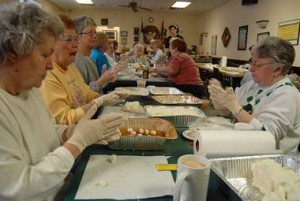
The ladies at my table, from left, Anne Marie Carr-Hanson, Dolores Stevenson, Mary Jane Haughley Hayes and Ellie Zimmerman.

The ladies at my table, from left, Anne Marie Carr-Hanson, Dolores Stevenson, Mary Jane Haughley Hayes and Ellie Zimmerman.

Every year, the women of the Ladies Ancient Order of Hibernians (LAOH) in Philly make a ton of Irish potatoes.

And in one case, we’re talking literally here. Two thousand pounds of sugary, cinnamon-dusted candy that’s so sweet it makes your teeth hurt and weighs enough to balance a giant scale with a VW Beetle on the other side.

And last weekend, I was rolling balls with the ladies of Divisions 1 (Daughters of Erin, Center City) and 87 (Our Lady of Knock, Port Richmond) at AOH Div. 87’s Hall in Port Richmond, trying to help them reach their appointed tonnage. Just so you know, I’m not trying to be cute—“rolling balls” is the official terminology of Irish potato production in Philadelphia, where the candies originated. At least, that’s what I garnered sitting at a table with six LAOHers whose hands were a blur of activity.

“You gotta keep your balls small,” advised Ellie Zimmerman as she took a pinch of “dough” and started rolling it in her palm. “Or else you’ll get in trouble.”

What kind of trouble I found out rather quickly, when Donna Donnelly of Bridesburg, apparently head of the LAOH Irish Potato Rolling Weights and Measures department, got into it playfully with my table mate, Anne Marie Carr-Hanson. “Ladies,” she announced, after Anne Marie turned in an Irish potato that Donna thought was the size of a Quarter-Pounder, “we’re making our balls too big here. Some people are only going to get six Irish potatoes to the pound.” She hoisted another one from the filled aluminum trays that half a dozen runners were carrying to her from the tables. “We could feed a family of four on this!”

Anne Marie stared at her deadpan, then quickly popped the offending Irish potato in her mouth. “That’s what we do with the big ones,” she explained. “Or else we hide them from Donna.”

“We call her the ‘ball Nazi,’” piped up Ellie Zimmerman with a laugh.

Not only is it all in good fun, but it’s all in a good cause. These women, who often take whole-day shifts, produced enough Irish potatoes last year to give away $5,000 to charity. This year, they hope to earn even more for their ton of candy, which they sell—and by now, have sold out—for only $5 a pound.

“We give money to places like Providence House, which is a shelter for abused families, and the Philadelphia Veteran’s Multi-Service Center,” explained Maria Gallagher, president of LAOH Div. 87. “The rest we give away in smaller amounts, $100 here, $100 there, usually to special projects that come from the ladies who spend so much time here. How can you say no to people who come out two or three days to do this?”

Gallagher herself has been in the seasonal Irish potato business for a decade. She and Donnelly purchase the raw materials from Shamrock Foods (yes, that confectioners’ sugar, coconut, and cream cheese are 100% Irish-American), then combine all the ingredients in an industrial mixer that was donated anonymously. It lives in a small shed, built specially for it by Home Depot, next to the AOH Hall. It’s not heated, so “fold in ingredients” is one of the more uncomfortable directions in the LAOH recipe.

Divisions 1 and 87 aren’t the only LAOHs in the Delaware Valley rolling candy for charity in the weeks leading up to March. So are Divisions 13, 39, 61, 33, and 88. Division 25 makes a scone mix, which doesn’t sound nearly as fun to do. I mean, how do you throw scone mix at someone who’s ticked you off? While I was there, Donna Donnelly dealt with harassment from one table by pitching an extra-large Irish potato at them. This is my kind of charity.

“There’s a lot of camaraderie here,” says Maria Gallagher with a smile. “This is not just a fundraiser. People are making new friends. It’s a lot of work,” she said, wiping her cheek with a cinnamon-dusted hand, ”but it’s a lot of fun.”

News

Philly’s Parade Celebrations Officially Start

Rince Ri Dancers

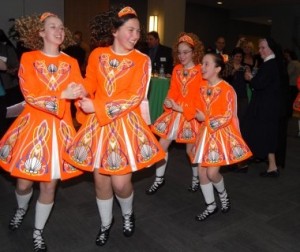
The Rince Ri dancers of Upper Southampton join Sister James Anne Feerick, a parade honoree and an Irish dance teacher, in a turn around the dance floor.

The event was a pre-St. Patrick’s Day Parade kick-off, mingling parade coordinators, this year’s honorees and their families, local Irish notables, and the staff of CBS3, which broadcasts the event every year. It was held at the new CBS3 studios on Spring Garden Street on Thursday night, February 21, and was lavish with food, drink, and music.

But what most people took away from the evening was a story told by the Irish Society’s Edward Costello, one of the 20 honorees of the 2008 parade. It was about “a kid from Fishtown” named George Costello, who was Grand Marshal of the parade in 1992. Ed’s father. And it was a poignant reminder that sometimes a parade isn’t just a raucous collection of marchers, floats, and music. Sometimes, it’s somebody’s dream.

“Two days before the parade, we were at Penn with him and the doctors told us he did not have much time to live,” Costello told the rapt crowd of more than 100. “George being George, he told me, Ed, take care of the family. And then he asked the doctor, ‘so how can I get out of here?’ The doctor said, ‘George, you’re a sick man, you can’t leave.’ And George being George, he said, ‘I’m just a kid from Fishtown, and all I ever wanted to do is be the Grand Marshal of the St. Patrick’s Day Parade. So I need to get out of here.’” Fortunately, his doctors were Irish “so we got George out.”

His father promised to take it easy, but George being George, he spent the entire parade “standing next to Cardinal Bevilaqua and tipping his hat to every organization that went by.” At the end of the parade, he turned to his son. “Ed,” he said, “it’s time to take me back. I promised the doctors I’d be back and I’m a man of my word. It’s been a grand day. I wish it would never end.’”

“Two weeks later, he died,” said Costello. “But there wasn’t a happier kid from Fishtown.”

Along with Costello, honorees this year include Donegal Association Chaplain Father Joseph McLoone, St. Malachy’s pastor and poet Father John McNamee, teacher Sister James Ann Feerick I.H.M., Justice Seamus McCaffery, the Donegal Association and parade committee’s Kathy McGee Burns, Perry Casciato of CBS3, The Irish Immigration Center’s Tom Conaghan, Finnigan’s Wake owner Mike Driscoll, Hibernian Hunger Project founder Bob Gessler, and three couples recognized for their many contributions to the Irish community, Barney and Carmel Boyce, Michael and Jeannie O’Neill, and James J. and Megan White IV.

Lifetime achievement awards are going to Edward Kelly and John Stanton, and special posthumous honors are being award to two Philadelphia police officers killed in the line of duty: Gary Skerski and Charles “Chuck” Cassidy.

Grand Marshal is Jack McNamee, a 30-year board member, past president and past treasurer of the Philadelphia St. Patrick’s Day Observance Association.

The parade is scheduled for Sunday, March 9. It will be aired from noon to 3:30 PM on CBS3 and live on the CBS3 home page at www.cbs3.com. It will be replayed on CW Philly 57 on March 17—the real St. Patrick’s Day—from 11 AM to 2:30 PM.

Food & Drink

Irish Coffee Rivalry Brewing at AOH Division 1

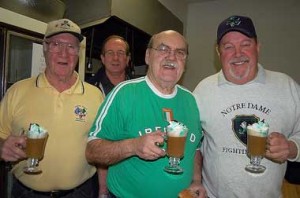
The 2007 judges: from left, Jack Brennan, Ed Halligan, Seamus Dougherty, and Verne Leedom.

The 2007 judges: from left, Jack Brennan, Ed Halligan, Seamus Dougherty, and Verne Leedom.

Who makes the most bracing brew of all?

Our friends at AOH Notre Dame Division No. 1 will put it to the test Thursday, March 13, in the club’s Annual Irish Coffee contest. The event kicks off at 7 p.m. at the division hall at 342 Jefferson Street in Swedesburg, Upper Merion Township.

Nine candidates will be fighting for bragging rites for 2008. Last year’s winner, Bridgeport Rib House, will return to defend their title. Chick’s Tavern, the 2006 winner, is hoping for a comeback. Others contestants include: Screwballs, Spams, American Pub, Boathouse, Elks, Swedesburg Fire House and Guppy’s.

Five judges will decide on the best-tasting coffee. The judges are: Pete Hand, 2008 Grand Marshal of the Conshohocken St. Patrick’s parade; and Verne Leedom, Jim Murphy, Jim Cahill, and Jim Dougherty, all past grand marshals. Parade chairman Jim Gallagher will make any decisions on tie-breakers.

The tasting is only part of the judging. Contestants also will be vying for “best presentation.” In previous years, contestants have gone all out on presentations.

Winners will receive the first place plaque, plus a place in the line of march in the Conshohocken St. Patrick’s Parade that takes place on March 15. Second- and third-place finishers also will be honored.

Columns, How to Be Irish in Philly

How To Be Irish in Philly This Week

Are you getting excited? It’s less than two weeks till March madness starts, and while we’re all about resting up for big events, there are still plenty of do-not-miss Irish activities in February.

Like this weekend’s concert at the Irish Center by Matt and Shannon Heaton, once part of the critically acclaimed Irish band, Siucra. This multi-talented couple from Massachusetts blend traditional and original tunes, with Matt on guitar and Shannon on flute. Those of you who attend the Catskills Irish Arts Weekend know the Heatons and may even have sat in on their workshops. In fact, they’re offering workshops before the concert, which starts at 8 PM on Saturday.

If you’re in the Allentown area, stop by Jack Callaghan’s Ale House on Tilghman Street to help raise money for the city’s St. Patrick’s Day parade, scheduled for March 30. See our calendar for all the great events leading up to Allentown’s parade, including a Mass and pre-parade breakfast. They’re also promising a coronation. We’re not sure what that is, but the King of Prussia had better watch out.

On Sunday, the Celtic Fiddle Festival arrives at the Sellersville Theater. See our review of the remarkable new CD by these four amazing musicians, each representing a different take on Celtic music.

On Monday, the Ladies AOH Division 4 of Delaware County will attend a Mass in celebration of the feast of St. Brigid (a County Louth girl) at The Church of Notre Dame de Lourdes on Fairview Road in Swarthmore. For those not familiar with the lives of the saints, Brigid refused many offers of marriage to become a nun, founding the Convent of Cill-Dara, now Kildare. She was a good friend of St. Patrick.

Of course, Finnegan’s Wake is still playing at the Showboat Casino in Atlantic City (featuring The Barley Boys). On Thursday, you can hear the local group, The Shantys, at McKinley’s Tavern in Elkins Park, and the dynamic duo of Kathy DeAngelo and Dennis Gormley (McDermott’s Handy) at the Bridgeton Public Library in Bridgeton, NJ.

The first parade of the season is March 1. They’ll be stepping out on High Street in Mount Holly for the annual Burlington County event. That weekend is jam-packed with events, so check our calendar before checking yours.

Arts

Former Ardmore Artist Brings His One-Man Show Home

This pastel drawing is called "Wild Irish Rose."

This pastel drawing is called "Wild Irish Rose."

Pat Gallagher is just this much closer to getting his “license to be a little weird.” The former Main Liner who now lives in Kentucky is parlaying his penchant for doodling into a fulltime art career. In the past year, he’s achieved notable success:

He did a one-man show at the home of former Philadelphia 76ers’ coach Larry Brown.

He’s currently on a cross-country tour (called “From the Outside Looking In”), bringing his paintings not only to art galleries but to the livingrooms of high-rolling art lovers in Atlanta, Miami, Indiana, Pennsylvania, and Boston.

On Derby day in Louisville, that will be Gallagher, the Ardmore-born son of Irish immigrants, drawing his heart out in “Millionaires’ Row” (“where the Queen was last year,” he points out).

Starting February 1, he’s having a month-long one-man show at the gallery at Advanced Medical Solutions, 52 Oakland Avenue in Doylestown, where you can see a little art, get a little acupuncture.

In March, one of his canvases (he works in pastels, pen and ink, and Sharpie) will be part of the WMGK Classic Rock Art Show to benefit Bon Jovi’s Soul Moving Experience charity, which sends needy kids to Soul games.

And he’s gotten the ultimate compliment. “I was going to a frou-frou event and I asked the person running it what I should wear. She said, ‘You’re the artist. You can wear whatever you want.’ And I’m like , that is so cool. I have a license to be a little weird. I like that! People always considered me a little quirky and now that’s okay because I’m an artist.”

Gallagher, who is self-taught, needed a push from the unseen powers of the universe to discover the artist inside. It first came from a New York art dealer who saw Gallagher in his usual artist mode, sitting in a bar with a glass of Woodford Reserve bourbon in front of him, doodling on an art pad. “He told me my style was like Henri Matisse and I said, ‘Who’s that?’ I had one art class in high school and I got a D. But he convinced me that I had talent worth exploring.”

Since then, he’s had a painting on loan to a Louisville art museum, invitations for exhibits and art shows, and at least one appreciative nod from an art world legend. Gallagher recalls meeting noted sports painter Leroy Neiman at an event in Kentucky and, of course, the conversation turned to art. “He happened to see a picture of mine called ‘Sisters’ on my phone and he interrupted me. He said, ‘Sorry, but whose work is that?’ I said it was mine. He said, ‘Really?’ And he asked me, ‘Is this your main form of expression?’ I said it was my only form of expression besides talking and I’m really good at that. He reached out and shook my hand and said, ‘It’s really a pleasure to meet you.”

Unlike many neophyte artists, Gallagher’s talent isn’t just for creating art that spawns an emotional connection between himself and the viewer (he’s actually had one prospective buyer burst into tears looking at one of his canvases). He’s a funny, friendly guy who knows how to market himself. He’s convinced the makers of Woodford Reserve bourbon to provide the alcohol for his home showcases and sent complimentary art work to prospective patrons (like Larry Brown’s wife) to encourage them to sponsor an event. Ultimately, it’s the artwork that clinches the deal, but it’s Gallagher’s Irish charm that first opens the door.

But it’s not about the money. Well, it is, but not so Gallagher and his wife Trisha can live in a McMansion and own a Saab apiece. The man who has spent his life in the business arena has finally found his calling and he’d like to spend his life heeding it.

“Before I found the art, I always felt like an outsider,” he confesses. “Back when I was hanging around Villanova, even at family get-togethers, I always had these crazy insecurities. But with the artwork, I feel like this is what I’m supposed to be doing. Weird things keep happening that encourage me to keep at it. And I’ve never been as remotely as happy as I am. When I’m pissed off, I paint. When I’m happy, I paint. When I’m bored, I paint.”

In fact, the only time he doesn’t paint is when his wife is worried. “Trisha has always been supportive, but she’s a military brat and she’s all about structure and plans,” he says. “I’ve learned this: If my wife is nervous or concerned about our stability, I can’t paint. If she’s feeling good, I’m painting like crazy. I hate that she has this over me, but she has. If momma ain’t happy, ain’t nobody happy. My paintings are true love stories, because between her and I, that’s what this is.”

He admits that what he’s looking for now are his own Medicis, the Florence family who supported leading Renaissance artists such as Botticelli, Michaelangelo, and DaVinci. “If I had a backer I could storm the world!” he laughs.

But, like a true artist, Gallagher knows it’s ultimately not about the money. “If I never sell another painting, it’s what I’m going to do every day,” he says. “I recently told my mother, God forbid I was to croak, I would die a happy man. Of course, we’re morbid family, obsessed with death. What can I say?” He laughs again. “We’re Irish.”

To see more of Pat Gallagher’s work, visit his website.

“From the Outside Looking In,” a one-man show, will be at the gallery at Advanced Medical Solutions, 52 Oakland Avenue, Doylestown, PA (215-348-4002) the entire month of February. On Friday, February 1, meet the artist at a reception that starts at 6:30 PM.