All Posts By

Denise Foley

News

Local Irish Business Leaders Honored

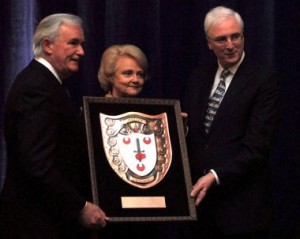
John and Joan Mullen accept the Taoiseach's Award from Irish Ambassador Michael Collins.

John and Joan Mullen accept the Taoiseach's Award from Irish Ambassador Michael Collins.

Irish American Chamber and Business Network honored John and Joan Mullen, founders of Apple Leisure Travel and Apple Vacations, for their contributions not only to Philadelphia’s business community but the community at large at a luncheon at the Ritz Carlton Hotel in Philadelphia on Friday, February 27.

The Mullens received the Taoiseach Award from Irish Ambassador Michael Collins. Collins was also on hand to honor ICON, a clinical research company founded in Ireland with satellite offices in the Philadelphia area and in Delaware.

News

Party!

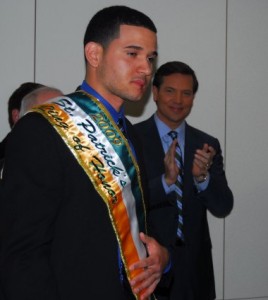
Philadelphia Highway Patrolman Richard Decoatsworth received his Ring of Honor sash on Thursday night.

Philadelphia Highway Patrolman Richard Decoatsworth received his Ring of Honor sash on Thursday night.

Supporters of the Philadelphia St. Patrick’s Day Parade got to mingle with their favorite on-air personalities from CBS3, which broadcasts the parade live every year, on Thursday, March 5, at the first big parade kick-off event.

This year’s parade honors Philadelphia’s fallen and injured police officers, and one, Richard Decoatsworth, who last year was shot and followed his assailant, radioing in his description, before he collapsed due to blood loss, was on hand to accept his parade sash.

We were there and took lots of pictures so you could feel like you were there too, but without the seafood buffet.

Food & Drink, People

Rollin’, Rollin’, Rollin

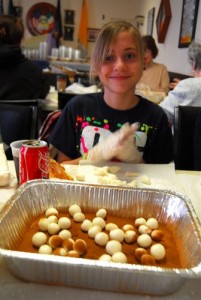
Leah Mulholland, 12,at her first Irish potato rolling.

Leah Mulholland, 12,at her first Irish potato rolling.

Diane Driscoll warned me. “After breathing the cinnamon for a while, you get a little crazy,” she said, leaning across a table that was liberally dusted with the spice.

Donna Donnelly, her hands moving at light speed as she rolled the confectioner sugar and cream cheese concoction that would soon be an Irish potato, took no time to snap back, “It’s not the cinnamon, Diane!”

It might be the cinnamon. This was my second year with the Ladies Ancient Order of Hibernians Div. 87 in Port Richmond, helping make the 2,000 pounds of Irish potatoes they sell as their main fundraiser for the year. And it was as crazy and funny as the first time.

Many of the volunteers had been rolling potatoes all week, dropping into bed at night, their backs, necks, arms, and hands aching, with visions of tiny little balls plopped in a sea of cinnamon the last thing they saw when they closed their eyes. The goal was to make 2,000 pounds of the candies. That’s a ton. A person could be forgiven a little nuttiness.

Donna Donnelly, whom the rest of the women refer to as “the ball Nazi,” hustled, cajoled, bullied, threatened, and, occasionally even encouraged her workers to “just keep rolling.” At one point, she went from table to table with soft pretzels and let people take bites, exhorting them, “Don’t stop rolling! The only reason to stop is death. Yours.”

But it’s all for a good cause. In fact, it’s for lots of good causes, from the Columban priests and nuns to Providence House, a local organization that shelters abused women and children.

Check out our photos and video. Once you see how much fun it is, you’ll want to roll with the ladies (and a few gents!) next year. I know I do.

Music

irishphiladelphia.com Hosts GiveWay in Concert

GiveWay is a group of four Scottish sisters named Johnson who have been playing together professionally since 1998, when the oldest were barely in their teens. They include Fiona, an accomplished fiddle player, vocalist, guitarist, pianist and whistle player; Kirsty, a skilled pianist, accordion player and singer; Amy, a talented drummer and accordion player; and Mairi, an accomplished piano and keyboard player, vocalist and bass player.

The band plays a mixture of Scottish traditional music, and haunting airs, to lively jigs and energetic reels, with the occasional original song as well. After playing in competitions and clubs all over the UK, the girls got their real break when they won a prestigious “Danny Award” at Celtic Connections in 2001. Later the same year the band placed first in the BBC Radio “Young Folk Awards.” Appearances at Celtic Connections, Cambridge Folk Festival, Tonder Festival, Denmark, and Celtic Colours (Cape Breton), followed.

The band was also invited to take part in the BBC 1 “Hogmanay Live” television show, sharing the stage with a host of major UK artists, including Phil Cunningham and Aly Bain. In 2003 the band signed to Greentrax Recordings and their debut album “Full Steam Ahead” was released to stunning reviews. The second, “Inspired,” produced by Phil Cunningham, was released in 2005 and covered traditional Irish and Scottish tunes, as well as foot-tapping and jazzy folk songs.

In 2008, the band recorded a single, “The Water is Wide,” produced by Brian Hurren of Runrig. A new album is scheduled for release in Spring 2009.
For more information, visit; http://www.myspace.com/givewaymusic

Columns, How to Be Irish in Philly

How To Be Irish in Philly This Week

After last weekend’s Midwinter Scottish-Irish Festival in Valley Forge, I’m all pumped for St. Patrick’s Month. If you missed last weekend’s craic, you’re in luck. There’s more this week.

Remarkable Tipperary-born uilleann piper Michael Cooney will be appearing at the Coatesville Cultural Center on Sunday night. Winner of multiple All-Ireland championships in pipes and whistle, Cooney will be accompanied by guitarist/singer Pat Egan.

On Sunday morning, AOH Div. 22 is hosting an Irish benefit breakfast at Smoke Eater’s Pub at Franklin and Sheffield Streets in Philadelphia. And who is the recipient of this benefit? Aside from you, the money will go to the Philadelphia St. Patrick’s Day Parade, the Hibernian Hunger Project and the charities sponsored by Division 22.

In the Lehigh Valley, the Dublin Philharmonic plays Russian classics at Lehigh University’s Zoellner Center on Sunday afternoon. In York, PA, the Screaming Orphans (you may have seen them last weekend in Valley Forge) will perform at a benefit at the Harp and Fiddle Pub and Restaurant for the York St. Patrick’s Day Parade. Irish items will also be up for auction.

There’s also a benefit for the Allentown St. Patrick’s Day Parade on Sunday at Callaghan’s Pub on Tilghman Street.

Sunday night (yes, we’re still at the weekend), Irish singer-songwriter Noellie McDonnell will open for folk-pop winger Patty Larkin at the World Café Live in Philadelphia.

McGillins, a great Center City Irish pub, has some fun events planned this week, including its popular St. Patrick Daze—Countdown to St. Patrick’s Day event. Music will be provided Bostonians Patsy & John. On tap: Authentic Beamish Irish Stout, Seamus Irish Red Ale and O’Reilly’s Irish Stout from Sly Fox Brewery in Phoenixville, plus Chocolate Leprechauns. To eat: bangers and mash (Irish sausage and mashed potatoes), Shepherd’s pie, Irish lamb stew and corned beef with cabbage throughout March.

On Friday, Irish Ambassador Michael Collins will be in Philadelphia to give out the annual Taoisech and Ambassador’s Award at a luncheon at the Ritz Carlton in Center City sponsored by the Irish American Business Chamber and Network.

If you’re in Kennett Square on Friday night, head over to Kennett Flash for an evening of Irish and American folk music with Danny Quinn.

At Finnigan’s Wake in Philadelphia, there’s a beef-and-beer fundraiser Friday night for the Cardinal Dougherty soccer team. Music will be provided by The Hooligans, the Bogside Rogues, and No Irish Need Apply.

As we always remind you, check our calendar for all the details. And in these tough times, support your local Irish pub and merchant! Eat, drink, and shop Irish!

News

Come to the Rambling House

If you’re looking for an old-fashioned good time, next month try the Rambling House free entertainment event that’s scheduled for March 12 at 7:30 PM at the Irish Center in Philadelphia.

The program, the brainchild of WTMR 800-AM Irish radio hosts Marianne MacDonald and Vince Gallagher, debuted February 19 with music, dancing, recitations, joke- and limerick-telling, even a short lecture on the meaning of tradition by dancer Ed Reavy, Jr. Fiddler Mary Malone of The Morrigan, Blackthorn’s John Boyce, Fintan Malone, John Donnelly, and guitarist-singer Kevin Brennan provided the music in front of a roaring fire in a scene reminiscent of the old Irish “house parties” of long ago, when neighbors entertained one another in the kitchen. (The Irish Center provided hot snacks and desserts.)

We were there, and of course we took photos and video so you can see why we’re recommending it.

  • Check out our pictures too.
  • Dance

    Regional Competition Draws Nearly 200 Dancers from Around the Country

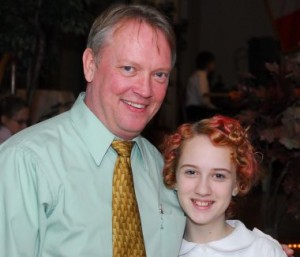
    Kevin Kennedy and his daughter, Kaelah, of Southampton's Rince Ri school.

    Kevin Kennedy and his daughter, Kaelah, of Southampton's Rince Ri school.

    Kevin Kennedy is an especially empathetic “Irish dance dad.” His two daughters, Molly, 17, and Kaelah, 11, perform with Rince Ri Dance School in Southampton, where they live. Last weekend, they were at the Irish Center in Mt. Airy, competing for a chance to go to Ireland in May for the world championships of the Cumann Rince Naisiunta (CRN), an Irish dance association founded in 1982 that has only recently made its way across the ocean.

    “I have nine brothers and we all danced,” says Kennedy, a biologist and businessman who was taking tickets at the door. “My Dad and his buddies at the Irish Club needed something to entertain them. We would do it after Irish football, or as we called it, ‘kill me with a ball.’ What we did wasn’t nearly as elaborate as what the kids do today. We were taught by someone who had about six Jamesons.”

    His studiously deadpan face gave way to a laugh.

    Olivia Hilpl, who founded Rince Ri five years ago, is a far more disciplined teacher than Kennedy’s was. The Sligo-born Hilpl began taking step-dancing lessons at 4 ½, before the Riverdance Effect high-kicked in. “We did a lot more steps on the floor than we did any high flying,” she says. That’s what drew her to CRN, which focuses on teaching students basic steps, then moving them up gradually at their own pace until they’re physically ready for more aerial work. The aim is to prevent injuries, so CRN-style dancers don’t do toe stands either.

    While the nearly 200 dancers, from as far away as Santa Fe, NM, and Portland, OR, were competing this weekend to go to the championships, they were also, in effect, taking their final exams. Winners in each age group move up one level. “When they achieve that, they know they’re getting better,” explains Hilpl, who organized the competition.

    They certainly had a good time, as their smiles will prove.

    Music

    5 Questions for Fiddler Martin Hayes

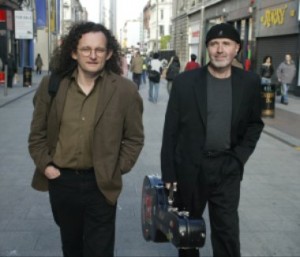
    Martin Hayes, left, and Dennis Cahill. Photo by Derek Speirs.

    Martin Hayes, left, and Dennis Cahill. Photo by Derek Speirs.

    “Welcome Here Again” is the name of the latest CD from fiddler Martin Hayes and guitarist Dennis Cahill, widely recognized as perhaps the greatest combination since chocolate and peanut butter.

    Not only is it the title of one of the tunes in this collection of silky, melancholic, syncopated East Clare music, it’s an acknowledgment that these two have been away far too long. “It suggests that it’s been a long hiatus since our last recording and here we are, we’re back, we know it took forever, but there it is,” explains Hayes, of whom one Los Angeles Times critic wrote, “[he] has one of the most ravishing violin styles in all of Celtic music.”

    But the title was hard to come by. “It’s really hard to think of titles for albums,” confesses Cahill, who grew up in County Clare but now lives in Connecticut. “They seem obvious when you hear them, but I’m really not too good at them. I can’t come up with anything smart to sign when I have to sign a birthday card with 20 other people, so I settle for ‘best wishes,’ and titles are not my strongest suit.”

    But playing the fiddle is, and you can hear Hayes performing with his longtime musical partner, the Chicago-born Cahill, on Tuesday, February 17, at the World Café Live in Philadelphia, starting at 7:30 PM.

    Born near Feakle—famous for its music festival–Martin Hayes grew up surrounded by some of the greatest musicians Clare has ever produced, including Paddy Canny, Martin Rochford, Francie Donellen and Martin Woods. His father, P.J. Hayes, was leader of the legendary Tulla Ceili Band, and Martin, who started playing at 7, was touring with them by the time he was 13. Before the age of 19, he’d won six all-Ireland fiddle championships and today is considered one of the most influential musicians to come out of Ireland in 50 years.

    We caught up with Martin Hayes recently and, truth be told, asked him more than five questions.

    When you came to the US in the 1980s after college, you played with a rock band rather than playing traditional music. Why was that?

    I continued to play traditional music, but I didn’t do it professionally. I played in the sessions with people like Liz Carroll. I was getting by by playing for money in bars and I wasn’t doing much else. I got pretty tired of that eventually and ended up in an experimental electric band with Dennis. That was my real transition to America, hanging out with these musicians, experimenting with what we’d got and what we each would bring to the table. Obviously, I was going to bring Irish music to the table. But it was an electric band, and there’s something about hearing that all the time that makes you crave subtlety. I had come to the conclusion that it really wasn’t who I was and it was never where I was going to find my soul in music. I knew I definitely needed to come back and play traditional music like I knew it as a teenager. But that experience had its effect. Because of having played in that band, I saw music in different context, and when I was playing particular tunes from my locality, I came to appreciate it even more.

    It was from that experience that you also found Dennis Cahill. Critics have described you two as “having a rare musical kinship.” It’s almost as if you were born to play together. To what do you owe that?

    I would say it’s got to do with the fact that we know each other really well. We’ve talked about the music and tried to get on the same page with it. In all music-making, jazz, rock or whatever, when it happens well, when you have the proper space for making music, then you have that instant rapport where everything is obvious and everybody understand everybody else. It doesn’t happen all the time, but when it doesn’t we’re pretty close anyway.

    The East Clare style is very distinctive—slow, emotional, and genteel, even the reels and jigs which were composed for dancing. Why do you think it developed that way?

    It’s very difficult to come up with any reason for a particular style. What’s often discussed is landscape: When you have gentle landscape, you have gentle music. There’s the possibility of that. It’s a bit beyond our knowing. But every region and locality is influenced by particular individuals who’ve shaped people’s ideas about music. The important factors in the music of East Clare, and there are two standards: They were always looking for music with feeling, which often meant a little taint of sadness and melancholy–the same element you have in the Blues–and rhythmic pulse and dance. It wasn’t about playing super fast, it was about playing real swing. Count Basie played swing but he didn’t go that fast. The tempo allowed dancers to dance in a more ornamented kind of way.

    To me, the East Clare style sounds a lot like the old-timey music of the U.S. Appalachian region. Is there some connection?

    Yes, I think it’s comparable to old-timey music. It’s the effect of a simple melody repeated over and over till you’ve created a kind of mantra, almost its own form of hypnosis, that similarly is going on in old-time music. I think if you go farther back you’ll find a convergence. And there are different versions. Some of it will take you to Scandanavia, some to Scotland, and some directly to Ireland. When I was a teenager, I went on a local “safari” to the houses of the old guys, the old musicians, where I would hang out, talk to them, tape them, and get all these old tunes. Over the course of the 20th century, a lot of recordings came to Ireland and people began to copy these styles of these fiddle players till the only variances you found where when people failed to copy them precisely. But these were the fiddlers I admired who kept the unique sound of the locality, like Junior Crehan, people who played a whole repetoire before all those recordings were available and didn’t change. They had an incredible rustic simplicity, like old-timey music, so simple that you might not bother learning it, some people thought. Yet it’s incredibly hard to achieve from a compositional point of view, oozing with earthiness and common sense. There’s nothing pretentious about it. You can’t be pretentious and be an old-time player.

    There are some who say they can hear a little bit of the jazz or even rock in yours and Dennis’s style. Is that deliberate, or just incidental to your background?

    I listen to loads of things—jazz, baroque, world music—but I don’t take it and put it into my music, though it influences how I look at music overall. There are universal things that you learn from different forms of music. Stepping into other worlds helps you see your own.