All Posts By

Jeff Meade

Sports

An Ancient Irish Sport, American-Style

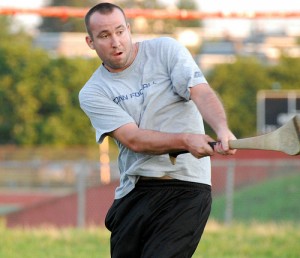
Joe Harrington takes a swing.

Joe Harrington takes a swing.

It’s a quiet late summer night at Northeast Philadelphia High School. The only sounds are the rubbery whirr of tires as traffic passes by along Algon Avenue, and the occasional “clink” of an aluminum bat as someone gets a hit during a pickup game up on the school’s brightly illuminated baseball diamond.

And down on a hardscrabble pitch just below the diamond, you can hear one other particular noise from time to time, best described as a “clop.” It’s the distinctive sound of the Irish sport known as hurling.

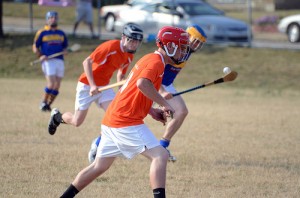
As dusk descends over the city, seven young members of the Philadelphia Shamrocks hurling team are charging up and down the field, attempting to hit a small white ball with a flat-bladed wooden bat. The ball is called a sliotar (pronounced shlitter); the bat, which looks like a giant cheese spreader, is a hurley. As with most field sports, the goal is to drive the ball through a goal. Every time a hurley makes contact with a sliotar: “clop.” (Learn more here.)

A nearly full moon hangs over the field, casting just enough light so that you can make out the shadowy outlines of the players as they charge back and forth. Finally, out of the darkness, there comes a slightly different sounding “clop,” followed by a sharp expletive. In the dark, a player has evidently mistaken another player’s helmet for the ball. The guys quickly huddle around the fallen player to make sure he’s not badly injured. He slowly pulls himself up off his hands and knees, yanks off his helmet and gingerly rubs his sore head. He says he’s OK. With that, they all decide that this would be a good time to end practice.

Hurling has a long history in Ireland. In one form or another, historians say, the game has been played for 2,000 years. And unlike your average American football game, which some historians say lasts about the same number of years, hurling is lightning-fast. Games last 60 minutes, 30 minutes a half, but it’s all over before you know it.

The game is also also a little nuts. It’s brutally physical, a tangle of hardwood sticks and straining limbs locked in a struggle to the death, all to gain control over a tiny ball. Hockey-style body slams aren’t allowed, but maybe the Irish just have a different name for the high-speed collisions that regularly leave players sprawled on the ground like squashed bugs.

Players wear no padding. Helmets were not required until 2010. Hell, it only took 2,000 years.

Naturally, the Irish play this sport beautifully, effortlessly.

For the Shamrocks, though, it’s a different story. When the team formed back in 1985, it was mostly Irish guys out on the field. Now, all but four of the players are Yanks.

The Irish start to learn the sport practically when they’re still in nappies. “We’re not starting to pick it up until we’re in our 20s,” says Shamrocks player Fiachra (FEE-kra) Malone. “We’re at a disadvantage.”

For the American guys, who grew up loving and playing American sports, at least some of the rules and playing techniques of hurling are counter-intuitive.

Joshua Burns, the team PR guy and a regular player, offers a case in point: The way you grasp a hurley. When you hold a baseball bat, your dominant hand is on top, says Burns. With a hurley, it’s the opposite: dominant hand on the bottom.

“You’re reversing everything you thought you knew,” Malone says.

Picking up hurling takes about three years, Burns says. “Your third year is when you’re about as good as you’re gonna get.” And that would be OK except for one thing: high turnover. The longest-tenured Shamrock has been on the team four years.

In spite of the obstacles, the Americans who play for the Shamrocks are fully committed gung-ho types. There are 24 of them altogether, and they’re dedicated to sport, hoping to raise its profile in the local Irish community.

Coach Frank O’Mara, who first started playing the game when he was a 10-year-old boy in Tipperary, thinks he understands why such a rugged, demanding sport might be a draw for Americans.

“They’re at a point where they’re not really playing any kind of organized team sports like they might have done when they were in school,” O’Mara says. “Now they see this new sport as a challenge. It has the eye-hand coordination of baseball, the physical contact of hockey, and it appeals to them.”

If hurling is going to remain a viable concern in the Philadelphia Irish community, it’ll be up to the Americans to make it happen. “We know we either have to appeal to a broader audience, or the club could fold. We’ve always wanted to attract Americans. We’re looking to get everybody we can to come and play.”

The Shamrocks are considering starting a fall league, so now’s a good time to pick up a hurley.

Learn how to play. Visit the Shamrocks’ Web site.
Music

The Musical Evolution of Moya Brennan

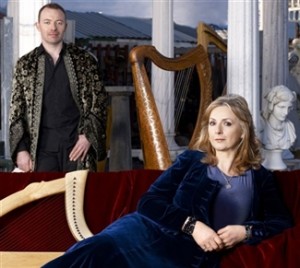
Cormac De Barra and Moya Brennan

Cormac De Barra and Moya Brennan

When we called singer Moya Brennan the other day, her husband, photographer Tim Jarvis, had to put the phone down for a few moments while he went to get her. “She’s up a ladder,” he said.

A minute or two later, Brennan was on the phone, laughing, and explaining that she’d been off in her son Paul’s room painting when the call came in. “I wasn’t just putting on my wings,” she said. “I was decorating. I love DIY. It’s so different from what I do in my life.”

What Brennan does, when she’s not laying down masking tape and slathering on primer, is sing wonderfully, beautifully, expressively, passionately—in Irish, English and at least once in Mohican. And that’s just for starters. Starting in 1970, she made her mark as the lead singer for the pioneering Celtic band Clannad. The Grammy-winning, Donegal-based ensemble, which Brennan formed with her brothers Pól and Ciarán and her mother’s twin brothers Noel and Pádraig Ó Dúgáin, was one of the first to take bold liberties with traditional music. The sound of Clannad is unlike any other, effortlessly and seamlessly blending elements of Irish, folk, rock, chant, jazz, New Age and world music. Clannad never found a genre it could not bend to its will.

Brennan launched her solo career in 1992, with the release of the eponymous CD Máire. (Moya is the phonetic pronunciation of her name.) She has performed all over the world, collaborated with performers as varied as the Pogues’ Shane MacGowan and Bono. She has recorded 25 albums, and has performed for popes and presidents. And as if Brennan’s not busy enough already, lovers of Clannad will be gratified to hear that she and the rest of the band are recording a new album, to be released in 2012.

More about that in a moment.

Next Saturday, she’ll appear in concert with friend and world-class harper Cormac De Barra at Sellersville Theatre.

Brennan’s collaboration with De Barra is just one of many intriguing turns in her 40-year musical career. Looking back on her career, she said she has always craved challenging new creative opportunities.

“I’ve matured so much in the way I sing and the way I know I can carry my voice and use it to the best of its ability, and in the way I have shared musical spaces with so many different artists,” Brennan explained. “There’s so much great music out there—great genres, great young acts coming up. It’s great to brush up with them at festivals or in a session. You have to be open to creativity at all times. There’s so much to be had out there. I’m in the middle of so many different projects. That’s what I love about it. That’s what keeps me going.”

Brennan’s quest for the new and experimental has its roots, of course, in Clannad. The band’s constantly changing perspectives, she recalled, sometimes perplexed fans who couldn’t understand why they didn’t just stick to one particular sound and keep pounding away at it. But Clannad’s members knew no other way. The band just kept evolving.

And soon, fans will get to hear and judge the latest stage in Clannad’s evolution. The band had played together from time to time in recent years, and a new album was promised. Toward the beginning of the new year, the band will make good on that promise.

“We started recording at the beginning of the summer,” Brennan said. “Because of all our different commitments, we’re not in the studio all the time, but we hope to be finished by the end of November, to be released at the beginning of the new year, and we’ll go out and do a bit of touring. It’s exciting because we haven’t been doing the same thing for years.

“This is going to be a very interesting album. I think it’s going to be our strongest album ever. It’s to do with all the different influences we’ve gained and surrounded ourselves with over the last 15 year. We’re coming to the table with different takes and new ideas. When I go into the studio, I’m just very excited about it.”

In between recording sessions, Brennan continues to maintain an active and varied touring schedule. She’ll be at the Dublin, Ohio, Irish Festival this weekend, then back to Ireland for the Kilkenny Arts Festival on Tuesday and to Lorient, France, the next day for yet another festival.

And then, at last, to Sellersville, which has nothing in common with the south coast of Brittany, but it’s a pretty nice town all the same.

The last time Brennan performed at Sellersville Theatre, she had a terrible cold, and felt bad about not giving the audience her best. This time, health permitting, will be a different story, she said. She’s especially excited about sharing the stage with De Barra, with whom she released a CD, “Voices & Harps.” Also on stage, playing guitar, singing and playing whistle, will be Brennan’s 19-year-old daughter Aisling Jarvis.

“We (Brennan and de Barra) had been around and playing together for years,” she said. It’s been kind of a nice gradual thing. He’s the best harper in Ireland. We always knew we’d do an album together. It just fell into place at the right time. It’s really special doing this project with Cormac—old songs, new songs, but creating a different sound from our harps and voices. Cormac is a lovely singer as well. I do a little bit of harp; he does a little bit of singing. It’s kind of nice, you know.”

You can hear for yourself. Learn more about the Sellersville Concert here.

Music

Young Local Trad Phenom Conal O’Kane is On His Way

Conal O'Kane, third in from the right.

Conal O'Kane, third in from the right.

Conal O’Kane. We knew him when.

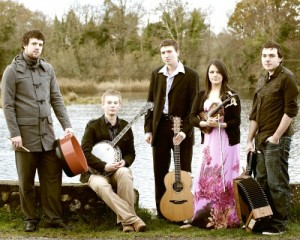
We first met the Philadelphia-born fiddler/banjo player/guitarist back in May 2006, when he played fiddle with two bands, both of them comprised of young local phenoms, in a traditional music concert at Palmyra Cove Nature Park. Like proud parents, we still have the pictures.

(We also have a photo of him playing at the 2006 Penn’s Landing Irish Festival with a fun little pick-up band called Pat the Budgie.)

Philadelphia has long been an incubator for young Irish musical talents. Conal O’Kane is one of our local kids who has, predictably perhaps, gone on to bigger things as a young adult. Now 23 and a recent graduate of the prestigious traditional music and dance program at the University of Limerick, O’Kane is getting set to make his mark in the traditional Irish music world.

O’Kane is the guitarist for the jazzy little Irish band Goitse (pronounced “gwi-cha”), which will perform in a Green Willow-sponsored concert in Wilmington on Sunday. All the members of Goitse are present or former University of Limerick students. He’s the only American.

Even though his roots are in South Philly, O’Kane from a young age has had deep musical roots in Ireland. O’Kane’s father Patrick is from Buncrana in Donegal, and the family returned there for visits every summer. During one of those visits, when O’Kane was 13 or 14, his dad introduced him to a legendary Donegal fiddler Dinny McLaughlin. McLaughlin taught or inspired many present-day stars, including Liz Doherty, Ciaran Tourish and Mairéad Ní Mhaonaigh.

“Dinny is a great fiddle teacher from my dad’s home town,” O’Kane said in a recent interview. “He taught me half of a jig, the ‘A’ part of Whelan’s Fancy, and he told me that if I couldn’t play it well the next time I came to Ireland, he would strangle me. I don’t think I ever got the ‘B’ part off of him. I had to figure that out on my own.”

Long before his introduction to McLaughlin, O’Kane was on intimate terms with Irish music; his dad loved it. Recordings by groups like Altan, the Bothy Band and Dé Danann played in heavy rotation around the house, O’Kane explained, and he had always enjoyed listening to it. “It was a growing interest,” O’Kane said, “but the thing with Dinny definitely kick-started it.”

When he returned to Philadelphia, O’Kane looked for a fiddle teacher. At a Sunday session sponsored by the Next Generation, a group of young Irish music students led by local talents Dennis Gormley, Kathy DeAngelo and Chris Brennan-Hagy, O’Kane met one of the area’s top fiddle players and a four-time All-Ireland medalist, Brendan Callahan. O’Kane became a student.

Callahan proved to be a major influence right from the start, O’Kane recalls. “I got really lucky there. He’s just an awesome player, and I went to him for a few years.”

Thanks to Callahan, the next time O’Kane returned to Buncrana, he’d learned well enough that Dinny McLaughlin took him under his wing. That summer, and each summer thereafter, O’Kane completely immersed himself in the local music.

“I improved enough for Dinny not to strangle me. That was the main point,” O’Kane quipped. “I mean, when you know you’re going to be playing for Dinny, you want to be solid. I started playing in Irish music sessions with him around Buncrana. I really enjoyed the session scene. That’s what Irish music was about for me—it was playing with other people in sessions.”

O’Kane continued to play fiddle and improve. Along the way, he picked up and also loved banjo, which Callahan had recommended to him as a way to learn to play triplets on fiddle.

And when he was about 16, he added guitar to his arsenal, inspired by the likes of Irish guitar great Arty McGlynn.

O’Kane’s next big move was the University of Limerick, although there was a brief musical detour along the way.

“I took a year off after high school, sort of bumming around Galway playing music, trying to figure out what to do. And then a friend of mine from Philadelphia told me about the program at the University of Limerick. I went down and auditioned for it, and got accepted. I just auditioned on the fiddle. I figured the fiddle would be my main instrument, with banjo as the second, and then just sort of plunk away on guitar on my own.”

About midway through his stay at the university, O’Kane was invited to join the then brand spanking new band Goitse (it means “come here”) after he competed in a local battle of the trad bands sponsored by the university. Goitse won the competition, and O’Kane’s band lost … but the members of Goitse plainly saw something they liked. He’s been playing with the band ever since.

For now, O’Kane is committed to pursuing a career in Irish music. You won’t see him play often, though, because he’s living in Limerick. Philly is where he’s from, but Ireland is where his heart is.

“I go back to Philly maybe once or twice a year. But basically, yeah, I’m still living in Limerick. It’s my home now and all of my friends are there … and there is always good music around. I’m here for the long haul.”

If you want to become re-acquainted with this gifted young man, you can see him in concert with Goitse at Timothy’s on the Riverfront, 930 Justison St., in Wilmington on Sunday,starting at 7 p.m.

Dance, Music

Make Plans Now for the 2011 Philadelphia Ceili Group Festival

Matt Ward will sing out at this year's singers' session.

Matt Ward will sing out at this year's singers' session.

The annual Philadelphia Ceili Group Festival is just a little over a month away, but the excitement is already building.

The festival runs from Thursday, September 8, through Saturday, September 10, at the Philadelphia Irish Center in Mount Airy. Planning continues now at something of a feverish pace for a jam-packed program of Irish music, dance and culture.

One of the highlights of this year’s festival is the Saturday night concert by three members of a superb Irish ensemble, The Pride of New York—Brian Conway, Brendan Dolan, and Billy McComiskey.

“(It’s) a great band out of New York City that usually includes Joannie Madden,” says the Ceili Group’s Anne McNiff. “Joannie will be out of the country in September and unable to join her bandmates for the festival concert. We were just thrilled to have “the boys” and know that everyone can look forward to a great show.”

The hot local band Runa, featuring singer Shannon Lambert-Ryan, is also on the bill, as are dancers from the Coyle School.

The long weekend opens with singers’ night, dedicated to the late longtime festival chairman Frank Malley. “The first singers night was held at the Mermaid Inn as a ‘prefest’ event and was such a success that he (Malley) brought it in as a regular part of the lineup,” says McNiff.

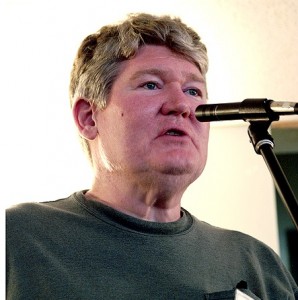
The great Irish singer Matt Ward, one of Malley’s favorites, is in this year’s lineup. Local singers include the well-known singing publican Gerry Timlin, together with longtime favorite Vince Gallagher and the talented Terry Kane, who sings in both English and Irish.

On the following night, a terrific band from Baltimore, Dan Isaacson’s Simple System, is featured in fireside concert.

For those who want to hone their Irish music performance skills, Saturday offers a wide array of workshops, taught by some of the best in the business:

  • Brian Conway (fiddle)
  • Billy McComiskey (accordion)
  • Dan Isaacson (pipes and whistle)
  • Danny Noveck (guitar)
  • Matthew Olwell (bodhran)
  • Terry Kane (Irish singing)

Other workshops include:

  • Brendan Dolan – Irish Music: Gems from the Moloney Collection
  • Tracing Your Irish Roots, the Ins and Outs of Genealogy with Lori Lander Murphy
  • The true story of Duffy’s Cut, presented by Frank Watson
  • A workshop on Sean Nos (old style) dancing with Kelly Smit for dancers at all levels
  • An Irish Language workshop with Leo Mohan
  • Knitting and spinning demonstrations
  • An informational talk on Commodore Barry by Frank Hollingsorth and Billy Brennan
  • “How to be Irish in Philadelphia” with Jeff Meade and Denise Foley
  • Tin Whistle for Beginners with Dennis Gormley
  • St. Brigid’s Cross making
  • Irish Folk Tales for Children with Basha Gardner.

Also for the kids: face-painting and balloon animals.

Vendors also will be on hand with food, gifts, and more.

All of that, plus you never know when Irish music will spontaneously break out.

Tickets for the festival are on sale now. Visit the Philadelphia Ceili Group Web site for details.

Sports

Hurling in High Heat

A Shamrock hurtles downfield.

A Shamrock hurtles downfield.

What was the final score?

Blame the hundred-plus-degree heat out on the field at Northeast High School, but the end of Saturday’s game, no one seemed to know. Or care.

After the final whistle, the exhausted players of the Philadelphia Shamrocks and the Worcester (Mass.) Hurling Club dragged themselves off to a little corner near the pitch to sit in what little shade there was to be had. They stripped off their sweat-streaked jerseys, dropped to the ground and started to put away many icy bottles of water and Gatorade.

Everybody knew the away team had won handily, but no one knew by what score.

Frank O’Mara, captain of the rebuilding Shamrocks, suggested his own final tally. “Just say it was a draw,” he quipped. “These boys are from Massachusetts. They’re never gonna read it, anyway.”

When we weren’t sitting under a tree and drinking our own water and Gatorade, we headed out to the sidelines for some pictures.

Here they are.

News

Celts to Gather at Graeme Park

Have a hot time with the Hooligans.

Have a hot time with the Hooligans.

Another weekend, another festival.

This time out, its the 15th Annual Celtic Festival at Graeme Park in Horsham, Montgomery County.

As festivals go, this one’s a nice comfy size, spread out across the park, which features the historic Keith House, once home—in the early 1700s—to the provincial governor of Pennsylvania, Sir William Keith.

The festival started out pretty modestly, says park spokesman Carla Loughlin, but over the past six or seven years it has grown. The Graeme Park Celtic Festival features about 30 vendors selling all manner of Celtic-themed merch, from T-shirts to jewelry to gifts. Occupying a corner of the park will be about 10 Scottish clans and non-profits, hosting their customary There’s music all day on the main stage, local Irish dancers and three pipe bands—Bucks Caledonian, McKay and McGregor, circling up and playing several times during the day. The full schedule is below.

The festival started out as solely Scottish, Loughlin says, in honor of the local Keith, Graeme, and Fergusson families, but the festival is really for Celts of every stripe.

“Maybe the first few years it may have just been Scottish, but since then we’ve always included the Irish, and even Cornish the past few years,” Loughlin says.

In the past, the festival has drawn between 1,000 and 2,000 visitors, says Loughlin. “It all depends on the weather,” she says. “The weather is supposed to be nice tomorrow (Saturday), so we should be on the higher side.”

Here’s the schedule:

Schedule of Events

Main Stage (behind the Keith House)

11:30: Flag raising and pipe bands
12:00: Carl Peterson
12:30: Sabo School of Irish Dance
1:00: Timoney School of Irish Dance
1:30: Pipe Bands
2:00: The Martin Family Band
3:00: Sabo School of Irish Dance
3:30: Timoney School of Irish Dance
4:00: The Martin Family Band
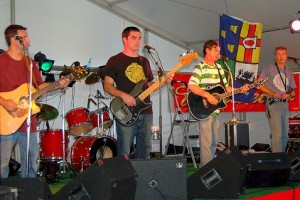
5:00: The Hooligans
5:45: Pipe Bands
6:15: The Hooligans

Barnyard

Carl Peterson

Front of the Keith House

Now & Then
WireHarp

Kids’ Area

The Kilted Juggler

To get there: Graeme Park is at 859 County Line Road in Horsham.

Music

Virtuoso Fiddler Maeve Donnelly Returns to Coatesville

Maeve Donnelly in concert at Coatesville in April 2007 (photo by Gwyneth MacArthur)

Maeve Donnelly in concert at Coatesville in April 2007 (photo by Gwyneth MacArthur)

The acclaimed East Galway-born fiddler Maeve Donnelly plays with deep passion and conviction, bringing out the beauty of Ireland’s old music and making it all seem new again.

We spoke to Donnelly in 2007 just before her Coatesville Traditional Irish Music Series appearance with Scottish guitarist Tony McManus. Donnelly returns for a concert at the Coatesville Irish Music Series Wednesday at 8 p.m. This time around, she is accompanied by the East Cork flute player Conal Ó Gráda.

The upcoming show gives us an excuse to dust off our 2007 Q and A. We’ll also link you to our review of that concert (short, but enthusiastic), together with Gwyneth MacArthur’s lovely photos.

Maeve Donnelly is that rarest of birds, an Irish musician whose parents are not players themselves. (Which would make them, um … kind of like the Muggles of the Irish traditional world.)

Somehow, in spite of her inauspicious roots, she has managed to muddle along.

She won her first All-Ireland Fiddle Competition at age 9. She won two more All-Ireland fiddle titles after that. She also picked up the National Slogadh Competition for Solo Fiddle and The Stone Fiddle Competition in County Fermanagh.

In a recent phone conversation from her home in Quin, County Clare, Donnelly explained how she made the journey from the Galway of her childhood and a house somehow not filled with fiddle-playing parents, aunts, uncles and cousins to emerge as one of the preeminent traditional players of her generation.

Q. How did you start out? How old were you?
A. I started very young. I was probably about 6 or 7 or so when I started playing. The reason for starting was, my two older brothers had gone to music lessons. Their teacher taught specifically Irish music.

We had a fiddle hanging on the wall at home. My other brother Declan had played fiddle, and so he had advanced on to another fiddle. It was no great mystique toward learning fiddle.

I got the fiddle put in my hand and a bow, and off I went with my two brothers to learn music.

Q. Not everyone who starts out on an instrument stays with it. Why did you?
A. I didn’t ever exactly like music lessons. I don’t think there’s a child who does. It was no great treat. My lessons would have started on a Saturday. I still feel like I had a big black cloud over me until it was over. I wasn’t great at reading music and I picked it up as best I could, playing by ear.

The way it happened was, we used to go to fleadhs as a family. We in turn were part of a bigger unit, and we played at fleadh cheoils all over the country. It was a special group of maybe 30 people. Within that group, everybody would go to the fleadhs. We would combine in different ways to go in for competitions.

A big proportion of praise goes to my parents, who put in a great sacrifice and weren’t pressuring us to get first place in the fleadhs. It developed as a social outing.

That (playing in fleadhs) made a difference. I was playing in fleadhs and competing from about the age of 9. At the time we would have traveled up to three hours back in the late 1960s. It was quite a journey to go to these fleadhs.

Q. Your parents didn’t play. It seems like everyone else I’ve interviewed who plays an instrument comes with a pretty deep family background.
A. I often think, would it have been nice to have had parents who were musicians? Sometimes it can be more refreshing not to have parents playing musical instruments at home. It’s better doing your own thing, and a challenge.

Q. Was there a point at which you felt like your playing had progressed beyond the routine of lessons, to where you knew that there could be something more?
A. I finished classes in my teenage years. At about that time, a whole new breed of festival started in Ireland. They were non-competitive workshops. The first one was Willy Clancy Week. That was my first introduction to learning music for a whole week, and having great fun and being immersed in it for a week. The first year I went there I was in a class taught by Sean Keane of the Chieftains. And I met a lot of pipers. I never met pipers. I met Seamus Ennis. It was an eye-opening experience. That was about 1974.

After that, I would go back annually.

Q. How has your approach to playing progressed since then? How did what you learn in workshops influence your playing?
A. It sort of organically grew. I enjoyed what I was doing. I also felt that I worked at what I was doing. I’m not claiming that it dropped down or I was gifted in any way. It sort of spurred me on to studying the music, to working at the music, rather than sitting and playing at sessions. I spend a lot of the just sitting at home and playing.

I think session music is a great form of practice and a great form of picking up tunes and great form of fun. As an exercise in improving your playing, I’m not sure I would agree. It depends on the session. At that level you just play as an ensemble groups. The individual part of the playing doesn’t come. But playing in sessions also gives you motivation to keep playing. Every time I go to a session, I always hear a new tune. It’s like a lifeline in its own way.

Q. What do you do when you aren’t playing?
A. My full-time job, and has been since I was 20, I’ve been a teacher. I teach in the area of learning support. I take children 7 to 12, children who have trouble with literacy and numeracy. Being a teacher means I have a long holiday time. I have more flexibility. I can take one week and I can tour.

Music

India Meets Ireland

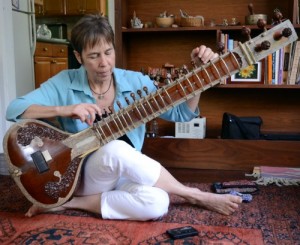
Allyn Miner, tuning up

Allyn Miner, tuning up

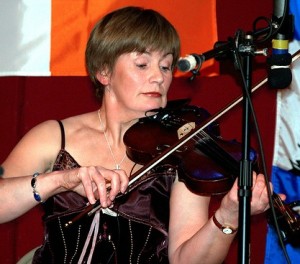
If you listen to Allyn Miner play fiddle in the Tuesday night Irish music session at the Shanachie Pub in Ambler, you’re hearing what one talented player can do with just four strings.

You ought to hear what she can do with 20.

In addition to her skill as a fiddler, Miner is a well-known player and instructor on the much-larger-than-a-fiddle traditional Indian instrument called the sitar.

(If you don’t know what a sitar sounds like, pull out your old Beatles Rubber Soul album. George Harrison plays the instrument on Norwegian Wood. You’ll recognize the distinctive metallic buzz, a kind of silvery sizzle, and the whining, hypnotic drone.)

A senior lecturer in Penn’s Department of South Asia Studies—she’s been there for 20 years—Miner began her long love affair with the sitar when she was still a junior in the Indian Studies program at the University of Wisconsin. Born and raised in Chestnut Hill, she grew up knowing how to play the violin. Sitar, when it came into her life, was not so much a departure, she says, but a way of building on musical skills she already possessed.

The path to sitar enlightenment evolved largely out of Miner’s enrollment in the University of Wisconsin, which had an Indian Studies program. The desire to attend school far away from the safe confines of Philadelphia came first, but the university’s Indian Studies was definitely an allure.

“My mother said I had that in mind before I went there (the University of Wisconsin),” says Miner. “Really, I was mostly interested in going to a different place, to another environment away from Philadelphia for a change. The university’s Indian Studies program was an attraction.”

Miner took Hindi to fulfill her language requirement, took courses in Indian culture, attended many of the department’s social functions. She found herself pulled more and more into this country 8,400 miles away.

“I guess I was first drawn out of curiosity,” she says. “I wasn’t sure what to make of it. I wanted to know more about it.”

When Miner got the opportunity, she signed up for the department’s junior year abroad in India.

She knew right away that she had made the right choice.

“It was a huge adventure, of course. I lived in Banares (now called Varanasi, in the country’s southeast.) It was a smallish town,” Miner recalls. “There were no telephones or refrigerators or even cooking gas at that time.”

For Miner, junior year in Indian was a total immersion learning experience, starting with the language. “Hindi was the whole doorway into everything. People didn’t feel comfortable speaking English, not the people I hung around with.”

In time, she met a teacher of sitar, Thakur Raj Bhan Singh. Before she left for India, she had taken some lessons from a teacher in Wisconsin. This new teacher was a very different. “My experience took a new musical direction when I found a good teacher. It sucked me in,” Miner says. “He took me under his wing. He had five kids but I became like a family member. He introduced me to all these other people, including his own teacher, this elderly man who gave me his instrument. None of his children played. It’s a very, very rare instrument. It’s one of a kind.”

When she first started to take instruction, Miner admits she was not “the quickest of students.” However, she persevered.

To be fair, the sitar probably is not the easiest of instruments to learn. (Many say it takes at least a decade to master.) First, there are the aforementioned 20 strings, stretching to the top of the instrument’s three-foot red cedar neck. The neck itself is about three and a half inches wide, with 19 widely spaced raised brass frets. The deep rounded base of the instrument is formed from a pumpkin gourd, and it is decorated with intricate carvings, often in a lotus design.

Traditionally, the sitar player sits cross-legged on the floor, with the neck draped across the right thigh. Miner is petite, and when she plays, the top of the keyboard is level with the top of her head.

Although sitar is a very different instrument, Miner found that her years of playing violin proved useful.

“It (the sitar) has a lot of strings, but it’s a single melody line, and all the rest of the strings are droning. Violin was great ear training. If you can hear intervals in a tune, you can just imitate.”

Unlike Western music, which is notated—violin players follow sheet music—sitar has no notation. There is a fixed scale, but sitar tunes—raags (pronounced roggs)—are taught by ear. Each of these raags has a basic core structure, Miner says, but then you improvise around it.

Complex rhythms also prove challenging.

“They have a long repeating number of beats—say, 16—and you improvise within that, but you have to keep track of where you are within the 16. The big thing is keeping track of where you are. That’s a skill that also takes a while.”

Sitar also appealed to Miner’s sense of creativity. There are rules and structure to a raag, but there is freedom as well, she says. “Those rules are free enough that you can do anything. You can do what your teachers taught you or you can take off from there. You have to create your own style, so you’re not reproducing anyone else’s music. You’re creating your own music.”

As Miner’s Wisconsin Year in India came to a close, there was little doubt that the country held her in thrall. She stayed another year in India before returning to the university to finish her degree, then headed back to India for a long stay, with the assistance of Fulbright and Rockefeller scholarships. In all, she lived in India nearly 11 years, receiving her Ph.D. from the Department of Musicology, Banaras Hindu University, in 1982.

After Miner’s return to the United States, she became a lecturer in ethnomusicology at Temple University, and in 1987 became a lecturer in South Asian studies at Penn. (She also received another Ph.D. from the university’s Department of Asian and Middle Eastern Studies in 1994.)

Like most good musicians, though, Miner always had room for other forms. Music is music. A few years ago, quite another culture and style of music intruded on Miner’s consciousness. One of her friends had traveled to Ireland and she had taken some Irish fiddle lessons. The friend asked if Miner wanted to take some lessons, too, and she said yes, never knowing where it would lead. So she went and learned a tune from another friend up in Boston. That tune was a jig called “Dan the Cobbler.”

Then, she looked for places where Irish music is played. She found the Sligo Pub in Media. “I just wanted to see an Irish music session. I’d never been to one before, and the one at Sligo was good-sized, maybe eight or nine musicians.”

Miner hadn’t brought her fiddle along, but another fiddler lent her his and invited her to play her one and only tune.

“And they all joined in and I was hooked,” Miner recalls. “Completely, totally, thoroughly. They all just joined in and I thought: I’m in heaven.”

After that, she took lessons from local fiddler (now in Boston) Brendan Callahan and later on from Padraig Keane and local teen phenom Caitlin Finley. (She remembers thinking: “Omigod, my idol is a high school senior.”)

Since then, Miner has become a regular at local sessions—the Shanachie in Ambler and the Plough and Stars in Old City, in particular.

That she should pursue two cultures and two different musical forms seems not at all unusual to Miner. Both are forms of folk music. Indian music does differ from Irish music in one key way, she says: Sitar music is mostly a solo performance. “You play with a drummer, but not a group ever,” she says. There’s a lot of pressure when you’re performing. You have to create the performance right on the spot. That’s a big responsibility.”

In contrast, Miner says, Irish musicians play in a group, and they play for each other. It’s a more social activity.

Miner remains devoted to Indian music in all its haunting loveliness. She continues to be renowned for her teaching and playing. But there’s always room in life for more passion. And Miner found it, she says, when she discovered the music of Ireland.

[kindlethis]