All Posts By

Jeff Meade

News

AOH Gives Jolly Old St. Nick a Run for His Money

Judge Pat Dugan

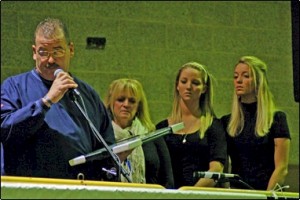
Judge Pat Dugan presented a citation from the state AOH to the family of fallen Philadelphia Police Officer Chuck Cassidy. From left: Judy, Colby and Katie.

There are ways in which members of the Ancient Order of Hibernians have a lot in common with Santa Claus. Yes, there are more than a few white beards and little round bellies that shake when they laugh, like bowls full of jelly—but that’s not what we mean.

What we’re talking about is the amazing generosity of spirit that typifies the AOH, and not just during this time of year, but all year-round.

That generosity was in evidence Saturday night at the Pennsylvania National Guard in Northeast Philadelphia as the AOH presented the first-ever Project St. Nicholas. The proceeds of the event benefited several local charities, including the Hibernian Hunger Project, Toys for Tots, Cure Autism Now, Project Children and the St. Baldrick’s Foundation.

“We raised thousands of dollars,” said master of ceremonies Pat “Paddy” O’Brien, chairman of public relations for the Pennsylvania AOH. “We’ll do it again next year. It’ll be even bigger and better.”

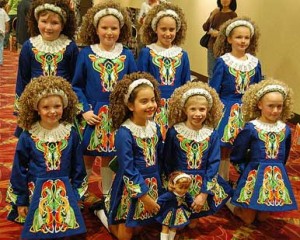
Local Irish who visited the armory throughout the day listened to music by great local bands, including the Bogside Rogues, Ballina, the Birmingham Six, Tullamore Trio and The Shantys. (More than a few weren’t content just to listen—they got up and danced.) There was plenty of great food, including a bit of soda bread. For the kids, Santa Claus showed up about midday. The Celtic Flame Dancers also made an appearance.

As the afternoon gave way to the evening’s festivities, the Hibernians took the opportunity to recognize one of their own. Judge Patrick Dugan presented a plaque from the state AOH to the family of fallen Philadelphia Police Officer Chuck Cassidy. Irish Thunder Pipes and Drums also played in Cassidy’s honor.

For O’Brien the healthy turnout was heartening. “It was good to see the AOH involved in a community event that went outside of the AOH. People came today just because they were Irish. And they came from everywhere. There’s a World War II vet who came all the way down from Scranton.”

Finally, a few other visitors were unexpected … but nonetheless quite welcome indeed.

It seems that four women from Ireland—dancers all—had just gotten off the plane at Philly International. They had an appointment in Southampton, Bucks County, so that’s where they asked the cabbie to take them. They didn’t get that far. The cabbie misunderstood and dropped them off at the National Guard Armory on Southampton Road.

“They were 15 miles of course,” O’Brien laughed. So we asked them to come in and get something to eat and drink, and we arranged for a ride for them back to Center City. I said to them, ‘If there’s any place on the planet where you want to get lost, this is the spot.”

Lost or not, we all felt just the same way.

Music

Interview With Harpers Gráinne Hambly and Billy Jackson

When you listen to the scarily good Celtic harpers Gráinne Hambly and William Jackson, you might assume that they both started playing before they were out of nappies.

In reality, the Claremorris, County Mayo-born Hambly and Jackson, from just outside Glasgow, were both late bloomers … and their magnificent careers never might have begun at all were it not for a chance bit of window shopping.

“It was my sister who saw the harp,” Gráinne remembers. “She (Róisín) was 7 and I was going on 15. My sister saw it in the shop window and said she wanted to play.”

At the time, Gráinne wasn’t interested. She had started out on tin whistle, and had moved on to concertina, and really wanted no parts of harp. One day, though, the girls’ parents surprised them with a week-long school taught by famed Celtic harper Janet Harbison. It was one of those awkward surprises—like getting pajamas instead of a toy for Christmas. “When I found out, I wasn’t enthusiastic,” Gráinne says. But her apathy didn’t last long. “As soon as I started to play it, I loved it right away.”

For William “Billy” Jackson, the story was not quite the same. “I had started on piano when I was 11,” he says. “I ended up being a bass player in a band. I was in London in the ‘70s, and I saw a harp in a (shop) window.” Jackson had spent a lot of time in Ireland—his parents are from County Donegal—so the music of the harp was not new to him. But on that street in London, something clicked. “Just getting to see a harp up close … I sold my bass, and all my friends said I would never work again.”

Billy Jackson is doing just fine, thank you. It was a rough go at first, though. He took six lessons with a classical harpist. (A Celtic traditional player is a harper; a classical player is a harpist.) After that, he says, he couldn’t afford any more lessons for a time. He took a few more lessons much later on as a student at the Guildhall School in London, but finding someone to teach him specifically about Celtic harp was impossible. “Some (classical harpists) regard the Celtic harp as a toy, not the ‘real thing,’” says Jackson. “They’re reluctant to teach it. I was never taught to play triplets on the harp. Nobody taught me any of it.”

But Jackson, who also plays uilleann pipes, fiddle, bouzouki and tin whistle, somehow managed … and then some. In 1976, he became a founding member of Ossian, the famed Scottish traditional band. As a solo performer, he has played for audiences all over the world. He has recorded numerous CDs and is also the winner of the 1999 “Song for Scotland” competition for his composition “Land of Light.” (Listen to it here.)

Hambly’s early experience on the harp was more nurturing than Jackson’s. In Harbison, she found both a teacher and an ardent advocate for doing things the old-fashioned way. In traditional harp, there is no sheet music. Instead, the student watches and listens to the instructor as he or she plays a line. Then, the student repeats the line, and then another line, and so on, until the whole tune is committed to memory.

“That’s the traditional way to learn in Ireland,” says Hambly. “That’s how I learned, by ear. Janet brought harp teaching back to the roots.”

Age can work against you when you’re starting out on a musical instrument, but for Gráinne, it was a powerful incentive to learn. “Generally children do start learning early,” she says. “I was in a class with 7-year-olds. That was great motivation to learn quickly. Parents often ask me, ‘Is my child too old to start?’ I don’t think any age is too old, especially if you played another instrument first.”

Like Jackson, Gráinne also tours extensively throughout Europe and the U.S. She was a member of Harbison’s Belfast Harp Orchestra, as well as the Irish National Harp Ensemble and the National Folk Orchestra. She too has recordings under her belt. (Listen to An Draigheann, or “The Blackthorn.”)

Over the last couple of years, Jackson and Hambly have been touring together, giving audiences a sampling of harp music from both sides of the North Channel. You can hear them on October 29 in their “Masters of the Celtic Harp” concert at Trinity Church in Cherry Hill. The performance begins at 7.30 p.m.

Like their musical careers, their decision to tour together was a happy accident.

They were playing a concert in Asheville, N.C., two years ago, when, Jackson recalls, “at the end of the performance, “the organizer asked us to do a couple of tunes together.” They did, and the audience loved it. At the end of the concert, Gráinne says, “people came up to us and said ‘you should do more things together.’”

Gráinne, who knows so many players in the small village that is Irish traditional music, asked her friend and fellow harper Kathy DeAngelo of Voorhees to set up some concerts. Jackson and Hambly have been playing steadily together ever since.

And the sound is pretty wonderful—but it isn’t necessarily as effortless as it seems. “It’s difficult to play two harps together,” Jackson explains. “They have to be perfectly in tune, but there are so many more strings, it’s difficult. It’s not like playing fiddle together.”

Fortunately for Hambly and Jackson—and for us—they’re both skilled multi-instrumentalists.

“I’ll play concertina while Billy plays harp,” Gráinne says. “And sometimes, I’m playing the harp while Billy plays bouzouki. It’s a bit livelier.” (Listen to Hambly and Jackson play “Celia Connellan” and “Rectory Reel.”)

Editor’s Note: Gráinne’s new CD, “The Thorn Tree,” will be released Nov. 28. But you can get a sneak preview. A CD release party will be held Saturday, Oct. 28, at 7 p.m., at the Cooper River Yacht Club. For details, call Kathy DeAngelo at (856) 795-7637.

Music

It’s Beginning to Look a Lot Like Irish Christmas in America

Muireann Nic Amhlaoibh joins the show this year.

Muireann Nic Amhlaoibh joins the show this year.

Take Oisín Mac Diarmada, Seán McElwain and Tristan Rosenstock of the brilliant Irish traditional folk band Téada. Add , the highly acclaimed singer from Danú, along with the gifted harpist Gráinne Hambly and Riverdance piper Tommy Martin. Mix in champion Irish step-dancers Abbey Magill and Sienna Hickey. Wrap it all up in a big green bow, and what you have is “Irish Christmas in America.”

Now in its third year, the show swings into the Philadelphia Irish Center/Commodore Barry Club on Saturday, December 15, starting at 8:30. The event is presented by the Commodore Barry Club in association with the Philadelphia Ceili Group.

Quite the Christmas present, eh? Lots nicer than a Chia Pet. Heaps classier than that “Snowy the Singing Snowman” voice-activated Christmas tree ornament from QVC. (Will that damnable thing never shut up?)

Seriously? This is a chance to see some of the finest musicians Ireland has to offer, all in one show. And, just like Christmas, it comes but once a year.

You get the sense that producer and all-Ireland fiddle champ Oisín Mac Diarmada (pronounced O-shin Mac Der-metta) himself appreciates just how cool this is.

Speaking by scratchy cell phone from a car hurtling down a highway somewhere in Georgia—I could hear the talking GPS squawking in the background—Oisín said he was eager to begin the 15-city tour. For one thing, there’s the ensemble itself, which is kind of like the Irish traditional version of the Supremes, the Temps and the Four Tops all rolled into one. In particular, Muireann Nic Amhlaoibh (pronounced MWI-ren Nick OWL-eve), with a voice like honeyed whiskey and major talent on flute and whistle, adds a major new dimension.

“This will be the first time we’ve done the show with Muireann. It’s great to get the opportunity to have her in the show, she’s such a good fit,” says Oisín. He notes that Nic Amhlaoibh is well known and highly regarded, not just for her singing, but for her singing in the irish language. ”She’ll be doing quite a few Irish language songs,” he says. “And she may have a couple of good stories to tell during the show.”

Working with Hambly, too, is a great pleasure, he says. Hambly has played the show before, and she has toured throughout the United States many times. “Gráinne is amazing on the harp,” he says. I’ve known her for many, many years. I’ve done plenty of shows with her in Ireland. She’s a very natural fit for the show.”

Oisín also find travel through the United States during the Christmas holidays to be fascinating, as well, and having the opportunity to experience all the seasonal variations from one coast to the other. (The tour begins Friday night in Peoria, Arizona.) He also appreciates the opportunity to do something different. “It’s a bit of a break,” he says. “It’s different from the regular Teada concerts we do the rest of the year. We’re bringing in two dancers this year, and some photographic images as well. It’s a varied show.”

What makes “Irish Christmas in America” different from any other holiday show, obvously, is that it blends traditions from the two countries—including some traditions, like the Wren Boys, that some may find a bit strange. It’s a holdover from pagan times, in all likelihood, but the more current legend (one of several) has it that a wren betrayed St. Stephen’s hiding place. And you know what happened to poor St. Stephen. So on December 26, the feast of St. Stephen, boys would dress up in rags, blacken their faces and hunt down one of the poor birds. Then they’d tie it to a pole and go from door to door begging for money and eats. (And you thought Festivus was silly.) In modern times, no one kills birds any more. But the day is still celebrated with music, dance, food, drink … and maybe some funny outfits.

“It all probably seems a bit bizarre to onlookers, but it goes back many generations, ” says Oisín. “It’s sort of a well-known observance in Ireland. We’ll have a bit of fun on stage of trying to capture the Wren Boys tradition.”

At the heart of it all, though, will be good, solid Irish traditional music. Oisín says the band doesn’t try to force Irish traditional music and standard American Christmas music to blend into a weird hybrid that, in the end, turns out to be neither. “The approach we take in the show,” he says, “is that the music itself is all traditional. We don’t play any of the well-known Christmas songs or crossover stuff. We do stuff that has musical ties to Christmas in their titles and such.”

You can see and hear for yourself. (Please do.)

Tickets are $20 in advance, $23 at the door. Call (215) 843-8051 to order.

Dance

Always On Their Toes

The Coyle girls, posing for the Mom and Pop-arrazzi.

The Coyle girls, posing for the Mom and Pop-arrazzi.

It was a Kerri Strug moment.

Kerri Strug, you may recall, was the U.S. gymnast who wrenched her ankle badly as she landed the vault in the 1996 Olympics, collapsing in tears.

On Saturday, in competition at the 2007 Mid-Atlantic Oireachtas in Philadelphia, I watched a young dancer breeze through her routine. It wasn’t flawless, but still, it was pretty good. As the piano accompanist struck the last note, the dancer’s hard shoes slammed into the floor like a rifle shot. In that moment, her face registered not relief or triumph—relief being the far more typical response up to that point—but only shock and pain.

She limped off the stage and sobbed all the way back across the competition hall to the front row, to where her teachers were sitting.

Yes, they wear Shirley Temple wigs, flouncy lamé skirts and sparkling rhinestone tiaras, but Irish dance competition is not pretty. A lot of these girls could crack walnuts with their toes. I can think of at least one NFL quarterback who could learn a thing or two about toughness from some of those 6-foot-1, bird-legged 14-year-olds in their corkscrew curls. (My partner Denise saw one of the girls wearing a T-shirt that read, “If Irish dancing were easy, it would be called hockey.”)

The kids can’t help it: Gotta dance.

I’m not about to suggest that they are altogether lacking in external motivation. I’m certain that dominating stage parents must exist. But most of the parents I ran into seemed to be just along for the ride. The dads seemed especially burdened. Balancing half-moon-shaped dress cases, shoe bags and makeup kits, the intrepid feis sherpas scaled the steep escalators at the Marriott Midtown, where the Oireachtas is held. Moms touched up hairpieces and fastened backpieces with strips of Velcro. (The Oireachtas runs on Velcro.)

I suspect a lot of these dancers would want to compete, regardless of parental desires or inclinations. For them, Irish dance is not just an interesting hobby. It’s more of an indispensable life element, like air, water or text messaging.

Which is pretty much the conclusion you reach when one of them almost takes your nose off with a high kick, which happened (or nearly happened) to me as I was entering the Starbucks on the ground floor of the Marriott. There is practically never a moment when the competitors are not in motion. No one at the Oireachtas just walks. They skip, prance and caper just about everywhere, all the time.

On elevators and escalators, in the gift shop, or waiting in line to get into the Hard Rock across the street—they danced. Wearing gym shorts or jammie bottoms, Crocs or Hello Kitty scuffs, they danced. My guess is, more than a few of them dance in their sleep. They probably dance in line for communion.

On my way to the Marriott, I passed a girl in sweats, a winter jacket and Uggs who was making her way along Chestnut Street near Macy’s. The first giveaway that she might be an Irish dancer was the wig and tiara. But the second, more obvious, cue was that she was up on her Ugg-encased toes and boogying all the way up Chestnut Street.

Hey, gotta dance.

News

Honoring the Delaware Valley’s Irish Leading Lights

Hall of Fame

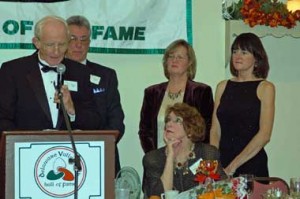
Remembering Philomena and Daniel Browne. From left: Barney Boyce, Tom Farrelly, Kathy McGee Burns, Carmel Browne Devlin, and Annette Browne Ward.

So many walks of life were represented: First woman president of the Philadelphia Mayo Association, inexhaustible parade organizer, industrious CEO, generous and loving couple (always with an open door for anyone from Ireland), and the gifted television exec.

Attracta O’Malley, Michael Bradley Jr., Michael O’Neill, Daniel and Philomena Browne, and Michael Colleran. The first four are 2007 inductees into the Delaware Valley Irish Hall of Fame; Colleran earned this year’s honorable recognition. All of them different, as noted, but all of them the same in the ways that count: generosity of spirit and tireless dedication to the Irish community.

All were honored Sunday night at the Philadelphia Irish Center, the ballroom filled nearly to bursting with more than 500 guests. (And it seemed like half of them had ties to Mayo, perhaps in honor of Attracta O’Malley, who came to the Philly area from Charlestown in 1961.)

And maybe the other half of the audience consisted of members of the Browne family. (There are a whole lot of them.) Philomena and Daniel Browne who died in 2006, but they are well remembered and loved in the Philadelphia Irish community. Ancient Order of Hibernians (AOH) Division 80, of which Danny Browne was a member, is now named after him. Daughters Carmel and Annette offered a lovely tribute.

We’ve captured many of the most memorable moments of the event. You can see them all in our photo essay.

Music

The Best of the Best

Patrick Street

Patrick Street: From left, Kevin Burke, John Carty, Ged Foley and Andy Irvine.

Think about the bands Andy Irvine has been associated  with—Sweeney’s Men, Planxty, De Danaan, Mozaik and Patrick Street, to name but a few.

Think about the names he could drop, people he’s rubbed shoulders with at one time or another, all of them stars in the Irish traditional firmament: Kevin Conneff, Davey Spillane, Frankie Gavin, Bill Whelan, Kevin Burke, John Carty, Joe Dolan, Johnny Moynihan, Paul Brady, Jackie Daly, Christie Moore, Gerry O’Bierne, Matt Malloy, Dolores Keane, Arty McGlynn … and now I’m just plain running out of breath.

Sure, we’re blessed with relatively new, young Irish traditional supergroups like Teada, Solas, Cherish the Ladies and Danu—but probably none of them ever would have sprouted up at all, were it not for the likes of Andy Irvine and his small but influential circle of friends. They really started Irish music along on its current path to worldwide acceptance and popularity, bridging the gap between the unquestionably influential Clancys and the bands of today.

“We all kind of grew up together,” says Irvine of his many friends in the Irish music scene of the early ‘70s. “Thirty-five years ago, there was another generation of musicians that were in charge. We were young pups, but gradually the mantle decended upon us.”

When Irvine first started to appear on the scene, Irish music was in the throes of a “ballad boom,” probably best personified by the Clancy Brothers, whose music Irvine liked—but whose sweater-clad on-stage personas, he did not. The Kingston Trio also was quite popular at the time, and Irvine was not a fan. What sprang from his discontent was a band called Sweeney’s Men, which he founded in 1966 with Moynihan and Dolan. With Sweeney’s Men, the ballads continued unabated—though the band apparently took a kind of perverse pride in not singing ballads the crowd could sing along with—and polished instrumentals moved to the fore.

Not long after the dissolution of Sweeney’s Men came Irvine’s next big band—Planxty. For Irvine, that’s when the “ballad boom” breathed its last. “The real breakthrough was in ‘72 when Planxty started playing,” he says. “It was like a moment in time that was waiting to happen.”

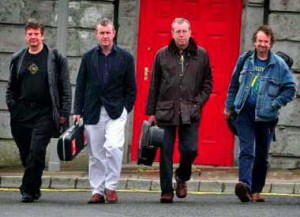
Fast forward to Patrick Street, conceived of as a band that showcased “the best of the best.” It sounds like promotional hyperbole until you consider the musicians who have wound up in Patrick Street. The current lineup includes founders Irvine, singing and playing bouzouki and mandolin, along with fiddler Kevin Burke, formerly of the Bothy Band. John Carty plays fiddle, banjo and flute, and Battlefield Band vet Ged Foley plays guitar. In previous incarnations, the band included button accordion wizard Jackie Daly, a De Danaan alum, and guitarist Arty McGlynn (Planxty). “Best of the best” accurately sums it up.

Now the band is on the road again, in support of a new CD, “On the Fly,” from Burke’s Loftus Records. (Jackie Daly also makes an appearance on the recording.)

Some things about the band are clearly new and different, but at its core, the sound is the same, Irvine says.

“We played a bit in Ireland over the summer with Jackie,” he says. “And then we did a couple of gigs without him. It’s really quite remarkable the difference in themusic. The music had a lot more air in it without the accordion. You could hear everything a little bit better. We all noticed it. I’m not saying that it’s better … it’s just different.”

Also a bit different is the addition of Carty, who has been with the band since 2005, mostly as a result of a comment by Ged Foley.

“He said, maybe we were getting into a bit of a rut, and we should do something about it,” Irvine says. “It was Ged who suggested having John play with us. It seemed like a real good idea to me.”

Carty’s presence also led to the new CD. Members of the band saw it as a great opportunity to record his unique contribution to the band.

You can hear Patrick Street for yourself Wednesday, Nov. 14, at 7:30 p.m., at Calvary Centre for Culture and Community, 801 S. 48th Street in Philadelphia.

People

Still Inflammable: Stiff Little Fingers

Two days have gone by, and my ears are still ringing.

Stiff Little Fingers, the pioneering punk band from Belfast, played to a hugely enthusastic audience Monday night at World Cafe, many of them leather-clad, studded, and pierced in places I’d rather not think about. And me, fresh from the office in a tweed sportcoat and khakis, a symphony in corporate browns and tans. (I felt like a salesman at an Amway convention who’d blundered into Sid and Nancy’s wedding reception.)

I’ll admit from the outset that, yes, I probably have lived under a rock for the past 56 years. Until a few weeks ago, I’d never heard of Stiff Little Fingers. But I followed the links to the “artist’s MySpace site” from the World Café Web page, and listened to a few of their tunes, and right away, I thought: Interesting. To my ears (still intact at the time), SLF sounded very unlike what I expected to hear. That is to say, they sounded … musical

What I heard were great, snarling yarns of anger and general pissed-offness, and yet nothing about SLF’s songs seems cliché. It all rings true. The guitarwork (by Jake Burns, who is also the group’s lead singer) is easily on a par with anything I’ve ever heard Pete Townshend play. The energy level of the band is far in excess of what one would expect from a bunch of guys who started playing together 30 years ago—and who look a lot like your average, paunchy guys-next-door, the type you’d not be surprised to see on a Saturday morning, queuing up at Sears to buy cans of semi-gloss wall paint.

Naturally, I had to go.

Unfortunately, I did not have time to swing by the house and pick up my ear plugs, so I decided to risk it. How bad could it be?

It was bad. And, oh, it was good. It’s safe to say that one SLF concert probably did more damage to my hearing than 10 years of playing drums in a bagpipe band. I won’t tell you that it was worth it. (Believe me, if you want to keep hearing and playing music, it is never worth it.) But it might have been an acceptable sacrifice.

To celebrate their 30 years in the business, the band performed tunes from “Inflammable Material,” their 1979 debut album. (“Like CDs, but bigger, and made of vinyl, and you could play both sides,” Burns informed the younger crowd.)
 
As with most punk bands, alienation is SLF’s stock in trade. But I think you could argue that kids coming of age in Belfast 30 years ago would have had a unique worldview.

Take for example, these lyrics from “Wasted Life:”

I could be a hero
Live and die for their ‘important’ cause
A united nation
Or an independent state with laws
And rules and regulations
That merely cause disturbances and wars
That is what I’ve got now
All thanks to the freedom-seeking hordes

Or these, from “Barbed Wire Love:”

I met you in No Man’s Land
Across the wire we were holding hands
Hearts a-bubble in the rubble
It was love at bomb site

Alrighty, then.

It might all seem silly and trite, I suppose, except that Burns spits out those now ancient lyrics with such conviction, and backs them up with guitar hacks of such volume and ferocity, it’s as if he’s shoving all of that pent-up angst through a musical wood chipper.

At the same time, I can only stand back in breathless admiration of Ali McMordie, who wields his bass like a battle sword; guitarist and backup vocalist Ian McCallum, with his daring leaps; and drummer Steve Grantley, who pounded sticks into kindling the whole night long. It’s reassuring to see guys my age who can still dish it out. They can hold their own with any band on the planet, regardless of age.

All that, and you’ll probably never hear “Barbed Wire Love” used to peddle Cadillac Escalades. And Jake Burns will never perform a duet with Cher.

Thank God.

News

Attention, Pub Denizens: Irish Thunder’s Pipes are Calling

If you’re heading out to the pubs Wednesday night, you might get a little whine along with your beer.

The “lads” of Irish Thunder Pipes and Drums are staging their annual Thanksgiving Eve pub crawl.

Just in case you’re an Irish Thunder pub crawl virgin and you have no idea how this works, it goes like this:

  • You’re sitting on the stool, nursing your pint. Nothing special happening.
  • The door of the bar bursts open.
  • Twenty or so dudes in kilts and playing bagpipes march into the bar, playing “The Minstrel Boy” and “The Wearin’ o’ the Green.”
  • Your dull, boring night at the pub just got a whole lot more interesting.
  • You are so happy and grateful, you open your wallet and you dump a pile of money into a hat (or whatever else the Irish Thunder boys are passing around.)

I used to play drums with Irish Thunder, so I have done a pub crawl or two. I promise you, this raucous musical interlude will absolutely make your night.

Here’s where the band expects to show up, according to the Thunder’s Pete Hand:

“After getting together at the AOH Club House and getting things tuned up, the band will head over to Conshohocken around 6 p.m.

There, they will make stops at the American Pub, Flanigan’s Boat House, Guppy’s and Spam’s.

Then onto the bus down to Philly were they will plays some tunes at the Cherry Street Tavern, Fado’s, Irish Pub, Moriarty’s, Fergie’s, McGillin’s and the last stop, Tir na Nog.”

Hey, you were already planning on a trip to the ol’ watering hole, anyway, right? Might as well visit one where the pipes are calling. Between the beer and the tunes, you’ll get all misty for the old sod.

And, as they say around AOH Division 1 in Swedesburg, the band’s home: “Up the Thunder!”

(I think that’s meant to be a good thing.)