All Posts By

Jeff Meade

People

Helping to Make a Difference in the World

Born in Jenkintown and presently residing in Villanova, Emily C. Riley is creative, multi-faceted and generous with her time and connections.

She has been a trustee for a number of significant organizations in such disparate fields as services for the homeless, arts and culture, and higher education. Besides spending happy times with her three adult children and four grandchildren, she loves to travel and has an appreciation for world culture and history.

Emily C. Riley

Emily C. Riley

Today, with her sister Josephine Mandeville as president, and a board of trustees comprised of family members and civic leaders, Emily heads the Connelly Foundation (she is executive vice president) whose mission, simply stated, is to “foster learning and improve the quality of life in the greater Philadelphia area.”

To that end, the foundation gives grants to non-profit organizations working in the fields of education, health and human services, arts, culture and civic enterprise. Its special focus also is providing scholarships to parochial school students to attend archdiocesan high school and developing initiatives in collaboration with the high schools and elementary schools of the Archdiocese of Philadelphia.

The Connelly Foundation, established in 1955 by her parents, John and Josephine Connelly, both children of Irish immigrant parents from Counties Waterford and Tyrone, is the financial legacy of John Connelly’s extraordinary business acumen and work ethic.

Forced to leave school after the eighth grade to help support his family, John Connelly went on to engineer the turnaround of a company, Crown Cork and Seal, that is now literally a textbook example of brilliant business management.

In their lifetime, John and Josephine Connelly raised six children and donated more than $70 million including major grants to Villanova, La Salle, Gwynedd-Mercy and Thomas Jefferson Universities, and Roman Catholic Archdioceses of Philadelphia and Newark, largely to fund Catholic education.

Emily Riley considers herself “fortunate to be able to continue this work.” Though she has a degree in English literature from Rosemont College, philanthropy “was what we were preparing for all our lives.”

“Our parents led by example,” she says. “They both came from modest backgrounds and were very giving people—of their time, resources and compassion. And we trekked along behind them.”

“My work has been rewarding in many ways,” she says, and the word “fortunate” comes up again. “I’ve been fortunate to have the experiences I’ve had and to meet the people I’ve met, like Sister Mary Scullion, who has been a friend for 20 years. It’s part of the pleasure of working in philanthropy to know people like her and to see the difference one person can make in the world … with a little help from their friends.”
Dance, People

A Heart as Big as Her Smile

Rosemarie and Mairead

Rosemarie Timoney and daughter Mairead.

A native of Clady, County Derry, Rosemarie Timoney began Irish dancing the age of four and won the South Derry Championship at the age of 17. In 1961, she came to the United States and five years later, she founded the Timoney School of Irish Dance in Glenside in 1966 as a way to share her love of dance—its fun, camaraderie, and its place in the history of the Irish culture.

Her classes are not just about teaching dancing, but about giving the children the confidence to always be and do their best. Her students don’t compete, but they do support the community. Her dancers have performed at nursing homes, hospitals, for handicapped children and school assemblies, as well as festivals all over.

The 1997 Grand Marshal of the Philadelphia St. Patrick’s Day Parade who also does color commentary during its broadcast on CBS3, Rosemarie is wife, mother of five, grandmother of nine, and has been described as “a virtual library of all things Irish in the Delaware Valley.”

She’s also tough—that must come from her years of playing camogie, the ladies’ version of the Irish game hurling, once described as a cross between hockey, lacrosse, and assault with a deadly weapon. She has traded that for much tamer bowling—she now plays with the St. Luke’s Mother’s League.

Rosemarie Timoney also has a heart as big as her smile. As someone who knows her once said, “It’s useless to try to give Rosemarie anything. She just gives it to someone else she thinks needs it more than she does.” She collects donations of clothes and other items for her thrift shop which benefits her hometown church in Ireland.

And though it will make her blush to hear it, she is beloved. In fact, when you talk to her her family, her dancers, or even the children she crosses to safety in her crossing guard job at Copper Beech Elementary School, the one phrase that comes up again and again is, “we just love her.”

People

Don’t You Just Love Us?

Nearly everybody reads the Bulletin.

That was the advertising slogan of the late, lamented Philadelphia Bulletin. I mean the Bulletin Sandy Grady wrote for, not the Bulletin in its most recent incarnation.

Number me among the ranks of “everybody.” I delivered it, and when I got home I read it all, beginning to end.

Well, the Bulletin (that Bulletin) is long gone. P.M. newspapers are gone, or mostly. Morning newspapers are biting the dust. Those that remain are struggling. (As witness the recent epic battle over the Inquirer and Daily News.)

Some say that small local Web sites like ours are part of the problem. We do what we do (most of us) for free. We have no employees. We have no paper boys or delivery trucks. There are no presses. No paper or ink. Doing what we do costs us almost nothing. And today it might be fair to say: Nearly everybody reads (whatever they read) online.

On the other hand, many of us have no idea what we’re doing. 🙂 A lot of community sites are published by people with no journalistic training, and no understanding of professional journalistic standards. (We’re both Temple J-school grads, and we’ve worked in newspapers, magazines, books and the Web since the days of Ben Franklin. OK, maybe not that long. But long enough to remember editing stories with a pencil.)

Now the people at The Reynolds Journalism Institute at the Missouri School of Journalism want to know: What does irishphiladelphia.com mean to you? Do you like us? Do you trust us? Do we help build the community?

They asked us to post a survey, and of course we said “you betcha.”

Here’s the survey. It’ll take you less than 10 minutes:

http://rjisurvey.irishphiladelphia.sgizmo.com/s3/

People

Ghost Story


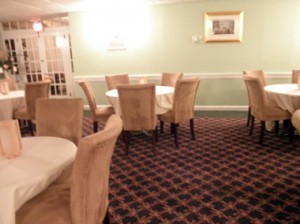
The Irish Center's dining room: Site of a ghostly experience.

The Irish Center's dining room: Site of a ghostly experience.

By Susan Spellman Burns

You may not believe in ghosts, but 22 percent of Americans assured CBS news pollsters that they’ve been up close and personal with the dead.

Paul Gallagher is one of them. It has been several months since the Irish Center bartender’s startling experience that Friday night as he closed up the Center, which included cleaning up the Texas hold-em game in the front dining room. At the time, Paul felt a cold breeze pass through his chest, though he had just closed and latched all the windows. Then he heard someone say. “What are you going to do now, Paul?”

I sat down with Paul, and we talked about the ghost he encountered, who he is fairly sure was the spirit of a late customer who made a very heartfelt gesture to Paul before his death.

Paul told me that he has been teased often by patrons and his friends after his previous interview about the ghost with irishphiladelphia‘s Denise Foley so he was hesitant to talk about it again. But we both agreed that his visitation was a gift, and a gift that can be shared to perhaps give others new insight on such a personal experience.

Q. Has your “secret admirer”contacted you in any way since that memorable night?
A.
No. I really don’t look for it, or try to think about it. Yes it happened. I have moved on.

Q. Do you have a better understanding of who may have visited you?
A.
I feel it was a patron that passed away last fall. My gut tells me it was him. I know it was him.

Q. Why do you feel this spirit chose you to contact?
A.
It was probably just his way of saying good-bye. I feel honored.

Q. The ghost asked “What are you going to do now Paul?” Did this have anything to do with your own personal struggles?
A.
No, definitely not. I have thought about this several times. I have my own personal struggles like everybody. It was again, just his way of saying good-bye.

Q. Has this experience sparked a greater interest in the paranormal?
A.
Not really. Sometimes I watch one of the ghost hunter shows on television, but when it comes to choosing that or sports shows, I prefer watching sports.

Q. I know you mentioned that you think the ghost has moved on since that night, do you feel there maybe other spirits in the Irish Center?
A.
I have not sensed this in any way myself, but there is certainly talk that there are other ghosts here.

The Burning Question:

As I stood in the front dining room after my interview with Paul, did I experience anything paranormal?

Nope. However, I did feel something quite normal. I could feel that this building was filled with dear memories, dreams, happy times, and that magical Irish love.

Do you have a true ghost story to tell? Contact Susan Spellman Burns via the “contact us” link on the home page. She’s on the trail of Irish spirits—of the other-worldly kind—and will be taking us on ghost tours periodically.

Sports

For the Delaware County Gaels, the Ultimate Road Trip

The competition

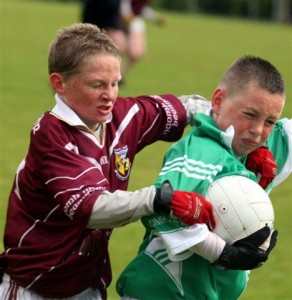
A look at the Delco Gaels' tough competition.

They’re the future of Philadelphia’s Gaelic Athletic Association, and they’re just about to be put to the test.

On the upcoming July 4th weekend, when most of the rest of us are attending parades, noshing on hot dogs and ooh-ing and ahh-ing over fireworks, 22 young members of the Delaware County Gaels Irish football team will be slugging it out at the Féile Peile na nÓg, a national festival of Irish athletics for young people, this year held in County Derry.

Tom Higgins, a Gaels coach, says the boys are looking forward to the challenge and are busily preparing to compete in the tournament’s Division 5. (There are eight divisions in all, with Division 1 reserved for the toughest and most skilled.)

A group of under-14s from the Philly area competed in that grade three years ago, with some success. “We did pretty good,” says Higgins, now a real estate agent in Plymouth Meeting. (He’s originally from Galway, with a long history of involvement—on the field and off—in the Philadelphia GAA.) “We won two out of three. This year we chose to stay in that same division. We try to know our limitations. We’ll play local Irish teams from smaller clubs.”

The trip lasts from June 25 to July 6. Once they get to Ireland, the boys will play a few warm-up matches before they compete in earnest. The first is in Convoy in County Donegal, the next at St. Eunan’s in Letterkenny (also Donegal), and the last against St. Gall’s in Belfast.

Three of the boys who competed three years ago are with the Delco Gaels club that is going to Ireland this year to represent Philadelphia. In the last tourney, the team included members of all the local youth teams. This year, it’s just the Gaels. It’s a strong team, says Higgins.

Like many youth GAA teams in the States, he says, the Gaels are a mix of boys whose dads are from Ireland, who themselves played Gaelic athletics, and kids for whom the sport of Irish football was brand-new when they joined. The Irish come to the game already knowing a lot about it. The kids who have not played before have a bit of a learning curve, he says, but they catch on fast and seem to love it.

“They like the contact,” Higgins says. “They like the speed of it and the passion. It’s like soccer but there’s more activity and it’s higher scoring. It’s a mix of football, soccer, basketball—there’s a few sports jumbled up in there.”

If GAA sports are to survive in the United States—and certainly in the Philadelphia area—Higgins says teams like the Delco Gaels are essential.

Higgins, who has played Irish football in the Delaware Valley for years, says he remembers back in the 1980s, when there were about 15 teams, and the games brought out hundreds of spectators. One reason for the success of GAA teams in those days, he adds, was the participation of players from Ireland—many of whom were in the country illegally. Bringing in players legally these days just isn’t happening.

“Immigration (to the United States) has stopped,” he says. “The players are going to Australia or Canada instead. So we really need to grow our own. It really should have been done long ago.”

The team needs about $50,000 to get the team to Derry, Higgins says, and so far about $35,000 has been raised. The team has already run two fund-raisers, he adds, and around mid-June there will be one more. “That should put us over,” he says.

The team is also looking for a sponsor for its jerseys—roughly $5,000. If you want jersey naming rights—or you want to help in a smaller way—contact Higgins at (215) 275-0591.

Columns

Saying Farewell to BallyPhilly

By May 15, the little online village of BallyPhilly will be just a fond memory. On that date, we’re turning the lights off for good.

Lately, we’ve done a lot of work to make the site more attractive. In fact, we think it looks pretty good. We thought the facelift might attract new members and generate more discussions, inspire more blog posts, encourage more people to share photos and videos, and interest more members in starting or joining groups.

Nothing like that has happened. Aside from one incredibly prolific correspondent from Belfast (thanks, Dick!), hardly anyone posts anything on BallyPhilly. Daily visits to the site hardly ever exceed 30. And, lately, the only prospective new members we get on a day-to-day basis are porn peddlers. (This morning we received a membership application from Sexy Shannon Elizabeth. We’re not sure who that is, and it sounds intriguing, but … no.)

That’s not to say that the idea of a robust online community for Irish Philadelphians can’t work. In fact, it does work … and it has been working for quite a while. It’s our Irish Philadelphia group on Facebook.

In all the time BallyPhilly has occupied its little corner of the Web, we’ve signed up only 335 members. In contrast, our Facebook page has 1,487 members—and our Facebook page has not been on the Web as long as BallyPhilly has.

What’s more, our Facebook group is infinitely more active. People are always posting their thoughts there, asking genealogy questions, announcing their concerts—even trying to hire a nanny!

The way to go seems obvious to us. It just makes more sense to devote our energies to maintaining our Facebook group.

And in case you’re wondering … no, we’re not closing down BallyPhilly because the host is about to start charging for what is now a free service. We have a pretty fair idea what those charges will be, and they seem quite reasonable. If BallyPhilly was a going concern, we’d happily foot the bill. But it really makes no sense to pay for a site that is visited by 30 people a day.

So for those of you who have been loyal members, especially those who were in on the ground floor, thank you so much for taking part in this experiment in online community building.

But bear in mind, even though BallyPhilly is going away, you can still belong to a vibrant Irish online community. Just relocate to our Facebook page, and join up! Again, our thanks for your support.

People

2010 Easter Rising Commemoration

Easter rising

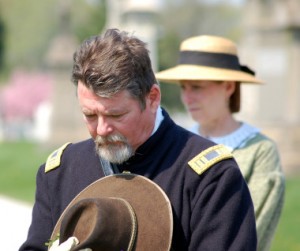
An officer of the 69th Pa. Irish volunteers bows his head in prayer. (Click photo to view slideshow.)

It happened nearly a hundred years ago.

It lasted only seven days.

The good guys lost, and their leaders were imprisoned or executed.

It was the 1916 Easter Rising, a bloody, brave but unsuccessful attempt to expel the British from Ireland and to establish a sovereign republic.

Today, more than a few Delaware Valley Irish-Americans remember, and their goals are substantially unchanged from those of the patriots of 1916.

On Sunday, several Delaware Valley Irish groups gathered once again at Holy Cross Cemetery in Yeadon to commemorate the abortive (but successful in the long run) Rising. Led by the 69th Pennsylvania Volunteers and members of the Philadelphia Emerald Society Pipe Band, the group marched to the gravesite of Joseph McGarrity, the County Tyrone-born Philadelphia businessman and a leader of Clan na Gael. They reaffirmed the Easter proclamation’s “right of the people of Ireland to the ownership of Ireland.”

McGarrity holds a special place in the republican heart. The one-time successful entrepreneur was involved in efforts to arm the forces arrayed against Great Britain. He published a fiercely pro-republican newspaper called the Irish Press. He was a friend to Irish leader Eamon de Valera (with whom he later parted company). He never gave up on the armed struggle for independence and unity.

It was a brief ceremony, but moving, as always.

People

A Night of Celebration for St. Patrick’s Day Award Winners

St. Patrick's Day Parade awards

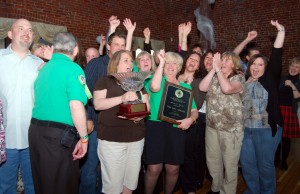
Tara Gael dancers relish their big win. (Click on photo for slideshow.)

It was an exciting night all ’round at Finnigan’s Wake as the Philadelphia Saint Patrick’s Day Observance Association finally put the 2010 parade to bed. (Not that parade planning and fund-raising ever really stops.)

Anyone who won was plainly pleased to have been chosen. But if there was a prize for over-the-top enthusiasm it would have to go to the Tara Gael Dancers, who won the Marie C. Burns Award for Outstanding Adult Dance Group. They also won in 2008 and 2007, but clearly, winning never gets old for this group.

There were several repeat winners as well. 2nd Street Irish Society was the winner of the Msgr. Thomas J. Rilley Award for Outstanding Fraternal Organization for the third year running. Rince Ri dance school won the Walter Garvin Award for Outstanding Children’s Irish Dance Group for the second year in a row. St. Katherine of Siena N.E. Philadelphia picked up the Father Kevin C. Trautner Award for Outstanding School or Religious Organization that displays their Irish Heritage while promoting Christian Values for the third year since the prize was established.

Here are this year’s award winners overall:

Honorable James H.J. Tate Award
Group that Best Exemplified the Spirit of the Parade
McDade / Cara Championship Dancers

Msgr. Thomas J. Rilley Award
Outstanding Fraternal Organization
2nd Street Irish Society

George Costello Award
Organization with the Outstanding Float in the Parade
Cavan Society

Hon. Vincent A. Carroll Award
Outstanding Musical Unit Excluding Grade School Bands
Philadelphia Police & Fire, Pipes & Drum Band

Anthony J. Ryan Award
Outstanding Grade School Band
Catholic Elementary Schools Marching Band

Walter Garvin Award
Outstanding Children’s Irish Dance Group
Rince Ri School of Irish Dance

Marie C. Burns Award
Outstanding Adult Dance Group
Tara Gael Dancers

Joseph E. Montgomery Award
Outstanding AOH and/or LAOH Divisions
All AOH & LAOH Divisions

Joseph J. “Banjo” McCoy Award
Outstanding Fraternal Organization
Cairdeas Irish Brigade

James F. Cawley Parade Director’s Award
Outstanding Irish Performance or Display
2010 Cardinal O’Hara High School Marching Band

Father Kevin C. Trautner Award
Outstanding School or Religious Organization that displays their Irish Heritage while promoting Christian Values
St. Katherine of Siena N.E. Philadelphia

Maureen McDade McGrory Award
Outstanding Children’s Irish Dance Group Exemplifying the Spirit of Irish Culture through Traditional Dance
Coyle School of Irish Dance