All Posts By

Jeff Meade

People

Ireland’s Loss, Our Gain

Laurence Banville grew up in the tiny townland of Ballykerogue, a few miles from the Kennedy family homestead of New Ross in County Wexford. For the first few years of his life, Banville’s family owned a pig farm. “That’s before my dad became a builder,” he recalls, “until I was about 5 or 6. I do remember the smells and all that.”

We all have to start somewhere and, although the farm really played a minor role in Banville’s early life, that was his beginning.

Laurence Banville

Laurence Banville

Banville has come a long way from Ballykerogue, and not just in air miles. Today, this son of a rural Irish contractor is an attorney with the Center City Philadelphia firm of Willbraham Lawler & Buba, specializing in asbestos defense litigation. He has a bachelor of law degree from University College Dublin and was admitted to the New York state bar in 2009. Banville works on New York asbestos cases from Philadelphia. He is also the founding chairman of the nascent Irish Network-Philadelphia.

That he would wind up practicing law, and in the United States, is not much of a surprise to Banville. He wasn’t drawn to the law at first, but it wasn’t long before the cool logic and fact patterns of the law began to appeal to this analytical young man.

“When I went looking at all the various degrees that were available in the country, I found the program at University College Dublin, which was business and law combined,” he says. “I figured it was a safe option. I was curious about law, but obviously I’d never studied or practiced it before, so (if things didn’t work out) I decided I could always fall back on the business side of things. But after sitting in a few courses, I found the law more interesting than the business.”

Banville would go on to graduate from the program with honors in 2008. but early on in his academic career, it was clear that Banville wasn’t likely to return home to Ballykerogue for a small local practice dealing in wills and probate, traffic accidents and property transactions.

In 2006 he landed a spot in a prestigious exchange program at the Université catholique de Louvain in Belgium (classes were in French), and he stayed on for a summer associate posting at the huge international law firm Cleary Gottlieb Steen & Hamilton in Brussels. Next up, in 2007, a stint as summer associate at Ireland’s prestigious commerical law firm Matheson Ormsby Prentice in Dublin.

Somewhere along the way, he found time to create a small company called Roasted Promotions, described as “an Irish partnership offering student-focused advertising in Dublin’s entertainment industry.”

Laurence Banville was one busy young fella. But it was his international experience that most opened his eyes to future possibilities. “”Ever since I went to Belgium,” he says, “I knew I wouldn’t stay in Ireland. I really like living in other countries with different cultures and different diversity.”

It was while at Cleary Gottlieb that someone told him he ought to investigate the practice of law in the United States. So, in 2008, he sought and earned another summer associate position, this time at the Westmont, N.J., firm of Brown & Connery. And shortly thereafter, the bar exam in New York.

It was love that brought him to Philadelphia. His girlfriend Brooke Holdsworth lived here, so he sought a position in the city … and that brought him to his current firm, and the asbestos work.

Believe it or not, even though various federal agencies started banning asbestos in the late 1970s, there’s still plenty of asbestos litigation. “There’s a 40-year latency period with asbestos, he says. [That’s the time between exposure and the onset of mesothelioma, a cancer attributed to asbestos exposure.] Currently we are seeing more secondary exposure cases, like wives who washed the clothes of their husbands who worked with asbestos.”

At this early stage of his career, asbestos law is the focal point, but Banville is open to whatever comes next. “I’m pretty flexible. I’ve practiced in a number of different areas of law–antitrust, mergers, corporate takeover work.”

it was probably only a matter of time before the Irish-born attorney made his way into the Philadelphia Brehon Law Society–an organization of lawyers and judges of Irish descent. “The only support group I had in Philadelphia was the Brehons,” he says. “If it weren’t for the law, I wouldn’t have known where to go for support.”

And then, back around St. Patrick’s Day, Banville helped form another welcoming organization when he joined with several other Irish and Irish-Americans to create Irish Network-Philadelphia (IN-Philly), a local chapter of an organization to which he had belonged in New York. “When I was in New York, it (the Irish Network) was one of the first events I went to,” he says. “I liked the diverse ‘boots to suits’ nature of the group and the laid-back attitude toward networking that the group in New York had. They were very welcoming, and that was really helpful. So when I was asked to look into seeing whether an Irish Network would be good for Philadelphia, I thought it would be a great idea.”

Obviously, Banville is far from alone in guiding IN-Philly through its formative stages. But with someone with such a strong creative spirit and drive at the helm, IN-Philly is bound to be just what Banville predicts: one great idea.

News

Learning from Multicultural Philadelphia

Recent remarks posted to an online news forum:

  • “We cannot afford any more illegal immigrants, especially illegal liars.”
  • “Most welfare fraudsters are illegal immigrants.”
  • “We cannot afford to pay for non-nationals, and we do not want this many here, anyway.”

And finally, lest you assume these comments were written by an angry Arizonan about illegal entry into the United States:

  • “Is it unreasonable for us to expect that Ireland be governed for the Irish first? When will the Irish government protect their own native population?”

At a time when many in the United States rail against the undocumented, the Irish are struggling with their own immigration problems. A survey a few years ago suggested that foreign nationals make up 10 percent of the Irish workforce. Those numbers probably have dropped since the Irish economy went into the tank, but all the same, Ireland is still learning to cope with the many non-Irish who are suddenly in their midst.

“Right now the Irish feel like they’re coming over and taking their jobs,” says Center City attorney and County Wexford native Laurence Banville, chair of Irish Network-Philadelphia. “In the rural areas there is culture clash. You have an older generation not happy to see a Polish shop setting up in the middle of town, or a section of a city becoming a Chinatown. It’s something different and they don’t like it.”

Such suspicion and animosity gives rise to ethnic tensions—something about which we Philadelphians know all too well, as witness violence against Chinese students at South Philadelphia High School. It’s that kind of experience that informs a special program this afternoon at 2 in Center City sponsored by IN-Philadelphia and the Brehon Society, to be attended by the 2010 Irish participants in the Washington Ireland Program (WIP).

The program is called, “What Lessons Can An Increasingly Multicultural Ireland Learn From Philadelphia’s Conflict Resolution Strategies.” It’s to be held at Janney Montgomery Scott LLC, 7th Floor Education Center, 1801 Market Street, in Philadelphia.

Over 70 people have already registered to attend the event, featuring a panel discussion by Pamela P. Dembe, president judge of the Court of Common Pleas in Philadelphia, City Council member Jack Kelly, and Amy S. Cox, Ph.D., adjunct professor, Arcadia University International Peace and Conflict Resolution. (Other local experts were expected to join the panel.)

The main purpose of the Washington Ireland Program is to support continuing peace and reconciliation efforts in Northern Ireland and Ireland by training future leaders, says Banville. There are 30 Protestant and Catholic university students in the Class of 2010, currently residing in Washington, D.C. Banville has no doubt that Philadelphia has a lot to offer them.

“These individuals who will be going back to Ireland will bring back the conflict resolution strategies that are implemented here in Philadelphia,” he says. “Ireland is behind Philadelphia in terms of how multicultural this place is… and how multicultural Ireland will be. It’s something they have to learn pretty fast. This program will be a benefit to Ireland directly.”

Music

The Plinkety Plink Diaries

Wednesday, July 28

Hello all, and welcome to the first installment of the Plinkety Plink Diaries.

The 10th annual Somerset Folk Harp Festival is about to begin. This event is a gathering for harpers of all levels, taking place this year in Parsippany, N.J., and is run by Kathy DeAngelo, half of McDermott’s Handy and director of You Gotta Have Harp Productions.

This is my first year attending, and I am simultaneously thrilled and horrified.

I am thrilled because I’ll get to meet harpers from all over the world. (The preliminary e-mail from Kathy mentions that there will be attendees from the Netherlands, South Korea and Taiwan.) I’ll also get a chance to listen to and learn from some of the best harp players out there (including Grainne Hambly and William Jackson, who have been featured on Irish Philadelphia before).

I am horrified because I’ve just realized that I have no idea what I am doing, have never bothered to learn what key anything is in and actually my playing is terrible. That’s a moot point, really, because I’ve suddenly forgotten every song I ever learned. Also, my suitcase won’t shut.

My status as a festival first-timer will be marked by a green dot on my name tag. I feel it would be more appropriate to stamp “NOOB” in large red letters on my forehead, but perhaps that would be excessive—after all, I’m not exactly a beginner. I’ve played Celtic harp for roughly six years, took lessons for a handful of them, and competed in the Mid Atlantic Fleadh in 2005.

However, I haven’t had lessons for some time now and, to
perfectly honest, do not practice every day. So I’m not really a total noob, but I am most definitely an amateur and a slightly rusty amateur at that.

Here’s hoping the other kids will want to play with me.

Friday, July 30

On Thursday morning, a low rumble wakes me at seven, and I wonder: was that thunder, or someone’s harp falling over upstairs?

Fortunately, it was only thunder. Within an hour or so, the morning rain cleared up and we had a sunny day for the beginning of the festival.

Figuring I might as well jump in with both feet, I’ve signed up for as many workshops in advance as possible. First up is Creative Marketing Techniques with Pamela Bruner, a Celtic harper and singer turned small business marketing coach. She possesses
apparently boundless energy and is full of smart, no-nonsense info for harpers looking to build a stronger brand and get more gigs.

My favorite piece of advice from her?

“There’s three cases in which you don’t follow up [with potential clients]: if they’re dead. If you’re dead. If they tell you to buzz off. And that last one’s negotiable.”

In the afternoon I have back-to-back workshops with Billy Jackson and Grainne Hambly: one is an introduction to Scottish music for harp, the other is on Irish traditional dance music.

Both classes are full to bursting, and at times they both gently remind us to stop noodling about on the strings. And with good reason: when twenty-some harpers all begin practicing trebles at the same time, they tend to sound like a room full of drunken
Tinkerbells.

By the time we’re finished, I have the beginnings of quite a few new tunes to work on and I’m pooped.

Luckily, we all have a chance to relax at the first of the evening concerts. Tonight’s performers are Nancy Hurrell, Janet Witman and Nicolas Carter. What strikes me most about the performances is how different their individual styles are, from Witman’s jazzed-up hornpipes to Carter’s more percussive Paraguayan pieces.

Yet all of them have that surety, a certain precision of fingering and control over volume (from feeling the bass in the floor to being just barely audible) that marks them as true masters (or
mistresses, as the case may be) of their instrument.

Before Nancy Hurrell begins her set, she says something to the new festival attendees: “You have no idea what you’re in for.”

I’m beginning to get an idea.

Arts, People

Much More Than Child’s Play

Kathy O'Connell

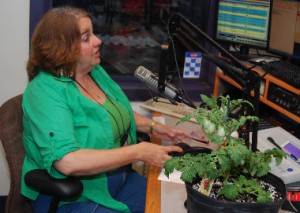
Kathleen Ann Clare O'Connell, doing what she does best ... entertaining and educating kids.

It’s a few minutes before 7 o’clock on a Wednesday night at the University City studios of radio station WXPN. Two floors below street level, tucked away in a boxy basement studio, Kathy O’Connell is seated before a stack of keyboards, blinking buttons and computer monitors. A boom microphone hovers just inches from her face, like an electronic cobra poised to strike.

O’Connell, longtime host of the station’s Peabody Award-winning “Kids Corner,” is having a leisurely chat with frequent guest Jeff Clarke about a tomato plant he has brought in from the Camden Children’s Garden, where he is the supervisor.

From an overhead speaker, we hear the voice of producer Robert Drake, who is tucked away in his own box on the other side of a large window. “Thirty seconds,” he says. O’Connell casually slips a chunky pair of Sony earphones over her graying red hair, and in a moment the familiar strains of the Kids Corner theme fill the room. It’s a catchy little tune, a cross between an electronic synthesizer and the sound of someone blowing across the lip of a Coke bottle.

This is as planned as “Kid’s Corner” gets. O’Connell arrived in the studio only a few steps ahead of Clarke. She wasn’t expecting her guest; Drake ducked in briefly to explain that there was a mix-up in the schedule. Clarke’s unexpected appearance doesn’t throw her off.

O’Connell appears to follow no script, but after the music stops, she smoothly and enthusiastically launches into her intro and then turns in her chair to interview Clarke. The rest of the show hums along with all the reliability of an atomic clock. Kathy O’Connell, every kid’s favorite fun radio aunt, is never at a loss for words.

“The number one rule here is, if something goes wrong, turn Kathy’s mic on right away,” she explains in a post-show interview. “I can talk through anything. This is just some quirky thing I know how to do.”

By all accounts, she does it spectacularly well. She now presides over one of the longest-lived, most acclaimed radio shows exclusively for children, but it is not a career anyone might have foreseen for her.

O’Connell’s early college career, which proceeded in fits and starts—and ultimately a hard stop—had nothing to do with broadcast. She graduated from secretarial school and, for a time, seemed to be following the office worker bee career path.

O’Connell’s long, storied life in radio began by accident—largely in response to a far more notable accident. It was in 1979 that the young O’Connell, riled up over the nuclear disaster at Three Mile Island, started volunteering at the listener-supported, lefty New York radio station WBAI. She answered phones, ran the elevator after midnight and became a member of the small cadre of volunteers—dubbed the “reception riffraff”—who kept the place running.

“As soon as I walked in the door (of WBAI), it was like, ‘Honey, I’m home.’ The only place I had ever felt that comfortable and that at home before that was when I started hanging out at Channel 5 in front of the Soupy Sales show in 1965,” she says. “I recognized that sense of familiarity, and I stayed. I wound up really building a life there.”

Regardless of what anyone else might have predicted, it’s not a complete surprise to O’Connell that her deep fascination with radio was able to take root at WBAI. “I was always the kid entering talent shows and doing dancing school. I did standup comedy for a while. While I went into WBAI without the agenda of ‘Oh, I’m going to get a career in radio,’ performing was part of the deal for me always.”

Kathleen Anne Clare O’Connell made her debut in Mary Immaculate Hospital in Bayside, Queens; she grew up in Huntington, Long Island. Given her name, her obvious Irish Catholic roots and her early childhood in two hotbeds of Irish-American culture, you’d expect O’Connell to have grown up—as the saying goes—as Irish as Paddy’s pig.

Certainly, Irish influences were everywhere in O’Connell’s life. Her father, Thomas John O’Connell, was a New York City cop. So was her grandfather, and her great-grandfather. Her uncle Eddie was with the New York City Fire Department and her Uncle Steve was a New York City cop. Her father was a Hibernian and, for a time, he ran the local St. Patrick’s Day Parade–about which, O’Connell has one standout memory.

“One year he died a puppy’s fur green. I’m not proud of that,” she laughs. “He did it with food coloring. The pictures were in Newsday, which was a black-and-white newspaper, so you have black-and-white pictures of this dog who was dyed a very light shade of green. This was my father’s publicity stunt. I think that was his equivalent of painting a green stripe down the middle of the road.”

She remembers a time when her father brought home a book called “Cry Blood, Cry Erin.”

“He said he wanted us to know where we came from,” she says. But the book sat on the coffee table, unread. In fact, no one other than her father talked much about their Irishness.

She remembers when Father O’Brian, pastor of St. Hugh of Lincoln Catholic School, called upon her during report card time and asked her, “When is St. Patrick’s Day?” “I said… March 19th? He made sure I never forgot it again!” she says.

That no one thought much about “the ould sod” wasn’t all that unusual in those days, she says. “There was a real disconnect between that country over there that we came from and the Irish identity here in America. That was a very strong thing. We’d probably tell you our family was from New York before we’d tell you we were from Ireland.”

So that was Kathy O’Connell’s early life… a plain-vanilla ‘60s American upbringing in a plain-vanilla town that was just a stop along the Long Island Railroad.

And then Soupy Sales happened along.

To most, Soupy was just the popular pie-in-the-face host of what was ostensibly a kids’ show. To a kid growing up in the far New York City suburbs, though, Soupy probably seemed like a major subversive influence.

At the age of 13, O’Connell started taking the train into the city and hanging out at Channel 5, the station where Soupy did his show. She joined a gaggle of girls who dogged Soupy’s every step. in time, she began to have conversations with him, and started to get to know him.

“May 27, 1965, was Ascension Thursday, and I had off from school. I was in 8th grade. That was the first time I went into New York to see the Soupy Sales show,” she recalls. “I became a regular. My friends and I basically stalked him. We would follow him everywhere. I was not as bad as a couple of my friends, who planted themselves outside of his house on 80th Street every weekend.”

For most of O’Connell’s teenage years, stalking Soupy was an all-consuming passion. But as she entered her late teens, she moved on to more adult interests and, in 1968, deeply adult concerns. That was the year, she says, that her family “fell apart.” Kathy O’Connell moved on from the passions of her early adolescence, unaware of the part that Soupy Sales would someday play in her life.

In 1972, O’Connell’s father died, followed in 1976 by her mother. Her mother’s life insurance settlement made it possible for her to explore interests beyond the secretarial pool. That’s when O’Connell started volunteering at WBAI.

Although she started by performing menial chores, she started taking classes offered by the station, learning how to operate the sound board. Then she was asked to read the community calendar—which she did to accompaniment of little comedy routines and wacky sound effects like the “Dragnet” theme. The station management liked her work so much, they offered her regularly scheduled shows.

She then moved to WNYC, the city’s large public radio station—not on air, but again working the board. One night in 1983 when she was pulling engineering duty, the two co-hosts of the station’s show for kids walked off with only minutes to go before air time.

“Four people in suits came walking in, one of whom was the program director, and he says to me, ‘We need you to help us out.’ None of them knew what buttons to push to keep the show on the air,” she says. “I said, ‘You let me talk and I’ll help you out however I can.’ That was when I got the job at ‘Small Things Considered.'”

The three-hour show wound up winning a Peabody Award. It morphed into a nationally syndicated show called “Kids America.” That was a pretty rapid rise, but O’Connell’s career seemed to come to an abrupt halt when the Corporation for Public Broadcasting declined to renew its financial support for the show.

Christmas Eve 1987, marked the show’s swan song. “A Merry Christmas, I don’t think!” she exclaims in her silly Kid’s Corner voice.

A couple of months before “Kids America” bit the dust, Philadelphia radio station WXPN picked up the syndicated show. Not long after the show folded, the station manager called up O’Connell and asked: How would you like to start a kids’ show in Philadelphia? She remembers her grateful response: “I said, I’ll give Philly a year, sure.”

O’Connell came to the city the weekend after Christmas. January 4, 1988, was the first show. Starting a new show in 10 days would be a daunting proposition for anyone, and O’Connell truly felt the pressure. But the show must go on… and it did.

“Here’s where WBAI’s training really, really helped. I said to myself, OK—I’ve got to talk for an hour and a half. I can do that,” she says. She resolved to play kids tunes she had hijacked from WNYC—”I think the statute of limitations has run out on that,” she says—and make up a history game, and then open up the phones.

“Thank God for WBAI and their live radio department,” O’Connell says. “I did worry about what I was going to do on that first show. I mean, there was planning. But I knew that I wasn’t going to know what would happen until the on-air light went on.”

She remembers WBAI talk radio being very confrontational. With kids, there’s no confrontation. “They may say ‘what?’ a couple hundred times, but they don’t come to argue,” she says. “They’re a really great starting off point. It’s not hard.

Amazingly (but probably not to O’Connell, who radiates self-confidence), the show went very well. There was even another Peabody Award. Life was very good indeed. In 2002, it got better.

O’Connell, who had continued to run into Soupy Sales now and again, renewed the relationship. “That’s when I got to know his second wife, Trudy,” she says. “Soupy and Trudy, from 2002 and on until the day he died, when I was with him, they were like my parents. “I got to see Soupy’s look of pride on his face, watching me up on the stage or coming to an event where my fans were, and watching me sign autographs. He was like my dad.”

It’s a sign of Sales’ high regard for O’Connell that, after he died in 2009, she inherited his two memorable puppets, “White Fang” and “Black Tooth.” She’s hoping to donate them to the Smithsonian.

When O’Connell looks back on her career, it’s clear to her now that Soupy Sales was always a profound influence. She knows she has a fairly large adult audience, along with the kids. It’s because her brand of radio works on both levels. She remembers Soupy’s “stuff” working the same way. “He could say something that worked on a goofy kids’ level, and then go on to make Leopold and Loeb jokes,” she says.

“I used to say to Soupy all the time, ‘Thank God I wasted my life on you. I still do his jokes and the things Iearned from him. I learned from the best. I learned from Soupy.”


Sports

Gaels Still Riding High After Their Tournament Play in Derry

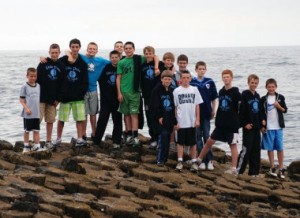
The Delco Gaels at the Giant's Causeway. (Photo by Mike Boyce)

The Delco Gaels at the Giant's Causeway. (Photo by Mike Boyce)

When most people tour Ireland, they visit the crumbling castles. They sniff wildflowers in the Burren. They tap their feet to fiddle music in Doolin. They ignore all the warning signs and stand looking out over the edge of the Cliffs of Moher. They eat brown bread and butter in the morning, and drink Guinness in the evening.

And make no mistake, that’s a pretty good trip.

But becoming a part of the community, and throwing yourself heart and soul into one of Ireland’s most prized pastimes? Priceless!

That’s what the Irish football-playing boys of the Delaware County Gaels did a few weeks ago when they headed to County Derry for the Féile Peile na nÓg, a national festival of Gaelic athletics for young people.

Did they come home champs? Nah. Did they come happy? You bet, says Tom Higgins, of the Gaels organization.

“We did well. We won our group,” he says. “We were in with the host team from Derry and another team from Derry, and a team from Gloucestershire, England. We got to the semi level of our division, and we lost by a point to Kildare, in overtime. Kildare eventually got killed in the finals, and the same thing would have happened to us, anyway. We did as well as we had hoped to do.”

When the Gaels first arrived, over the July 4th weekend, they played a warmup game against the host team, St. Gall’s. “They hosted us and had a great night for us,” he says. “Then we went on to Letterkenny in Donegal for a four-team tournament. We won two out of three of those games, and then it was on to the tournament.” The team and families stayed in Letterkenny for most of their visit.

The last two nights they stayed in Ballymaguigan in Derry’s far southeast “They’re the smallest club in Ulster, maybe the smallest club in all Ireland. So an event like this might never hapopened again for them,” says Higgins. “They hosted us well and treated us great.”

Traveling to the Feile in Derry was a huge thrill for the boys, Higgins says. More than half of the kids aren’t Irish. “I’d say they were blown away by the hospitality,” he says.

Playing in Derry was also gratifying because there are so many ties between Philadelphia and the North. “A ton of people came out to see us,” Higgins says. “It was a reunion of sorts.”

For a time, Higgins says, it must have seemed to the locals like Ireland was overrun by Philadelphians. He and a group of about 30 from Philly were visiting a pub called The Cottage in Letterkenny, and a lot of them were wearing Philadelphia GAA jerseys. Higgins said he overheard a tourist comment on the jerseys and ask the bartender: Is there a Philadelphia in Ireland? Higgins says he went over and introduced himself. Turns out the tourist was from Levittown.

A little while later, another tourist came ambling in, looking for a place to hear Irish music. Higgins recognized the new visitor as Tom Johnson, someone he knew from Lafayette Hill.

“The bartender comes over to me and asks: How many people from Philadelphia are in this town?”

Ah … never enough.

Music

Help Three Talented Kids Get to Ireland

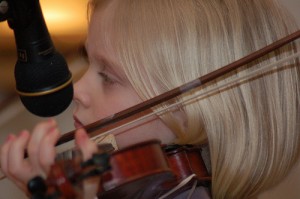
Haley Richardson isn't shy about performing.

Haley Richardson isn't shy about performing.

Saturday probably won’t be much of a beach day. The weather man predicts thunderstorms.

Looking for a way to salvage the first half of your all-too-short weekend? Head on over to the MacSwiney Club in Jenkintown, slip into your dancing shoes and create a little thunder of your own.

The Irish music and culture group Comhaltas Ceoltóirí Éireann (just say COAL-tus for short, and you’ll be close enough) is going to pound out Irish tunes from 7 to 11 at its Summer Social Evening, and you can dance till your feet cry “uncle.” Best of all, your ten bucks will also help support three of CCE’s youngest and most talented members as they prepare to compete in the All-Ireland Fleadh Cheoil (music festival) in County Cavan in August.

CCE’s Cass Tinney, who is helping to organize the night of music, dance, food and fun, says two of the kids—fiddlers Haley Richardson and Alexander Weir—will be in North Carolina at a kind of fiddle camp as a tune-up for the Fleadh, so they won’t be able to attend. Haley won for solo fiddle and Alexander, for slow airs, in the 6- to 12-year-old group at the Mid-Atlantic Regional Fleadh in Pearl River, N.Y. However, harper Emily Safko—who won solo harp in the 6-12 group—will be there to pluck out some tunes.

“We usually have our social in the spring,” says Tinney. “But every date we picked out, something else came up. So we decided to do it in the summer, and then we thought: Why not do it for the kids?”

Why not, indeed. John Shields will be spinning the tunes (do we say “spin” anymore?) and presiding over the dancing. If John Shields can’t get you off your tush, no one can. CCE will also be providing snacks, but is asking folks to bring some of their own. You can also sidle up to the bar, or teetotal along with coffee and tea.

Tinney recognizes that a summer night can hold many other attractions. And lately, the weather has been challenging. But she hopes that people won’t pass up the opportunity to help out three nice kids.

“It can be a bad time of year,” she says. “It’s ungodly hot. People are on vacation. We’re just going to hold it and hope for the best.”

The MacSwiney Club is at Greenwood Avenue and Walnut Street in Jenkintown. Come and dance, Tinney says. Or sing, if you’ve a mind to. But by all means, come out and support the future of Irish music in the Delaware Valley.

Sports

Three Big GAA Games This Weekend

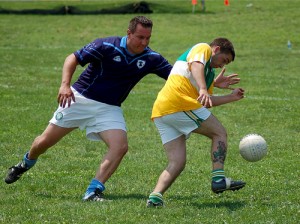
They can dish it out and they can take it.

They can dish it out and they can take it.

Philadelphia’s Gaelic Athletics Association season continues Sunday with three Irish football games scheduled for the afternoon.

Bragging rights are on the line in two of the match-ups. In the first game, starting at 1 o’clock at cardinal Dougherty High School in West Oak Lane, the St Pats and Eire Og will slug it out for the Junior C title, says GAA chair Sean Breen. In the second game, two women’s teams—the Mairead Farrells and the Notre Dames—will vie for the Mairead Farrell Cup.

In the last game, the Kevin Barrys and the Young Irelands will play the first of a two-game set for the Philadelphia senior championship.

(And if you’re at the field earlier in the day, you can see some the GAA youth teams playing a series of games as a warm-up to the adult matches.)

Cardinal Dougherty is at 6301 North 2nd Street. The school is closed, alas, but the GAA will be holding court there most Sundays through the rest of the summer.

Starting next summer, though, Breen is hopeful the GAA will be in new digs at a new 11-acre facility in Limerick Township.

Right now, digging is all that’s going on.

“We started on the property last month,” says Breen. “We cut down some trees, and put up an erosion control fence. We’ve also done the entrance way and set up a trailer. Within the next week to week-and-a-half, the dozers will be coming in to remove the topsoil and do all the rough grading. We’re hoping to get at least one field ready for springtime next year.”

The project will bring modern facilities, including shower and locker space, to the Philly GAA. And the project will also mark an important “first” among all U.S. GAA branches. “We own the property,’ says Breen. We’re the only GAA organization in America that owns their own property. This is a really unique situation. We’re in control of our own destiny, and that’s what makes it big for us.”

The project is estimated to cost $2.2 million. The Philly GAA is making good progress toward that goal, and hoping for matching funds from the GAA in Ireland. One major fund-raiser is really humming along. The GAA is holding a raffle on August 22. The grand prize—the only prize—is $40,000. The group started selling tickets in March, and they’re moving. More than half the tickets are sold.

More fund-raising is planned, including a golf outing in the fall.

If you’ve never seen Irish sports in action, Sunday looks like a good day for it: mostly sunny and highs around 90. (But who are we fooling? We’ve seen these guys play in thunderstorms and lakes of mud.) These are the sports of your ancestors. Check out Dougherty on Sunday.

News, People

Double Win for the 2010 Rose

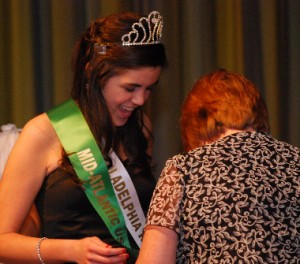
The second sash of the night for Mairead Conley.

The second sash of the night for Mairead Conley. (Click on photo to view photo essay.)

Mairead Conley was very pleased to have been crowned as the 2010 Philadelphia Rose of Tralee.

“I feel dumbfounded. You never expect to win,” said the self-described introvert and deputy director of community programming at the Irish Immigration Center of Philadelphia, following her local triumph Saturday night at the Philadelphia Irish Center. “I was completely blown away.”

But the night held one more surprise for Mairead. Saturday night marked the first Mid-Atlantic Rose of Tralee Final. With two other women in the running–Washington, D.C., Rose of Tralee Katherine Walsh and Teresa Marie Parks, Baltimore’s Rose–Mairead was the judges’ choice to become the first Mid-Atlantic Rose. She’ll travel to Tralee, County Kerry, to compete in the Rose of Tralee International Festival August 20 through 24.

It was a special night for yet another reason, Mairead acknowledged. “What a birthday present,” she said as she extricated herself from a throng of friends and relatives. “I was very content with being the Philadelphia Rose. I thought that was a great way to end the evening. Earlier in the night, someone asked me whether I had summer plans. I said, ‘I don’t know… Maybe I’ll go to Sea Isle.’ Now, I’m going to Tralee.”

2009 Philadelphia Rose of Tralee Jocelyn McGillian acknowledged a “huge mix of emotion” as her year came to a close. But she was thrilled for friend Mairead. “Now,” she said, “she gets to feel all the things I felt last year.”

We have many, many photos from Mairead’s big night. (And of course, it was a big night for all of the other bright, talented young women.) Click on the photo at upper right to view the slide show.