Monthly Archives:

April 2014

News

Inside the Irish Tay-Sachs Study

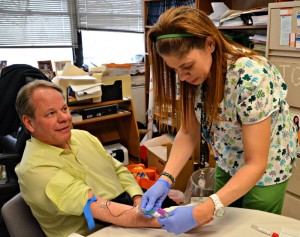
Bill Ryan and nurse Maria Miranda

Bill Ryan and nurse Maria Miranda

Bill Ryan is assistant vice president in the department of government affairs for the Albert Einstein Healthcare Network. Today, sitting in a cramped lab area of the Einstein Medical Center, with his sleeves rolled up and a rubber tourniquet stretched around his upper arm, he looks like a patient, but he’s not. Maybe more like a guinea pig.

Rows of blood sample tubes are arrayed in racks on a table in front of him. They look like little church organ pipes. Nurse Maria Miranda swabs alcohol onto a small patch of skin on Ryan’s arm, and then, with the ease of someone with long practice, she inserts a needle. Soon one of those tubes is filling up with Ryan’s blood.

Ryan confesses to a bit of trepidation, but he’s really OK with it. This small donation is for a very good cause.

Ryan—whose name probably betrays his ethic heritage—is being tested to see if he is a carrier for Tay-Sachs, a rare, inherited neurodegenerative disorder that claims the lives of children who are afflicted with it, typically before they reach their fifth birthday.

It’s a pretty altruistic way to spend part of your St. Patrick’s Day.

Ryan is not alone. On a day far too often given over to partying, staffers at Einstein are observing the saint’s feast day in a way that is actually more in keeping with a saint’s feast day. They’re trying to raise awareness to what is believed to be a relatively high Tay-Sachs carrier rate among people of Irish descent. They’re wearing green, everything from cable knit fisherman sweaters to shiny plastic shamrock beads. At least one is wearing a kilt—in the national tartan of Ireland, of course.

And like Ryan, if they claim Irish heritage, they’re dropping by the lab to donate a bit of blood—all in the cause of determining exactly what that carrier rate is.

“I’m aware of Tay-Sachs, and the devastation that it causes,” says Ryan. “A least I can contribute in a small way.”

Tay-Sachs is commonly associated with Jews of Central and Eastern European descent. And with good reason. The Tay-Sachs carrier rate in the general population is 1 in 200 to 1 in 250. Among Ashkenazi Jews, the carrier rate is from 1 in 25 to 1 in 30.

Less well known is the disorder’s high carrier rate among other ethnic groups, including French Canadians, the Cajuns of Louisiana, and the Amish.

Einstein researcher and pediatrician Adele Schneider is intensely interested in nailing down the carrier rate among the Irish. Here’s why she’s so interested. Within the past several years, three new cases of Tay-Sachs were diagnosed in the Philadelphia area: all of them in children born to parents of Irish descent.

“It is remarkable,” Schneider says. “Until now, I had never seen a living child with Tay-Sachs, so uncovering three of them, all of them in this area, all of them in children in Irish descent … that would be pretty remarkable.”

Remarkable, yes—and heartbreaking.

Some medical literature suggests the carrier rate among the Irish might be 1 in 50. But there are other estimates, too, and they’re all over the place. Schneider suspects the less extreme estimates are likely to be more on target.

“I’ve read everything from 1 in 8 to 1 in 400—which is obviously wrong,” says Schneider. “We think it’s going to be something in between, about 1 in 50. That’s the empiric number we’ve been using, but we don’t have any data yet to support that. But even if we don’t come up with an absolute number, there’s enough reason to be concerned and the Irish community should know more about this.”

One way Irish-Americans and the Irish living in this country will come to know about Tay-Sachs will be through screenings just like the one at Einstein on St. Patrick’s Day.

“Today is just one in a series of screening we’re doing,” says Rebecca Tantala, executive director of the Delaware Valley Chapter of National Tay-Sachs & Allied Diseases Association, and Einstein’s director of grants, foundation & contracts, who was on hand at Einstein on St. Patrick’s Day. “We need 1,000 blood samples. We’re hoping for 600 or so locally, but we may also be going to Boston and New York. We’re looking for it to be a geographically diverse selection of individuals.”

No one can be sure when the researchers will hit that magic number, but, says study coordinator Amybeth Weaver, “we’d like it to be in the next year. The sooner we get 1000 individuals, the sooner we can complete the study.”

For Adele Schneider, that day can’t possibly come soon enough.

“To have a child coming into my office and to have to make that diagnosis … it was devastating to have to tell the parents, your child is not going to survive. This is not what I want to do. I want to say, let’s take steps to have a healthy child. It’s just so sad.”

Testing is provided at no cost. Study participants will be informed of their carrier status, and genetic counseling will be provided. The Einstein study is funded by the National Tay-Sachs & Allied Diseases Association of Delaware Valley. For details: http://www.tay-sachs.org/irish_taysachs_study.php
People

How to Be Irish in Philly This Week

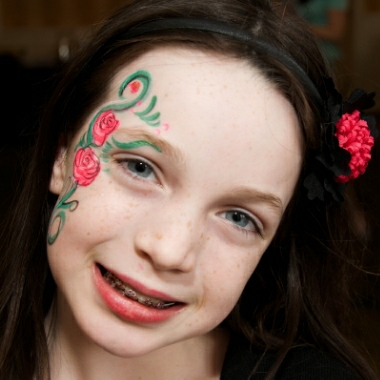
Saorla Meenagh, wearing her Rose of Tralee face paint.

Saorla Meenagh, wearing her Rose of Tralee face paint.

Tickets were going fast for the Gerry Timlin solo show at Act II Playhouse in Ambler on Saturday. Better call now.

If you happen to be in North Wildwood, the Shantys will be playing at the Anglesea Pub. We happen to know that there will be an influx of Irish folk in Wildwood this weekend for the Cummins School of Irish Dance Feis at the Beach.

On Sunday, see a documentary exploring the controversial case of 10 people shot by British soldiers in West Belfast in 1971 including a Catholic priest and a mother of eight. Relatives and victims will be able to answer your questions in a Skype session after the showing. The event is free at The Irish Center.

The Coyle School of Irish Dance is sending some of its best dancers to the world championships in London this year. They’re holding a fundraiser on Sunday April 6, between 5 and 8 PM, at The Irish Pub, 1123 Walnut Street in Philadelphia. Bartenders for the evening will be world contenders Moira Cahill, a former Philadelphia Mary from Dungloe, and Padraig Glenn. Your $30 covers a delicious meal and open bar. Kids are only $10.

On Friday, one of the classiest events of the year, the Philadelphia Rose of Traleen Selection and dinner will take place at The Radnor Hotel. CBS3’s consumer reporter Jim Donovan will be the emcee (he’s very funny) and a brand new Rose will be chosen to compete in Ireland next summer. The current Philly Rose is congressional aide Brittany Killion.

On Saturday, April 12, about a dozen East Coast university-based Gaelic football and hurling teams will converge on Msgr. Bonner High School in Drexel Hill for a day of competition. We’d say all in fun, but we’ve seen Gaelic football and hurling—it’s serious.

And if you like what you see, the Glenside Gaelic Athletic Association is holding an open house for youngsters and their parents interested in Gaelic sports at Bishop McDevitt High School in Wyncote on Sunday, April 13.

Save some time that day to attend the Derry Society’s Spring Social at The Irish Center, featuring music by the Derry Brigade, the Cummins School of Irish Dance, and Bill Donohue Jr. will be playing DJ for the kids to compete in musical games. There’s face painting, food, and raffles. And you don’t have to be from Derry to come. It’s a great day out for the kids.

People

Social Media Reunites Cousins

The descendants of Patrick Murphy look at special photos at the Irish Center.

The descendants of Patrick Murphy look at special photos at the Irish Center.

Constructing an Irish family tree poses particular challenges. First, there’s the dearth of written records. Not only were the most fruitful life events—birth, marriage, death—not recorded until 1864, many of those records were lost to fire during Ireland’s 1922 Civil War and to other calamities (including being pulped to support war effort in World War I).

And in many Irish-American families, roots run deep and wide. Siblings were separated, by oceans or land, as they sought new opportunities. For some, contact became sporadic and eventually faded to black. The prejudice the new immigrants encountered in America propelled them to quickly shed their Irishness and with their self-imposed rapid Americanization, family histories were lost in the silence. For modern family historians, those roots remain hidden from view, sometimes forever, sometimes until some fate intervenes.

In the 21st century, fate uses social media: You suddenly come across photos of your great grandparents on flickr.com or read familiar names in a post on a genealogy page on Facebook that you stumbled upon.

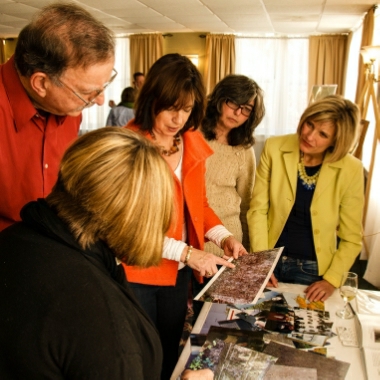
It was social media that finally brought the roots of Marianne MacDonald’s mother’s family, the Murphys of Tuosist, Collorus Point, County Kerry, to the surface, and a couple of weeks ago, she gathered about a dozen long-lost cousins from Florida, Tennessee, New York, and North Jersey at the Commodore Barry Club (The Irish Center) in Philadelphia where they shared their separate “bits and pieces” of family history.

Including letters from the girls their Great-Aunt Peggie met when she lived for a time in Ireland with an aunt, after the death of her mother. And photos of the Murphy headstones in Tuosist, some barely legible, that cousin Ellen Dyal of Jacksonville, Florida, took when she was in Ireland last year.

It was when Dyal was preparing for her trip, her second, that she came across a Facebook page dedicated to Tuosist, the parish on the scenic Beara Peninsula where the Murphy clan lived. There, she saw Marianne MacDonald’s post seeking information about her grandmother, Julia, Peggie Murphy’s sister. And the sister of Dyal’s grandfather, Patrick.

“I read it and thought, oh my God, my sister had just given me a piece of paper with a lot of the family names and Julia’s name was on it,” says Dyal. “I realized that she was the sister of my grandfather, Patrick Murphy. I tried to message Marianne and Facebook told me it would cost me $1 to send a message to her since I didn’t know her and I decided to pay the dollar. Five minutes later I heard from her. ‘Oh my God, we’re cousins!’”

The two got on the phone and talked for an hour and a half. MacDonald, a special education teacher from Mantua, NJ, who hosts the “Come West Along the Road” Irish radio hour every Sunday on WTMR, 80 FM, was able to hook Dyal up with people in Tuosist she met during her many trips back who knew the Murphy family. That included the postmistress, Maureen O’ Sullivan, who helped Dyal find the family home, a large, rambling house on secluded wooded point that had been vacant for many years before being turned into a holiday home. “She even remembered my grandfather going back every year,” says Dyal.

During her last trip, MacDonald says, she spent two hours talking to O’Sullivan whose prodigious memory turned up another cousin, Ed Murphy of Monmouth County, NJ, who attended the Philadelphia reunion. “She said to me, there was another Murphy here a couple of years ago and she pulled out a big ledger, and there was his address and phone number, so I called him.”

It turned out that their paths had likely crossed before. “We started talking and realized that we had been at the same Irish events at the same time,” says MacDonald, laughing. They just don’t remember meeting.

That wasn’t the only coincidence these Murphy descendants uncovered. When MacDonald was looking for her grandmother on the 1930 US Census, she discovered that Dyal’s grandfather, Patrick Murphy, was rooming with her grandparents in New York. And Ellen found a letter from her grandfather, written after MacDonald’s grandmother’s death, saying, Julia, had been his “favorite sister.”

The family lost touch for many reasons. For one, there were 10 children scattered all over, some across the country, others in Ireland and England. There’s no information on two of the siblings at all. Dyal’s mother married a man named Shapiro and was, for a time, ostracized by the family for marrying out of the Catholic faith. Her grandfather, Patrick Murphy, had only daughters, so their Murphy line was subsumed by other family names.

Not all the Murphys could make the Philadelphia reunion, including Kevin, whom MacDonald met via email several years ago after he saw her photos from Collarus Point on flickr.com, a photo storage site.

But they’re planning another one. “We were all so thrilled to meet each other—it was the best thing eve,” says MacDonald, “so we’re thinking of going to Ireland next spring. Ellen is in touch with the cousins in England, so they may come.”

In Irish genealogy circles, that’s what’s known as a sublimely happy ending.

See our photos of the Murphy Family Reunion.

People

Grab Your Blankets! The Fleadh is Coming Back!

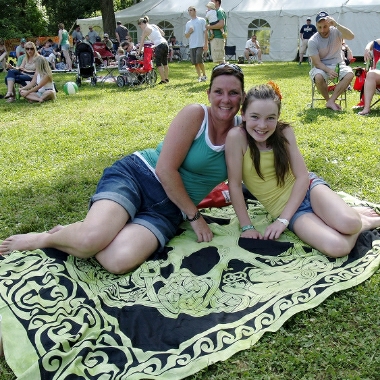
Fun and family friendly!

Fun and family friendly!

File this piece of advice from Frank Daly away to pull out any time you’re thinking of throwing a big music event: “Never rent a park.”

Not that Pennypack Park isn’t a great venue for an Irish music festival. Daly and partner C.J. Mills rolled out their first one there last year, the very successful Philadelphia Fleadh, in a niche of this rambling, 1300-acre green space in northeast Philadelphia. Best friends, partners in American Paddy’s Productions , and members of the band, Jamison, Daly and Mills are putting the finishing touches on their second festival—scheduled for Saturday, May 3—and Daly says it was an easier sell to the Fairmount Park Commission this year.

“They weren’t difficult to deal with last year, but they weren’t inviting,” says Daly. “Frankly, they heard Irish event and they thought debauchery, port-a-potties, people fighting.”

In other words, not exactly like folks letting out of Sunday Mass. “They were there last year watching, and I think they have a much different idea,” says Daly. In fact, it’s a little more like folks letting out of Sunday Mass, only with bands, beer, and bouncy castles.

“We had 2,700 people attend last year and they were a great group of people. It was very family friendly,” he says. And the Fairmount Park Commission was impressed. “They say me and CJ out there the next day at 5 AM picking up trash,” he laughs. “They saw we weren’t throwing a giant drunkfest there.”

This year, expect more of the same—along with Irish beer. “That was the only complaint we got,” says Daly. “We didn’t have Irish beer. Well this year there’s Guinness, Smithwicks, and Harp.”

And an appealing mix of both traditional and Celtic rock acts, including some of Philly’s finest: the Paul Moore Band, Jamison, the John Byrne Band, Buring Bridget Cleary, the Hooligans, Raymond and Mickey Coleman, the Birmingham Six, the Jameson Sisters, the Broken Shillelaghs, Killen-Clark, The Ladeens, and Seamus Kennedy. This year’s import are the Mahones, a punk rock Celtic band from Canada. Last year, it was the Young Dubliners.

Instead of a DJ tent, says Daly, this year’s festival will include an acoustic tent with music sessions and workshops for those who want to perfect their tunes and a ceili dance at 1 and 3 PM where instructors will show you the steps to the Gay Gordon and Siege of Ennis so you can join in the fun.

Festival Food and Maggie’s on the Waterfront will be feeding the crowds and there are 10 vendors selling everything from kilts to t-shirts. And this year there’s a bonus—an open feis (pronounced “fesh,” it’s an Irish step dance competition) hosted by Celtic Flame School of Irish Dance that’s also free. “You don’t have to buy a ticket to the festival to go to the feis,” Daly says.

Philadelphia Fleadh is one of three Irish-themed events American Paddy’s Productions mounts every year, including American Celtic Christmas during the holidays and Paddypalooza, a tented Celtic rock party around St. Patrick’s Day.

Next year, they’ll be adding a fourth—Sober St. Patrick’s Day, a family-friendly, alcohol-free program that got its start in New York and has been enormously successful (as in, sold-out) in New York, Casper, Wyoming, Richmond, Virginia and Belfast, Northern Ireland.

“It came about because of my friendship with Katherine Ball-Weir who is involved in the local branch of Comhaltas Ceoltoiri Eireann [an Irish organization supporting Irish music and culture among Irish people]. We met when I was doing marketing for Kildare’s pubs and we worked on bringing big name Irish traditional musicians to West Chester University who would then play at the session in the pub.”

Ball-Weir, whose teenaged son, Alexander, is a fiddler and a member of The Ladeens, managed to secure the rights to the name from the New York organization and she, Daly, and Mills are planning the event for 2015, on Philadelphia parade day.

“We’re looking for a spot—and we’re definitely not renting a public park,” laughs Daly. “They told us when we rented the park they’ve only rented out Fairmount Park two times. One was for “Made in America,” and the other was the Philadelphia Fleadh. So me and Jay-Z,” he deadpans, “are almost exactly the same.”

You can order tickets for the Fleadh by clicking on the Fleadh ad on our pages, or by going to their website.

News

The Resurrection of Big Green

Big Green at home in its Delco firehouse.

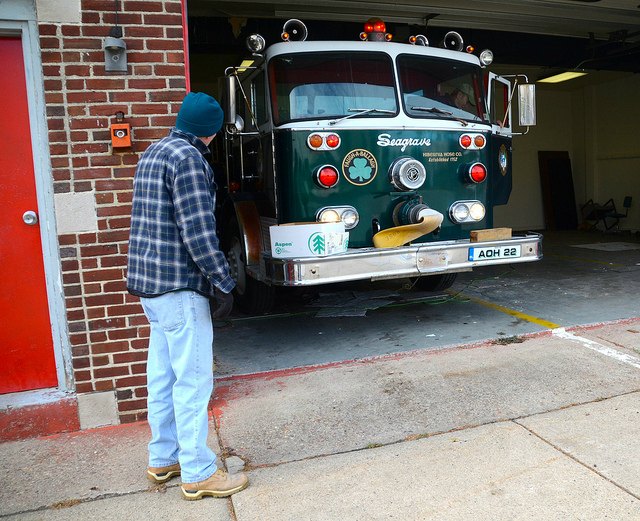
Big Green at home in its Delco firehouse.

When the members of Firefighter John J. Redmond Ancient Order of Hibernians division marched past the reviewing stand in the Philadelphia St. Patrick’s Day parade, they were missing their most important publicity vehicle: a well-worn 1975 Seagrave pumper truck called “Big Green.”

“It didn’t make the parade because it was sidelined by some last-minute issues,” says the division’s publicity chairman Jeff Jackson. Among other issues, the power steering pump failed. If you’re going to maneuver a truck weighing several tons—a truck without water can tip the scales at 12, 13 or more—you better have power steering.

Big Green, stored away in an old firehouse in Lester, Delaware County, has been sidelined for a couple of years by a host of other problems, some of them mechanical and more than a few cosmetic. A T-shirt campaign last year helped the division raise enough money to replace some vital components, including a new starter, new batteries and new filters.

In hopes of getting the truck parade-ready, members of the division had hoped to continue working on it through the winter. But with the kind of winter we had, those hoped were dashed.

“We haven’t been able to do anything with the truck,” Jackson says. “It was a pretty harsh winter. We kept getting snow. In order to work on it properly, if it’s running, we need it to be outside.”

Adding insult to injury: “There was some damage to the roof of the firehouse because of the weather. Some debris fell on the truck. There was some cosmetic damage.”

And this, to a truck already in need of a facelift.

Now, the division is hoping for a bit of financial help to get the truck into running order. They plan to get it at a big beef and beer bash at their division hall at 415 North 5th Street in Philly on May 30. Headlining the event, entitled “The Resurrection of Big Green,” is Jamison, acclaimed as the best Irish rock band in America. Opening is a five-piece cover band called Rita’s Fog, featuring classic rock and R & B.

It might seem a little early to be plugging an event scheduled for the end of May, but the division is banking on a big turnout, and they’re hoping the truck benefit will start to gain traction—so to speak—right from the start.

The division has big plans for the old pumper, and a big bash seems like a good way to get there.

“We want to get it up and running, to make it roadworthy,” Jackson says. “Depending on how things go, hopefully we can complete our project, maybe put benches in the back and rig it out for parties.”

Jackson says the big party is attracting a lot of early interest. “We’ve got Jamison, and they’re a top-notch draw.”

So for now, Jackson says, the job is to get the word out: “by e-mail, Facebook, smoke signals—any way possible.”

Want to party for Big Green? Buy your tickets here.