Monthly Archives:

July 2012

Music

CD Funding in Record Time

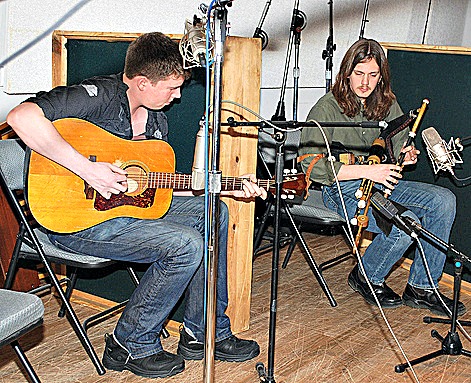
Conal O'Kane and Tim Hill

Conal O'Kane and Tim Hill

Who knew we had so many friends?

Last Saturday morning, we launched a website to raise funds for our CD project, “Ceili Drive: The Music of Irish Philadelphia.” The goal: $3,000. We figured it might take a few weeks to hit the $3,000 mark, and even then, we might not hit our goal.

How wrong we were–in a really good way.

As of midday Tuesday, we were just $830 short of our target, which was, all by itself, pretty amazing. We never thought we’d get so far, so fast. But we weren’t prepared for the incredible surprise that greeted us the morning of Independence Day, by which time we had officially crossed the $3,200 mark. All that was thanks to amazing generosity from many people, with a big assist—$500—from the great Delaware Valley band Blackthorn.

All told, 55 people or organizations contributed to our fund. Even more surprising: More money continued to flow in, even after we had ripped past the $3,000 mark. As of Friday midday, we’d raised $3,420.

With that, we can now very comfortably move on to production of our CD, which showcases Irish traditional music from many of the area’s finest players and singers, moving them to center stage—right where they belong. Our plan was to share the talents of mature veterans and young upstarts alike, and to draw attention to the role families play in upholding the tradition, and moving it forward. (Kudos to the the Boyces, Brennans, and McGillians, all of whom contribute tunes to the effort.) Of course, Irish music in Philadelphia probably wouldn’t be as rich and as vibrant as it is without the contributions of Irish natives who now make the Delaware valley their home. Their influence on the making of “Ceili Drive” is also significant.

That we are where we are now is actually pretty remarkable, given that we’d never done anything like a recording project before, and often had no idea what we were doing. (Thanks to our musicians for their patience, and for setting us straight when we needed it.)

Clearly, we had a lot to learn. Then again, maybe recording a CD really is just that challenging. Harper Ellen Tepper, in an email a few weeks ago, helped us put it all in perspective: “Recording projects, like home improvements and divorces, take longer than you think, cost more than estimated, make a big mess and are SO nice when they are over.”

Ain’t it the truth.

So, here is where we are.

We recorded six original tracks in Milkboy Studios. We have six additional tracks donated by musicians who have previously recorded on their own. Now we move on to final production. All of that is what the $3,000 is for.

There are some loose ends we need to tie up, but we expect to release “Ceili Drive” toward the end of the summer. (And, though we’ve mentioned it before, it bears mentioning again: Our gratitude to Facebook fan Pete McDermott for suggesting the clever name.)

Thank-you gifts should be mailed out to all of our donors at about the same time.

The ultimate thank-you, we hope, will be “Ceili Drive” itself. We’re onto something special here, and we can’t wait for you to hear it.
How to Be Irish in Philly

How to Be Irish in Philly This Week

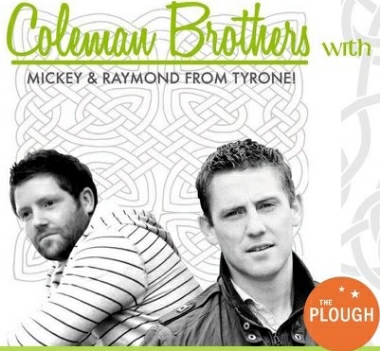
The Colemans at the Plough on Thursday

This weekend through August 26, you can see what Irish musicians do in their spare time. A show featuring the other talents of a group of fiddlers, guitarists, and singers opens on Friday, July 6, and runs through August 26 at the Water Elemental Crafts and Fine Art Gallery in Lansdale.

Tipperary singer and guitarist Pat Egan, for example, is a photographer. Ellen Tepper, who is usually wrapped around a harp, creates wondrous Celtic knot windows and other mixed media work. Harpist Irish Nevins, guitarist John Brennan and fiddler Bette Conway, who co-owns the gallery, create fine jewelry. They’re just a few of the musician-artists whose work will be on display. Bonus: Count on hearing some live music at the gallery at 319 W. Main Street in Lansdale.

Speaking of live music, you can see Timlin & Kane all over the place this week. After Friday night at the St. James Gate Pub at the Sands Casino in Bethlehem (Friday), they’ll be performing at JD McGillicuddy’s in Kirklyn on Saturday night and making an encore appearance at Catherine Rooney’s Irish Pub in Wilmington, DE, next Friday, July 13.

Another treat this week: Raymond and Mickey Coleman of Tyrone (and Philly and New York) will be performing together with fiddler Plunkett McGartland in a foot-stomping, hand-clapping show at the Plough and the Stars at 123 Chestnut Street in Philadelphia on Thursday, July 12. I haven’t heard the Colemans together live yet, but here’s a little taste.  You can’t just drop in—they’re selling tickets and they’re going fast. Give the Plough and the Stars a call.

If you’re looking for a day trip with a Celtic flavor, next weekend is the 2012 Irish Festival in Annapolis, MD, featuring Scythian, Albannach, Barleyjuice, Screaming Orphans, Seamus Kennedy, The Rovers, Kilmaine Saints, Crossing Celtic, the Chesapeake Caledonian Pipes and Drums and many others. There will be visits from some of the animal ambassadors from Busch Gardens and pony rides and other treats for the kids. So, tear yourself away from the shore to go to another shore just a few hours south.

News, People

The Irish Risk for Tay-Sachs Disease

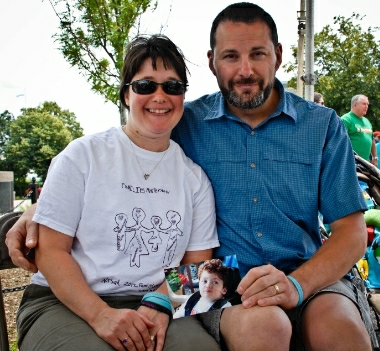
Cathy and Jeff Mitchell with a photo of their late son, Harrison, who had Tay-Sachs.

When Cathy Mitchell’s son, Harrison, was diagnosed with Tay-Sachs disease, she and her husband, Jeff, were devastated–and more than a little confused.

“I thought Tay Sachs was a Jewish disease,” says Cathy. The Mitchells, who live in Langhorne, then learned that this deadly inherited disease, which cripples and kills, is common among people of Irish descent. As many as 1 in 50 Irish Americans is a carrier.

Children can only inherit the disease when both parents carry the trait; with every pregnancy, a couple runs a 25 percent chance of having a child with Tay Sachs and a 50 percent chance of having one who is a carrier but doesn’t have the disease. Cathy and Jeff Mitchell are both carriers.

“I didn’t even know I was Irish,” said Jeff Mitchell, who, with his wife and another couple–Aaron and Kathryn Harney of Downingtown—manned an information booth on Tay Sachs at the recent Irish Festival on Penn’s Landing. Mitchell hadn’t been close to his father’s side of the family and only learned after Harrison was diagnosed that his grandfather was Irish.

Like other children with Tay-Sachs, Harrison seemed like a perfectly normal baby when he was born. But at six months, he began showing troubling symptoms. “Harrison didn’t sit up. His muscle tone was weak,” says Jeff, a shop foreman at a truck equipment company. “When you would pick him up he would fall over. He startled to loud noises. He rolled over once and then never rolled over again.”

When Harrison seemed to have trouble seeing toys in front of him, the Mitchells took him to their pediatrician who, says Jeff Mitchell, “kept pushing it off on the fact that Harrison was born a month early,” implying he was experiencing normal developmental delays. Eventually, the Mitchells took their baby to a pediatric opthamologist who saw a cherry-red spot on his retina, a physical marker of Tay-Sachs.

The disease is a particularly cruel one. New parents come home with an infant who appears to be healthy and normal, but is lacking an important enzyme, hexosaminidase (Hex-A), that helps clear out fatty protein and other substances from the tissues and nerve cells of the brain. That regular housecleaning allows the infant to develop vision, hearing, movement, and other vital functions. For a few months, the Tay-Sachs babies grow and develop as babies do—cooing, reaching for toys, smiling, laughing, turning over.

But as those proteins build up in the tissues and nerve cells, a relentless deterioration of physical and mental abilities begins. Children lose their sight and hearing. Their muscles atrophy and they become paralyzed. Eventually, they’re unable to swallow, and they develop seizures and dementia. Most children born with Tay-Sachs die by the time they’re five. “They just slowly fade away,” says Jeff.

In 2010, Harrison Mitchell died just shy of his sixth birthday.

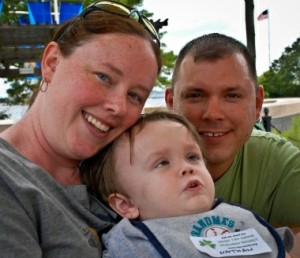
Kathryn and Aaron Harney of Downingtown, with their son, Nathan, who has Tay-Sachs.

Unfortunately, most doctors don’t encourage any but their Jewish patients—particularly Ashkenazi Jews–to be tested for Tay-Sachs. They also may not recognize the symptoms when they see them in children like Harrison. Like the Mitchells, Kathryn and Aaron Harney saw doctor after doctor before their son, Nathan, now 18 months old, was diagnosed—again, by a pediatric opthamologist. “A lot of doctors looked and us and said, ‘Well, you’re first-time parents. . . .,” says Kathryn Harney, Nathan slouching on her lap, his hazel eyes wandering, unfocused.

Like the Mitchells, they Harneys didn’t know that Tay-Sachs is common among the Irish. After they were tested, Aaron Harney learned that he carries a strain common among French Canadians. “I didn’t realize I had French Canadian ancestors,” he says. Tay-Sachs is even more common in French Canadians and Cajuns than in the Irish—an estimated 1 in 27 carry the trait, the same as Ashkenazi Jews. Nathan also has a rare form of Tay-Sachs that more often occurs in older children. “That gives us some hope that he might survive longer,” says Kathryn.

There’s no cure for Tay-Sachs, but it can be prevented with genetic screening. The National Tay-Sachs & Allied Diseases Association of the Delaware Valley offers free Tay-Sachs screening to anyone over the age of 18. Researchers at Einstein Medical Center’s Genetics Division in Philadelphia are now conducting a study to determine an accurate carrier rate for Tay-Sachs disease in the Irish and to identify the most common gene changes in this demographic. If you qualify for the research project (you must have at least three Irish grandparents), you will be screened for free and also get genetic counseling to explain your results and discuss your options.

For more information about Tay-Sachs disease carrier screening or to participate in this study, contact Amybeth Weaver, MS, CGC at irish@tay-sachs.org or call 215-887-0877. You can also go to the website and download a brochure that explains the Irish connection to Tay-Sachs.

Eight weeks after Harrison died, the Mitchells went to their first information session to help spread the word about the disease and especially to let others know that the Irish are among the most vulnerable populations. Last March, they manned a stand at the Bucks County St. Patrick’s Day Parade in Levittown (they serve on the parade committee) where they sold T-shirts, hats, and souvenirs to raise money for the parade—and passed out Tay-Sachs pamphlets for free.

“It’s important to us to raise awareness about Tay-Sachs,” says Cathy. “We need to get the word out there that it affects everybody.”