Monthly Archives:

June 2011

Arts

“Ulysses ‘Seen'” … A Comic Odyssey

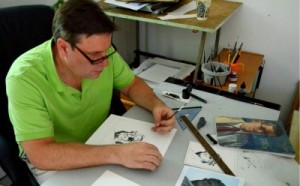
Rob Berry at work.

Rob Berry at work.

As we walk from our meeting place at the Starbucks in the Fairmount section of Philadelphia to Rob Berry’s studio, just a few blocks away, Berry asks the question I’d been both anticipating and dreading: “Have you read ‘Ulysses?’” At which point, I came clean and admitted I hadn’t.

(Although, in my clearly woeful preparation for the interview, I had read the Sparks Notes.)

My ignorance of Irish poet and novelist James Joyce in general and his 1922 masterwork, in particular, apparently didn’t put Berry off. He seemed happy that I hadn’t tried to bluff my way through. He’s asked others the same question, and they’ve, well, lied. Berry himself admits he attempted to read the labyrinthine 265,000-word novel five times before he could make it all the way through.

Still, the fifth time was the charm. Berry got it—and he was hooked.

But perhaps even Berry could not have predicted where his Joycean passion someday might lead. Berry—with graphic and web designer Josh Levitas, Joyce scholar Mike Barsanti and several other equally talented colleagues—is in the early stages of publishing a Web- and iPad-based comic adaptation of “Ulysses.” Two chapters, complete with hypertext-linked reader’s guide, have been published on the Web site “Ulysses ‘Seen’.”

If you’re looking for a way to get a handle on this classic of modernist literature, with its allusions to Homer’s “Odyssey,” its rich symbolism and subtle nuances, “Ulysses ‘Seen’” might be just your ticket.
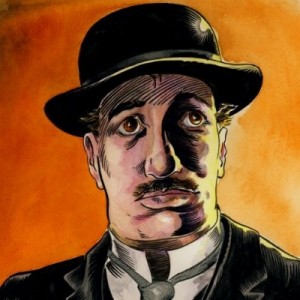
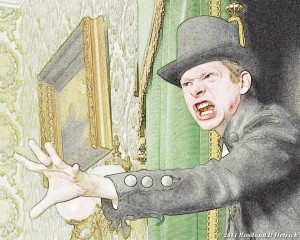
Leopold Bloom, as imagined by artist Rob Berry

Leopold Bloom, as imagined by artist Rob Berry

The project was hatched in June 2004, appropriately enough, in an Irish bar—The Bards at 20th and Walnut—during the Bloomsday Centennial. Bloomsday is the worldwide celebration of Ulysses, held every June 16, which takes its name from Leopold Bloom, who serves as Joyce’s Everyman. All of the events of “Ulysses” occur on that single day in Dublin.

“I was at a Bloomsday reading with a friend of mine who was a cartoonist,” Berry recalls, and talk turned to how “Ulysses” might be portrayed in film. “We were talking about how difficult it is to translate Joyce into other mediums. I was the one to say comics were ideally suited. Joyce uses the weight of visual symbols and he also uses a plasticity of time that you can’t put on film. What you are able to do with comics is to set a rhythm to it (the story) that’s visual, that allows people to know where they are.”

Some who listened to that argument weren’t so sure, and one of his fellow bar patrons bet Berry it couldn’t be done. “I wound up story-boarding 20 pages of ‘Ulysses’,” he says. “I won.”

The idea languished for a few years. in August 2007, at Berry’s wife’s urging, he submitted a snippet from Ulysses to the Philadelphia City Paper for its Comics Issue.

For help in scanning and translating his hand-inked cartoon into a Web-friendly graphic format, he turned to Replica, a high-end print and design shop, which is where Levitas worked. “That’s how I met Josh,” Berry says. “It turned out he actually lives on my block.”

From there, an idea that started out as a barroom bet began to take on a lot more substance. As he continued his wanderings among the “Joyce heads,” Berry met (at a Bloomsday festival) Mike Barsanti, a senior program specialist at the Pew Center for Arts & Heritage and former associate director of the Rosenbach Museum & Library in Philadelphia. He pitched the idea to Barsanti. Barsanti’s reaction was, perhaps, predictable. “At first, he thought it was the craziest idea he’d ever heard,” says Berry, “And Joyce scholars know ‘crazy’.” But the more they talked—over beers, and maybe the brews paradoxically helped lift the fog—the more intrigued Barsanti became, and in time he was on board.

Another partner, copyright attorney Chad Rutkowski—the one who bet that a comic version of Ulysses couldn’t be done—joined the project in 2008 following an encounter at The Bards. Rutkowski became the counsel and business manager for a new company called Throwaway Horse LLC. (Throwaway was the 20-to-1 winner of the Gold Cup race featured in “Ulysses.”)

In time, another passionate Joyce enthusiast joined the project: Janine Utell, former facilitator of the Ulysses Reading Group and Bloomsday coordinator at the Rosenbach, who teaches 20th century British literature at Widener University.

Like a lot of start-up companies, this one is mostly virtual. (Company meetings, Berry says, take place at the Black Sheep near Rittenhouse Square.) If Throwaway Horse can be said to have an “office,” it’s the Callowhill Street studio Berry shared with Levitas.

To reach it, you climb two flights of well-worn gray steps bounded by mustard-colored walls. The studio is a bright, cozy and somewhat cluttered cube, with scuffed white walls and, along one side, exposed brick. At the far end of the studio sits two desks, positioned so they face each other—one of them, covered by illustrations in progress, belonging to Berry; the other, dominated by a large flat-screen monitor, hard drives, a tangle of cables and a pen-and-touch tablet, where Levitas helps translate Berry’s work into an electronic format.

The wall closest to the door is dominated by a cluster of paintings featuring Captain America re-imagined in a wide assortment of characters—black, white, bearded, bespectacled, double-chinned, and one with dark purple lipstick. An equal opportunity Captain America. The theme continues on the wall up above Berry’s left shoulder, where a plastic Captain America costume mask hangs. And here and there, black-and-white comic panels on large sheets of sketchpad paper are tacked into the wallboard.

On the bookshelves, reference works like “Atlas of Human Anatomy for the Artist” and “The Book of a Hundred Hands” share space with ”The Complete Tales of Winnie the Pooh” and the Winston Graham crime novel “Marnie.”

Berry’s musical tastes are eclectic, too. The iPod is set on shuffle, and all the tunes reflect the artist’s diverse interests. It wouldn’t be unusual, Berry laughs, to hear Bach’s “Goldberg Variations” followed by Iggy Pop.

Before moving to Philadelphia in 2000, Berry had an enjoyed a successful career as an artist in Detroit, his easel paintings appearing in many galleries and shows. He says his paintings always followed a narrative style, in effect, telling a story. When he moved to Philadelphia, he says, “I didn’t want to do easel painting any more. The stories were becoming more important to me than the paintings themselves. I started to move away from paint to watercolor and ink drawing. It’s a faster medium to work in and better for print.”

For a time, he considered working in the world of mainstream superhero comics—not surprising, perhaps, for an artist who counts among his earliest creative influences the great comic artists Hal Foster (Prince Valiant), Burne Hogarth (Tarzan) and the immortal Jack Kirby (Captain America, Fantastic Four, X-Men and probably dozens of other comic creations).

Ultimately, though, the idea of creating longer-form stories was more appealing.

And then, in 2007, Steve Jobs and Apple introduced the iPhone. Berry knew things would never be the same, and he began to see creative possibilities on the Web, and—with the dawning of the iPhone—beyond. That’s when Berry’s thoughts about creating a comic version of “Ulysses,” which he had put on a back burner, popped back into his head again. “It all came back when I started to think about the digital page,” he says. “At that point I barely knew how to type. I knew that if I was going to reinvent, I was going to have to reinvent everything.

“I started to look at what had been done with CD-ROMs and hypertext. Hypertext (the presentation of intertwining text, graphics and other info on the Web) was a really exciting approach. With hypertext, you can go behind the page and go right to the reader’s guide. You can join a discussion from there.”

In 2009, Berry and his colleagues launched “Ulysses ‘Seen’” with the publication of the first chapter, “Telemachus.” In 2010, Apple introduced the iPad. In the same year—after a brief media-fueled dust-up resulting in changes to Apple’s prohibition against depictions of nudity and lots more attention to the project—”Ulysses ‘Seen’” became one of the first creative applications for the iPad. “We were geared to the idea that the iPad would come out,” Berry says, “and we would be ready.”

Interestingly, although “Ulysses ‘Seen’” appears in an electronic format, Berry creates the world of “Ulysses” by hand, his panels later scanned by Levitas. “I still use a brush. I still use water colors. It works for me.”

Overall, the process of creating “Ulysses ‘Seen’” is hugely time-consuming. Drawing on the 1922 version of “Ulysses,” which is in the public domain, the team plots out scenes and chapters, with multiple layers of review and re-review. It’s a comic, yes, but there’s an almost academic level of integrity to what the Throwaway Horse team is trying to do.

So, yes, it takes a long time, but the results are stunning. Berry’s renderings of characters like the unhappy Stephen Dedalus, for example, are almost three-dimensional and meticulously detailed. Dedalus fairly pops off the page, in all his unwashed misery, living out the nightmare from which he is trying to awake.

In at least one way, “Ulysses ‘Seen’” is following in the footsteps of the original, which was serialized. The electronic comic version, though, has a much longer timeline. “We’re expecting to be able to do two chapters a year,” he says.

Judging by the critical acclaim with which the first two chapters have been received, it’s well worth the wait.

You can share the Throwaway team’s enthusiasm for Ulysses this week as the Rosenbach hosts the annual all-day outdoor reading of “Ulysses” at its Delancey Place location on Thursday, June 16, from 12 noon to 7 p.m. Berry and Levitas are scheduled to read from 12:55 to 1.

Berry and company are also promoting “Gibraltar: An Adaptation After James Joyce’s Ulysses,” at Plays & Players, 1714 Delancey Place. Showtimes are:

  • Wed, June 15 at 7pm ($15)
  • Thursday, June 16 at 11am and 3pm ($15)
  • Saturday, June 18 at 5pm ($25)

Visit the Web site for more information.

Arts

Bram Stoker’s “Dracula” by Gothic Candlelight

Josh Hitchens, writer and actor, "Stoker's Dracula"

It’s often a jolt for folks when they first hear that the world’s most famous vampire was created by an Irishman. Bram Stoker, author of “Dracula,” was born in Clontarf, north of Dublin, and moved to London in 1878 where he was hired to manage the Lyceum Theatre and act as personal assistant to the theatre’s owner, Henry Irving. But in his spare time, Stoker kept busy creating the ultimate tale of nocturnal terror.

This weekend, the Ebenezer Mazwell Mansion and the Rosenbach Museum & Library are presenting “Stoker’s Dracula,” adapted and performed by Philadelphia actor Josh Hitchens. 

From the time of its completion, Stoker envisioned “Dracula” being turned into a dramatic piece for Henry Irving to enact onstage.  According to Stoker’s grand-nephew, Daniel Farson, who wrote a biography on his relative, Irving walked in on a reading at the theatre (to an audience of two people) and gave his one word review of the piece: “Dreadful!”

That is not a word that’s being applied to this weekend’s presentation.

The Ebenezer Maxwell Mansion is “the perfect backdrop” for Stoker’s legend. Located in Germantown, the Mansion is the only Victorian house museum in Philadelphia. And boy, is it a good one. With its stone façade and gothic tower, visitors can experience the spectral mood before they even enter the dark parlor, lit only by candlelight, where the reading is being held.

Hitchens’ adaptation is abridged, but contains Stoker’s own words—giving the dramatization the authentic sense of horror created by the author.  “This is how Stoker wanted to see his novel,” Hitchens explains.

Also on display at The Mansion this weekend are facsimile copies of Stoker’s notes kept during the seven years he spent writing the novel.  The originals are owned by The Rosenbach Museum & Library, a Philadelphia treasure house that is home to “a nearly unparalleled rare book and manuscript collection, with particular strength in American and British literature and history.”

During Stoker’s lifetime, “Dracula” did not produce the kind of critical and financial success that he had hoped for. When he died in 1912, his widow Florence was forced to sell the notes at a Sotheby’s auction the next year. They were purchased for a little over 2 pounds. 

This weekend’s presentations of “Stoker’s Dracula” promise to thrill and chill audiences with the author’s words that are “better and scarier than any of the ‘Dracula’ movies.”  As of Friday, there were still tickets available for tonight’s 9PM performance, as well as Sunday’s 2PM and 4PM performances. Saturday evening is sold out.

For more information, contact the Ebenezer Maxwell Mansion at 215-438-1861, or online at www.ebenezermaxwellmansion.org/dracula.

Music, News

The Irish Take Over Penn’s Landing

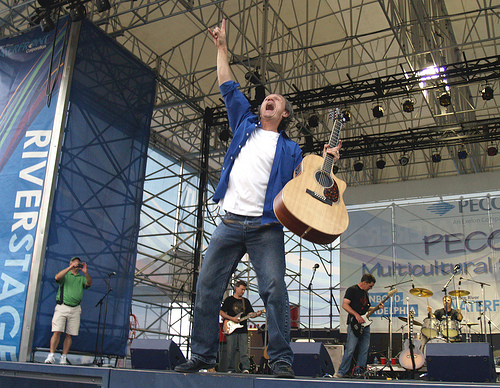
The Hooligans end their set big time.

It was a gorgeous day for an Irish Festival and the crowds at the annual Penn’s Landing fest on Sunday filled the stands. . .er, steps, to hear and cheer their favorite bands (Blackthorn, the Hooligans, and Jamison on the main stage), enjoy some “Irish ice,” and wade in the fountains.

They were also there to cheer on two stalwarts of the Irish community, Irish Edition photographer Tom Keenan, and WTMR radio host Marianne MacDonald, who were honored for their service to all things Irish.

Photographer Gwyneth MacArthur represented www.irishphiladelphia.com (the rest of us had to miss our first fest in five years) and captured the flavors and frivolity of the day.

Check out her photos.


Dance, News

Dance for Dreams

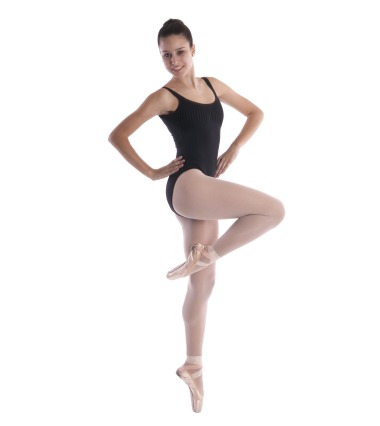
Emily Teitelbaum. Photo by Brian Mengini.

When she was little, Emily Teitelbaum’s parents couldn’t get her interested in anything on TV. She couldn’t care less about “Barney.” But ballet? One day her mother, Terri, caught her then two-year-old daughter standing in front of the set, eyes locked on the screen. “It was a production of the Royal Ballet that just happened to be on,” says Terri. “She stood there transfixed for an hour.”

Emily, now 17, started her first ballet lessons at three. Today, the junior and honor student at Moorestown High School in Moorestown, NJ spends roughly 20 hours a week on her toes, taking classes and practicing. This summer she’ll be training with the Joffrey Ballet in New York.

Declan Crowley was 6 when he had his dance epiphany. His parents had gone to see “Lord of the Dance” in New York and brought back the tape of the Michael Flatley show that turned Irish step dancing into a global craze. He played it over and over.

Crowley’s not sure why the dancing—a combination of quick foot movements like tap, with a straight, stiff upper body like a soldier marching—grabbed him. But, once he saw it he knew it was something he had to do. He had to dance. And someday, he had to perform in “Lord of the Dance.”

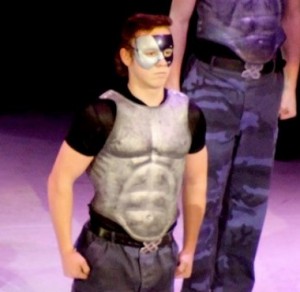
“It’s all I ever wanted to do,” says Crowley, 20, now a student at Holy Cross College in Holyoke, MA. Eventually, he was traveling twice a week from his home near Saratoga Springs, NY, to Westtown, NJ, to take lessons at the Broesler School of Irish Dance, founded by world champion Irish step dancer Kevin Broesler. Twice a silver medalist at the World Championships and a All-Ireland winner, Crowley last year achieved the last part of his dream: He was signed to the cast of Flatley’s latest blockbuster, “Feet of Flames,” and went on tour to Taiwan.

On Saturday, June 18, these two young dancers who have given their all to their passion and dreams will be on the same stage at the Painted Bride Art Center in Philadelphia for “Dance for Dreams,” a gala dance performance to benefit Hope Dances, a program that brings dance to special needs children.

Founded in 2010, it’s a melding of two things dear to the heart of founder Brian Mengini: dance—he’s a dance photographer—and Dominic, his 9-year-old son, who was diagnosed at the age of 4 with sensory processing disorder (SPD), a neurological condition that makes it difficult for him to take in and process sensory information about his environment and his body.

“One day it just hit me—dancing works on coordination, it’s exercise, it promotes body awareness, and there’s a social aspect to it too,” says Mengini. “This is perfect for special needs kids. It’s a safe place for kids to go and find their center, almost like meditation. “

He and his wife, Sandy, who are also the parents of six-year-old Micheala, talked it over and decided to do a small test-run, using a Wii dance program called “Just Dance Kids.” The Menginis invited kids from their network of special needs families and held a “Wii Dance Party,” which became a monthly event. At a launch program in January, Pennsylvania Ballet soloist Ian Hussey and Michael Patterson, a ballet teacher at the Barbara Sandonato School of Ballet in Philadelphia, along with some advanced students gave an introductory ballet workshop. (Patterson is one of Emily Teitelbaum’s teachers.)

Declan Crowley in "Feet of Flames"

The proceeds from the “Dance for Dreams” gala will go to fund a school at the Performance Garage in Northern Liberties in Philadelphia where Patterson will be one of the instructors for “Hope Dances.”

But the event is more than just a fundraiser—it’s a serious and entertaining look at all forms of dance featuring well-known dancers from around the East Coast, including Crowley (the only Irish stepdancer); Delaware County siblings Jeffrey and Lisa Cirio who are soloists for the Boston Ballet; Zachary Hench and Arantxa Ochoa, principal dancers with the Pennsylvania Ballet; Dylan G-Bowley and Chanel DaSilva of the Trey McIntyre Project, a company founded by one of the leading young dance choreographers in the country; Rennie Harris—Rhaw, a Philadelphia hip-hop choreographer, and Tap Team Two & Company, a street tap (hoofing) company.

Emily Teitlebaum expects the performances to “be incredible,” but she’s not nervous. “I’ve actually been in the Pennsylvania Ballet’s ‘Nutcracker’ so I know what a professional show is like,” she says.

Emily is actually living proof of Mengini’s belief that dance has the power to help children overcome obstacles. Like Dominic Mengini, Emily Teitlebaum also has SPD. In her case, it affects her body awareness. “I mainly had trouble with the feeling in my arms,” she says. “I worked really hard to gain strength in them.”

“Part of the problem is that Emily couldn’t feel exactly where her limbs were, which is very difficult for ballet,” says Terri Teitelbaum. “Of all the things to pick. We would towel off her arms and legs in the morning so she could feel them better. But her teachers at Barbara Sandonato School—Barbara and Michael, who were both with the Pennsylvania Ballet—were really helpful. They would instinctively position her arms and rub them, so her brain would have a memory of where she was putting her limbs.”

Eventually for Emily, ballet took the place of occupational and physical therapy, helping her, she says, to “grow out of” SPD, something that’s possible with early intervention.

Declan Crowley too credits his dancing for more than just killer legs and cardio fitness. “The discipline of dancing helps with so many things,” he says. “It worked like cross training for me when I played lacrosse in school. It gives you motivation. No one is very motivated to do homework, but if you have dance practice at 7 it has to be done, you have no choice.”

Ironically, says Mengini, his son Dominic hasn’t shown an interest in dance, even when it just involved Wii. “He’s pretty busy with horseback riding, swimming and soccer so he’s doing alright,” he laughs.

The “Dance for Dreams” Gala is slated for June 18 at 7:30 PM at the Painted Bride Art Center, 230 Vine Street, Philadelphia. Tickets are $25 each and can be ordered online.

Columns, News

Aon Sceal?

Jamesie Johnston of Albannach

Albannach drummer Jamesie Johnston of Glasgow, Scotland, is recovering in the University of Louisville Hospital after being stabbed in the liver and thigh by an intoxicated fan after the Glasgow, KY, Highland Games on June 5. He’s expected to fully recover.

Johnston, his band mates, and members of several other bands were relaxing post-Games at a cabin at the Barren River Lake State Resort Park. According to published reports, a fan, James E. Null, 42, of Glasgow, KY, had been hanging out with the band and started to become belligerent. Johnston attempted to force the man to leave, which is when, reports say, Johnston was stabbed. Albannach drummer Colin Walker also was scraped by the knife. Null was arrested and charged.

The popular Scottish percussive group appears every year at the Mid-Winter Scottish-Irish Festival in Valley Forge and performed on May 22 at a street fair at Molly Maguire’s in Lansdale. They’re managed by Bill and Karen Reid of East of the Hebrides Entertainments in Plymouth Meeting.

“Jamesie is on the mend,” Bill Reid assured us this week. “It will take some time but he’s physically fit so that will speed things up. If it was me I’d be in bed for years.”

The band has gigs in the US through mid-July, including the annual Celtic Fling at Mount Hope Winery in Manheim, PA, June 24-26, Camping Weekend Festival in Barto, PA, July 1-3. They plan to keep those commitments, though Jamesie will sit out the first few. “”The others can do the job and from the fan reaction, the vibe is good and the shows will have that high energy everyone loves,” says Reid, who joined the band at its gigs in Rhode Island this week.

Our Rose Moves Up!

Philadelphia’s Rose of Tralee, Beth Keeley, is heading to the finals in Tralee this August! Keeley, a 25-year-old writer, competed last week in the International Rose of Tralee Regional Finals in Portlaoise and was one of 23 Roses from around the world chosen to compete in the main event in August. Congratulations to Beth!

John Byrne and the Blind Pig

Like many musicians, John Byrne (The John Byrne Band) has a secret “other” life. Until recently, the popular local Irish musician was an English teacher and a part-time bartender (at Kelliann’s on Spring Garden Street). Soon, he’s about to be part-owner of his own pub, along with Debra Ciasullo (another tap-meister from Kelliann’s) and David Hentz.

The Blind Pig is scheduled to open soon at 702 N. Second Street in the young and trendy Northern Liberties section of Philadelphia. The menu will be “pork-centric” and the atmosphere, “neighborhood bar.”

“I’ll be working there a bit and playing music fulltime, and putting the teaching on hold for at least a year,” Bryne told us.

Know Someone Who Should be Honored?

The Delaware Valley Irish Hall of Fame (DVIHOF) is looking for a few good Irish people. For the eleventh year, the Hall of Fame will be honoring people from the Delaware Valley region who have contributed to the preservation of Irish culture.

Last year’s honorees include Vince Gallagher, Donegal-born and president of the Irish Center and founder of DVIHOF; Msgr. Joseph C. McLoone, son of Irish immigrants and chaplain of several Irish organizations including DVIHOF, the Donegal Association, and the Danny Browne AOH Div. 80.; and Kathleen Sullivan, vice president for government and community affairs at Comcast and vice chairperson of the Irish Memorial.

Send your letter of nomination by June 24 to The Delaware Valley Irish Hall of Fame, c/o Kathy McGee Burns, 2291 Mulberry Lane, Lafayette Hill, PA 19444, or call 215-872-1305.

The Hall of Fame Event Dinner is scheduled for Sunday, November 13, at the Irish Center, 6815 Emlen Street, Philadelphia.

The Irish and Their Horses

Irish native Kevin Babington of Gwynedd Valley captured first place in the Grand Prix at the Devon Horse Show last week. He was riding Mark Q, a horse owned by a friend in Ireland.

Babington is the principal in Kevin Babington LLC, a large equestrian facility in Gwynedd Valley that provides training, boarding, and sales.

Babington, born and raised in Carrick en Suir in County Tipperary, has represented Ireland more than 30 times on National Cup teams, came in fourth as an individual in the 2004 Summer Olympic Games, and contributed to a team gold medal in the 2001 European Championships. Recently, he placed first in the $25,000 Ted Grant Welcome Grand Prix and second in the $40,000 Essex Troop Grand Prix on Mark Q.

Babington came to the US in 1987 to work as a riding instructor at a Vermont summer camp. He met his wife, Dianna, at a horse show in Pennsylvania. They have two children.

Aon sceal means “what’s the story?” in Irish. If you have a story you’d like us to tell, email denise.foley@comcast.net.

Columns, How to Be Irish in Philly

How To Be Irish In Philly This Week

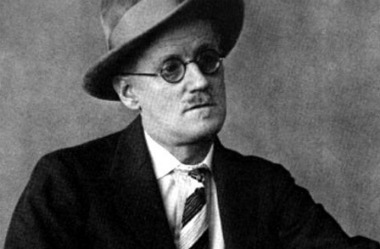
James Joyce Himself.

It’s Bloomsday week—the annual event celebrating the day (June 16) in the life of Leopold Bloom, chronicled in James Joyce’s “Ulysses.” The Rosenbach Museum on Delancey Street in Philadelphia has a copy of Joyce’s manuscript so it’s the perfect venue for a day of readings by local actors, celebrities, and ordinary Joyceans. You can also go inside and take a peek at the manuscript.

Before that—on Monday, June 13—you can spend an evening with Irish author Jamie O’Neill. His stream-of-consciousness style novel, “At Swim, Two Boys,’ tells the story of two 16-year-olds caught up in the 1916 Easter Rising in Dublin and owes something to Joyce, O’Neill admits.

Quick, get your reading done! Fergie’s Pub is holding a Bloomsday 101 Quiz with James Joyce experts Melanie Micir and Lance Wahlbert on Tuesday, June 14. Not your usual Quizzo, but we happen to know that owner Fergus Carey is a serious literature fan and is usually one of the readers on June 16.

Speaking of literature, this is also the week to catch “Stoker’s Dracula,” a play adapted and performed by Philadelphia actor Josh Hitchens at the Ebenezer Maxwell Mansion in Philadelphia. Setting: a dark, candle-lit room, perfect for this tale of horror. And there’s another Rosenbach connection. This wonderful little museum-library also owns a copy of the Dublin-born Stoker’s handwritten notes to Dracula, his best known work.

There’s plenty more going on this week that doesn’t require any extensive reading:

Sunday, June 12. An Evening at the Races at the Philadelphia Irish Center will benefit the family of Lori Kiely, who died last August leaving four small children. Kiely was involved in kids’ sports, particularly Gaelic sports, so many of her friends from the fields are sponsoring this event to help out her young family.

Thursday, June 16. After a day of Joyce, drop by the Camden Riversharks stadium. It’s Irish Heritage Night there, with Irish music, dancers, and probably a few surprises. (Order tickets for as little as $5 in advance by using the secret discount code: IRISH. Oops, guess it’s not a secret anymore.)

You can also hear Shaun and Jerry of the Broken Shillelaghs at the Blue Monkey Tavern in Merchantville, NJ, that night. Why do we know this? Because Shaun and Jerry wisely put this on our calendar themselves, knowing we would mention it here, in our most-read feature. You can do this too. Simply go to the orange bar at the top of the page, click on Irish events listing and you’ll see the words, “Submit Your Irish Event.” Fill in the blanks and submit! See, it’s so easy, even Shaun and Jerry can do it.

Check said calendar for all the details and, if people put addresses in correctly, even a map!

People

Tom Keenan’s Kodak Moment

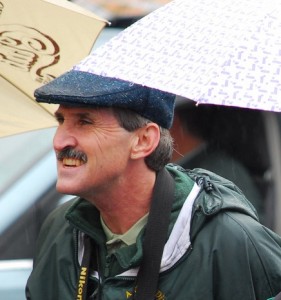
Tom Keenan, in the rain, at a recent Philadelphia St. Patrick's Day parade.

Tom Keenan, in the rain, at a recent Philadelphia St. Patrick's Day parade.

Dress in a leprechaun suit or win a tiara, dance a jig or sing “Danny Boy,” march in the Patrick’s Day parade or hoist a pint anywhere in the Philadelphia area, and chances are pretty good that Tom Keenan will be there with his camera to record the occasion for posterity. Or the Irish Edition. Either one.

Keenan has been documenting virtually every aspect of Irish life in the Delaware Valley since the mid-’90s. He’s zoomed in on everyone from Irish presidents to Kensington publicans. He knows everybody, and they know him. He’s the slim, average-looking guy with the graying brown hair and the brushy moustache who quietly slips into the ballroom or onto the ball field, settles into the background and quietly, dutifully records all those Celtic Kodak moments.

The Irish Edition’s longtime shooter clearly loves being on the viewfinder side of the camera. It’s a passion he developed early in life, never realizing that his hobby might someday become a profession. He’s grateful for that, and he’s happy to continue playing the role of invisible man.

That’s why, he confesses, he’s a little embarrassed to be on the receiving end of an award recognizing his service, to be presented Sunday afternoon at the Penn’s Landing Irish Festival. “That’s why I’m on the other side of the camera,” he says. “I take pictures of other people doing good stuff.”

To Michael Bradley, Philadelphia St. Patrick’s Day parade director and emcee of the Penn’s Landing festival, Keenan’s “aw, shucks” attitude just proves that he richly deserves the attention.

“When you hear a remark like that, you know that’s the right person to honor,” says Bradley. “There are always so many people behind the the scenes who don’t get recognition. Tommy’s at everything. I’ve never seen him honored. He’s gotta be there for 20-30 years and never any recognition. I don’t see a lot of people saying ‘thank you.’ I thought he was a great choice.”

That Keenan would ever become such an integral part of the fabric of Philadelphia’s Irish community is as much a surprise to him as it is to anybody. He’s been part of the community for his entire life. His grandparents are from Ireland, and his uncle Mike Ruan headed up Irish Northern Aid in Delaware County. “When I was a kid,” he recalls, “my parents used to take me and my brothers to the Irish Center. That was our playground.”

As an adult, he became active in the Ancient Order of Hibernians. Still, he didn’t set out to be the Philadelphia Irish community’s unofficial documentarian.

Tom Keenan first started taking photos as a leisure-time pursuit back in the ‘70s when he served in the Navy. “I always took pictures wherever I went,” he says. “I entered some contests and won some amateur contests. People liked what I did.”

After his discharge, Keenan didn’t completely sever his ties to the Navy. He settled into a job at the Philadelphia Naval Shipyard, installing missile systems. Then, in the early ‘90s, work at the shipyard started to slow down—and on September 30, 1995, the facility closed, costing Keenan his job.

“When they closed the shipyard, I had to find a new career,” Keenan says. “They offered to send us back to school for something, so I decided to go to Antonelli Institute (in Erdenheim, Montgomery County) for photography.”

Round about the same time, he noticed that the Irish Edition office was in Wyndmoor, just around the corner from school. He’d spent a lifetime in the Philadelphia Irish community and he thought shooting photos for the paper might be a good fit.

“I looked for a niche,” he says. “Jane Duffin (the editor) is a very nice lady, and she started to send me out on projects. Over the years, I’ve developed a pretty good clientele from it.”

Keenan is quick to point out that photographing Irish people and events is only a part of his business these days. “There’s nothing I can’t shoot,” he says.

Maybe there is one thing Tom Keenan can’t shoot. That moment will come on Sunday afternoon, when he steps onto the main stage overlooking Penn’s Landing’s Great Plaza and accepts his award. For someone who’s happiest becoming part of the scenery, it’s an uncomfortable position to be in.

Well, we’ve known and admired our fellow photographer for several years. In fact, it’s very likely that we’ll be there to record his special moment. So here’s to you, Tom, and let us offer this advice: Just smile and say “Cheese.”

Dance, Music, News

Hot Fun in the Summertime

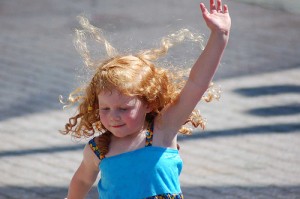
Not all the dancers belong to a dance school.

Not all the dancers belong to a dance school.

Memorial Day is seen as the official start of summer. But for those of us following a slightly different calendar, summer doesn’t truly begin until the annual Penn’s Landing Irish Festival.

This year’s festival kicks off Sunday at 12 noon, going all the way to 8 p.m., at the Great Plaza at Penn’s landing, Columbus Boulevard at Market Street.

If you’ve never been, here’s why you should go…

Music (and lots of it, all day long), with Blackthorn, Jamison and the Hooligans headlining on the main stage.

Dance, with so many of the Philadelphia area’s schools of Irish dance prancing all over the place that we can’t list them all.

Food and drink, including traditional Irish noshies like shepherd’s pie, along with water ice, ice cream, and appropriately seasonal liquid refreshment.

Vendors galore, so you can pick up all of the T-shirts, hats, mugs, home decor, jewelry and other goods necessary to confirm in the eyes of all the world that you are, yes indeed, Irish.

Kiddie stuff, including face-painting, of course.

Atmosphere. Yes, Penn’s Landing lacks shade and technically, kids aren’t supposed to wade in the fountains (but they do anyway), and it can get a little hot out there along the river. But, hey, you’re along the river, which you can bet will be dotted with pleasure boats, some of which stop dead in the water to take in the music emanating from the main stage.

OK, so we’ve told you. But if you still need convincing, let us show you. Check out our photos from past years.