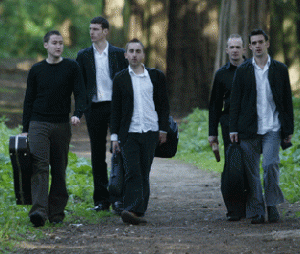
The band Teada in a pensive pose.
We’ll start with track 4 from the new Téada CD, Ceol & Cuimhne. It’s a set of reels including “The Russians Are Coming,” “The Miller’s Daughter” and “The Boston-Sligo Reel.”
The set begins with a few bars of airy bouzouki flatpicking by Seán Mc Elwain. It’s a deceptively light introduction to a sudden, frenzied duel between flutist Damien Stenson and Tristan Rosenstock, the band’s bodhrán player. By the time fiddler Oisín Mac Diarmada and Paul Finn on button accordion jump into the set, just before the transition to the second reel, things are already rocketing along. If there is some physical law of music that says a performance cannot exceed the speed of sound or light, or the bounds of good sense, these boys just broke it.
They can get away with it. Téada is just that good.
Whether they’re playing the foot-stomping “Circus Polka” or the tender “Sligo Air” (accompanied by the gifted County Mayo harper Gráinne Hambly, who has performed with the band on its annual Christmas tour), these five young exponents of traditional Irish music don’t make artistic compromises. Expect excitement, expect invention, but don’t expect trade-offs. They’re like the Blue Brothers of trad–they’re on a mission from God.
“Ceol & Cuimhne”–Irish for “music & memory”–is all about fidelity to tradition. Téada is demonstrably bound by an obligation to the past, but with their exuberant style of play and the sheer force of their virtuosity, the band succeeds wonderfully well at making the old tunes revelant and compelling here and now. For Téada, temporal convergence seems to be a recurring theme. Their 2006 album, “Inne Amarach” means “yesterday tomorrow.”
Like “Inne Amarach,” “Ceol & Cuimhne” is also a loving tribute to the legends of traditional Irish music, like Junior Crehan, Paddy Fahy, Michael Coleman and Philadelphia’s own Ed Reavy. Diehard traditionalists will find a lot to like in tunes like “Paddy Cronin’s,” “All Around the Room” and “Seamus McKenna’s.”
There are many standout performances on this recording. Fiddle fans will savor Oisín Mac Diarmada’s fresh interpretation of “Clothiers,” a march here presented as an air. “All Around the Room,” the middle tune in a set that includes “Miss Cassidy’s” and “The Ballingra Lass,” showcases the fine talents of Paul Finn, as does “Merty Rabbett’s.” And of course, Damien Stenson is everywhere, generally setting things on fire.
A comment or two on Rosenstock and McElwain. (Sounds like a law firm.) Rosenstock is like the Ringo Starr of the bodhran. (Which would make John Joe Kelly, what … Keith Moon?) As with Ringo, I think it’s easy to underrate Rosenstock. He just sets down a rock-solid rhythm, really knows the tunes well, and sticks to the other players like glue. Do I like the flashier stuff? You bet. But I can also appreciate the artistry and sensitivity with which Rosenstock plies his trade.
In much the same way, I think it’s all too easy to overlook McElwain. He’s always in the background. But if you listen to what he’s up to, you realize that the question of whether a tune holds together or falls apart often hinges on how well he plays. A band couldn’t have a better backbone.
The point is, they’re all world-class. And “Ceol & Cuimhne” is a world-class contribution to the tradition.