Monthly Archives:

January 2010

News, People

After More Than 40 Years, The Philadelphia Parade Committee’s Money Man Hands In His Ledger

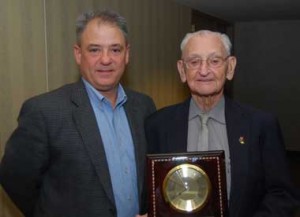
Paul J. Phillips Jr., right, with son Chris.

Paul J. Phillips Jr., right, with son Chris.

How long has Paul J. Phillips Jr. been involved in the Philadelphia St. Patrick’s Day Parade?

“Longer than I’ve been alive,” says son Chris Phillips, current recording secretary of the St. Patrick’s Day Obervance Association. Chris was born in 1963. His dad became treasurer of the association in 1962. Aside from a couple of years when he served as president (1989-1990), Paul Phillips has been treasurer ever since.

Phillips recently retired from the position, handing over the reins to Leonard Armstrong.

He wasn’t expecting to be treasurer for quite so long. “They asked me to do it on a temporary basis, and I did,” he says. But the Philadelphia parade is the sort of thing that stirs passions and inspires deep loyalty. So for more than 40 years, the 86-year-old Gray’s Ferry native and Southeast Catholic alum diligently watched over the finances of the nation’s second-oldest parade of any kind.

It was never an easy job, his son says—and over the years, it got harder. But Paul Phillips was equal to the task.

“He’s always been a man who kept good records,” says Chris, who recalls his father showing up at his last meeting as treasurer with the same leather-bound ledger he inherited upon becoming the association treasurer. In the early going, the parade was relatively small. But, says Chris, “over the year’s it’s grown, and he’s had to deal with managing large amounts of money every year. Keeeping all of that together has been a stretch sometimes.”

Though the job was difficult, the unflappable treasurer apparently took it all in stride. For that, he says he owes a debt of gratitude to current and past colleagues on the board. “I’ve always had a great deal of cooperation from the other board members,” Phillips says. He remembers many of them with great fondness, and he counts himself lucky for all the friendships he made on and off the board, including such notables as former mayors James Tate and Bill Green.

For his partners on the board, the feeling is mutual. They honored him Thursday night for his many years of service. (Happily for everyone involved, he’ll remain on the executive committee.)

As he accepted a large plaque from association President Michael F. Callahan, Phillips took a moment to reflect on all those years of service. “I thought it was the greatest thing that ever happened to me,” he said. “I loved it.”

People

Marching Since 1955, Seamus Boyle Gets to Wear the Top Hat in The 2010 St. Patrick’s Day Parade

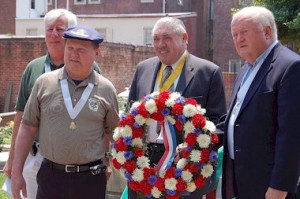
Seamus Boyle, center, at a Commodore Barry commemoration.

Seamus Boyle, center, at a Commodore Barry commemoration.

Seamus Boyle arrived in Philadelphia from County Armagh in 1954. In 1955, with his father Terence, he marched in his first Philadelphia St. Patrick’s Day parade. Boyle has marched in the Philly parade almost every year ever since.

This year is no exception. But this year’s parade is going to be extra-special for the burly, low-key Boyle, a resident of the Academy Gardens neighborhood in the Northeast. He’ll be marching at the head of the parade as grand marshal.

Boyle is no stranger to honors. A longtime member of the Ancient Order of Hibernians Division 39 in Tacony, Boyle last year was elected AOH national president—the first national president from Philadelphia since 1927 and a three-to-one favorite.

Still, he says, “I was humbled and shocked that I was even considered for it. I was told maybe a month or so before the election that my name was put in. Then when I was told I won, that was unbelievable. It’s a great honor, especially when I look at some of the people who came before me. There’re some very serious high-class people there.”

It’s an especially great honor when he thinks how far the parade has come. Back when he was first starting his annual St. Patrick’s Day parade tradition, it was much smaller. “It was not anywhere as big as it is today,” he says. “It’s grown even over the past 20 years.”

AOH representation in the parade is pretty much taken for granted. About 20 Philadelphia-area divisions march in the parade now. But back in 1955, only three or divisions took part—but of course, there weren’t that many AOH divisions in Philadelphia then, either. The AOH, too, has grown.

“It’s a privilege for me to represent the AOH in the parade,” he says. “The AOH is probably the largest Catholic fraternal organization in the country, and it’s known all over. In Philadelphia, it has grown tremendously. I think this is great for the AOH. We do a lot to bring out the culture and heritage of Ireland. This helps our cause.”

Boyle is also pleased to represent the Irish immigrant population. As a member of the AOH, he has been very involved in promoting peace in Northern Ireland and Irish unity. He hasn’t forgotten his roots in the North. The fact that the parade committee selected an immigrant, he says, makes it “all the more impressive.”

Parade Director Michael Bradley says Boyle’s Northern Ireland efforts were one of the main reasons he was recognized to head the March 14 parade. “He’s been going over the Belfast for years,” Bradley says. “He represents Philadelphia very well over there in all the good things he does.”

The fact that Boyle is national president of the AOH also probably played a role, but that was not the principal reason for his selection. Boyle has been very active in the Philadelphia Irish community for quite some time, including his activities at Division 39. Boyle’s national AOH leadership, Bradley says, is “just icing on the cake. But he’s being honored for a lifetime of service. He was long overdue for grand marshal. There’s five or six people who are so deserving and its so hard to select one person every year.”

Boyle is obviously excited to have been picked, and that too is gratifying, says Bradley. “When they see a grand marshal who is thrilled and very happy to be honored, it makes us feel like we did a good job,” he says. “Then our marshals get excited and it transfers to everyone involved in the parade. It just seems to spread.”

One reason for Boyle’s clear excitement is simply this: his memories of his father’s own involvement in the parade. That’s who he’ll be thinking about as he marches up the Parkway. His father Terence passed away in 1992, but the parade was always close to his heart. “My father brought me to my first parade in ’55. While he was alive, I don’t think he missed too many parades, either. He was always there. It would be nice if he was still around to march with me up at the head of the

Columns, How to Be Irish in Philly

How To Be Irish in Philly This Week

Some fine Celtic doings this weekend. First off, Paddy’s Well headlines AOH Div. 87’s annual Beef and Beer Night at that Irish playground, Finnigan’s Wake, at Third and Spring Garden Streets on Saturday afternoon. You get to kill many birds with one stone here: Have a good time, listen to a great band, support AOH charities as well as Mike Driscoll, owner of Finnigan’s and a generous supporter of all things Philly and Irish.

Also on Saturday, three remarkable musicians will converge on Coatesville from Baltimore to present an evening of virtuoso traditional music: singer-guitarist Pat Egan, his wife, flutist Laura Byrne, and accordian player Bill McComiskey. You get to do a good deed here too—support the Coatesville Traditional Irish Music Series, whose founder, Frank Dalton, has been bringing the best in traditional music to a beautiful venue (the Coatesville Cultural Society) for many years. It only costs $15, there are no bad seats, the acoustics are great, and you can even have a light supper or dessert at the snack bar.

On Thurday, Con Murphy’s Pub on the Parkway in Center City is featuring County Tyrone’s Raymond Coleman, and acoustic performer with an eclectic play list (Shane McGowan to David Gray). You can use the opportunity to scout out Con Murphy’s Pub for your post-St. Paddy’s Day tall one. Or check out how much the parade you can see from your barstool. Whatever.

Next weekend looks like a big one too: Enter the Haggis, the sensational Toronto-based band, will be at World Café Live on Saturday. Their concerts are always sold out at Sellersville, so call now for tickets.

And Blackthorn will be playing a benefit next Saturday for the AOH Black Jack Kehoe Division at the Knights of Columbus Hall in Springfield. If Blackthorn had a middle name it would be “sold out,” so get there early while there’s still dancing room.

Just a couple of reminders: The Sunday WTMR radio shows are running out of dough, so if you can send a donation their way, it would be a good thing. And if you haven’t already done so, fill out the Irish Immigration Center’s Irish Community Survey. We thank you.

News

What’s The Immigration Bill All About?

By Stephen M. Dunne, Esq.

On December 15, 2009, Congressman Luis V. Gutierrez (D-IL) introduced legislation (HR 4321) to reform our immigration laws. To date, the bill has 92 co-sponsors, all of them Democrats.

The Comprehensive Immigration Reform for America’s Security and Prosperity Act of 2009 (CIR ASAP) represents an important step in getting Congress to repair our broken immigration system.

The CIR ASAP bill is the first comprehensive immigration reform bill that aims to rectify some of the egregious immigration practices set in place since 1996 while simultaneously establishing a 21st century approach to protect and secure our nation’s borders.

Below is a thumbnail sketch of the contents of the bill:

Border Security: The bill creates a Southern Border Security Task Force that is composed of federal, state, and local law enforcement officers with oversight and accountability provided by the Department of Homeland Security. The enforcement provision of the bill ensures that the Customs and Border Protection have sufficient assets such as helicopters, power boats, motor vehicles and other advanced aerial surveillance equipment to properly secure the U.S. – Mexico border.

Enforcement: The bill repeals the controversial 287(g) program, a provision of immigration law relating to cooperation between state and local enforcement agencies and ICE (misused by some agencies bent on harassing immigrants) and clarifies that the authority to enforce the federal immigration law lies solely with the federal government.

Judicial Review: The bill would restore provisions providing for judicial review of immigration proceedings that were stripped from the law by 1996 legislation. The federal courts would be free to review the decisions and practices of the Department of Homeland Security (DHS) thereby restoring the historic role that the courts play in reviewing agency actions.

Legalization: The bill would create a program providing conditional nonimmigrant status for undocumented immigrants (and their spouses and children) in the U.S., which is valid for six years. An undocumented immigrant must establish his/her presence on or before December 15, 2009, pass a criminal background check, learn English and U.S. civics and pay a $500 fine (plus necessary application fees) in order to obtain a six-year visa. After the six-year term has expired, the undocumented immigrant is also eligible to adjust their status from conditional nonimmigrant to lawful permanent resident status (green card) and eventual citizenship.

Visa Reforms: The bill would reduce the existing backlog by permitting “recapture” of unused employment-based visas and family sponsored visas from fiscal years 1992-2008 and allows future unused visa numbers to roll over to the next fiscal year. It is estimated that these recaptured visas would number in the hundreds of thousands. The bill would increase the number of employment-based green cards from 140,000 to 290,000 per year. To promote family unity, the bill reclassifies the spouse and children of Legal Permanent Residents and treats them the same as the spouses and children of citizens, exempting them from the annual immigration cap. Furthermore, immigration judges are given great discretionary authority to waive unlawful presence bars to reunite families upon a demonstration of hardship for applicant’s U.S. citizen or lawful permanent resident family members.

Our current immigration system has failed by all accounts and we desperately need to begin the comprehensive immigration reform dialogue in Congress in order to solve the current crisis. President Obama has indicated that he wants Congress to pass an immigration bill in 2010 and (HR 4321) may be that bill. It certainly would be a brilliant way to start the New Year.

Stephen Dunne is a Center City attorney who was born in Dublin. He graduated from Penn State, got his law degree from New England Law, and has served in the Pennsylvania Army National Guard. He volunteers at the Philadelphia Irish Immigration Center, the Pennsylvania Senior Law Center and the Immigrant Migration Center in Philadelphia, among others.

News

Help Build Support for Immigration Reform

With the introduction of a new bill in the U.S. House, immigration is back on the table again. Siobhán Lyons, executive director of the Irish Immigration Center of Philadelphia, wants you to forget past setbacks and help rally support for legislation to bring 50,000 undocumented Irish out of the cold.

“We need to get people talking again and to feel that this is something we could possibly do,” she says. “Sitting around and saying ‘we tried it before and it didn’t work’ will guarantee that nothing will happen.”

You can get involved and learn more about the Comprehensive Immigration Reform for America’s Security and Prosperity (CIR ASAP) Act at a special “happy hour” meeting hosted by the Irish Immigration Center Tuesday night at 5:30 at Tír na nÓg, 1600 Arch Street in Philadelphia.

“Our goals are modest,” Lyons says. “We just want to start a conversation about immigration in the Irish community. There won’t be a lot of ‘speeching.’ The main goal is to get people together and spread the word that immigration reform is back in the House.”

Aside from desperately needed visa reform, Lyons says, the new legislation would set forth a path to legal residency and perhaps full-fledged citizenship. Under the provisions of CIR ASAP, undocumented immigrants could apply for conditional residence. After six years, they’d be able to apply for green cards. “At some point, then, the 50,000 Irish who are undocumented would have a solution,” Lyons says.

Lyons would also like to see House lawmakers consider negotiation of a bilateral treaty between Ireland and the United States to establish E3 visas along the lines of a similar agreement between the Republic and Australia. E3 visas would permit skilled Irish workers to come to the U.S. to work for a period of two years, and allow them to renew those visas indefinitely.

Given the current state of the U.S. economy, some might say it’s a bad time to be making it easier for undocumented immigrants to compete for jobs. But, Lyons says, a lot of undocumented immigrants are here already. “These people have jobs,” she says. “This (legislation) would free them to earn more and spend more and to negotiate for higher wages across the board.”

Tír na nÓg is donating the space for free, with happy hour specials, Lyons notes. She hopes that this meeting will trigger still more meetings on the subject. “If this meeting is successful, we’ll try for more,” she says. “If we all work together we can absolutely make this happen.”

Food & Drink

The Spirits Move Him

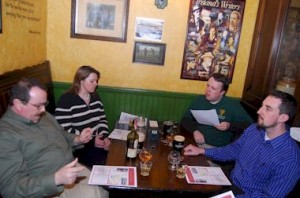
A recent whiskey tasting at Maggie O'Neill's. From left: Steve and Carol Pester, Shaun Griffin and Eastern Pennsylvania Whiskey Society presider Kevin Quinn.

A recent whiskey tasting at Maggie O'Neill's. From left: Steve and Carol Pester, Shaun Griffin and Eastern Pennsylvania Whiskey Society presider Kevin Quinn.

Kevin Quinn does not claim to be “a professor of whiskey-ology,” but he does know a fair bit more than the average imbiber about the aromatic amber spirit revered by kings and commoners alike as “the water of life.”

As a professed “enthusiast,” this private school teacher of physics and computer science and former part-time bartender at Maggie O’Neill’s in Drexel Hill collects obscure and intricate details about the process of Irish whiskey making, from the distilling process to the casks in which the whiskeys are aged. He can quote chapter and verse on the history of whiskey in Ireland. He speaks about Irish whiskey with the reverence and erudition more commonly associated with lovers of great wines.

Actually, some experience with wine helped him along on the path to whiskey appreciation. When Quinn was a senior at Bucknell, the president of the university hosted wine tastings. Quinn attended them, and learned the ropes. At about the same time, he came under the influence of two uncles who know and love Irish whiskey, and he discovered that tasting whiskey requires many of the same sensory skills.

“The production of whiskey and wine is similar,” he says. “The way you grade them and drink them is similar. You judge things like color, viscosity, finish, and nose. As with wine, there are things on the label that tell you what to expect. The only real difference is in some of the stages of production. Wine ages in the bottle; whiskey doesn’t. Once it gets bottled, it is what it is.”

Like many, Quinn was not overly enamored of the taste of whiskey when he first tried it. But at some point, something about Irish whiskey began to appeal to him. Now he loves Irish whiskey in the way gearheads adore Lambos. “The thing I like most about Irish whiskey is how smooth it is,” he says. “Often, people take a whole shot of whiskey and toss it back, but Irish whiskey is meant to be sipped. If you really sip it, you get a smooth finish. (“Finish” refers to how long the taste lingers on your taste buds after you sip it.) I like them to have a long finish. I can take a glass of whiskey and sip it over an hour, and not even finish it, and yet still taste it the entire time. A better whiskey should stick with you.”

Along with its finish, Quinn also takes time to appreciate a whiskey’s aroma, or nose, which can be very different from one whiskey to the next. Whiskies can be complex: malty, fruity, sweet like cake, honey or sherry, spicy, nutty, even peppery. It takes time to appreciate all of the subtle notes, but Quinn says it’s worth the effort. “When you nose whiskey, you don’t take a big, deep inhale and you don’t stick your nose in the glass, like with wine. With whiskey, you keep your nose above the glass and take a short, sustained sniff. Then you take another one. Then, on the third one, you can pick up the subtle notes. You really taste with your nose a lot. It gives you a preview of what you’re in for.”

At this point in Quinn’s whiskey tasting career, he’s nosed quite a few varieties, probably more than 20 whiskeys. Getting to that level can be hard. First, you have to cope with Pennsylvania’s antiquated liquor sales establishment. Usually, the state stores stock are no more than four or five whiskeys—the usual suspects like Jameson’s, Bushmills and Tullamore Dew, all very good but really just a fraction of the Irish whiskeys available. And more than a few whiskeys, he says, are not available in the United States at all.

His favorite is Redbreast Pure Pot Still Irish Whiskey, described by the Web site Epicurious as the “ne plus ultra of spirits.” Says Quinn, “It is the most characteristically Irish whiskey you can get. It’s very rich, and incredibly smooth.

Jameson 12 year is another good Irish whiskey. It’s very good, but it’s also affordable. I also have a bottle of Black Bushmills. It’s not super expensive but it’s very good.”

There are many more Irish whiskies, though, many of them quite costly.

“Bushmills 16 year old is a fantastic Irish whiskey; so is Jameson 18 year,” Quinn says. “Midleton Very Rare is about $140 a bottle, so I don’t get to drink that very much. Connemara is a single malt Irish whiskey. This is from the Cooley Distillery, the only Irish distillery (the other two are owned by Pernod Ricard). The nice thing about Connemara is that it’s peated, one of the steps in making Scotch whiskey. Usually, with Irish whiskey they put the malt in a closed kiln and heat it with coal. With Connemara, they put it in a kiln and leave it open and they heat it with peat. The smoky flavor gets into the grain and into the whiskey. Connemara tastes like Scotch because it’s very peaty, but it finishes like Irish whiskey. It’s very smooth.”

Most people who appreciate Irish whiskey nonetheless tend to stop at one or two brands that they prefer. But Quinn thinks they might be missing out: “There might be something better.”

Quinn hopes to open whiskey lovers’ eyes (and noses and taste buds) to something better through the Eastern Pennsylvania Whiskey Society—a new project sponsored by Maggie O’Neill’s. Maggie’s has held whiskey tastings before on about a quarterly basis, says owner Mike O’Kane. These are much more formal affairs usually paired with food. But the whiskey society will meet more frequently, and focus on tasting just one variety at a time. Quinn is the master of ceremonies. The next meeting is Tuesday, January 12, at 7 p.m., at the well-known Delaware County eatery. (Maggie O’Neill’s is in the Pilgrim Gardens Shopping Center, 1062 Pontiac Road, in Drexel Hill.)

“It’s pretty informal,” says O’Kane. “We shoot out an e-mail blast just to get a sense of who’s coming. They’re welcome to bring friends. We encourage that.”

O’Kane says the whiskey society was Quinn’s brainstorm: “We just thought it was a cool idea to sample some good whiskey and enjoy each other’s company.” For Maggie O’Neill’s, which stocks about 20 Irish whiskeys, the scheme seemed like a natural.

If you want to join in the good company and learn a thing or two about Irish whiskey, contact Maggie O’Neill’s at (610) 449-9889.

News

Re-Celebrate the New Year!

Sarah Conaghan rings in the New Year.

Sarah Conaghan rings in the New Year.

A roaring fire, a table laden with goodies, and live Irish music–it was enough to make you think that 2010 was going to be a mighty fine year, no matter what economists were saying.

That was the scene at the Philadelphia Irish Center on New Year’s Eve 2009. We were there and have the photos to prove it.

Columns, How to Be Irish in Philly

How to Be Irish in Philly This Week

An eclectic—one might even day “odd”–mix of events this week, from a Celtic worship service to an immigration reform “happy hour” to a performance by The Band of the Irish Guards. We’re going to peek into next week a little because there’s a fabulous music event coming up that you trad fans won’t want to miss.

First up: Tune in to 800AM between 11 AM and 1 PM on Sunday to learn how you can support the WTMR Irish radio shows. Fundraisers last year kept the shows going for seven months, but that money has run out. You can make a donation to the shows by sending a check made out to WTMR Radio (that’s important–it has to be made out to the station) to WTMR Radio-Sunday Irish Radio Shows, 2775 Mount Ephraim Ave, Camden, NJ 08104. Mark the envelope “ATTN: Vince Gallagher and Marianne MacDonald.”

St. Thomas Church in Whitemarsh is holding its monthly Celtic worship service on Sunday at 5:30 PM. Read our story explaining what it’s all about.

On Tuesday, join representatives from the Philadelphia Irish Immigration Center at Tir na nOg pub and restaurant in Center City to learn about how the new immigration reform bill could affect Irish immigrants. There will be “happy hour” specials for those who attend. There are other immigration meetings going on throughout the city next week, but I believe this one will be the most fun along with being informative. Way to go, Irish!

Pipe and drum aficionados, listen up: The Band of the Irish Guards will be performing at the Stabler Arena in Bethlehem on Thursday night. Also featured: the Pipes, Drums and Highland dancers of the Royal Regiment of Scotland and the Argyll and Sutherland Highlanders. What a sound!

If you’re marching in the St. Patrick’s Day Parade this year, you have a meeting on Thursday night at the Doubletree in Philadelphia at 8 PM to pay up and pick up your badges. That apparently means that there will be a parade this year. Yay!

Frank McCourt’s “The Irish and How They Got That Way” is playing through April at the Kimmel Center. If you mention the word “special” you get 20 percent off your ticket price. It’s the Irish discount.

Peeking into the following week: AOH Div. 87 is holding its annual beef and beer fundraiser at Finnigan’s Wake in Philadelphia on Sunday, January 17. Paddy’s Well is playing. As always, money raised at AOH events goes to charities large and small.

Later on Sunday night, three incredible trad musicians will be playing at the Coatesville Cultural Society. Singer-guitarist Pat Egan, his wife, flutist Laura Byrne Egan, and Brooklyn-born accordian player Bill McComiskey not only play together regularly, but teach others to play at the Baltimore Irish Arts Center. The Egans were recently in Philadelphia with Jim Eagan for an Ed Reavy tribute at the Irish Center.

As always, there’s a session just about every night of the week in the Philly area. One of our new year’s resolutions is to get to every one of them. Maybe you should add that to your list too!
Check the calendar for details.