Monthly Archives:

November 2009

People

Halloween at the Philadelphia Irish Center

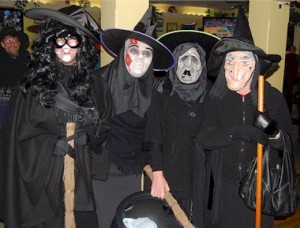
Four hags, no waiting.

Four hags, no waiting.

The witches didn’t both waiting for the witching hour. In fact, the whole darn coven—four altogether ugly hags—showed up for the start of a special Rambling House party at the Philadelphia Irish Center Friday night.

And they weren’t the only creepy crawlies at the bar that night. There was an especially strange looking thing in a dashiki, for one.

But of course, it was all in good fun, and host Marianne MacDonald kept the fun rolling all night long. There was music, for sure, as there always is. And there was dance, as there always is, but with monsters on the Irish Center floor this time around.

A ghastly time was had by all.

Music, News

Irish Music for a Sacred Cause

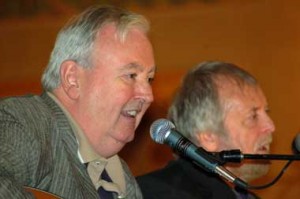
Robbie O'Connell and Mick Moloney.

Robbie O'Connell and Mick Moloney.

Father John McNamee, the former pastor of St. Malachy Church, looked out onto the audience gathered for Sunday’s annual Irish music concert with Mick Moloney and friends, and marveled at how the tradition has helped keep the parish school open and thriving.

“The only way we can keep this school open,” he said, “is through our own effort. Thanks to you, we cost the archdiocese nothing.”

Keeping the school in business is a costly proposition, but it apparently pays big dividends to the kids who attend. Roughly 50 percent of students attending city public schools drop out before they finish high school—but St. Malachy’s kids determinedly swim against that discouraging tide. Ninety-five percent of the school’s students finish high school, Father Mac said.

Thanks to Mick Moloney and a small group of immensely talented fellow musicians—including fiddler Dana Lyn, uilleann piper Jerry Sullivan, accordion player Billy McComiskey, and singer Robbie O’Connell—the school acquired a healthy infusion of cash from the fans who nearly filled all the pews. It’s a tradition Moloney has carried on for over two decades. “Here it is 25 years, and here it is Mick’s still coming,” said Father Mac.

We have photos from the concert, and several videos. Check them out.

The videos: 

Mick Moloney and Friends Play a Medley of Reavy Tunes
http://www.irishphiladelphia.com/video/mickreavey

The Emigrant and Lough Derg
http://www.irishphiladelphia.com/video/sullivanjigs

Yesterday’s Men
http://www.irishphiladelphia.com/video/yesterdaysmen

The First Half Closer
http://www.irishphiladelphia.com/video/firsthalf

An O’Carolan Tune
http://www.irishphiladelphia.com/video/mickocarolan

The House In The Glen/The Bohola Jig/Josie McDermott’s/Free And Easy
http://www.irishphiladelphia.com/video/mickopeningset

News, People

Ireland’s “Immigration Bishop” Visits Philadelphia

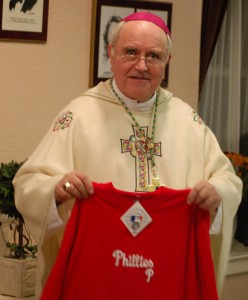
Derry Bishop Seamus Hegarty with his Phillies shirt, a gift from the Philadelphia Derry Society.

Derry Bishop Seamus Hegarty with his Phillies shirt, a gift from the Philadelphia Derry Society.

As he prepared to say a Requiem Mass for the souls of the faithful departed at Philadelphia’s Irish Center on Tuesday night, Dr. Seamus Hegarty, the Bishop of Derry, Ireland, paused to acknowledge the living who are far from peace.

The chairman of the Irish Episcopal Council for Emigrants, in Philadelphia briefly on a multi-city tour to meet with immigrants, was clearly moved by the stories he heard from undocumented Irish who had lost loved ones in Ireland and were forced to grieve alone, far from family and friends, because they could not return home. Illegal aliens can’t risk returning to their country of origin for fear that they will not be allowed back in the United States where they may have American-born children.

“It’s one of the things that really got to me,” said the Bishop, who has served the Derry diocese since 1994. “It’s a double tragedy for people who have lost someone and then aren’t able to go home and grieve with their families. I lost my own mother when I was seven, so I know how they feel.”

Bishop Hegarty spent part of the day at the Irish Immigration Center in Upper Darby. But not far from his mind were the immigrants he’d met in Boston. “They’re hurting very badly there,” he said. “I met many people who were bereaved and unable to go home and they were just devastated.”

He used the message of the Gospel to urge those in attendance to put pressure on the political powers-that-be to pass comprehensive immigration reform bills that would create legal pathways for the undocumented to become citizens. In Matthew 25:31-45, Jesus promised that those who fed the hungry, gave drink to the thirsty, welcomed strangers, clothed the naked, cared for the sick, and visited those in prison will sit to the right of him in heaven “because whatever you did for one of the least of these brothers of mine, you did for me.”

“The attitude that ‘as long as I’m allright, I don’t care about you, is not the Irish way,” he said in his homily. “We had nothing and we shared our nothingness with each other. You need to forge a community here that carries out the message that the interest of one is the interest of all. Reaching out to people is a gift and certainly will not go unrewarded.”

The Philadelphia Donegal Association and the Derry Society participated in the Mass and the reception that followed. Bishop Hegarty also renewed old acquaintances, including Mary McHugh of Lindenwold, NJ, who knew the bishop as a youngster in Kilcar, County Donegal, where he was born. “I was born and raised in Scotland, but my mother grew up in Kilcar and my father was from the next village, so I spent my summers there,” she said. “The bishop is actually related to me through my mother. When you grow up in these little towns and villages, you keep the connections.”

Bishop Hegarty was on his way to Washington, DC, to meet with US legislators about immigration issues and was clearly aware of the effect the visit of one Irish bishop would have. “I’m sure they’ll be very gracious and as soon as I’m gone they’ll forget all about it,” he said to laughter. “That’s why you need to pressurize them. . . You can do something. We are all responsible for one another’s welfare. Use your voice in a responsible and constructive way to try to improve the welfare of immigrants.”

Siobhan Lyons, executive director of the Philadelphia Irish Immigration Center, was Bishop Hegarty’s host for much of the day.

“We were delighted to welcome Bishop Hegarty to Philadelphia.,” she says. “The Irish Apostolate has been a strong supporter of the Irish diaspora and we deeply appreciate the work they do on behalf of the Irish community in the United States. I particularly welcome their efforts in the campaign for comprehensive immigration reform and wish the bishop the best of luck in Washington DC.

“But Bishop Hegarty is right when he says we can’t sit back and wait for other people to solve our problems,” Lyons says. “We must use our voices and our votes to advocate for the most vulnerable in our community, and that includes the undocumented. I hope everyone will listen to his message and make sure their representatives know that the Irish community supports comprehensive immigration reform. “

News

Will the Parade Pass Us By?

During the worst recession in 80 years, with an unemployment rate inching up like holiday weight gain, you might think that whether the City of Philadelphia funds or doesn’t fund the St. Patrick’s Day parade is a non-issue. Petty. Paltry. Pale by comparison.

But not to parade director Michael Bradley. Nor to the thousands who plan their last Sunday before March 17 around the nation’s second oldest (starting in 1771, it has marched continuously every year) St. Paddy’s Day Parade. Traditions are by their very nature part of our history, allowing us to mark time or relive the past–a rare gift, which is what makes it so hard for us to let go of them.

So Bradley will be fighting City Hall again this year—not to have the city pick up the entire freight for the parade, but to give the Irish and all the other ethnic groups who march every year down the Parkway, Broad Street, or through a neighborhood, a break on the bill.

“We’re not out to get the city to cover 100 percent of everything,” says the Delware County businessman, who also runs the Irish Festival on Penn’s Landing in June. “Everyone should kick in. I proposed that the city provide $125,000 and the state another $125,000 and that will cover the expenses for all the ethnic parades. We need everyone to compromise. It can’t be us 100% and them zero.”

Bradley will be testifying next Tuesday before City Council which is holding hearings on the parade costs, which are higher than in most large cities. In Chicago, for example, the city not only allows parade organizers (the local plumbers union) to dye the Chicago River green, it only tags them with an $8,000 bill, says director Kevin Sherlock. The organizers make up the rest of the money they need—including $27,000 for “terrorist insurance”—at an annual fundraiser in January

“For $8,000 we get a lot,” says Sherlock, who is vice president of the Chicago Journeyman Plumbers Union Local 130. “I can’t complain. The street sweepers keep the streets spotlessly clean, the city supplies port-a-potties all over the place, they close the streets down for us, set up the staging area, all traffic is stopped. We get a tremendous amount of help and support from the city.”

Along with Michael Blichasz, co-host of the Pulaski Day March, Bradley formed a group called Ethnic Americans United which includes representatives from the Puerto Rican, Italian, German, Greek, and other ethnic communities whose parades might not get off the curb this year. Or ever again. As Blichasz said in a letter to Mayor Michael Nutter, “the unaffordable fees being charged this year threaten the parades’ continued existence.”

That was certainly true for the Columbus Day parade. It didn’t happen this year. Though the Mummer’s Parade is expected to march down Broad Street as usual, the city will be delivering organizers a bill too—one much larger than last year, when the last-minute announcement that the city wasn’t going to pick up the tab nearly caused the strutting to stop dead on Two Street. Last minute donations and fundraisers—and the gesture by the city to forgive $300,000 in costs because of the short notice– saved the Mummers’ parade. The city will not be so forgiving this year. Last year’s St. Patrick’s Day parade was also shortened to save thousands in police and sanitation bills, and shortfalls were made up by donations and 11th hour fundraisers.

Bradley has also asked for an accounting from the city on the fees they’re charging for items like portable rest rooms, police, and bleachers. “I looked at the sanitation fees and I felt they were fair,” says Bradley. “But I contacted the port-a-potty vendor and their price was half what the city is charging us. I’m also concerned about the security costs. The police are wonderful, but I can’t believe that some of them can’t be working straight time. They can’t all be on overtime.”

He pointed to the last year’s Phillies’ World Series parade which, he said, cost the city $1 million. “I was told they bring lots of money to the city,” he says, “but so do we. We hold all our meetings in Center City, put up out-of-town bands in the city, bring people into the city for the day where they spend money. I want some acknowledgement of that.”

Though some have suggested that the parade be moved out into the suburbs, Bradley doesn’t think it’s a good idea. Many suburban communities now have their own parades. And for 239 years—before the Declaration of Independence was signed–it’s been the Philadelphia St. Patrick’s Day Parade. “All of these ethnic parades celebrate city neighborhoods,” he argues. “We don’t want to see these traditions go by the wayside.”

What can you do? Write a letter to Mayor Nutter or the Philadelphia City Council in support of the efforts of Ethnic Americans United before next Tuesday’s City Council meeting.

Food & Drink

Tea Story

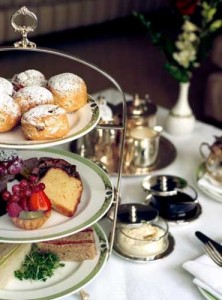
Tea at the Merrion Hotel in Dublin, from Margaret M. Johnson's "Tea & Crumpets."

Tea at the Merrion Hotel in Dublin, from Margaret M. Johnson's "Tea & Crumpets."

You could just drink a cup of Tetley with a packet of Krimpets on the side. Or … you could settle down to a steaming china cup of oolong, accompanied by dainty sandwiches, lemon curd tartlettes and sweet, crumbly scones and strawberry jam.

Which sounds more relaxing to you?

Clearly, there’s more to the civilized repast called “tea” than just tea. Having tea, the meal, is an opportunity to sit and quietly exchange gossip with friends and to nosh on all the neat little treats at a leisurely pace.

All of which makes tea so very appealing, according to well-known cookbook author Margaret M. Johnson, whose latest offering, “Tea & Crumpets” (Chronicle Books, $13.57 on Amazon) documents the history and customs associated with the meal. She also serves up a treasure trove of recipes for tarts, breads, cakes, scones, sandwiches and savories, from many of Europe’s finest tea rooms.

There are recipes from England, of course, which claims to have invented tea. (As witness Johnson’s story about Anna Maria, seventh duchess of Bedford, who is said to have originated the custom in the 18th century.) But there are recipes, too, from France, Scotland, and, of course, Ireland. (Including a delicious recipe for Teatime Fruitcake, which she has generously consented to share.)

In her travels for “Tea & Crumpets,” Johnson visited many of the better-known spots, including London’s Savoy, the Merrion Hotel in Dublin, Le Jardin d’Hiver in Paris and Edinburgh’s Balmoral Hotel. (Where do we get a job like that?) A few of them stand out as favorites.

“The Shelbourne Hotel in Dublin has always served lovely tea in the Lord Mayor’s Lounge,” she says. The Merrion in Dublin is also quite lovely. (The hotel ‘lobby’ is really a series of three drawing rooms, so it’s quite special.) In London, Brown’s Hotel was just named ‘top tea spot’ for 2009.”

No matter where you have it, to share a tea is to indulge in a bit of quiet refinement that often is missing from other meals. “Participants share the food from the tea stand, so there’s a social aspect to that,” says Johnson. “And because everything is dainty, there’s lots of room for conversation—no cutting meat or asking people to pass the salt.”

No doubt, tea is a departure from our fast-food ways. It can also be something of a mystery, what with cream tea, high tea, afternoon tea and more. Maybe not knowing what to expect has kept you from enjoying one of the great gustatory pleasures.

Let Margaret unravel the mysteries for you.

“Afternoon tea is simply what we all know of as a formal tea, with the three-tiered stand, a selection of sandwiches, pastries, and, of course, tea,” she says. “In many hotel rooms in London, Dublin and elsewhere (Philly, too), you can add a glass of champagne for even more elegance. It comes with an additional cost, naturally! High tea is often confused with afternoon tea and because of the word “high,” is usually thought of as even more elegant. Not so. (High tea is actually more sunstantial, like an early dinner, with savory pies and sausages. It’s also called “meat tea.”) Cream tea is usually simply tea and scones.”

For special occasions, like bridal and baby showers, you can also have it at home. (Which is where “Tea & Crumpets” comes in handy.) And don’t feel, Johnson says, like you need your best silver (assuming you have any). Even the three-tiered stand can be bought on the cheap at a store like Marshalls. Use your own dishes on it, she says—these stands usually are designed to take seven- or nine-inch plates.

Of course, tea is truly special when you have it out. Happily, the Philadelphia area is filled with places where you can indulge. See our tea guide.

News, People

Hibernians Present O’Hanlon With MacBride Humanitarian Award

While it was the occasion of his wedding anniversary, Editor-in-Chief of the Irish Echo newspaper Ray O’Hanlon stood without his wife at the podium to accept the Ancient Order of Hibernians Sean MacBride Humanitarian Award. The award was presented in Philadelphia at the annual president’s dinner presided over by AOH National President Seamus Boyle.

The award is named for Dr. Sean MacBride, the Irish statesman and Nobel Peace Prize winner whose name is attached to the MacBride Principles on Fair Employment for Northern Ireland. MacBride, who died in 1988, had a long and distinguished life. He fought for Irish independence, was at one point chief of staff of the IRA, later became an Irish government minister, and helped found a number of international organizations, including Amnesty International.

Ray O’Hanlon had been selected as the MacBride recipient based on balloting conducted among National Board members and State presidents of both the AOH and LAOH. The purpose of the prestigious Sean MacBride Humanitarian Award is specifically stated in the AOH National Constitution: “To memorialize the human rights contributions made by Nobel Peace Laureate Dr. Sean MacBride and to recognize the efforts of others who make similar contributions in the cause of peace, justice, and the economic well-being of the Irish people…” (Article XXVII).

Ray O’Hanlon has been a most significant force in reporting on the many generations of the Irish Diaspora in the United States, the experiences of the new Irish who have recently immigrated to America, and the ongoing challenges of transforming the North of Ireland.

Having immigrated to the United States in 1987 from his native Ireland, he immediately became recognized as a major voice of the Irish-American press. In 1988 Ray began working as a journalist at the Irish Echo and, coincidentally, was immediately assigned to work on the MacBride Principles campaign. As a direct result of his careful research, Ray quickly became a major promoter for the passage of MacBride legislation in many states. The MacBride Principles gave Irish-American advocates for the North, such as the AOH and LAOH, a solid opportunity to educate legislators regarding the real reasons for conflict in the Six Counties.

Ray became associate editor at the Irish Echo in 2007 and has since risen to the post of editor-in-chief. Over the course of his career in journalism, Ray has reported from three continents, has appeared on numerous TV and radio shows on both sides of the Atlantic, and has found the time to author a book on a subject dear to his heart, The New Irish Americans, which was published in 1998 and subsequently received the Washington Irving Book Award. Amazingly, on the very day that The New Irish Americans was published, May 1, 1998, Ray was sworn in as a United States citizen.

Ray’s writing has consistently reflected the ideals and cultural concerns of Hibernians, always assuring that both the AOH and LAOH have received proper recognition and that our viewpoint has been clearly and fairly represented in the Irish Echo. On more than one occasion O’Hanlon has described the Hibernians as, “The bricks and mortar of Irish America.”

O’Hanlon spoke of MacBride as a man who spoke “Truth” which is important to all of us in the Irish community. Speaking about the Irish-American media O’Hanlon pointed out that “we exist because our (Irish Americans) stories continue to be told. And he concluded by telling a well impressed audience that when it comes to the Irish-American community “The story is still not fulfilled.”