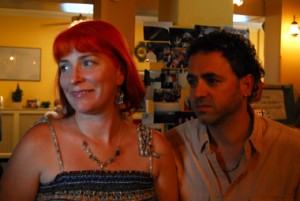
When she fields the calls from Ireland, Siobhan Lyons makes it clear that she’s executive director of the Irish Immigration Center of Greater Philadelphia, not the Welcome Wagon.
“I’ve taken several calls from people who say, ‘I’m coming over, how do I find jobs?’ I say, ‘Please don’t come,’” says Lyons, who has been on the job at the 10-year-old center in Upper Darby for only about three months. “’You do not want to come here undocumented, because that’s getting harder and harder.’”
Although there aren’t any hard figures on new immigration trends, Lyons says that other Irish immigration experts are expecting to take more of those calls as economic conditions in Ireland—where unemployment, in the double digits, is at a 14-year high—continue to deteriorate.
New laws and programs in the US and Pennsylvania in particular have made it dicey for immigrants to overstay their visas. “For example, you need to prove that you are in the country legally in order to get or renew your driver’s license in Pennsylvania,” says Lyons, who was born in Dublin and came to this country (legally) five years ago. “That means that undocumented immigrants will either be forced not to drive or could be arrested for driving without a license. Local police officers are also being tasked with enforcing immigration laws. So, under the ‘Secure Communities’ program, the fingerprints of people arrested for any reason, including minor traffic offenses, are checked against the Immigration and Customs Enforcement database, meaning that you could end up deported after running a red light.”
Laws like those are likely to drive the undocumented Irish underground even further, making them fearful of contacting the police if they’re victims of a crime or coming forward as a witness. “These policies are not the solution,” she says. “We need comprehensive immigration reform to create an immigration system that works and that is flexible enough to respond to the changing needs of the American workforce.”
Getting here legally is no picnic either, as Lyons knows personally. She’s held several visas, including the H4 (as the spouse of an temporary foreign worker), the F2 (for spouses and children of a foreign student), and the TD (for immediate family of a foreign worker), all of which prepares her well for dealing with the Byzantine legal regulations immigrants face and gives you a little insight into her own history.
The daughter of an Irish diplomat, Lyons spent her childhood and teen years in Dublin, Nairobi, Washington, DC, London, and Riyadh, Saudi Arabia. While at university, she visited her father in the Arab capitol where she caught a glimpse of the older Saudi princesses with their black costumes and tribal tattoos “who were so different from all the young princesses I knew who spoke English, skied, and wore designer clothes.” She paid close attention when the wife of the then British ambassador, an Arabic speaker, approached and began to chat with them. “I thought I’d really like to know what these women have to say,” she recalls. So instead of getting the law or history degree she thought she wanted, she majored in Arabic at the School of Oriental and African Studies in London.
Of course, like all best laid plans, this one has gone astray. She hasn’t really had to use her language skills, even though she served in the Irish diplomatic service. “My area was looking at Ireland’s role in the EU (European Union), specifically whether the money we gave to the EU was being spent the way it should have been,” she explains. Today, she says with a grin, “my taxi Arabic is good.”
She came to the US in 2005 with her then-husband, a Canadian who was finishing his PhD at Princeton and later launched a start-up company in Philadelphia—hence the plethora of spouse visas. But those visas had a major drawback—while Lyons was here legally as a spouse, she couldn’t work. So she began volunteering with nonprofits “just to fill up my days.”
While her marriage didn’t last, her love for the area did. But to stay, she needed a company that was willing to go through intense rigmarole to hire her. “If you’re looking for a job the first thing they ask is if you have a Green Card. If the answer is no, clunk!” She pantomimes a phone being slammed down. “To hire a foreigner, a company has to prove that the candidate is better than any other American who applied for the job and that they’re not undercutting standard wages.”
Companies who want to hire foreign workers face an uphill battle. Workers need to be offer employment by April 1 (leaving a small window for recruitment and interviewing ) and can’t start work until the following October. Only 65,000 work or H1B visas are issued each year and in the past there have been as many as 145,000 applications so even after a worker has passed the employment tests and been hired, the visas are only issued after a lottery. “You have about a one in three chance of getting one,” she says. For a company that has spent considerable time and money recruiting, interviewing and hiring a worker and filling out all the forms and paying the fees, that means it all could come down to the luck of the draw.
“This is something Bill Gates of Microsoft is always complaining about,” says Lyons. “Of course, my bugbear is the visas for spouses. If America wants to attracts PhDs and MBAs and other skilled professionals, you have to understand that highly educated people tend to have highly educated spouses who don’t want to end up working as a volunteer.”
Lyons eventually was hired by the World Affairs Council in Philadelphia as its director of communications and foundation relations, largely, she says, “because they’d never hired a foreigner before and didn’t know what they were getting into! But, of course, I will be eternally grateful that they didn’t back out once they realized.”
A chance meeting with a member of the Immigration Center board last St. Patrick’s Day while she was attending the annual breakfast sponsored by Judge Jimmy Lynn at The Plough and the Stars led to the offer of a job to be the executive director of the 10-year-old center, founded by Donegal-born Tom Conaghan, who is continuing a director of immigration services on a voluntary basis.
Lyons has her work cut out for her. Anticipating a favorable change in immigration laws—a campaign promise of the Obama administration—she’s working with her 10-member board on plans to prepare local undocumented Irish for eventual legalization.
“They’re going to need proof of residence, proof that they’ve paid taxes, and are of good moral character, and paying taxes is one way of showing that,” she explains. “The problem is, many undocumented workers may be using false names, not keep a proper address, have nothing in their name, using other people’s phones, just to stay under the radar. They’re going to need to be able to prove that they’ve been here a while and didn’t just arrive as a tourist. They’re going to need a tax EIN (a federal tax identification number) so they can pay taxes since they don’t have Social Security numbers.”
One goal: To have the immigration center certified by the US Board of Immigration Appeals “so that we can provide assistance to Irish workers in dealing with some of the legal issues for a nominal fee. If we’re recognized,” she says, “it will help stop unscrupulous people from taking advantage of undocumented residents. Those people are already out there and they see easy money to be made.”
Another target: Creating as many new American citizens as possible. As as many Irish citizens as she can. “We want to push citizenship on both sides so the Irish who live here can gain all the advantages of being American and Americans can gain the advantages of being Irish.”
In fact, Americans whose parents or grandparents were born in Ireland qualify for Irish citizenship and passports. The more Irish there are, she reasons, the more powerful they are as a constituency. The Irish diaspora—historically a source of pain and sorrow for many Irish—is also one of Ireland’s greatest strength, she says. “Having Americans with connections to Ireland has been a great thing for Ireland. In hard years, Irish Americans send money home. In good times, they travel to Ireland. It turned out to be to Ireland’s benefit and the opportunity for dual citizenship helps Irish Americans keep that connection to Ireland.”
There are also other benefits for Americans who gain their IRish citizenship—lower cost visas to other countries, no visas for Europe, breezing through customs, the latter no small thing to anyone who has ever had their packed unmentionables manhandled in front of an audience.
“So everyone needs to come in and we’ll help,” she promises with a laugh.
The Irish Immigration Center of Greater Philadelphia (formerly the Irish Immigration and Pastoral Center) provides confidential counseling services at its office at 7 S. Cedar Lane (at its intersection with Route 3) in Upper Darby. Phone: 610-789-6355. Website: www.philadelphiairishimmigrants.org