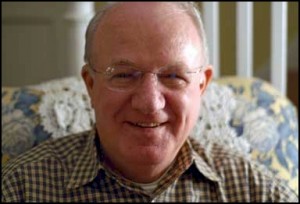
Bob Hurst
You might think being president of the Irish Memorial, Inc., is a tough job. After all, you’re heading a board that oversees the largest, most visible presence of the Irish in the city other than the crowd that comes downtown for the St. Patrick’s Day parade. The Irish Memorial is a 24-foot long bronze sculpture depicting the spirit of immigrants taking on the challenges of the new world, set in a 1.75-acre park at Penn’s Landing.
But former Philadelphia Police Sergeant Bob Hurst Sr. spent his childhood in an orphanage, was hospitalized 50 times in the line of duty, mugged 278 times, stabbed eight times (once in the neck, leaving him paralyzed for more than five hours), once walked the streets of the city dressed as a nun and—in what might have been the most harrowing adventure of his life—served as the president of the Philadelphia Fraternal Order of Police for four terms. In that last role, he had to deal on a daily basis with politicians. When he served in the police stakeout unit, he says, at least he “knew who the enemy was. With politicians, the bugger’s behind you.”
So, president of the Irish Memorial? Piece of cake.
Of course, that’s not really how the 70-year-old Hurst sees it. Despite his 16 years on the street, Hurst is far from cocky. If anything, he’s got the market cornered on humility. Hurst, says his friend Bob Gessler, who has been on the Memorial board since its inception, feels such a “personal connection to the Memorial” that he goes down a few times a month just to pick up the trash. “This St. Patrick’s Day, I saw Bob with a bag in his hand going through the site, picking up trash, cigarette butts and cans,” Gessler says. “I was impressed that he wanted to make the site look better for this very public event. I told Bob so and he indicated that he did this monthly. He would come down early Saturday mornings and take an hour or so just to clean the site. This is the sort of dedication that he brings to the board.”
But Gessler left something out. “I might also chase a few bums off,” concedes Hurst. Though he’s been retired from the Philadelphia police department since 1987, Hurst is still in touch with his inner cop. That’s understandable. For a decade, Hurst was a member of the force’s so-called “Granny squad,” whose members dressed up as the mugging target group du jour, whether it was insurance salesmen or grandmothers or even nuns. “I did pose as a nun but we got out of that business real fast because we got letter from Cardinal,” recalls Hurst, barely stifling his rich, infectious laugh. “He took umbrage with the idea of using a shotgun from underneath the habit to blow people through windows. We were not the little sisters of mercy.” That last quip was almost smothered by laughter—his and mine.
Hurst has that essential quality—a great sense of humor—that allowed him to survive not only life on the street, but his early tragedies and the tough world of city politics. His mother, a native of Swinford, County Mayo, who had nine children, died at the age of 37 of breast cancer. Hurst’s father, a PTC motorman who was born in County Sligo, wasn’t able to care for his entire brood. He kept five and the other four, including Hurst, were sent to the now closed St. John’s Orphanage at 49th and Wyalusing Avenue, which was run by the Sisters of St. Joseph. His father and siblings visited every Sunday. Later, he attended St. Francis Vocational School in Eddington where he spent half the day on academics and half in woodworking shop, making church pews.
But don’t expect Hurst to moan about his tough childhood. He has only good memories of his time at both institutions. “The nuns—those women did a tremendous job under the circumstances,” he says. “They really raised us. At St. Francis we were taught by Christian Brothers and I take my hat off to them. It was a good experience. For guy who had to leave home and go to an orphanage, it could have been a lot worse.”
After graduation, Hurst went into the service, returning to start a career in insurance. He had never considered joining the police force. Didn’t even know a cop until, one night, when he ran afoul of the law. While having dinner with an old school friend who had become a doctor, the two got into an altercation with another man who, as Hurst recalls, was smart-mouthing them to impress a girl.
“Well, one thing led to another,” recalls Hurst. “I got up, slipped, fell flat on my back, but he was coming at me so I put my feet on his belly and right over he went, right through the plate window, $638 worth. I thought, well this is a fine how do you do. So I take off one way, doc takes off the other way. I must have run for two blocks, and came out to Germantown Avenue near the library, and when I did, who’s standing in front of me but a cop, Tony Kane. I looked at him and asked, ‘My only question is how did you know I was coming out here?’ He said, ‘Just a hunch.’”
Kane and his partner, Michael Chitwood (now police chief of Upper Darby), decided not to arrest the two men, but made them split the cost of the window they’d broken. About a month later, Hurst ran into the two in their unmarked car and started chatting. “They asked if I’d ever thought about becoming a cop and I said no,” Hurst says. “But I started to think about it and where it could take me.” So he enrolled in the police academy. (He credits his decision to Kane, who is now dead, and Chitwood, both of whom he still speaks of with admiration. “They could find a criminal in heaven,” he says.)
His first beat was in Roxborough, where he made the acquaintance of a young bank teller named Kathy Durning. “I always had my eyeball on her, but I couldn’t bring myself to talk to her,” he says. “You know that old saying about the Irish wedding proposal: ‘How would you like to be buried with my people?’ Well, I just didn’t have the brass to ask her out.”
One Friday night, when she was working late, she asked him to stick another dime in the meter where she’d parked her car so she wouldn’t get a ticket. “I took the dime from her and walked out to her car thinking, ‘Why the hell did I take that dime?’ and when I got to the meter, there I’d written the darn ticket already. I’d seen her car thousands of times but I didn’t recognize it. So I took the ticket and put it in my pocket and went home and wrote a $3 check and sent it in.”
So, was that how they started dating? No. “I didn’t tell her about it till we were married,” says Hurst, the infectious laugh starting to bubble up. They didn’t actually become a couple until the evening he ran into her in a bar where she was sitting with friends, there to comfort her on the breakup of her engagement. “I asked if I could sit with them, we had a very nice time, and from then on, that was it,” Hurst says.
This year. Bob and Kathy Hurst, parents of four grown children and grandparents of 12, will be celebrating their 40th wedding anniversary on a 16-day tour of Europe, though not to Ireland. “We’ve been there many times,” says Hurst, who has headed so many local Irish organizations—the Mayo Association, the Delaware Valley Irish Hall of Fame, the Danny Brown Division of the AOH—as well as serving on the boards of the Irish Center and the Friendly Sons of St. Patrick, that the top job at the Irish Memorial might be the only gavel-banging job he hasn’t had.
You have to ask others why Bob Hurst has been tapped so often to chair boards. “Bob always has his feet planted firmly on the ground, he’s always positive and optimistic,” says Kathy McGee Burns, who succeeded Hurst as president of the Delaware Valley Hall of Fame and now serves with him on the Irish Memorial board. “Whenever I have a problem, it’s Bob I go to for guidance, and he always gives it.”
If you ask Bob Hurst, the answer is much different. “A lot of people don’t know how to run a meeting with parliamentary rules,” he says by way of explanation. “When I was president of the FOP, we had a parliamentarian come in and give us some schooling on it. When you have 300 people a week at a union meeting, I found that a good chair has one blind eye and one deaf ear. I think people just think, he can run a strict, decent meeting, let’s put him in there. People think I know a lot, but I don’t know any more than the man in the moon. I just know how to run a meeting.”
But his love for the Irish community is palpable as is his deep humility, and it’s likely that that’s what people see when they’re casting around for someone to run their meetings. Roberts Rules of Order may help motions get passed smoothly, but respect for someone who isn’t above picking up trash—without wanting thanks or a pat on the back—is what makes Hurst a sought-after leader.
He’s a doer who admires other doers. When he returned from the service, Hurst started going to the newly built Irish Center where he met so many people he felt a special kinship with. Later, he became part of the core group dedicated to rebuilding it when it fell into disrepair. “Guys like Vince Gallagher, Barney Boyce, Mike Burns, Sean McMenamin, Tom Farley—these aren’t just guys you belly up to the bar with. They are people who want to do something, and I like that,” says Hurst.
“There’s an old saying that I’ve always subscribed to,” he says. “‘You can do whatever you want if you don’t care who gets the credit,’ and that’s the kind of people they are. I love being around the Irish. I love being at the Irish Center. You feel like you come as a stranger and you leave as a friend.”
A lot like you feel when you’ve spent a little time with Bob Hurst.
