Monthly Archives:

June 2008

Columns, How to Be Irish in Philly

How to Be Irish in Philly This Week

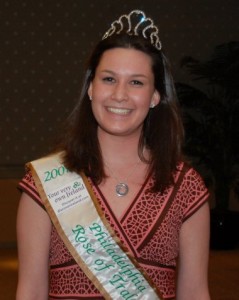
Philadelphia's Rose of Tralee, Colleen Gallagher, will give  up her crown on Friday night.

Philadelphia's Rose of Tralee, Colleen Gallagher, will give up her crown on Friday night.

If a pretty girl truly is like a melody, then Friday, June 20, will be quite a musical evening at the Hyatt Regency on Columbus Boulevard in Philadelphia. The Rose of Tralee Pageant, sponsored by the Irish Immigrational and Pastoral Center of Philadelphia, a nonprofit organization based in Upper Darby that provides assistance and social services to Irish immigrants in the Philadelphia area. The event is also the IIPCP’s main annual fundraiser.

Philadelphia’s current Rose, Colleen Gallagher, 22, an actress and singer who grew up in Bryn Mawr, will turn over her crown to another young woman who will travel to Ireland this summer to compete in the International Rose of Tralee pageant. It’s one of Ireland’s largest festivals.

Also on Friday evening, there are not-to-be-missed performances by the Pearl River Ceili Band and local traditional musician Caitlin Finley at the Irish Center. The event is a fundraiser to send the young people to Ireland to compete in the Fleadh Cheoil na hÉireann—otherwise known as the world championships of Irish music—in Tullamore, County Offaly, in late August. These kids are the future of Irish traditional music in the US—let’s get out and support them.

On Sunday, after the Mass at the Irish Memorial, head down to the Penns Landing waterfront for a day of Irish frivolity with bands like Blackthorn and Paddy’s Well, Irish food (like shepherd’s pie from Mike Driscoll’s Finnigan’s Wake) and vendors. (You can also see and hear Caitlin Finley playing with her band, Pat the Budgie.) This annual festival is one of a number of ethnic events at Penns Landing this summer (and we like to think it’s the most fun because it’s, well, Irish).

There are more major events coming up that we’ll tell you about next week. Or you could look them up on our calendar, which sees all, knows all, and tells all. What a blabbermouth.

Arts

Bloomsday!

Bloomsday is the day on which protagonist Leopold Bloom made his “odyssey” through Dublin in James Joyce’s celebrated and controversial novel, Ulysses. Every year, the Rosenbach Museum and Library joins with Joyce lovers throughout the world to celebrate “Bloomsday” on June 16.

Hundreds gather on Delancey Place for this event, which features readings from Ulysses by notable Philadelphians from the steps of the museum. This year District Attorney Lynne Abraham, NPR’s Marty Moss-Coane and Pennsylvania Governor Ed Rendell will be among the readers.

An exhibition of Joyce materials is also on view inside the museum, which is open to visitors all day.

For information, call 215-732-1600.

Columns, How to Be Irish in Philly

How To Be Irish in Philly This Week

Do some flag waving on Saturday. After all, it’s Flag Day. It’s also the day that local documentary filmmaker John Foley debuts his paean to the American Flag, “The Color Bearers,” at the Independence Living History Museum on S. Third Street. The Celtic connection: One of the stories Foley tells is of Col. St Clair Mulholland and the 116th PA Irish Brigade. Born in Ireland in 1839, Mulholland and his family emigrated to Pennsylvania when he was seven years old. Wounded four times in the Civil War, Mulholland was given the Congressional Medal of Honor for his bravery in the battle of Chancellorville.

On Friday (yes, we got a little ahead of ourselves), the Philadelphia Donegal GFC, AKA Four Provinces, will meet Cavan (head-on, we’re sure) at Gaelic Park in New York.

Next Tuesday, if you’re near Princeton, head over to Looking Glass Park to hear a terrific group of Irish musicians from Tucson, AZ, called Round the House, playing in concert. But if you miss them, don’t worry. They’re also playing at various locations in the area, including at the Suzanne Patterson Center in Princeton on Wednesday night, and accompanying the dancers at the Philadelphia Thursday Night Contra Dance at the Glenside Memorial Hall. On Saturday, June 21, you can hear them in a great setting: Four Dogs Tavern in West Chester.

Don’t forget on Tuesday night, June 17, the US Air Force Heritage Aire Celtic Ensemble will be giving a free concert at the Irish Center in Mt. Airy.

And plan carefully for next weekend. On Friday night, Philadelphia’s new Rose of Tralee will be selected at a gala held the Hyatt Regency on Columbus Avenue in Philadelphia. On Saturday night, support your local young Irish musicians by attending a fundraiser at the Irish Center to raise money to send our Fleadh winners to Ireland to compete. Many musicians will be there, including winners Caitlin Finley and the Pearl River Ceili Band.

And on Sunday, the Penns Landing Irish Festival—bands, food, beer, vendors, and always a good time. Pray for Celtic-friendly weather. See our story.

Check out our calendar for more details. It’s been checking you out for a while.

Music

Air Force Celtic Band Takes Wing in Philadelphia

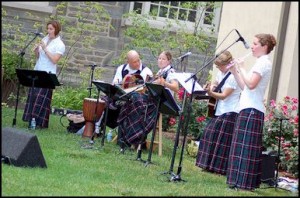
The Heritage Aire ensemble, performing on Father's Day in Chesthut Hill.

The Heritage Aire ensemble, performing on Father's Day in Chesthut Hill.

They’ve played all the big gigs—Iraq, Qatar, Afghanistan, Kuwait, Djibouti, and Kirghistan.

Now the Heritage Aire Celtic Ensemble can add Philly to their list of exotic locales. The U.S. Air Force’s nod to Celtic music played Tuesday night at at the Irish Center. But before that, shoppers in Chestnut Hill had the first chance to hear them locally when they played—clad in their clan Mitchell (after “Billy” Mitchell, father of the modern-day Air Force—tartans.

Members of the troupe are all full-time professional musicians who play other instruments as part of the USAF Heritage of America Band, based at Langley Air Force Base in Virginia. The troupe has been together about four years.

“We’re all classical musicians,” explains the group’s leader Technical Sergeant Sherry Burt. “I the band, I play flute and piccolo. In the Celtic Ensemble, I play flute and whistle and I sing. Our whistle and our accordion player are both clarinetists. Our guitarist is a sax player. Our gentleman who plays the bodhran (the traditional Irish frame drum) and dulcimer is also the timpani player. We’re all really breaking out of the classical shell. It’s very liberating.”

Being professional musicians, learning to play a traditional folk instrument like the whistle is perhaps less of a challenge than it would be for someone who has never played an instrument of any kind. Still, Celtic music has a looser, far less scripted feel to it, so for help members of the group reached out to those who know their stuff. Burt, for example, took some workshop lessons from whistle whiz Joanie Madden of Cherish the Ladies. (Talk about your drill instructors. They play Michael Burke whistles, too … another nod to Joanie.)

Since Celtic music isn’t their job full-time, members of the troupe do something you won’t see traditional musicians do—read sheet music.

Still, the group does a pretty credible job, and they have the performance skills down pat, as Chestnut Hill concert-goers were able to hear for themselves as the ensemble blasted through reels and jigs.

“Our prep for this ensemble is limited,” says Burt. “We get about a week of rehearsals and then we’re on the road. We print out the sheet music and we read it. But as we go along, the group has really adapted to the correct style. We’re getting closer and closer to the real thing.”

Of course, the job is more than purely musical. The band, and the Celtic ensemble—as well as several other small offshoots of the main band—perform public outreach on behalf of the Air Force. The musicians also provide much-needed entertainment for the troops, as they did last fall on a tour of the Middle East.
“We did 60 performances in about 55 of those days,” says Burt. Getting to the performance site wasn’t always as easy as hopping on the band bus. In Baghdad, for example, the troupe took to the skies in Blackhawk helicopters. A bit on the scary side, yes—but well worth it.

”It was important for us to go out and give soldiers, sailors, airmen and marines a bit of entertainment,” says Burt. “They work really long hours. Often we’d do five gigs a day in their workplace, and sometimes a nightly performance.

“We were definitely in some of the areas considered to be dangerous. On Thanksgiving Day, for example, we played a combat outpost. Conditions people were living in were not ideal, of course, but it was a perfect place for us to be. It meant a lot to them to have new people to interact with and to have music.”

In Afghanistan, the ensemble performed for NATO forces. The pub songs, Burt says, went over particularly well there. “”All the Europeans knew our stuff,” she says.

People

Five Questions for Caitlin Finley

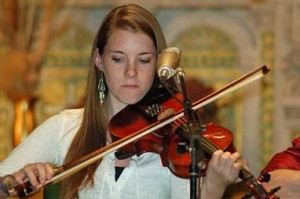
Caitlin Finley, at last year's St. Malachy fund-raiser with Mick Moloney.

Caitlin Finley, at last year's St. Malachy fund-raiser with Mick Moloney.

Caitlin Finley is getting set for another trip to the Fleadh Cheoil na hÉireann—otherwise known as the world championships of Irish music—in Tullamore, County Offaly, in late August.

Those who have heard Caitlin play usually are surprised at the level of skill in one so young. What’s more surprising, aside from her musical virtuosity, is her level of maturity. She’s a junior in high school, but, like so many of the kids who play in local traditional Irish music session, she seems more comfortable than most in the company of adults. 

Part of that is just Caitlin. But let’s also give credit to session musicians. Adult session musicians are generally welcoming to anyone with talent and interest, but they seem especially nurturing when it comes to kids. After all, it’s not a tradition if it isn’t handed down, and they seem to know that.

We recently posed five questions for Caitlin, who did exceptionally well for herself at the Mid-Atlantic Fleadh Cheoil in Pearl River, N.Y. Here’s what she had to say.

Q. You took third in fiddle and first in banjo. You’re in a trio that also took first place, and the Pearl River Ceili Band, which you’re also in, won the 15-18 competition. Tell me a bit about competing in so many categories. It doesn’t seem to have hurt you any, although I suppose that the third in fiddle means you wouldn’t be eligible to compete on that instrument at the Fleadh Cheoil na hÉireann in Tullamore in August.

Does competing in so many categories make you an overall sharper competitor, do you think, and maybe increase your competitive edge in all instruments? Or do you think there’s the possibility that maybe you consciously or unconsciously focus on one instrument over another?

A. Well, competing in so many competitions was certainly a challenge, especially because we had to arrange practices for the ceili band and trio, and the other kids all live in New York. I didn’t have much time to prepare because I’m a junior in high school, and AP Physics has taken over my life.

I think that because you have to concentrate on solely three tunes in preparation for the fleadh, competing on more than one instrument and in more than one category gives you a break sometimes.  For example, if I was practicing banjo and got tired of practicing my solo tunes, I’d just move on to the ceili band or trio tunes to play something different. And even though I wasn’t practicing my solo tunes, it was still preparing me for the solo competition just because I was constantly playing. 

At the same time, I had twelve tunes to really work up instead of only three.

As for switching back and forth between fiddle and banjo, I don’t know if it either benefited or hurt me. Although the technique for each instrument is completely different, I think that they complement each other. I don’t know if I focus on one more than the other.

I know that the fiddle is really my primary instrument and my favorite to play, but I still probably focused on each equally because when you’re tired and don’t feel like practicing, it’s possible to play the banjo on the sofa without much movement, whereas the fiddle’s a little more physically demanding. Oh, and for fiddle, even though I got 3rd, there’s a pretty good chance that I’ll still get to compete in Tullamore because the 2nd placer probably can’t make it, in which case I’ll be able to take his place.
 
Q. What tunes did you play in your competitions? And did you pick them yourself this time, or did you have a bit of help?

A. For the fiddle competition, I played the slip jig Gusty’s Frolics, a hornpipe called the Lass on the Strand, and a reel that I call Tom Steele’s (it’s also known as Hand Me Down the Tackle).  On banjo, I played a jig that I don’t know the name of, but I got from a recording of traditional Donegal style fiddling.  I also played a version of the Blackbird that actually doesn’t sound very much like the more common version that everyone knows, and a reel called Andy Davy’s, which is currently my favorite banjo tune.  I had some help from my fiddle teacher, Brian Conway, in deciding on the tunes for the fiddle competition, but he actually doesn’t play the jig or the hornpipe, which probably made it a little harder for him to help me out with variations.

For banjo, I picked the tunes myself, although I learned the hornpipe and the reel from my banjo teacher, Eamon O’Leary, and I had some help the night before the competition from my friend Dylan Foley with picking them out.

Q. I take it you’re planning to compete at the Fleadh Cheoil. You’ve done that before, so you know that this is not a trip to the beach. There are expenses and some crazy planning to do. How are you and your fellow musicians from the trio (Blaithin Loughran and Dylan Foley, it looks like) and the ceili band planning to get there? I know it’s early days yet, but are you thinking about fund-raising?

A. We actually are in the beginnings of starting to plan fundraisers. There’s going to be a big one up at Rory Dolan’s in Yonkers sometime during the summer, which is an annual fundraiser.  All the students of Rose Flanagan, Margie Mulvihill, Patty Furlong, and others who are competing at the Fleadh Cheoil will perform, as well as the teachers. Other folks from all over will donate their time to help us raise some money (last year Eileen Ivers and Jerry O’Sullivan performed).  Rory Dolan’s provides food and drinks and lets us keep the gate.  Also, each of the kids make a basket to be raffled off.

This year we’re also going to try a fundraiser in Philadelphia.  My parents and I will be organizing this. Currently it is scheduled for June 20th.  We’re going to try to bring down as many members of the ceili band as we can to play a ceili at the Irish Center and some of the parents, like Rose Flanagan and Margie Mulvihill, will play as well. It should be a lot of fun. I’ll keep everyone updated on both fundraisers.

Q. You’re in the 15-18 age group, which means that, by the standards of a lot of our local musicians, you have not been playing all that long. When did you start, and why? What inspired you? Why fiddle and banjo?

A. I’ve been playing for somewhere around eight and a half years.  I started playing the fiddle when I was eight.  I don’t really remember asking to learn the fiddle or my first lessons, but I’ve been told that I really wanted to play because I was an Irish dancer and saw a lot of fiddlers at feisanna.  There’s also the fact that all of us (my siblings and I) have to play some musical instrument, at least in a school program, until we graduate from high school.  I don’t think I’ll be quitting after high school, though.  I also went to every one of the Mick Moloney concerts at the IHouse at UPenn from the time I was born, my parents played old records of Irish music around the house, and I danced constantly, so I had music in my head. I originally started out playing classical but then moved to Irish almost immediately, both with my first fiddle teacher, Chris Brennan Hagy. 

I got my first banjo about two and a half years ago.  My fiddle teacher at the time, Brendan Callahan, encouraged me to get one because he said it would help with some of the technique involved with playing the fiddle, mainly being able to press down the strings all the way with my left hand.  Brendan actually gave me my first banjo lesson.  I’ve never stopped playing it since; it’s a pretty addicting instrument, actually.

I always enjoyed playing music, but practicing was like a chore and I didn’t like going to sessions. I remember the time, though, that I finally fell in love with the music. The summer before I went into 9th grade, my parents and I spent three weeks in Ireland.

We visited family and traveled around, and then we went to Willie Clancy Week in Miltown Malbay, County Clare (where local musician Fintan Malone is from).

I took fiddle classes for a week with Jesse Smith, who is one of my favorite fiddle players, and I met a bunch of kids from all over who played Irish music as well, including two from Italy, one of whom, almost three years later, is still my best friend. It was complete immersion in the music for a straight week.  After I came home, I went to as many sessions as I could. I’ve never slowed down and I love it more than ever.

Q. I imagine there are not all that many students in your school who would know one end of the Irish fiddle from the other. How does this interest of yours go over? Is it something you talk about? What’s the reception?

A. Irish musicians are definitely a rarity at my school.  My school’s probably around 70 percent Jewish, so most of my friends have never heard Irish music or, if they have, it’s only because they’ve seen Riverdance or Celtic Woman or something along those lines.  At school, I’m the Irish girl. 

Being Irish is so much a part of my identity, that I end up talking about it a lot, everything from history to music. At this point, most kids know I play Irish music; it’s a subject that comes up every time I’m asked what I did over the weekend. 

I think that in 9th grade, a lot of my friends thought it was really weird and just tolerated it, but at this point, most kids think it’s really cool.  I have kids asking me to burn them CDs of Irish music, my closer friends all know what a session and a fleadh are, and have seen numerous Comhaltas Live videos, and earlier this year in English class, when my teacher announced that we would be reading “A Modest Proposal” by Jonathan Swift, everyone turned around and looked at me. Just last week, I brought in my banjo to English class to play, to celebrate both a unit we had just finished on cultural identity, and one of my teachers favorite lines from The Great Gatsby: “the stiff, tinny drip of the banjos.” 

I’m glad that at this point in school people look at the fact that I play Irish music as something that makes me unique, but doesn’t change my personality.  It’s just a part of who I am and everyone seems to recognize and understand that.

Other local Pearl River winners include:

Harp

Jacqueline Hartley from Egg Harbor Township
1st
Under 15

Kathy DeAngelo student Reanna Barakat
3rd
15-18 age group.

Katherine Highet, another DeAngelo student
1st
Senior

Men’s Singing

Karl Jones
1st
Senior men’s singing in Irish as well as first in English

Josh Ely
1st
English singing ages 15-18 

Josh’s dad Jim Ely
3rd
Singing in English

Josh’s uncle Mike McElligott
2nd
Singing in English

Sports

Hurling, Football Results and Pictures from Sunday’s Games

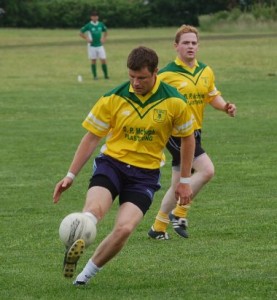
That's why they call it football.

That's why they call it football.

It was a close one for the Philadelphia Shamrocks hurling team who went up against the Allentown Hibernians again at Cardinal Dougherty High School on Sunday, June 1. The Shamrocks won 3-5 to 3-2.

The Shamrocks team, like the Hibernians, is a brand new bunch of guys, many American who are just learning the game. “We have a stronger team as well, largely Irish, who are going up against Washington, DC, later this year,” says Frank O’Meara, team captain. The other hurling team in Philadelphia, the Brian Borus, folded this year because of lack of players.

Also on the field: The Kevin Barrys GFC trumped the Young Irelanders 1-11 to 1-8 in a fierce game that left three footballers with minor injuries.

  • See the football action.
  • View the slideshow. 
  • News

    Help Save Irish Radio In Philly

    If, as it is for many, your Sunday morning ritual is Mass, breakfast, and Irish radio, you may need to make other arrangements. Two of the longest running radio shows in Philadelphia are in serious financial trouble and may come to an end.

    “Come West Along the Road,” with Marianne MacDonald, and the Vince Gallagher Irish Radio Hour, on WTMR 800 AM, rely on revenues from ads that the hosts must sell themselves. If there aren’t enough ads—and there haven’t been—both MacDonald and Gallagher must come up with the difference to pay for the airtime themselves. “Both Vince and I have spent thousands of dollars of our own money to keep the shows on the air, and we can’t do it anymore,” said MacDonald.

    Neither MacDonald or Gallagher make money from the shows. “Contrary to what many people believe, we don’t get paid any type of salary,” said MacDonald, who took over her show from longtime Irish musician and radio host, Tommy Moffitt, about three years ago. Gallagher took over the spot hosted for many years by Mary O’Kane. “We took over something that was already broke,” said MacDonald. “Both Tommy and Mary were struggling too.”

    For both hosts, the shows are a labor of love. If you love what they’re doing, come to the Philadelphia Irish Center at Carpenter and Emlen Streets on Friday, June 6,at 8 PM, for a meeting to brainstorm ways to save this important part of Philadelphia’s Irish tradition.

    News

    Still Young at Heart

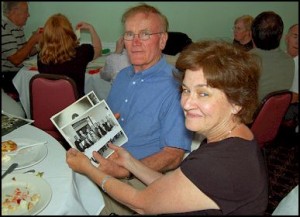
    Checking out the photos: Mary Ann and Pat.

    Checking out the photos: Mary Ann and Pat.

    It was just a slim folder full of old black and white photos, yellowed menus and dog-eared bank statements. You wouldn’t have thought they would have made much of an impression.

    Bernadette Coyle, for one, seemed surprised. She brought the photos to the Young at Heart luncheon on Sunday, a reunion of sorts held to celebrate the 50th anniversary of the city’s venerable Irish Center in Mount Airy. “My dad (Parker McGurk) was one of the original Irish Center shareholders,” said Bernadette. “He was the center’s treasurer, way back in the ’50s. These pictures were his. I’ve still got boxes of them. These are just a few. It’s something I put together on a whim.”

    Within moments of Bernadette producing them, the pictures were making the rounds of the room, with folks like the Irish Center’s president Vince Gallagher and Ed Reavey Jr. poring over the fading images, trying to pick out old friends or figure out who was in the picture of the old football team or the band.

    More than a few remembered the great meals served up in the old days, too, as they checked out the menus, like one from Tuesday, February 12, 1957, in which “braised turkey wings in jardiniere sauce” and “breaded deep sea scallops remoulade” were available for 85 cents. For an even buck, you could get the whole dinner, including mixed veggies, coffee, tea, Sanka or Postum, with Ross House cheese with crackers, butterscotch sundae or stewed prunes for dessert. (Yum.)

    The photos evoked lots of great memories, including those of John King, who used to play piano at the Friday night ceilis with the great Eugene O’Donnell. “That was when my hair was still black,” he added. Still a handsome fella, though.

    How much fun was the luncheon? Check out our photos. Maybe 50 years from now, someone will be passing them around the room.