Monthly Archives:

May 2008

News

Does Delaware County Need Its Own Irish Center?

To Denis Hickie it all makes sense. There are more Irish in Delaware County (where they’re 25% of the population) than in Philadelphia (13.6%, the second largest ethnic group in the city behind African-Americans). The drive to the Philadelphia Irish Center from his home in Upper Darby takes 45 minutes.

Then there are the steps. No doubt about that—the steps to the Irish Center are steep and daunting. The Center, also known as the Commodore Barry Club, sits atop a hill in the Mt. Airy section of the city, and those stairs can be punishing to old knees. “Some of the older people can’t make it up,” says Hickie. Even the ones who still love to set dance can’t make the drive, then the climb, he says.

So he wants Delco to have its own Irish center “with rooms for meetings, dancing, music, and the rest. I’ve talking to a lot of people in Delco who say they’d like to have an Irish center in their backyard.” On Sunday, May 11, at 2:30 PM, he’s holding a meeting at J.D. McGillicuddy’s on West Chester Pike in Upper Darby to see if there are enough like-minded people to establish an Irish Center of Delaware County. The meeting will not only be his way to judge interest, but he hopes people will bring ideas for what they’d like to see in a center—and even where in Delco they’d like it to be located.

Hickie doesn’t believe that a separate organization in Delco will compete with Philadelphia’s Irish Center, which turned 50 this year. “This will be catering to the people who don’t go to Philadelphia anyway,” he says.

Music

Inside the Heart of a Dreamer

I would fly from the woods’ low rustle
And the meadows’ kindly page.
Let me dream as of old by the river,
And be loved for the dream alway;
For a dreamer lives forever,
And a toiler dies in a day.

—John Boyle O’Reilly

Sean Tyrrell, the singer-songwriter from the West of Ireland, has performed in Philadelphia twice—including a memorable set with fiddler Tommy Peoples at the 2001 Philadelphia Ceili Group Festival. (You can hear it on the group’s commemorative festival CD, “Toss the Fiddles.”)

I’ve missed his local appearances, but I ran into him a few years ago on a trip to Ballyvaughan, County Clare. He was playing his regular weekly session at Green’s, a pub roughly the size of a confessional booth in the center of town.

After a strong set of the traditional stuff, Sean started noodling around on the guitar, getting set to play something soft and slow. It took me a few notes before I recognized the tune: “South of the Border (Down Mexico Way),” the peppy 1939 standard written by Jimmy Kennedy and Michael Carr, and a big hit for singers as diverse as Gene Autry and Frank Sinatra.

Tyrrell’s version was a different tune altogether. Gone was the hokey Latin syncopation. And that mental image of Dorothy Lamour with a bowl of fruit on her head? Forget that. This was a far more wistful treatment than ever I’d ever heard.

Tyrell’s great gift lies in his ability to interpret songs—even those, and perhaps especially those, that have otherwise been done until you’re sick of hearing them.

“I have often said that I don’t regard myself as having the greatest voice,” Tyrrell said in a phone interview from Seattle, “but that (his interpretive skill) is something that I do have. There aren’t that many bad songs, really, but there are a lot of bad singers. What I mean by that is, people who just don’t care about the lyric. You can take a song like “The Black Velvet Band” or “The Wild Rover,” and if you really read those lyrics, you’ll find that they’re great songs, but they’ve just been done to death.”

One example is Tyrrell’s take on the standard “Coast of Malabar.” It could be a cheesy or sentimental tune, he admits. It has certainly been performed in that way. But, he said, “If you really look at the lyrics, it’s about a man who has fallen in love with a woman who’s a different color. And he can’t bring her back to England, because she’s the wrong color. I just wanted to get that across.”

Tyrrell’s other great passion, for some time, has been poetry, including the works of the well-known—Oscar Wilde, for example—as well as some other poets who are not as well known, such as Louis MacNeice.

The poet with whom Tyrrell is most closely identified is John Boyle O’Reilly. O’Reilly was a member of the Irish Republican Brotherhood, captured and jailed, and subsequently transported to Australia. He escaped to Boston, where he became editor of the Irish newspaper, The Pilot.

Tyrrell’s interest in setting poetry to music stems from a chance encounter in New York City with a book called “100 Years of Irish Poetry,” edited by Kathleen Hoagland. “It’s still available, actually,” he said. “About 50 percent of my repertoire for years has been from poems from that book that I set to music. One of the poems was was John Boyle O’Reilly, ‘Cry of a Dreamer.’ I recorded it on my first album, and gave it (the album) that title.”

Tyrrell now performs five of O’Reilly’s poems set to music in a one-man show, also entitled “Cry of a Dreamer.” The show also includes music and poetry from a number of other diverse sources, including Wilde, as well as Bob Dylan and John Lennon. The show is meant to document O’Boyle’s life.

“He was an amazing human being,” said Tyrrell. “The magnitude of his soul just amazes me.”

You’ll get a chance to see the show here in Philadelphia on Saturday, May 17, at 8 p.m. at the Philadelphia Irish Center. The show is sponsored by the Philadelphia Ceili Group. The show has earned standing ovations in just about every city on the current tour where Tyrrell has performed it.

Sports

The Fierce Little Team That Could—And Did

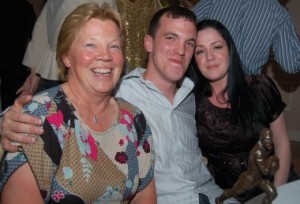
Four Provinces honoree David Doyle flanked by his two best girls, girlfriend Ann Rogers and mom Joan, who flew from Ireland to see her son receive his awards.

Four Provinces honoree David Doyle flanked by his two best girls, girlfriend Ann Rogers and mom Joan, who flew from Ireland to see her son receive his awards.

It could be a movie plot. A little team of Irishmen from Philadelphia, on its way to New York to compete in a Gaelic football championship, is involved in an accident that leaves their bus wrecked. Fortunately no one is injured, but they also have no way to get to Gaelic Park, where they’re facing the senior finals. But the team is carried off to the game in the dozens of cars of their diehard fans who have been following them on the highway.

And, of course, they go on to win the game. Colm Meaney will surely play the role of the team coach who, in real life, is Seamus Sweeney of Upper Darby (and before that, Cresslough, County Donegal, Ireland). It was his team, the Donegal Gaelic Football Club, also known as Four Provinces, that survived the frightening bus crash to dump Leitrim of New York 2-13 to 2-9 for the trophy (after trouncing Cavan 1-13 to 1-10). They went home with a police escort across the George Washington Bridge.

And on Saturday night, at the Donegal GFC Annual Banquet, they reveled in their win. They also finally received their medals during a ceremony held in the Barry Room of the Irish Center in Mt. Airy which also honored dozens of others who had played a pivotal role in resurrecting this fierce and proud club in 1988.

Among the honorees were Charlie and Peggy Murray who were not only founding members of the team, but for years opened their home to players from Ireland. “They are everything that epitomizes the Donegal GFC,” said Club Chairman Tommy Higgins as he presented the Murrays with their award.

Team members singled out for both their efforts during the finals and over the season were club high scorer for two years running, Liam O’Donnell, of Derry. O’Donnell was also one of the four New York all-stars who received a trophy. The others were Mike Higgins, David Doyle, and Liam Moore. Team Captain Liam McGroarty presented Coach Sweeney with a framed collage of the team’s 2007 exploits, and bid an emotional goodbye to his teammates; McGroarty and his wife, Claire, are returning to Ireland.

Music

Review: Capercaillie’s “Roses and Tears”

Twenty years together, and Capercaillie is still solidly Celtic … and, yet, still defiantly hard to pigeonhole.

With “Roses and Tears,” the Scottish band’s latest release on the Compass label, it’s clear the band has lost none of its creative energy. On the contrary, they’ve continued to advance the strongly percussive, polyrhythmic approach that had landed them pretty squarely in the “World” section of the CD sale racks since, um … forever.

Karen Matheson is, well, Karen Matheson. I first heard her years ago, before I even knew what a Capercaillie was, on a 1995 Putamayo “Celtic Women of the World” compilation. She was singing Dark Alan (from “Rob Roy”). Even then, her voice reminded me of single malt. Smoky, velvety, sweet, with a bit of an edge. (Bonus: No hangover!)

On “Rose and Tears,” Matheson’s voice seems to have entered a new level of maturity. I’ll admit that my judgment in this regard is colored somewhat by her performance on one particular tune, John Martyn’s anti-war song “Don’t You Go.”

This is the second CD from Compass in a year to include in-your-face ant-war material—the last being Michael Black’s eponymous debut album. In the ’60s, the airwaves were full of the stuff. You don’t hear it now much, except in the folk genre.

But back to the point … “Don’t You Go” is just a lovely song to begin with. Anyone could sing it. But when Karen Matheson sings it, you can truly feel the mother’s heartbreak that underlies the lyrics, especially in the wrenching last line.

Matheson is clearly the band’s anchor, but even without her, you’d recognize the sound as distinctively Capercaillie: Michael McGoldrick on pipes and flute, Donald Shaw on accordion, Charlie McKerron on fiddle and Manus Lunny on bouzouki. Propelling the band along, of course, is Capercaillie’s very own version of the fabulous Funk Brothers, the rhythm section: Che Beresford on drums; David Robertson on just about anything else percussive, and Ewen Vernal on the bass. I judge rhythm sections by how much they make me want to bang on the steering wheel. Let’s just say I bang … a whole lot.

It all comes together in several places on the CD, but probably my favorite is the fourth track, entitled “Aphrodesiac,” a wild collection of jigs, with McGoldrick just wailing away like a, I don’t know, wild wailing kind of thing.

The album, all too short at just 12 tracks, features many newly discovered traditional songs culled from the Gaelic song archive at the School of Scottish Studies. Capercaillie applies the good old reliable Capercaillie touch, and suddenly even old tunes sound fresh and vibrant.

All of which sums up what you get on “Roses and Tears.” It’s more of the same.

Ain’t it great?

Columns, How to Be Irish in Philly

How To Be Irish in Philly This Week

The hit off-Broadway musical, “The Irish and How They Got That Way,” by Frank (“Angela’s Ashes”) McCourt is in Philly till the end of June at the Walnut Street Theater. It sounds “don’t miss” to us.

But you only have one chance to see “Celtic Spring,” winners of the “America’s Got Talent” show. Think the Osmonds—it’s a sibling group—but with Irish instruments. They’re appearing Sunday at the Sellersville Theater at a matinee performance at 3 PM.

Later that evening, AOH Division 65 will honor two stalwarts of the Irish community, Jim Kilgallen and Paul Phillips, both longtime members of the Philadelphia St. Patrick’s Day Parade Observance Association (Kilgallen does the color commentary on CBS-3 the day of the parade; Phillips is treasurer, so he makes sure there’s enough money to have a parade.” The event is being held at the Irish Center from 4 to 8 PM. Parade Director Michael Bradley calls the duo “two of a kind.

“They are always there whenever I need advice and usually give you sound unbiased thoughtful responses,” he told www.irishphiladelphia.com. “Their years of experience in the various Irish organizations in which they belong, is truly priceless for the Irish Community of the Delaware Valley. AOH 65 is honoring 2 of the best we have in the Irish community. I would like to congratulate them on this and the many honors they have received in their lifetime, I am proud to call them friends!”

Next Saturday, plan to head over to the Radisson in King of Prussia for a benefit for the Upper Merion Police Department featuring Blackthorn and the Irish Thunder Pipes and Drums – wow, what a combo! Guys, consider a duet!

Looking ahead, time to think about getting tickets to a Phillies game. For the second year in a row, the Phillies are sponsoring Irish Heritage Celebration at Citizens Bank Park on Friday, May 16 at 7:05 p.m. when the team hosts the Toronto Blue Jays. Come out and enjoy Irish delicacies, live music and learn how to Irish dance. Emcee will be Bob Kelly from KYW – CBS 3.

To help honor the Irish community, the event features a $4 ticket discount off $16 – $27.50 regularly priced tickets. When you click on the “Buy Tickets” button on the Phillies’ website and enter the promotion code IRISH, you’ll get the special ticket offer. We think this is a very cool thing. Just don’t eat any green hot dogs.

All the details are you know where—the only calendar that Senator John McCain calls “friend.” And he’s seen plenty of calendars.

People

Miltown Malbay’s Unofficial Mayor Tom Malone Dies at 92

The late Tom Malone flanked by his daugher Marian and his son, Fintan.

The late Tom Malone flanked by his daugher Marian and his son, Fintan.

By all accounts, if you knew Tom Malone you were probably a sportsman. Or a piper. Or a trad musician. Or a lover of a good pint. Or a dog-racing aficiando. Or a Republican, in the Irish sense.

When he died on April 1 at the age of 92 in the town of Miltown Malbay in County Clare, Ireland, the local paper stressed his influence on local sports—it was he who set up the local GAA club in 1936, brought hurling and ladies football to the county, and launched a cycling race a la the Tour de France. But his son, Fintan Malone, now of Cheltenham, prefers to think of him as “a man of many hats.”

That’s an understatement.

“Firstly, he sold insurance starting out on a bike,” recalls Fintan, a musician who performs locally as part of the duo Blarney and at many sessions. His father also operated a bar in the Malone home on the main street. “But it was run mostly by my mother. He could never pull a proper pint, God love him. He ran horse races for a time. Next he bought a farm and we being townies, I found it hard to adjust.” It wasn’t so easy adjusting to Tom Malone’s next venture either. Terrier racing. “It’s like greyhound racing,” explains Fintan. “My job was to hook the artificial hare and take it back to the gate for the next race.”

When Tom Malone bought the Fair Green, he booked traveling circuses to come to town. “We never paid an admission into a single show.,” says Fintan. “We also traveled the countryside with amusements such as bingo, shooting gallery, and slot machines.”

Along with introducing hurling and ladies football to Miltown, Tom Malone was also the first to sell bottled milk and cooking gas cylinders. There were so many firsts,” says Fintan, “that I can’t remember them all.”

Though not a musician himself, Tom Malone loved music. “My mother was very much into both dance and music which is where I got my interest from.,” says Fintan. “I believe my father, when the house dances ceased, could see bigger and better things ahead and started to book traveling bands on their way from the North down to Kerry. Our house doubled as a boarding house and these musicians would stay with us and he, of course, would have clinched some deal to have them play across at the hall as part of their payment. I got a chance to see the singing tinker, Maggie Barry, along with the great Michael Gorman, Bridie Gallagher, Joe Heaney, and the hypnotist Edwin Heath who had the local bank manager under hypnosis, frantically looking for leprechauns up and down the Main Street.”

A number of ceili bands were booked into Malone’s venue, including the famed Kilfenora and Tulla bands. “I believe it was when he first saw the Tulla Pipe Band that he decided it was time for Miltown to have their own pipe band. “says Fintan. So he founded one—the Clonbony Pipe Band. “The first pipes that were brought into Miltown went to Willie Clancy and Martin Talty,” says Fintan. “Willie played the war pipes before he played the uileann pipes. My father told many great stories about cycling around the countryside to raise money for this endeavour as money was tight then.”

Uilleann virtuoso Willie Clancy was houseguest for several years. Born in Miltown Malbay, Clancy was such an iconic figure in traditional music that a trad festival held every July in the town was named in his honor. And Tom Malone’s pub has traditionally been a hub for festival goers, just the way his home was an inn for itinerants. Clancy was by far not the only houseguest, says Fintan. Some were even more. . .interesting.

“There were Ruari O’Bradaigh and Daithi O’Connell who escaped from the Curragh Concentration Camp; Van Morrison; Andy Irvine; Joe Cahill, chief of staff of the IRA at the time; Joe Cooley; Robbie MacMahon; the Liverpool Ceili Band; Tommy Peoples; even an elephant from Fossett’s Circus (with a drunken handler) and other numerous people on the run.”

Tom Malone’s political leanings—he was a 32-county Republican—also made him a controversial figure, says Joe O’ Muircheartaigh, reporter for The Clare People newspaper, who wrote a lengthy profile of Malone after his death. “He was very Republican at a time when it wasn’t popular to be a Republican. And he never made any apologies for this fact.”

It wasn’t easy being the son of a man like Tom Malone, says Fintan. “He answered to no one and marched to his own drummer. But I’d like to think he has made me the man I am today. He was among many things, a wheeler dealer and as an early teenager when I caught a religious bug, I went through a period when I feared for his mortal soul. I remember vividly going up to the local church to pray for his soul. But in his latter years he had made up for this as every time I would call my sister to check on him I could hear him in the background reciting the rosary. He always tried to cover all of his bases.”

Marianne MacDonald contributed to this story.